Medium vs Medium-Heavy Inshore Rod: Which One Do You Actually Need?
I choose Medium for lighter presentations over open water. I choose Medium-Heavy for heavier complete rigs, stout single hooks, and firmer control beside cover. I make that decision from the actual lure rating and fishing situation, rather than treating the stronger-sounding label as an upgrade.
I picture two presentations: a lightly weighted plastic landing ahead of a redfish on a grass flat, and a substantial single-hook lure beside a barnacle-covered dock. For medium vs medium heavy rod inshore fishing, the useful difference is the job I need the blank to perform.
Should I choose Medium or Medium-Heavy for inshore fishing?
I choose Medium for lighter lures, smaller hooks, and trout or redfish over open flats. I choose Medium-Heavy for heavier complete rigs, stout single hooks, and fish close to docks or mangroves. I check the specific rod’s lure rating because power labels alone do not define its usable range.
| My main job | My starting choice | What could change my decision |
|---|---|---|
| Light plastics over grass | Medium | Actual complete-payload weight |
| Small treble-hook twitchbaits | Medium | Action and working drag |
| Stout weedless single hooks | Medium-Heavy | Wire, gap, and lure weight |
| Substantial cork rigs | Medium-Heavy | Weight of the assembled rig |
| Docks and mangrove edges | Medium-Heavy or stronger | Current and immediate pressure |
| Mixed open-water fishing | Model fit first | My most-used lure and hook |
I do not buy extra power simply because a larger fish might appear. I consider how quickly that fish can reach cover and whether my usual lure loads the rod comfortably. A light presentation over clean bottom and a heavy rig in current deserve separate decisions.
I use the saltwater rods and reels guide to compare the broader outfit after choosing my presentation.
What actually changes between Medium and Medium-Heavy?
I use power to describe resistance to bending and action to describe where the bend develops. Medium-Heavy generally requires more force to bend than Medium within a comparable series. Either power can have a fast action, so I never assign a fixed flex percentage from the power label alone.
I compare fast versus extra-fast inshore rod action separately to match the bend response to jigs, treble hooks and live bait.
St. Croix’s explanation of power and action makes that distinction. A Medium fast rod and a Medium-Heavy fast rod can share an action description while responding differently to the same load.
I separate bending resistance from bend location
I cannot accurately label every Medium as bending through 30–40% of its length or every Medium-Heavy as flexing only in the upper 20–25%. Those claims need a defined load, mounting position, model, and measurement method. Power alone supplies none of those conditions.
More resistance. Not a fixed bend percentage.
I compare equal loads to study deflection, or equal deflection to study the force required. I keep those tests separate.
Medium / conceptual curve
I illustrate a more yielding blank under the same assumed loading conditions.
Medium-Heavy / conceptual curve
I illustrate greater bending resistance without implying a universal action profile.
I check the finished build
I would examine blank taper, guide weight, reel-seat position, grip length, and assembled balance. A material-modulus label does not establish the finished rod’s power, durability, or recovery by itself.
What lure weights suit each rod power?
I match rod power to the weight of the complete casting payload, including the plastic, hook, jighead, cork, and hardware. Medium usually covers lighter work within a comparable range. Medium-Heavy usually extends heavier, but I use the printed model rating rather than a universal power-to-weight chart.
For a same-length example, I compare the seven-foot St. Croix Triumph Inshore 27TIS70MF and 27TIS70MHF. The manufacturer lists both as fast action. Their published lure ranges are 3/8–3/4 oz and 1/2–1¼ oz respectively. I use the current manufacturer model table rather than transferring specifications from an older generation.
| Complete payload | Medium example | Medium-Heavy example |
|---|---|---|
| ⅛ oz / 3.5 g | Below range | Below range |
| ¼ oz / 7.1 g | Below range | Below range |
| ⅜ oz / 10.6 g | Lower boundary | Below range |
| ½ oz / 14.2 g | Within range | Lower boundary |
| ¾ oz / 21.3 g | Upper boundary | Within range |
| 1 oz / 28.3 g | Above range | Within range |
| 1¼ oz / 35.4 g | Above range | Upper boundary |
A 1/8 oz hook is not necessarily a 1/8 oz presentation
Suppose my weighted hook contributes 1/8 oz and my plastic contributes another 1/4 oz. My payload is approximately 3/8 oz before other hardware. If the complete lure actually weighs only 1/8 oz, I would seek a rod explicitly rated that light, potentially Medium-Light.
I weigh the whole rig.
I enter the complete weight below to check the published ranges of this specific Triumph pair. This is a compatibility screen, not a casting-distance prediction.
0.5 oz is approximately 14.2 g. Both published ranges include this payload.
My casting comparison would retain the awkward results
I would alternate rods while keeping the reel, spool fill, braid, leader, and lure constant. I would record wind and compare repeated landings, casting effort, distance, and accuracy. I would retain tangles and failed casts in the notes. I would not manufacture an efficiency percentage or a tip-damping score from the power label.
Is Medium enough for redfish and speckled trout?
I would start with Medium for many redfish and speckled-trout presentations over open water, provided the complete lure fits its rating. I value controlled casting and steady pressure more than unused power in that setting. I would reconsider when current, heavy hooks, or nearby abrasive cover change the job.
My grass-flat starting point
For a suitably weighted weedless plastic, I would consider 10–15 lb braid and approximately 20–25 lb leader. I would adapt those choices around abrasion and the complete outfit. If a fish can pull the line over shell, the flat is no longer an uncomplicated open-water setting.
I would pair the tackle decision with redfish location and presentation choices. A controlled landing ahead of a moving fish matters more than unused blank power.
My trout adjustment
With small trebles, I would take up slack and make a controlled sweep. I would choose a suitable action and working drag rather than assume Medium alone protects a delicate hook hold. At close range, I would keep steady tension and allow line release during a sudden surge.
When does Medium-Heavy become the better choice?
I prefer Medium-Heavy when the complete rig becomes too heavy for my Medium, when stout single hooks need a firmer sweep, or when fish can reach cover quickly. I still check the model’s limits. Large fish in heavy current or tight structure may require more than either category provides.
A snook beside barnacle-covered pilings
If I were targeting a 36-inch snook beside a dock, I would plan the first seconds after the bite. I would favor a suitable Medium-Heavy over a comparable Medium, but I would also position the cast and boat to pull toward clear water. I would choose stronger tackle when the required pressure exceeds either outfit.
A substantial popping-cork rig
A complete 1 oz rig falls inside this Medium-Heavy example’s range and above the Medium’s ceiling. A cork weighing 1 oz before adding bait and hardware is a different payload. I would weigh everything and use smooth acceleration rather than a sharp casting snap.
I choose around the escape route.
These are starting recommendations. I check rod compatibility and working drag independently from the braid label.
Open grass or sand
Medium
10–15 lb braid
20–25 lb leader
I prioritize complete-payload fit, a controlled cast, and room to manage the fight.
Oyster edges
Medium or Medium-Heavy
15–20 lb braid
25–40 lb leader
I increase abrasion protection when the line can cross shell. Stronger leader is not abrasion-proof.
Mangrove openings
Medium-Heavy
20–30 lb braid
30–40 lb leader
I check root density, hook wire, lure weight, and the available line angle.
Docks and strong current
Medium-Heavy or stronger
20–30 lb braid
40–60 lb leader
I move beyond this starting outfit if the stopping pressure or payload requires it.
I would not interpret 30 lb braid as permission to apply 30 lb of rod load. IGFA’s line-testing service measures breaking strength across repeated tests. Nominal line rating, knot performance, and operating drag remain different considerations. I compare components in the saltwater line, leader, and tackle guide.
Does Medium-Heavy drive large hooks better?
I prefer Medium-Heavy for stout single-hook presentations when its lure rating fits and I need a firm, controlled sweep. I cannot assign a universal penetration force to a 4/0 or 5/0 hook. Wire diameter, point geometry, exposed gap, jaw contact, line angle, and drag all affect the result.
I check point sharpness and whether the plastic can collapse away from the hook gap before blaming the blank. A size label does not establish wire thickness. With a circle hook, I reel steadily into tension rather than applying a conventional sharp strike.
I manage slack before force.
I separate handle torque from line tension and hook-point contact. The rod’s power label cannot supply a jaw-penetration threshold.
Stout single hook
- Recover slackI reel until I establish contact.
- Sweep with controlI apply a firm movement with a compatible outfit.
- Maintain pressureI direct the fish toward clear water.
Small treble hooks
- Recover slackI avoid striking against loose line.
- Make a controlled sweepI avoid repeated hard strikes.
- Manage the surgeI maintain tension and let the drag work.
Static approximation: handle torque = line tension × perpendicular moment arm.Which rod components matter beyond power?
I examine guide layout, tip weight, handle geometry, and reel-seat fit because those details affect how the complete rod behaves. I cannot infer blank wall thickness or stiffness from Medium versus Medium-Heavy alone. I also check whether my actual leader knot passes through the guides without repeated impact.
My butt-to-tip inspection
| Component | My inspection | What I avoid assuming |
|---|---|---|
| Rear grip | Forearm, clothing, and seat clearance | Power fixes handle fit |
| Reel seat | Threaded locking hood and reel-foot security | All reels fit equally |
| Blank wall | Measured inner and outer diameter | Medium-Heavy always has a thicker wall |
| Stripper and reduction guides | Spool geometry and line flow | One ring sequence suits every build |
| Running guides | Loaded line path and knot clearance | Spacing can be copied by power alone |
| Tip-top | Tube fit and ring condition | An undamaged-looking frame guarantees a sound insert |
For a circular hollow section, wall thickness equals half the difference between outside and inside diameter. I would compare measurements at the same station on each blank. An illustrative guide sequence such as 20, 10, 5.5, then size-5 runners is not a universal build prescription.
I follow Anglers Resource’s static-load guidance to check the actual blank and line path. I would not copy guide spacing from another rod solely because the power label matches.
Which Medium and Medium-Heavy rods would I compare first?
I would compare matched models from one series before mixing brands, lengths, and actions. The two seven-foot Triumph Inshore spinning models below provide a useful specification comparison. I have not established an on-water performance winner, and I would verify the exact model number before ordering through any retailer.
St. Croix Triumph Inshore 27TIS70MF: my Medium candidate
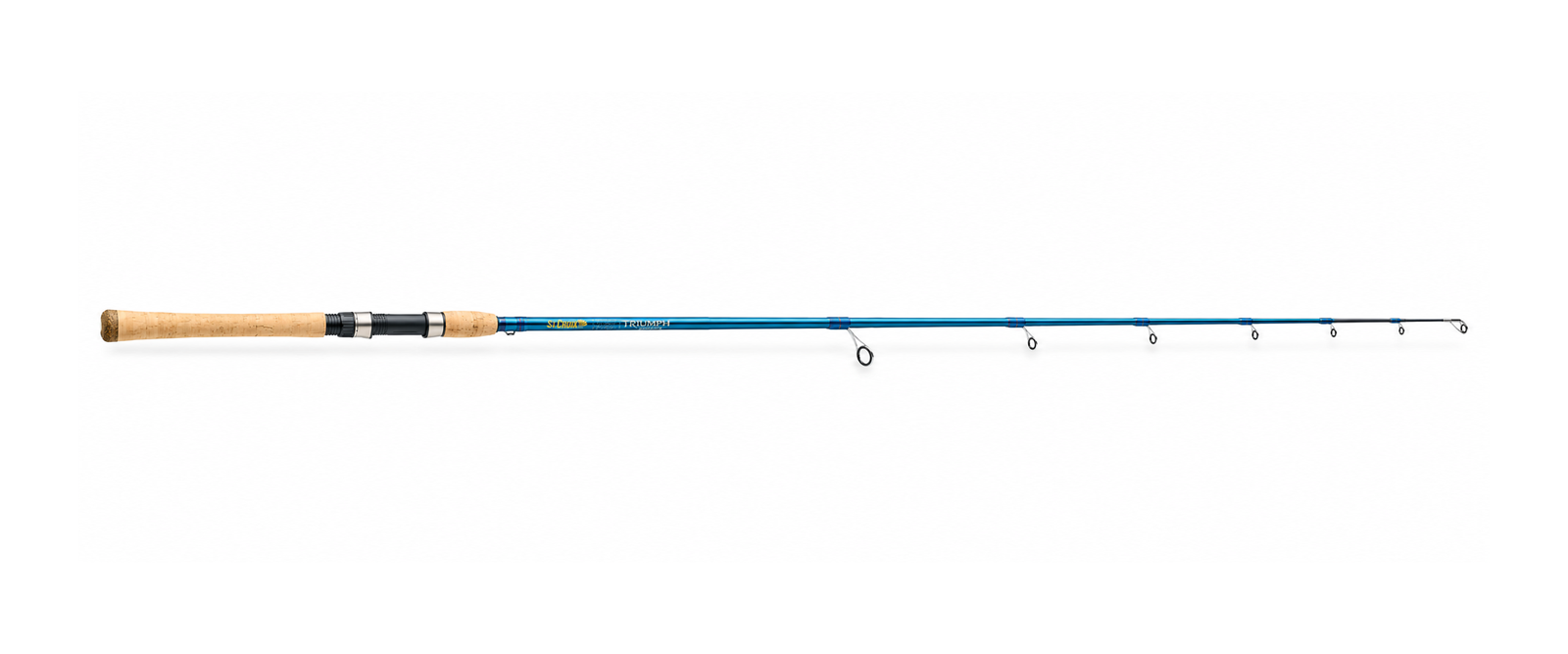
I would try this candidate first for compatible lighter rigs and open-water presentation work.
- My payload check: ⅜–¾ oz complete rig.
- My tradeoff: I would not choose it for a complete ⅛ oz lure.
- My fit check: intended reel attached, normal grip, actual leader connection.
St. Croix Triumph Inshore 27TIS70MHF: my Medium-Heavy candidate
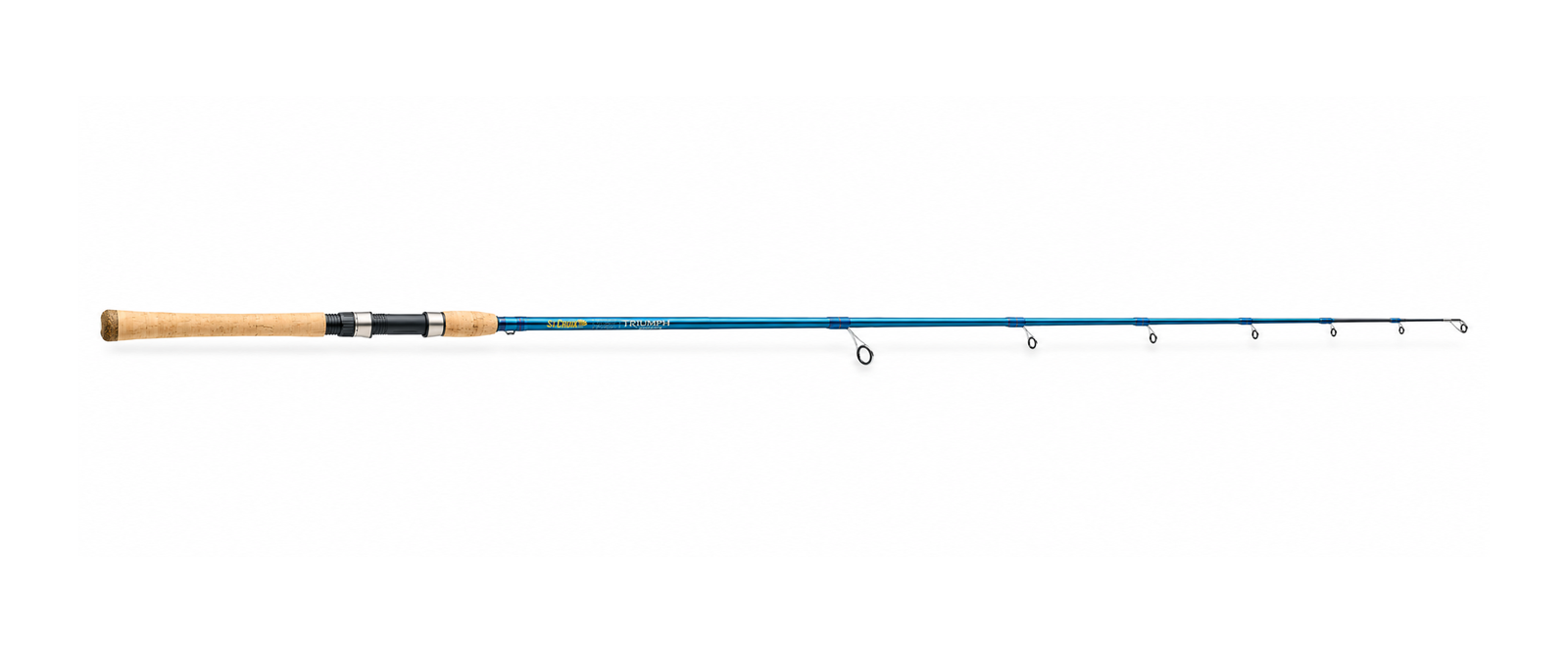
I would try this candidate first for heavier complete rigs and firmer control near cover.
- My payload check: ½–1¼ oz complete rig.
- My tradeoff: I would not expect an underweight finesse lure to load it effectively.
- My fit check: intended reel attached, normal grip, actual leader connection.
| Published specification | 27TIS70MF | 27TIS70MHF |
|---|---|---|
| Length | 7 feet | 7 feet |
| Power / action | Medium / fast | Medium-Heavy / fast |
| Line rating | 8–17 lb | 10–20 lb |
| Lure rating | ⅜–¾ oz | ½–1¼ oz |
| Sections | One | One |
I checked the specifications against St. Croix’s model table. The buttons open model searches, not confirmed offers or stock. The supplied product images are matched to the model names in their files; I have not independently authenticated the pictured SKUs.
What would I check before paying for either power?
I attach my intended reel, weigh my usual complete rigs, and compare the model’s ratings with my fishing conditions. Then I inspect hook compatibility, grip comfort, and leader-knot clearance. I prefer the outfit that handles my repeated presentations comfortably over one selected only for its stronger-sounding power label.
- Payload: I weigh the finished presentation, including bait and hardware.
- Hook: I check wire, sharpness, and exposed gap.
- Movement: I rehearse the cast and retrieve with a hookless setup.
- Connections: I inspect knots, leader condition, and guide clearance.
- Pressure: I set working drag within the complete outfit’s limits.
- Location: I consider current, cover, and the fish’s escape route.
From a kayak, I check bow clearance, rear-grip interference, and landing reach separately from power. For length, I use the companion 7-foot versus 7-foot-6 inshore rod comparison. I use the fishing guides for related presentation choices.
My answers to the remaining power questions
Can I use Medium-Heavy for trout?
I can with suitable lures, action, and drag. For mostly light trout presentations, I would generally prefer a properly rated Medium.
Can Medium land a large redfish?
I would consider it when the lure fits and there is room to manage the fight. Fish length alone does not establish the required outfit.
Does Medium-Heavy cast farther?
I would need comparative casts with the same rig and reel. A heavier payload may suit it better, while a lighter one may load Medium more effectively.
Can I use 30 lb braid on Medium?
I would check manufacturer guidance and operating drag. Stronger braid does not increase rod load capacity.
Do all popping corks need Medium-Heavy?
I weigh the complete assembly. Some lighter rigs suit Medium, while heavier corks and added hardware can require Medium-Heavy or stronger tackle.
Which power would I buy if I could own only one?
I would choose around my most-used complete lure and regular fishing ground. For lighter open-water work I would start with Medium. For heavier rigs and close cover I would start with Medium-Heavy.