Menu
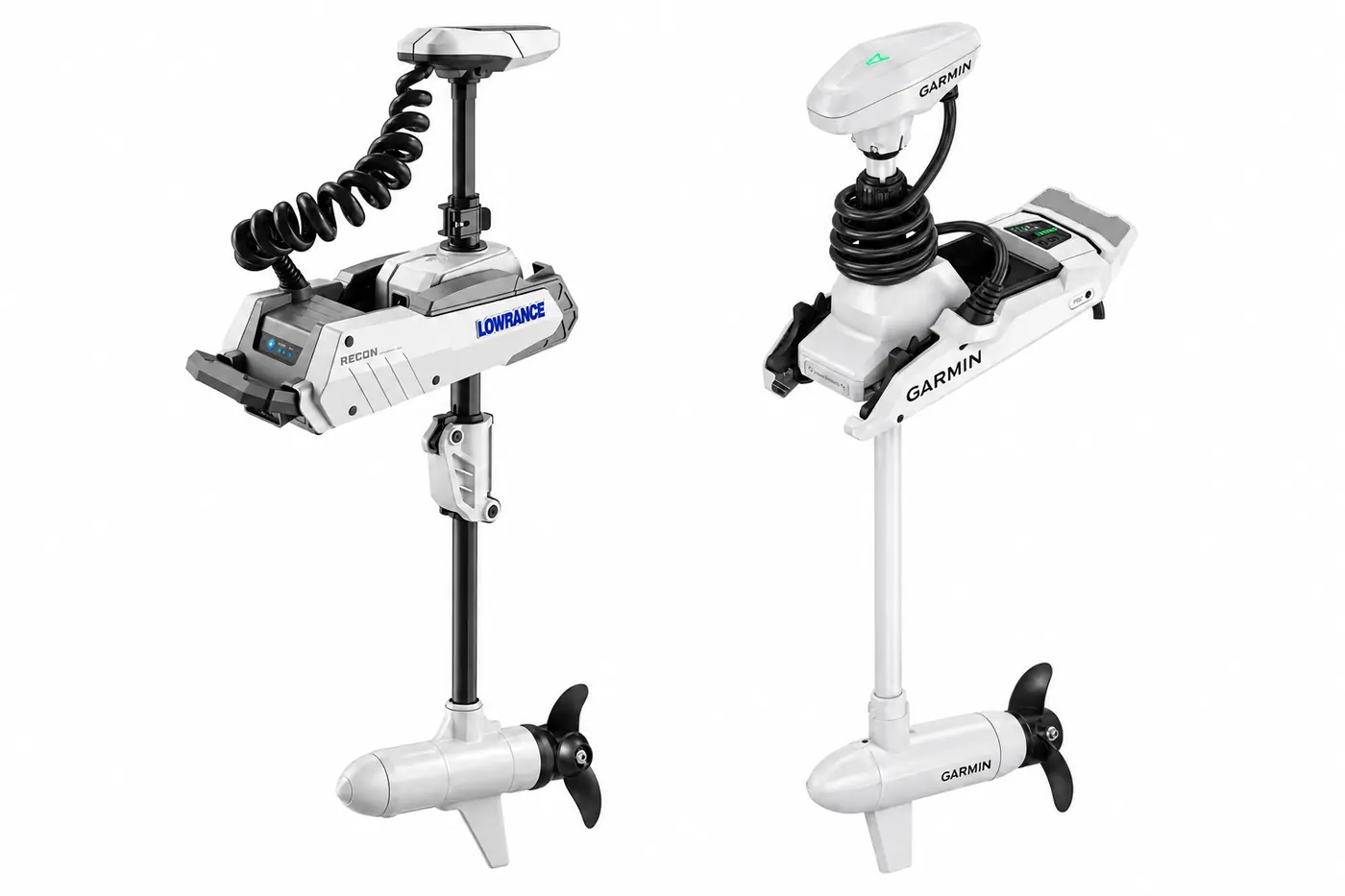
Lowrance Recon vs Garmin Force Kraken: Which Saltwater GPS Motor Wins?
The wrong shaft length can settle this comparison before either motor touches the water—and Lowrance’s own saltwater Recon pages currently disagree with each other on thrust.
By Larry Murray
Updated 11 September 2026
16 min read
Buyer’s Guide
The quick answer
Neither motor has a proven power, accuracy or reliability advantage from the evidence available. Kraken is the stronger shortlist choice when its longer shaft options solve a verified installation need. Recon deserves first consideration when it fits and supports Lowrance electronics you already own. Where both qualify, compare controls and installed cost, because published specifications don’t establish a universal winner.
That’s an editorial recommendation built on the fit and integration evidence below, not a lab result.
Affiliate disclosure. ReefReadyGear earns a commission on some links below at no extra cost to you. This comparison draws on manufacturer specifications and manuals checked September 11, 2026. It is a researched buying guide, not a claim of first-hand testing, and no controlled head-to-head results were available to establish a winner for anchoring accuracy, thrust, or long-term reliability.
Fit eliminates a candidate before power does
Kraken’s shaft options run 48 to 110 in; Recon’s run 54 to 72 in. On a high-bow bay boat or center console, that spread can rule a motor out before its thrust rating matters at all—and no independent test currently settles a power or accuracy winner between these two.
At a glance: documented shaft length options
Quick picks
Best for long-shaft reach
Garmin Force Kraken
Up to 110 in of shaft, plus Garmin ecosystem integration
Best for existing Lowrance gearLowrance Recon Saltwater
FreeSteer joystick control, NMEA 2000 integration
Verify before buyingThe Recon thrust discrepancy
Lowrance’s own pages disagree with each other
On this page
- The quick answer
- Quick picks
- How we chose
- Find your situation
- Specifications that matter
- Which motor fits a bay boat or center console?
- Is Recon more powerful than Kraken?
- GPS anchoring and remote control
- 24V or 36V?
- Will your electronics work?
- Which costs less fully installed?
- Maintenance in saltwater
- Frequently asked questions
- Final verdict
- Related reading
- Sources
How we chose
ReefReadyGear does not run a testing programme, and nothing on this page is presented as a first-hand test result. Every figure here is drawn from manufacturer product and manual pages, verified September 11, 2026, and dated where it matters. Where the published evidence does not support a verdict, we say so directly rather than manufacturing one.
- Fit checked before power, since shaft length and clearance eliminate candidates first
- Every thrust figure carries its voltage, and nominal voltage is distinguished from the voltage measured at the motor terminals
- Lowrance’s own conflicting thrust figures are shown side by side rather than resolved by picking one
- Electronics compatibility checked function by function, not brand by brand
Where two authoritative sources disagree, as Lowrance’s own product pages currently do, both are quoted and dated rather than blended into a single number.
The wrong shaft length can settle this comparison before either motor touches the water. Garmin’s Force Kraken lineup runs five shaft options out to 110 inches. Lowrance’s saltwater Recon runs three, topping out at 72 inches. On a high-bow bay boat or center console, that gap can matter more than either motor’s advertised thrust rating, and it’s the reason this article checks fit before it checks power.
It’s also worth saying plainly, up front, that neither brand currently offers proof of a clean power or accuracy advantage over the other. Lowrance’s own saltwater Recon pages list different thrust figures at the same voltages depending on which shaft length you’re reading, and no independent controlled test compares GPS-anchor accuracy or long-term saltwater reliability between these two motors. Where the evidence doesn’t support a verdict, this guide says so instead of manufacturing one.
Where both motors physically fit your boat, the decision comes down to something more specific: the electronics you already run, which remote workflow you prefer, and what the complete installation actually costs once the motor, battery, mounting and sonar are all on the invoice.
Find your situation
| Your situation | Recommended starting point | What must be verified |
|---|---|---|
| Your installation needs more deployed reach than Recon can provide | Garmin Force Kraken | Required shaft, mounting space, and local configuration availability |
| You already use compatible Lowrance electronics | Lowrance Recon Saltwater | Exact display, software, and required functions |
| You already use compatible Garmin electronics | Garmin Force Kraken | Exact chartplotter and sonar compatibility |
| You prefer joystick-based positioning | Try Recon’s FreeSteer remote | Whether its workflow suits how you fish |
| You have no electronics commitment either way | Compare both complete installations | Fit, controls, accessories, service, and total price |
The question that actually matters: which motor solves your boat-control problem with the fewest compromises, not which spec sheet reads better in isolation.
Recon vs Kraken: specifications that matter
Both motors run brushless propulsion and support 24V or 36V systems, but the differences beneath that similarity deserve more care than a simple feature count. Lowrance’s own published thrust figures disagree between two of its product pages, which is flagged below rather than smoothed over.
| Documented shaft options | 54, 60, 72 in | 48, 63, 75, 90, 110 in |
|---|---|---|
| System voltage | 24V or 36V | 24V or 36V |
| Mount design | Pivot style | Pivot style |
| Main handheld control | FreeSteer joystick remote | Remote with gesture controls |
| Display connection | NMEA 2000 | Wireless connection to compatible Garmin chartplotters |
| Sonar package | Verify saltwater package contents separately from freshwater Recon | Included transducer depends on configuration |
| Published warranty headline | Three-year motor; lifetime shaft | Three-year; limited lifetime shaft |
| Proven accuracy or endurance advantage | Not established | Not established |
Sources: Lowrance Recon overview and saltwater product pages, Garmin Force Kraken product details, reviewed September 2026. Treat the warranty row as a coverage headline rather than a settled fact—regional terms, exclusions and maintenance requirements still determine what a claim actually covers, on either brand.
Which motor fits a bay boat or center console?
Shaft length should be chosen from the boat’s mounting height and the manufacturer’s own sizing guidance, then verified against deployed and stowed clearance. Boat length alone can’t establish fit. Kraken’s extra long-shaft configurations are only useful if the candidate still clears the bow, stays properly immersed when deployed, and stows without blocking essential access.
Garmin instructs buyers to measure from the bow surface to the waterline, then add roughly eight inches where the boat regularly sees substantial waves, before consulting its selection chart. That’s Garmin’s own guidance for its own motor, not a universal formula that also applies to Recon.
The fit sequence, before comparing anything else:
- Measure the intended mounting surface to the waterline, with the boat loaded the way you actually fish it.
- Apply the selected manufacturer’s sizing instructions, including any adjustment for wave exposure.
- Check deployed geometry: clearance around the shaft, the hull, and any bow hardware.
- Check the full stowed footprint: access to the anchor locker, hatches, and walking space.
- Verify mounting access underneath the deck with your installer, including the fastening arrangement and any reinforcement it needs.
Recon’s installation manual specifically covers mounting access, deployed clearance, and keeping the stowed head inside the gunwale.
A longer shaft isn’t automatically the upgrade
It’s valuable when it solves a genuine immersion problem, and it still has to fit the boat once it’s stowed. Garmin publishes model-specific deployed dimensions for this reason: compare actual geometry, not the nominal shaft label, before treating either motor as a fit.
Buying recommendation: eliminate any configuration that fails the fit check before you spend another minute on power, sonar, or price.
Before the thrust numbers: a general trolling-motor buying primer
The video below, “Must Watch Before Buying A Trolling Motor For Your Boat!” from Aqua Lifestyle, is a general trolling-motor buying-guide. It does not test or name the Lowrance Recon or Garmin Force Kraken specifically, but it walks through the buying considerations—shaft length and mounting, thrust and battery voltage, and control style—that this guide applies directly to these two motors below. Watch it as background before the head-to-head thrust comparison that follows.
Is Lowrance Recon more powerful than Garmin Force Kraken?
The published numbers don’t support a clean power verdict, and pretending otherwise would overstate the evidence. Lowrance’s inspected saltwater pages disagree with each other on thrust, while Garmin publishes both a headline rating and a detailed table measured at specific terminal voltages. Without matched voltage, propeller and test conditions, calling either motor “more powerful” isn’t a claim this guide can stand behind.
Lowrance’s current pages contain a specification conflict
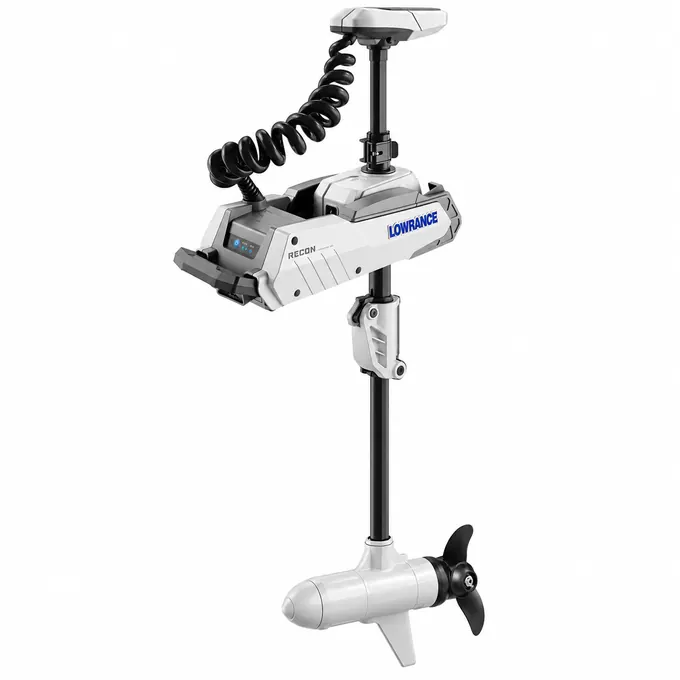
At the time of research, the official Lowrance pages showed:
| Official Lowrance page | Listed thrust at 24V | Listed thrust at 36V |
|---|---|---|
| Recon Saltwater 72-inch | 90 lb | 115 lb |
| Recon Saltwater 60-inch | 97 lb | 120 lb |
Warning: whether this reflects a specification update, a genuine model difference, or a publishing error isn’t something we can confirm from the outside. Before buying, ask Lowrance directly to confirm the rating and measurement basis for the exact SKU you’re quoting. Picking whichever number happens to flatter the motor you already prefer would be the wrong way to handle this.
Garmin’s detailed table adds necessary context
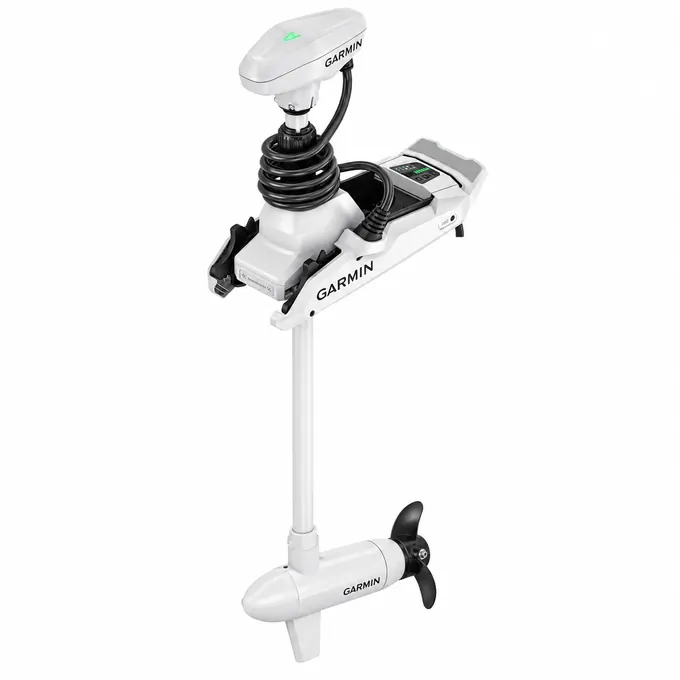
Garmin’s product specifications state 80 lb of thrust at 24V and 100 lb at 36V, using its high-efficiency propeller under the ISO 13342 standard. Its detailed manual table, measured at speed setting 20, reports:
| Voltage measured at motor terminals | Recorded thrust | Recorded current |
|---|---|---|
| 25.6V | 90.0 lb | 58.9A |
| 38.4V | 114.7 lb | 55.9A |
Garmin documents the test setup as calm water with adequate immersion, and states tolerances of ±5 lbf and ±5A. Those are Garmin’s own manufacturer test figures, not results generated for this article.
The takeaway is specific: a nominal system-voltage label (“24V,” “36V”) isn’t the same thing as the exact voltage measured at the motor terminals during a thrust test. And Garmin’s more detailed data doesn’t, by itself, prove Kraken outperforms Recon; it simply means Garmin has published more of its testing basis.
Which has better GPS anchoring and remote control?
Neither motor can be named the more accurate GPS anchor from the evidence available. Recon offers joystick-based repositioning; Kraken pairs its positioning system with button and gesture controls. The honest approach is to choose between documented workflows now, and reserve any accuracy ranking for repeated, side-by-side testing under recorded wind, current and loading conditions, which doesn’t yet exist for this pairing.
Recon: FreeSteer and diagonal repositioning. Lowrance describes eight-direction jogging, including diagonals, through the FreeSteer remote. The useful test at a dealer is a specific task: hold position, move the target diagonally, and stop exactly where you meant to. Try it while holding a rod, or wearing the gloves you actually fish in. That test establishes personal preference. It doesn’t establish superior GPS accuracy.
Kraken: gesture controls and positioning functions. Garmin’s documentation covers gesture steering, heading control, and adjusting a held position, and its manual separately distinguishes heading hold, cruise control and anchor lock. Ask for a demonstration of holding over a marked target, repositioning without abandoning the area you’re fishing, maintaining a chosen heading, and returning promptly to manual control.
Holding position on the screen doesn’t guarantee the bait stays on the fish
In deep water or strong current, a boat that’s holding perfectly on GPS can still have its bait dragged well off the target. Saltwater trolling-motor writer Capt. John N. Raguso makes this point in his tactics coverage for The Fisherman, and it’s worth carrying into how you judge either brand’s “anchoring” claim: evaluate whether the system helps you keep the presentation you actually need, not just whether the boat icon stays parked on the chart.
Should you run Recon or Kraken on 24V or 36V?
Choose the electrical system around required output, usable battery energy, installation space and charging compatibility, not around a headline voltage number. Both motors support 24V and 36V, but voltage alone doesn’t establish runtime. Compare battery watt-hours and measured power draw at the task you actually need the motor to do.
Compare energy, not amp-hours alone. For a transparent planning estimate:
Nominal energy in watt-hours = nominal battery voltage × amp-hour capacity
The higher-voltage bank stores 50% more nominal energy—(3,840 − 2,560) ÷ 2,560 × 100 = 50%. That is not proof of 50% more fishing time. Usable capacity, reserve, actual operating load and electrical losses all still apply before that number means anything on the water.
Estimate runtime with the assumptions stated out loud. Estimated runtime = usable energy in Wh ÷ average draw in W. A hypothetical installation with 2,000 Wh available after reserve, averaging 400 W of draw, works out to 2,000 ÷ 400 = 5 hours. That’s arithmetic applied to made-up numbers for illustration, not a Recon or Kraken runtime claim, and neither this site nor either manufacturer should be quoted as having measured that figure for a real installation.
Before retaining an existing battery, have the installer verify: the permitted operating voltage, continuous discharge capability, battery-management-system limits, charger compatibility, and wiring and circuit protection for the exact motor you’re installing. Garmin, for example, publishes input-current and breaker specifications directly rather than leaving them to be inferred from battery capacity alone.
Will your existing chartplotter and sonar work?
Existing electronics can genuinely favor one motor over the other, but compatibility has to be checked model by model and function by function, not brand by brand. Recon integrates over NMEA 2000; Kraken connects wirelessly to compatible Garmin chartplotters. Neither description guarantees every display feature you might want, so separate basic remote operation, chartplotter control, and sonar hardware before comparing packages.
Verify the function, not just the brand. Lowrance’s own specification matrix marks some functions, including depth routing and orbiting a waypoint, as HDS Pro-only. A blanket claim that Recon “works with Lowrance” doesn’t answer whether it does the specific thing you want on the display you own.
Bring the dealer this checklist:
| Question | Evidence to request |
|---|---|
| Can this display control the motor? | Exact display model and supported software |
| Can it send the route or positioning command I need? | Function-specific documentation |
| What networking parts are required? | Itemized connection components |
| Does my sonar transducer fit this motor? | Approved transducer and mounting combination |
| What can I operate without the display? | Remote-operation instructions |
Buying recommendation: price the functions you’ll actually use before treating an electronics-brand switch as settled.
Included sonar and compatible sonar are two different purchases. Recon’s installation manual lists an empty nose cone in the saltwater package; its freshwater package has different contents, including an HDI transducer and a foot pedal. Don’t let a freshwater description leak into a saltwater buying decision. Garmin offers Kraken configurations with an integrated GT56UHD transducer and documents LiveScope cable management, but LiveScope compatibility doesn’t mean a LiveScope system ships in the box. Ask the supplier to itemize the motor SKU and shaft length, the included transducer, any optional live-sonar hardware, required mounting and cable-management accessories, and whether a foot pedal is included or optional.
Which costs less fully installed?
There’s no verified installed-cost winner without matched quotes for a specific boat. Compare the motor, mounting hardware, electrical system, networking, sonar accessories and labor together; a lower motor price can be erased entirely by required changes elsewhere. Identify what you can keep before pricing the cost of switching brands.
For a dated reference point, Lowrance’s US pages showed $3,899.99 for the 60-inch saltwater Recon and $4,099.99 for the 72-inch when checked. Those are listed motor prices, not installed quotes, and not a guarantee of stock. A directly comparable, currently verified Garmin quote wasn’t confirmed at research time, so no numerical price winner is declared here.
| Quote component | What to record |
|---|---|
| Motor | Exact SKU, shaft, and included equipment |
| Mounting | Bracket, quick release, support, and required deck work |
| Battery | Existing compatible bank or replacement |
| Charging | Existing compatible charger or replacement |
| Electrical installation | Cable, connectors, protection, and labor |
| Networking | Required connections and components |
| Sonar | Transducer, mounts, cable routing, and any display changes |
| Final charges | Tax, shipping, commissioning, and stated exclusions |
Total installed cost is the sum of what’s actually required, not every accessory the dealer stocks. If you’re weighing an ecosystem switch, get two quotes: one that keeps your existing electronics where workable, and one that delivers the full integrated setup. That makes the real cost of the extra functions visible instead of buried in a single total.
A maintenance or durability winner isn’t established here either. Both motors need attention to their own documented installation and ownership requirements, and a warranty headline doesn’t tell you which one corrodes less or stays trouble-free longer. What’s worth comparing is access to service parts and local support, then following each motor’s own instructions to the letter.
Kraken has specific rinse and maintenance instructions. Garmin calls for a freshwater rinse after saltwater or brackish use, followed by a water-based silicone spray applied with a soft cloth, and warns against directing a water jet at the shaft cap. Its maintenance schedule also covers cables, hinge lubrication, the stow/deploy mechanism, anodes, and clearing fishing line from the propeller.
Recon’s anode requirement deserves attention. Lowrance’s installation manual requires the sacrificial anode for saltwater or brackish-water use, and warns of warranty consequences if it’s skipped.
Before buying either motor, ask the servicing dealer which maintenance tasks are owner-performed, which parts are stocked locally, who handles diagnosis and warranty work, and what proof of purchase and maintenance records you’ll need to keep. Those answers make for a far more useful ownership comparison than an unsupported claim that one brand is simply “bulletproof.”
Frequently asked questions
No. Garmin’s documented deployment procedure requires releasing the latch and manually moving the motor into position. Electric steering and GPS anchoring shouldn’t be confused with automatic deployment. If deployment effort matters to your decision, try the mechanism on an installed boat before buying.
Lowrance identifies compatibility with the MotorGuide Universal Quick Release Bracket and some brackets using the Xi5 hole pattern, but that doesn’t guarantee it suits every existing installation. Confirm the exact bracket, its permitted application, and the clearance it leaves on your specific boat.
No. Garmin states explicitly that autopilot functions don’t remove the operator’s responsibility for safe vessel operation, and that controls must not be left unattended. GPS holding is a boat-control aid, not a substitute for watching for hazards and nearby traffic.
This can’t be confirmed from the evidence available. There’s no comparable failure-rate data, exposure history, or controlled long-term testing between these two motors. Owner reports can raise good questions to ask a dealer, but they don’t establish a brand-wide reliability ranking without knowing how many units were run, and under what conditions.
Not necessarily. A boat can hold its GPS position precisely while current or depth still carries the bait away from the target, particularly offshore or in deep water. Judge either motor’s anchoring feature by whether it helps maintain your presentation, not only by whether the boat icon stays parked on the chartplotter.
An empty nose cone, per Lowrance’s installation manual. That’s different from the freshwater Recon package, which includes an HDI transducer and a foot pedal. Confirm the exact contents of the saltwater configuration before assuming sonar hardware is included.
Possibly, but confirm the specific function rather than the brand. Lowrance marks some functions as HDS Pro-only in its own feature matrix, and Garmin’s wireless chartplotter connection doesn’t guarantee every display supports every feature. Ask your dealer for function-specific documentation before assuming compatibility.
Final verdict
Choose Kraken when its additional shaft configurations solve a fit requirement you’ve actually verified, or when your Garmin electronics integration delivers functions you’ll genuinely use. Choose Recon when it fits, supports equipment you already own, and its controls suit how you fish. If both qualify, let matched installed quotes and a hands-on control demonstration make the final call.
These recommendations follow the documented shaft options and each manufacturer’s own feature information. They are not claims of measured performance superiority, because that evidence doesn’t currently exist for this pairing. Before ordering, confirm fit, functions, power, cost and support—and don’t pay for an assumed advantage hidden inside a thrust headline.

Larry Murray
Editor, ReefReadyGear
Larry edits ReefReadyGear, a research-led saltwater gear publication. Recommendations here are built from manufacturer specifications and manuals, and we say so plainly rather than implying a testing programme we do not run. Where a claim comes from a manufacturer, we attribute it. Where the evidence does not support a verdict, we say that too.
Related reading
Craft Accessories
Best Spot Lock Trolling Motors For Kayaks
GPS anchoring on a kayak, and the two motors that genuinely qualify.
X vs YForce Current vs Kayak Terrova
The $1,100 question, settled on published specs and thrust per volt.
X vs YForce Current vs Newport NK300
Position holding against plain propulsion, and when a stake-out pole wins.
Craft AccessoriesBest Trolling Motors For 20 to 22 ft Bay Boats
24V or 36V for a bay boat, and why windage decides it.
Sources
Specifications on this page were taken from manufacturer product and manual pages, reviewed September 11, 2026. Both products are newly released; prices and specifications move quickly—confirm current figures, and Lowrance’s thrust discrepancy specifically, before buying.
- Lowrance Recon Saltwater product overview and 60-inch/72-inch saltwater product pages, reviewed September 2026
- Lowrance Recon installation manual (mounting, clearance, package contents, anode requirement)
- Lowrance feature/compatibility matrix and MotorGuide bracket FAQ
- Garmin Force Kraken product page and specifications
- Garmin Force Kraken owner’s manual (thrust/current table, shaft-selection guidance, deployment, maintenance, autopilot precautions)
- Capt. John N. Raguso, saltwater trolling-motor tactics, The Fisherman
Join The ReefReady Community
Get saltwater Fishing Guides, expert Buyers Guides, equipment recommendations, marine electronics insights, and practical gear tips delivered to your inbox.
No spam. Unsubscribe in one click.
Premium Gear. Smarter Fishing. Endless Ocean Adventures.
Independent saltwater gear research, buying guides and fishing education for anglers who fish kayaks, boats, flats, surf and offshore.
Categories
Affiliate disclosure. ReefReadyGear is a participant in the Amazon Services LLC Associates Program. As an Amazon Associate I earn from qualifying purchases. Links to products on this page are affiliate links, and they never change what you pay.
© 2026 ReefReadyGear.com. All rights reserved.