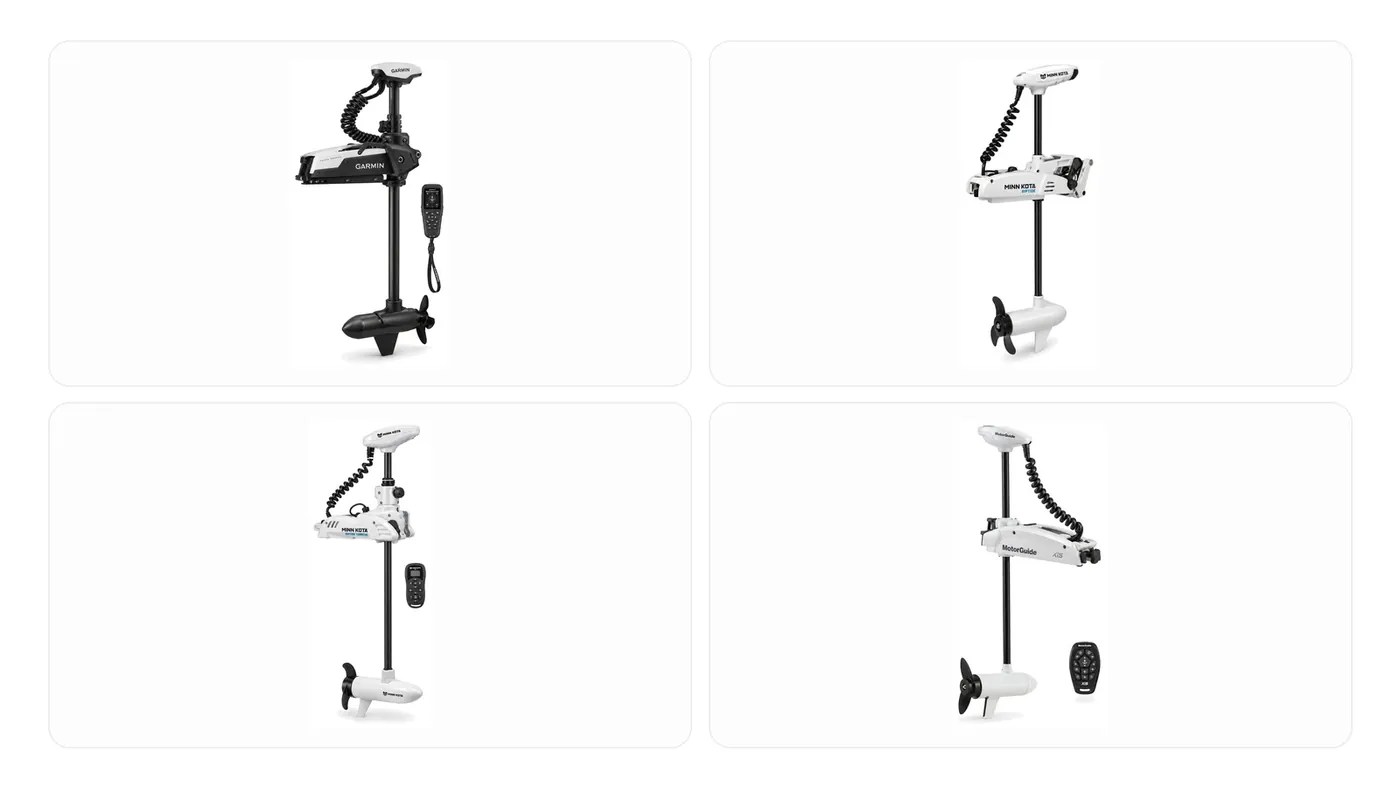
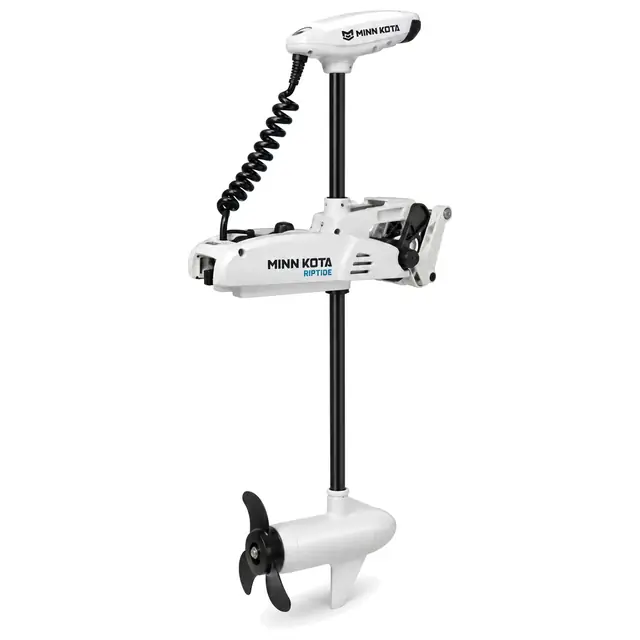
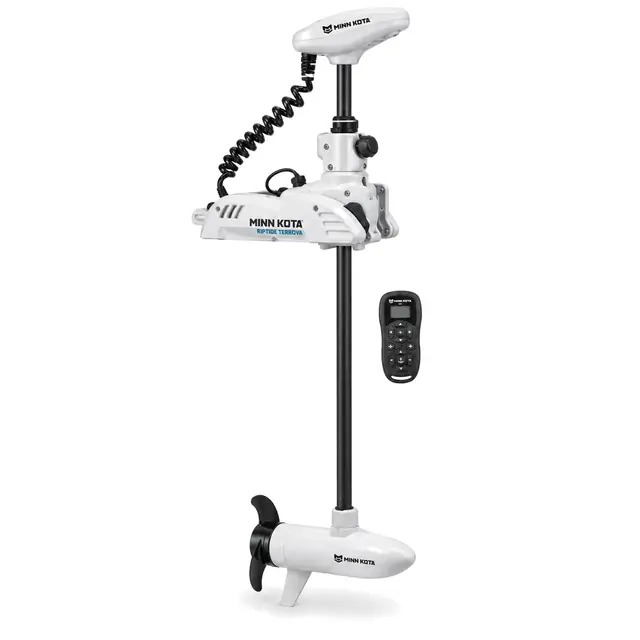
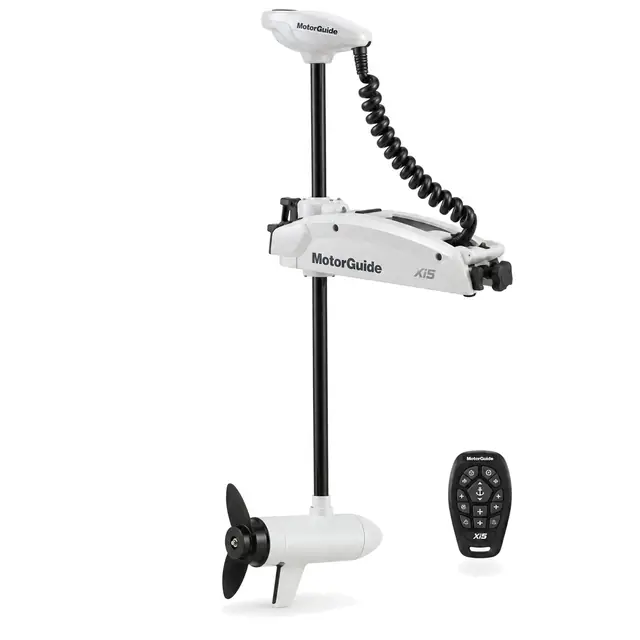
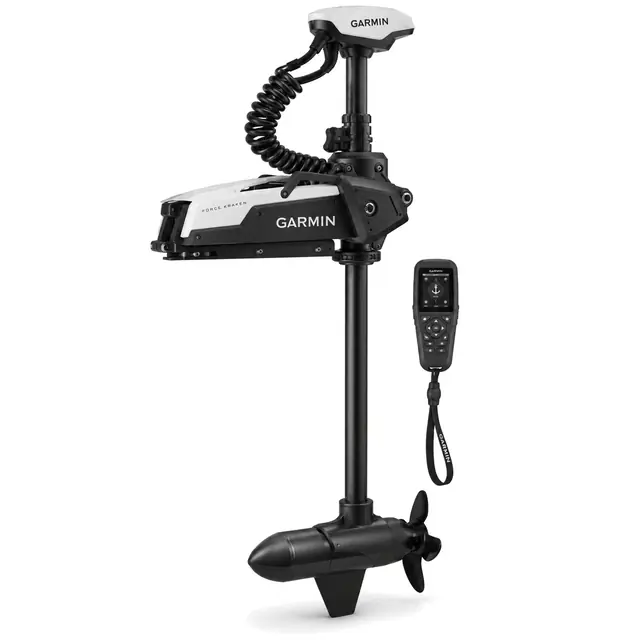
The saltwater trolling motors reviewed below. Manufacturer product photography.
Best Trolling Motors for 16 to 18 Foot Skiffs: Size It Off Loaded Weight, Not Length
Search “trolling motor for 16 foot skiff” and you land on a chart. Boat length down one side, recommended thrust down the other. Sixteen feet, get 55 pounds. Buy it, bolt it to the bow, and discover…
By Larry MurrayUpdated 6 September 202622 min readBuyer’s Guide
The quick answer
Trolling motors are sold by boat length and bought by boat weight, and the two rarely agree. A 17 foot skiff with a poling platform, two batteries, full fuel and two anglers can weigh twice what its dry hull figure suggests, which is the number that actually sets the thrust you need.
Size your motor off fully loaded boat weight, not length. Minn Kota advises at least 2 pounds of thrust per 100 pounds of fully loaded weight. West Marine’s guidance works out to roughly 2.5 pounds per 100 pounds and calls it a minimum. A typical 16 to 18 foot saltwater skiff loads to 1,800 to 2,200 pounds, which puts the published minimum at 45 to 55 pounds of thrust and makes 70 to 80 pounds the comfortable choice once you account for wind and tide.
For most readers who complete the worksheet below and land in that range, the Minn Kota Riptide Terrova at 24V is the motor that fits the largest share of 16 to 18 foot skiffs without overbuying. If your skiff runs heavier, or you fish moving water and want the extra holding margin, the Garmin Force Kraken is the premium alternative with real headroom.
Affiliate disclosure applies to the links throughout this article.
Affiliate disclosure. Affiliate disclosure: ReefReadyGear earns a commission on some links below at no extra cost to you. We don’t accept payment for placement, and every motor here was selected on published specifications, manufacturer documentation, and owner feedback from saltwater skiff forums. Specifications verified September 2026.
Loaded weight, not length
The published guidance is at least 2 lb of thrust per 100 lb of fully loaded weight. Nearly every undersized installation starts by applying that rule to a dry hull figure, so this page builds the loaded weight worksheet first and picks motors second.
ReefReadyGear does not run a testing programme, and nothing on this page is presented as a first-hand test result.
Every figure here is drawn from manufacturer and builder documentation, authorised retailer listings and published
angler experience, verified in September 2026 and dated where it matters. Where a number is our calculation rather
than a published figure, we label it and show the method.
A loaded weight worksheet built line by line, from dry hull through fuel, batteries, anglers and gear
Minn Kota’s published thrust guidance applied to the loaded figure, with West Marine’s operating-weight guidance quoted where the two differ
Shaft length measured from the casting deck rather than the gunwale, using the 12 to 18 inch propeller depth method
Voltage tier stated for this hull class, with the full 24V against 36V analysis linked rather than repeated
Where two authoritative sources disagree, both are quoted and attributed rather than blended, and where a maker
publishes no figure at all we say so instead of estimating quietly.
Search “trolling motor for 16 foot skiff” and you land on a chart. Boat length down one side, recommended thrust down the other. Sixteen feet, get 55 pounds. Buy it, bolt it to the bow, and discover on the first windy afternoon that it cannot hold the boat off a bar edge in a running tide.
The chart wasn’t wrong exactly. It was answering the wrong question. Minn Kota’s own sizing guidance, the one every retailer chart is quietly built from, is stated against fully loaded boat weight, not length and not dry weight. A 16 foot skiff with a 900 pound dry hull is routinely 1,800 to 2,200 pounds once the outboard, fuel, batteries, a poling platform, two anglers, and a day’s gear are aboard. Size off the dry number, or the length alone, and you buy a motor built for half the boat you actually own.
This article fixes that. You’ll build your skiff’s real loaded weight with a line-by-line worksheet, see the two published thrust rules side by side and why they disagree, get a straight answer on 12V versus 24V for a boat this size, learn to measure shaft length correctly from a raised casting deck instead of the gunwale, and understand what a bow-mounted motor and its batteries do to a hull you bought for its shallow draft. Then the motors themselves, organized by the tier your worksheet result points to.
How we got these numbers. The worksheet, thrust recommendation, and draft impact figures are our own calculations from published component weights and standard fuel and seawater densities, labeled as such throughout. The two published thrust rules are quoted and attributed to Minn Kota and West Marine, not blended into one number.
What your skiff actually weighs loaded
This is the number every thrust rule is written against, and it’s the number almost nobody calculates before buying.
Start with the dry hull weight from your builder’s spec sheet, then add every line below.
Item
Typical weight
Notes
Dry hull weight
Per builder spec
Bare hull, no engine, no rigging
Outboard engine
250 to 400 lb
Varies with horsepower, four-stroke adds weight versus two-stroke
Fuel, full tank
6.1 lb per gallon
A 25 gallon tank is over 150 lb full and near zero empty
Trolling motor batteries
60 to 130 lb
Depends on voltage and chemistry, covered in the voltage section below
Poling platform and tower
25 to 45 lb
Common on flats and bay skiffs
Anglers, two aboard
300 to 450 lb
Wet weight, clothing and boots included
Tackle, rods, and gear
40 to 80 lb
A loaded tackle bag plus four to six rods
Cooler with ice
20 to 40 lb
Livewell, filled
8.5 lb per gallon
Seawater, an 8 gallon livewell filled is 68 lb before the tank itself
Anchor, push pole, safety gear
25 to 40 lb
Add it up and the total is almost always well above what an owner has in their head as “my boat’s weight.”
Two worked examples
A light technical poling skiff. Dry hull 900 lb, 90 hp four-stroke at 310 lb, a full 25 gallon tank at 153 lb, poling platform at 30 lb, two anglers at 380 lb, gear at 55 lb, cooler at 25 lb, no livewell, anchor and pole at 30 lb. Total before batteries: 1,883 lb. Add a 24V battery pair at roughly 90 lb and the loaded weight lands at 1,973 lb.
A heavier bay-style skiff. Dry hull 1,150 lb, 115 hp four-stroke at 375 lb, a full 30 gallon tank at 183 lb, a platform and livewell combo (8 gallon livewell filled at 68 lb of water plus a 15 lb tank), two anglers at 400 lb, gear at 70 lb, cooler at 35 lb, anchor and safety gear at 35 lb. Total before batteries: 2,331 lb. Add batteries and the loaded figure crosses 2,400 lb.
Both boats go from a dry hull to a loaded weight more than double it. This is what length-based charts miss: two 16 foot skiffs can differ by 400 pounds or more loaded, and a chart built on length alone treats them identically.
Expert tip. Fuel is the item owners consistently forget when they estimate their own boat’s weight. A full 25 gallon tank is over 150 pounds. Your trolling motor has to hold the boat both on the day you launched full and on the day you’re running home on fumes, and the loaded weight worksheet should reflect the heavier day.
The two sizing rules, and why they disagree
Two organizations publish thrust sizing guidance, and they don’t quite agree. Both are legitimate; neither was written for a saltwater skiff holding against a running tide with a beam wind.
Minn Kota’s published thrust selection guidance: at least 2 pounds of thrust for every 100 pounds of fully loaded boat weight.
West Marine’s trolling motor advisor: roughly 5 pounds of thrust per 200 pounds of loaded weight, which works out to about 2.5 pounds per 100 pounds, stated as a minimum. West Marine separately gives operating-weight bands: up to 1,500 lb loaded needs 40 to 55 lb of thrust, and 1,500 to 3,000 lb loaded needs 70 to 80 lb.
The two numbers are close but not identical, and both describe themselves as minimums for general boating use, not saltwater-specific recommendations. Neither accounts for the wind resistance of a raised deck and a poling platform, and neither accounts for holding against a moving tide, which is a harder job than holding on flat, still freshwater.
Our reading, and this is editorial judgment rather than either publisher’s position: size a saltwater skiff above both minimums. The published numbers get you a motor that moves the boat and holds it in calm conditions. Salt water rarely stays calm for a full session.
Loaded weight
Minn Kota minimum (2 lb/100 lb)
West Marine minimum (~2.5 lb/100 lb)
Our saltwater recommendation
1,600 to 1,900 lb
32 to 38 lb
40 to 48 lb
55 lb
1,900 to 2,200 lb
38 to 44 lb
48 to 55 lb
70 lb
2,200 to 2,500 lb
44 to 50 lb
55 to 63 lb
70 to 80 lb
2,500 to 2,800 lb
50 to 56 lb
63 to 70 lb
80 lb
The “our saltwater recommendation” column is ReefReadyGear’s editorial judgment, built by sizing above both published minimums to account for tide and wind on an open saltwater flat. It is not a manufacturer specification.
Most 16 to 18 foot skiffs, fully loaded, fall in the 1,900 to 2,500 pound band, putting the practical answer at 70 to 80 lb of thrust for most readers, not the 55 lb a length-based chart hands out by default.
Two published rules, one editorial recommendation, and the gap between them is the wind you fish in.
12V or 24V on a skiff?
The published thrust bands by voltage are consistent across manufacturers: 12V covers up to about 55 lb of thrust on one battery, 24V covers roughly 70 to 90 lb on two batteries wired in series, and 36V covers 112 to 115 lb on three.
That maps directly onto the thrust table above. A lightly loaded skiff landing in the 55 lb recommendation can run 12V and one battery. Most skiffs, once the worksheet is done honestly, land in the 70 to 80 lb range, which means 24V and a second battery.
Voltage
Thrust available
Batteries required
Approx. system weight, AGM
Approx. system weight, lithium
12V
Up to ~55 lb
1
60 to 65 lb
25 to 30 lb
24V
~70 to 90 lb
2
100 to 120 lb
45 to 55 lb
36V
112 to 115 lb
3
150 to 180 lb
65 to 80 lb
The skiff-specific reading: that second battery is weight added forward, on a hull you likely bought for its shallow draft and light handling. Going 24V is usually the right call for a skiff fishing moving water, but it’s a real trim decision, not a free upgrade, and lithium narrows the weight penalty considerably at a higher price.
We won’t re-run the full 24V versus 36V argument here. That comparison, including runtime, charging, and chemistry trade-offs, lives in our dedicated 24V vs 36V trolling motor guide, worth reading once you know your thrust target. For a 16 to 18 foot skiff, 24V fits the large majority of loaded weights above; 36V is worth considering only near the top of the 2,500 to 2,800 pound band or in consistently hard current.
Every extra pound of thrust arrives as pounds in the bilge, which is why voltage is a draft decision too.
Shaft length from a raised casting deck
This is the measurement error that generic shaft charts cause on almost every skiff, because they assume a conventional low gunwale mount.
Measure from the mounting surface to the waterline, then add 12 to 18 inches of propeller depth. On most skiffs, the mounting surface is a raised bow casting deck, not the gunwale and not the waterline of a bare hull on a trailer. The raised deck adds real height to the measurement. Skip it and you’ll come out short by several inches.
The method, step by step:
With the boat loaded close to how you’ll actually fish it, measure vertically from the top of the casting deck, where the motor’s mounting bracket will sit, straight down to the water’s surface.
Add 12 to 18 inches to that number. This is the depth the propeller needs to run submerged, per West Marine’s published guidance, to avoid pulling air in chop.
If your result falls between two available shaft lengths, choose the longer one. A shaft that’s too long can be trimmed up slightly on mount; a shaft that’s too short cannot be fixed without buying a different motor.
Re-measure after any change that affects freeboard, including adding the trolling motor batteries themselves, which will sit the boat slightly lower than it was on the trailer.
[DIAGRAM: skiff shown in profile, raised casting deck marked, a line running from the deck surface down to the waterline labeled “mounting surface to waterline,” and a shaded band below the waterline labeled “12 to 18 in propeller depth.”]
Warning. A shaft that’s too short lets the propeller ventilate, pulling air instead of biting water, every time the boat rocks in chop. Ventilation shows up as reduced thrust, faster battery drain, and an anchor lock that seems to lose its grip in exactly the conditions you bought it for. Owners in this situation almost always blame the motor. It’s nearly always the shaft measurement.
The measurement that gets bought wrong most often. Start at the deck the motor mounts to.
The best saltwater trolling motors for 16 to 18 foot skiffs
Shop from your worksheet result, not from a flat ranking. These are organized by the tier your loaded weight and thrust recommendation actually point to.
55 lb, 12V: for lightly loaded skiffs in protected water — Best for lightly loaded skiffs
Minn Kota Riptide PowerDrive
Published specifications
Thrust
55 lb
Voltage
12V
Shaft options
45, 54 in
Saltwater rating
Yes, corrosion-resistant composite shaft and saltwater-rated electronics
GPS features
Available with i-Pilot on select configurations
Mount
Bow mount
Price
Around $1,300 to $1,600
Best for. A light technical skiff fishing protected backcountry water, where the loaded weight worksheet lands under about 1,900 pounds.
Key features. Minn Kota’s foot-pedal-steered bow mount at the entry point of its saltwater lineup, built around the same composite shaft and corrosion-resistant hardware as the rest of the Riptide range. Digital Maximizer electronics extend runtime by matching power output to demand rather than running at a fixed draw.
Advantages
– Single battery, lightest system weight in this guide
– Foot pedal steering keeps hands free for casting
– Proven saltwater durability in the Riptide line
– Lowest entry price among saltwater bow mounts
Limitations
– 55 lb is the 12V ceiling, a minimum-side number even for a light skiff
– No spot lock or GPS anchoring on base configurations
– Thin margin against wind and tide versus the 24V tier
Real-world application. Poling and pedal-motoring a grass flat in light wind, covering ground between spots rather than holding hard against current.
Who should buy it. Owners of a genuinely light skiff, worksheet result under roughly 1,900 pounds, fishing mostly protected water.
Who should avoid it. Anyone fishing moving tide or open bay wind regularly. Size up to 24V instead.
70 to 80 lb, 24V: the tier most saltwater skiffs land in — Best for most 16 to 18 ft skiffs
Minn Kota Riptide Terrova
Published specifications
Thrust
80 lb
Voltage
24V
Shaft options
60, 72, 87 in
Saltwater rating
Yes, full saltwater composite construction
GPS features
i-Pilot with Spot-Lock, heading hold, and course tracking; compatible with the One-Boat Network for chartplotter integration
Mount
Bow mount
Price
Around $2,200 to $2,800
Best for. The majority of 16 to 18 foot saltwater skiffs once fully loaded, and the motor most readers who complete the worksheet above should be shopping.
Key features. Pairs 80 lb of 24V thrust with Minn Kota’s i-Pilot GPS system, which handles Spot-Lock anchoring, heading hold, and saved waypoints. Spot-Lock is genuinely useful for holding off a bar edge or channel mouth without dropping a real anchor, though it works harder on a light, high-windage skiff than a heavier boat. Shaft options run long enough for a raised casting deck.
Advantages
– Thrust matches the recommendation for the most common loaded weight band on this list
– Spot-Lock and heading hold are mature, well-proven features
– Available in a 72 or 87 inch shaft, which fits a raised deck without guesswork
– Strong dealer network and parts availability
Limitations
– Two batteries add real weight forward, covered in the draft section below
– Spot-Lock demands more of the motor on a light, windage-heavy skiff than on a bass boat
– Premium price relative to a basic 24V motor without GPS
Real-world application. Holding station off an oyster bar on a falling tide with a crosswind, or working a mangrove shoreline between spots without firing the outboard.
Who should buy it. Owners whose worksheet result lands in the 1,900 to 2,500 pound range, which covers most loaded 16 to 18 foot skiffs.
Who should avoid it. Anyone loading past 2,500 pounds regularly, or fishing hard current where 36V holding margin matters more.
MotorGuide Xi5 Saltwater
Published specifications
Thrust
70 lb (also available at 55 and 80 lb)
Voltage
24V
Shaft options
54, 60 in
Saltwater rating
Yes, saltwater-rated composite shaft and stainless hardware
GPS features
Pinpoint GPS anchor, wireless remote, Sonar Trolling and DSG (digital sonar gimbal) support
Mount
Bow mount
Price
Around $2,000 to $2,600
Best for. Skiff owners who want GPS anchoring and a lighter-weight motor head than the Terrova, and who already run Humminbird or Lowrance electronics they’d like the Pinpoint system to talk to.
Key features. Uses a wireless remote rather than a corded foot pedal on most configurations, which some anglers prefer on an open casting deck where a pedal cable is one more thing to trip on. Pinpoint anchoring performs the same core job as Spot-Lock, with integration built around MotorGuide’s own sonar ecosystem.
Advantages
– Wireless remote keeps the casting deck clear of pedal cabling
– Slightly lighter motor head than comparable Minn Kota units
– Strong sonar integration for owners already in that ecosystem
– Available at 55, 70, and 80 lb thrust, so the lineup covers a wide loaded weight range
Limitations
– Shorter maximum shaft length than the Terrova, worth checking against your raised-deck measurement before buying
– Wireless remote needs its own battery and charging discipline
– Fewer chartplotter integration options outside the MotorGuide and Humminbird ecosystem
Real-world application. A bay skiff running mixed sonar and GPS electronics, where one ecosystem across motor and fish finder simplifies wiring.
Who should buy it. Owners already invested in Humminbird or MotorGuide electronics, or who want a wireless deck.
Who should avoid it. Anyone whose shaft measurement exceeds 60 inches once the raised deck is accounted for. Check the Terrova instead.
Premium GPS anchoring options — Best GPS anchoring options
Garmin Force Kraken
Published specifications
Thrust
Up to 150 lb (36V) or lower thrust tiers at 24V
Voltage
24V or 36V depending on configuration
Shaft options
45, 57, 72 in
Saltwater rating
Yes, saltwater-rated with corrosion-resistant construction
GPS features
Garmin GPS anchor with wireless connectivity, integration with Garmin chartplotters, Force Link app control
Mount
Bow mount
Price
Around $3,200 to $4,500
Best for. Heavier bay-style skiffs whose worksheet result pushes toward the top of the loaded weight range, or owners who fish hard tidal current and want real holding headroom rather than a motor working near its limit.
Key features. Garmin’s high-thrust update to the original Force line, built to give more holding authority in current and wind. Integrates directly with Garmin chartplotters for waypoint-based navigation and anchoring, and the app control gives a level of customization pedal-only systems don’t match.
Advantages
– Genuine holding headroom for skiffs at the heavier end of the loaded weight range
– Deep Garmin chartplotter integration for owners already in that ecosystem
– Wireless app control alongside a physical remote
– Shaft options run long enough for a raised casting deck with a poling platform
Limitations
– The highest price in this guide by a wide margin
– At 36V, the battery weight and cost add up quickly, which matters more on a light skiff than a heavier bay boat
– Overkill for a lightly loaded skiff, where the 24V Terrova or Xi5 tier is sufficient
Real-world application. Holding a bar edge in a running tide with 15 knots of wind, where a 55 or 70 lb motor is near its limit and this one isn’t.
Who should buy it. Owners of a heavier, fully rigged skiff in the upper part of the 2,200 to 2,800 pound band, or anyone fishing hard current routinely.
Who should avoid it. Owners of a light technical skiff, where the thrust, price, and added battery weight all exceed what the boat needs.
A saltwater specialist worth a mention rather than a full block here: Rhodan Marine’s HD GPS Anchor line is built from the ground up for continuous saltwater and offshore duty, rather than adapted from a freshwater platform, and it’s a common choice among guides and charter operators for that reason. Thrust runs 80 to 100 lb depending on configuration, voltage is 24V or 36V, and pricing sits around $3,500 to $4,800, similar to or above the Force Kraken. Confirm current shaft options directly with Rhodan, since the lineup moves faster than the major brands’ catalogs. It’s worth the premium for owners running hard, salt-heavy schedules; occasional weekend anglers in the standard 70 to 80 lb tier will do just as well with the Terrova or Xi5 for less.
What it does to your draft
A skiff earns its keep on shallow draft. A bow-mounted trolling motor and its batteries add weight forward, concentrated at the bow, on a hull that was designed and priced specifically for how little water it needs.
Voltage
System weight, AGM
System weight, lithium
Approximate draft increase
12V
60 to 65 lb
25 to 30 lb
Minimal, under half an inch on most hulls
24V
100 to 120 lb
45 to 55 lb
Roughly half an inch to just over an inch
36V
150 to 180 lb
65 to 80 lb
Over an inch, with a noticeable forward trim shift
Draft increase figures are our estimate based on typical skiff hull displacement curves and are not a manufacturer specification. Actual results vary by hull design and where the batteries are placed.
On a hull chosen for shallow water, that added weight matters more than it would on a heavier boat. A 24V AGM system can add over 100 pounds concentrated at the bow, which changes static draft modestly but shifts longitudinal trim more noticeably, since the weight sits forward of the boat’s normal center of gravity. That can make the bow ride lower at rest and change how the boat responds when poling or running skinny water.
Lithium cuts that weight penalty by more than half at every voltage tier, which is why so many skiff owners running 24V or 36V choose it despite the higher price. If draft and trim are a real priority, lithium is worth the cost. If budget is the constraint and the boat isn’t already near its draft limit, AGM remains reasonable.
Where the batteries go
Battery placement on a skiff is a trim decision and a wiring decision, not a storage afterthought.
Trim. Batteries mounted forward, near the motor, minimize wiring length but concentrate weight where the draft table above shows the biggest impact. Batteries mounted aft, closer to center or the console, add wiring length but distribute weight more evenly. On a light technical skiff, the trim consequence usually outweighs the wiring convenience, and the extra cable run is worth it to keep the bow from sitting low.
Wiring and voltage drop. A longer run needs a heavier gauge wire to avoid voltage drop, which robs the motor of usable power exactly when you need full thrust. Consult ABYC wiring standards for the correct gauge at your run length and current draw, and oversize when you’re between two sizes.
Access and water. Keep connections above the bilge waterline in a ventilated, accessible compartment. Standing water and corroded terminals are one of the most common, and most preventable, trolling motor failures on a skiff.
Skiff rigging checklist
Confirm battery placement against the trim consequences above before drilling anything
Size wire gauge to the actual run length, not a generic chart, per ABYC guidance
Install a properly rated circuit breaker between the battery and the motor
Use marine-grade, corrosion-resistant connectors and apply dielectric grease at every connection
Mount the motor bracket with backing plates through the deck, not just surface screws
Confirm the shaft length against your raised-deck measurement before final installation
Fit a weedless propeller if you fish grass flats regularly
Install sacrificial anodes per the manufacturer’s saltwater guidance
Does it replace the push pole?
No, they’re complementary, not interchangeable. A trolling motor covers ground between spots, holds you off a bar edge or channel mouth, and saves a tired body late in the day. A push pole is silent, and prop wash on hard sand or grass bottom in a foot of water will spook fish a pole never touches.
The motor extends your range and reduces fatigue; the pole remains the tool for the final approach in skinny, spooky water. Most experienced skiff anglers run both, and knowing when to lift the motor and pick up the pole, rather than running the prop into water where it does more harm than good, is the real skill.
Saltwater care
Rinse the motor with fresh water after every trip, before salt has a chance to dry
Flush the lower unit and shaft assembly, not just the exterior housing
Check anodes on a regular schedule and replace before they’re fully consumed
Inspect fasteners, mount hardware, and the mounting bracket for corrosion
Check the propeller and any weed guard for damage or fouling
Clean connector terminals and reapply dielectric grease periodically
Follow the specific service intervals published by your motor’s manufacturer, since they differ between brands
Usually around double its dry weight. Add the outboard, fuel at 6.1 lb per gallon, batteries, a poling platform, two anglers, tackle, and a livewell holding seawater at roughly 8.5 lb per gallon. A 900 lb dry hull commonly reaches 1,800 to 2,200 lb ready to fish, and that’s the figure every thrust rule is written against.
Not without a much shorter service life. Saltwater-rated motors use corrosion-resistant alloys, sealed electronics, marine-grade coatings, and stainless hardware a freshwater motor doesn’t have. Running a freshwater unit in salt water is a warranty problem first and a failure timeline second.
It works, but a light skiff with a raised deck and high windage is pushed off station faster than a heavier boat, so the anchor lock works harder to compensate. Size your thrust above the published minimum if you rely on GPS anchoring in moving water. Our kayak GPS anchoring guide covers the same mechanism at a smaller scale.
It depends on current draw and run length. Consult ABYC marine wiring guidance for the correct gauge, and oversize rather than undersize when you’re between two options.
Often yes on a skiff specifically. Lithium cuts system weight by more than half compared to AGM at every voltage tier, which matters more on a hull chosen for shallow draft. It costs more up front; our battery and lithium system guides cover the trade-offs in depth.
Yes, and most rigged skiffs run both. The platform adds to the boat’s overall windage, which is part of why we recommend sizing above the published thrust minimums for salt water.
It depends on thrust setting, how much of the day is spent holding position versus idling, and battery capacity and chemistry. Too variable for one number here; our battery guides break down runtime by configuration. —
Final verdict
Size your motor off your skiff’s fully loaded weight, calculated with the worksheet above, not off its length. Most 16 to 18 foot saltwater skiffs land in the 1,900 to 2,500 pound loaded range once you account for fuel, batteries, anglers, and gear, which puts 70 to 80 pounds of thrust on 24V as the tier that fits the majority of owners, with 12V and 55 pounds sufficient only for a genuinely light skiff in protected water. Whichever motor you choose, measure shaft length from the raised casting deck rather than the gunwale, and when your measurement falls between two shaft lengths, take the longer one.
Larry Murray
Editor, ReefReadyGear
Larry edits ReefReadyGear, a research-led saltwater gear publication. Recommendations here are built from manufacturer specifications, authorised retailer listings and published angler experience, and we say so plainly rather than implying a testing programme we do not run. Where a claim comes from a manufacturer, we attribute it. Where we have not verified something, we do not print it.
Specifications on this page were taken from manufacturer and authorised retailer listings and the regulatory and safety sources below, consulted September 2026. Prices and specifications change; confirm current figures before buying.
Minn Kota published thrust selection guidance (2 lb per 100 lb of fully loaded weight; 12V/24V/36V thrust bands) and current Riptide Terrova and PowerDrive specifications, pricing, and shaft options at minnkota.johnsonoutdoors.com
West Marine trolling motor advisor (12 to 18 in propeller depth method, choose-longer rule, thrust-by-operating-weight bands) at westmarine.com
MotorGuide Xi5 Saltwater current specifications and pricing at motorguide.com
Garmin Force Kraken current thrust tiers, shaft options, and pricing at garmin.com
Rhodan Marine HD GPS Anchor current lineup, shaft options, and pricing directly from Rhodan, since this line changes more frequently than the major brands’ catalogs
Battery weights and capacities for AGM and lithium system tables, from Dakota Lithium, Battle Born, Relion, and comparable AGM manufacturer specifications
Skiff builder dry weights used in the two worked examples (Hell’s Bay, Maverick, East Cape, Salt Marsh, Beavertail, or similar) confirmed against current model-year specifications
Join The ReefReady Community
Get saltwater Fishing Guides, expert Buyers Guides, equipment recommendations,
marine electronics insights, and practical gear tips delivered to your inbox.