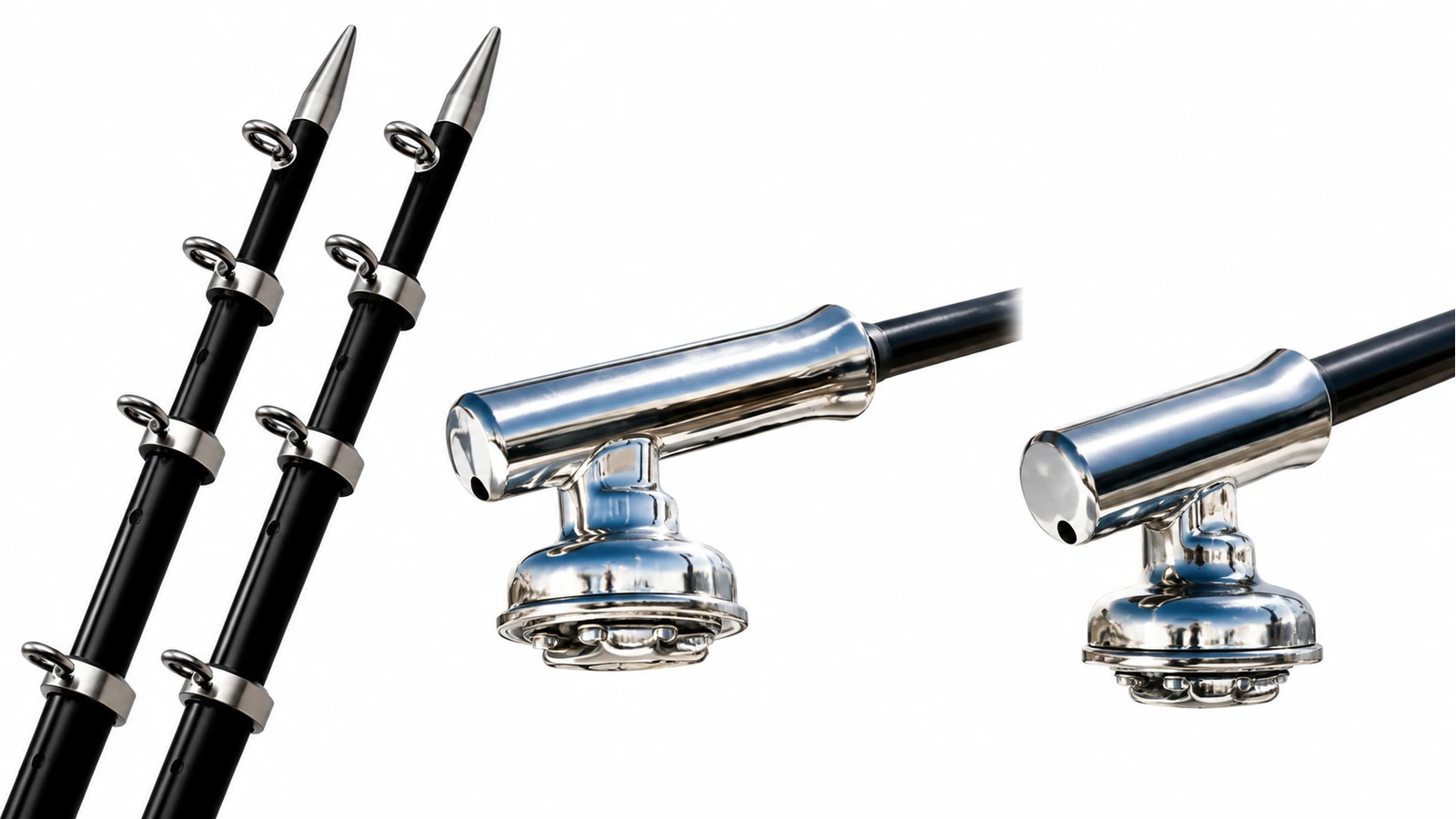
Best Outriggers for a 20-Foot Center Console: Why Pole Length Isn't the Same Number as Spread
You're running two rods off a 20-foot center console and the starboard bait keeps crossing the port line every time you clear a turn, which is exactly the tangle outriggers are sold to fix.
The quick answer
TACO's 15-foot Tele-Outriggers with a GS-170 mount are the best documented starting point for a 20-foot center console. The 1-1/8 inch aluminum pole is published as compatible with the named GS-170 base, weighs 4 lb per pole and telescopes to under 6 feet for storage, so you can quote a specific pole against a specific base instead of a loosely described universal kit. That only holds once your top has been confirmed to accept the GS-170's structural mounting provisions. Owners fishing a tight cockpit should buy the Gemlux Coastal 12-foot hybrid poles instead, a collapsible pole pair matched to the Coastal base family that trades roughly 2.6 feet of projection at the same mount angle for easier handling and storage.
Everything below is judged on one question: whether your specific top can carry the base, not how many feet are printed on the pole.
Affiliate disclosure. ReefReadyGear earns a commission on some links below at no extra cost to you. This guide draws on manufacturer product pages and installation manuals, checked September 12, 2026, and it is a researched buying guide rather than a claim of first-hand testing.
Pole length and mount approval are different purchases
A 15-foot pole raised steeply can project less horizontal spread than a 12-foot pole set flatter, and neither number confirms whether your top can carry the base's load. Confirming the mount, not the extra feet of aluminum, is the purchase decision that actually matters on a 20-foot boat.
The three awards
The three systems at a glance
| If you want | Consider | Why |
|---|---|---|
| A documented aluminum pole-and-base combination | TACO 15-foot Tele-Outriggers with a GS-170 mount | Published pole-to-base compatibility and a stated collapsed length, once your top is confirmed to accept the GS-170's structural mounting requirements |
| A shorter, lighter alternative for a tighter cockpit | Gemlux Coastal 12-foot hybrid poles | Same named Coastal base family in a shorter pole, for owners who want compact handling over maximum reach |
| The longer Coastal option, chosen for a stated reason | Gemlux Coastal 15-foot hybrid poles | Matches the Coastal base family with more horizontal projection, worth choosing only after the 12-foot system has been ruled out for your intended spread |
On this page
- The quick answer
- The three awards
- The three systems at a glance
- How we chose
- Pole length or mount approval: which one actually decides fit?
- How much horizontal spread does a 12-foot or 15-foot pole actually give you?
- What extra pole length costs you before it touches the water
- The mount check almost nobody runs before drilling
- The best outriggers for a 20-foot center console
- TACO 15-foot Tele-Outriggers with GS-170 mount
- Gemlux Coastal 12-foot hybrid poles
- Gemlux Coastal 15-foot hybrid poles
- Where each system sits on the length-versus-structure trade-off
- Rig it so the small parts don't fail first
- Check storage and trailering before you drill anything
- What a complete outrigger quote should include
- Do you actually need outriggers at all?
- Frequently asked questions
- Final verdict
- Related reading
- Sources
How we chose
ReefReadyGear does not run a testing programme, and nothing here is presented as a first-hand result. Every specification is drawn from manufacturer product and installation pages, verified September 12, 2026. Where a figure is our calculation rather than a published spec, it's labelled as ours with the method shown.
- Mount compatibility and structural approval are checked before pole length, since a longer pole on an unapproved base isn't a buying decision, it's a liability
- Horizontal spread is calculated explicitly from pole length and mount angle, not read off the number printed on the pole
- Manufacturer boat-size sizing charts are treated as a starting point, never a substitute for written approval of your specific top or gunwale
- Where two documents from the same manufacturer disagree, such as TACO's general sizing chart and its own 15-foot pole listing, both are shown rather than the more convenient one being picked
Where two authoritative sources disagree, both are quoted and attributed rather than blended, and where a maker publishes no figure at all we say so instead of estimating quietly.
You're running a trolling spread off a 20-foot center console, two rods in the holders behind the gunwale, baits set thirty feet back. The port bait swims clean in the wake. The starboard bait keeps crossing behind it every time you come off a turn to check the spread ahead, and by the time you've cleared the tangle and reset the clip, you've fished through the exact stretch of color change you turned to reach. Outriggers are sold as the fix for that thirty seconds of tangled line, and on paper they are: two poles, two release points, lines held wide enough that a turn doesn't cross them.
The listing that sells you the fix leads with a number: pole length. Twelve feet. Fifteen feet. It's the easiest spec to print and the easiest one to compare, so it's the one every product page puts first, and it's also the number that tells you the least about whether the fix actually works on your boat.
Pole length is what's printed on the box. Spread is what happens in your wake, and the two are connected by an angle you set at the base, not by the number stamped on the aluminum. A 15-foot pole raised steeply gives you less usable width than a 12-foot pole set flatter, and neither number means anything until the top or gunwale it mounts to has been confirmed to carry the load in the first place. That confirmation, not the extra three feet, is the actual purchase decision on a 20-foot boat.
This guide publishes the projection math that turns pole length into an actual spread number, walks through the structural check most buyers skip before a drill ever touches the top, and reviews the specific TACO and Gemlux systems worth putting on a shortlist, with the compromises named rather than buried in a spec sheet.
Pole length or mount approval: which one actually decides fit?
Mount approval decides whether a system belongs on your boat. Pole length only decides how far the release point sits once that approval is in hand. Treating the two as one decision is the mistake this section exists to correct, and it's an easy mistake, because every product page leads with the pole and buries the mount.
Buying by length starts with a boat-size chart. TACO's general Tele-Outrigger selection guide suggests 12 feet for boats 20 feet and under, a single number meant to cover a wide range of hulls and tops at a glance. That's a reasonable starting point for a first search, and it's also the only input most buyers ever check before adding a pole to a cart.
Buying by mount starts with what your specific top can carry. TACO's own OT-series aluminum pole listing puts the 15-foot pole on boats up to 30 feet, a considerably longer range than the general chart implies, and the GS-170 installation instructions call for structural mounting provisions the general chart never mentions at all. Two documents from the same manufacturer, read the same day, giving different starting numbers:
| Source | What it says | Read |
|---|---|---|
| TACO's Tele-Outrigger selection FAQ (general sizing guide) | Suggests 12 feet for boats 20 feet and under | tacomarine.com, checked September 12, 2026 |
| TACO's OT-series aluminum pole specifications | Lists the 15-foot pole as suitable for boats up to 30 feet | tacomarine.com, checked September 12, 2026 |
Neither document is wrong. They're answering different questions: one is a general starting recommendation, the other is a specific product's stated range. Boat length alone does not resolve the gap between them, and it isn't supposed to. What resolves it is the top or gunwale installation your boat or top builder approves for the mount you're actually buying. Write down your boat's make, model and year, plus the top manufacturer if it's aftermarket, and put that question to the installer before either chart decides anything for you.
How much horizontal spread does a 12-foot or 15-foot pole actually give you?
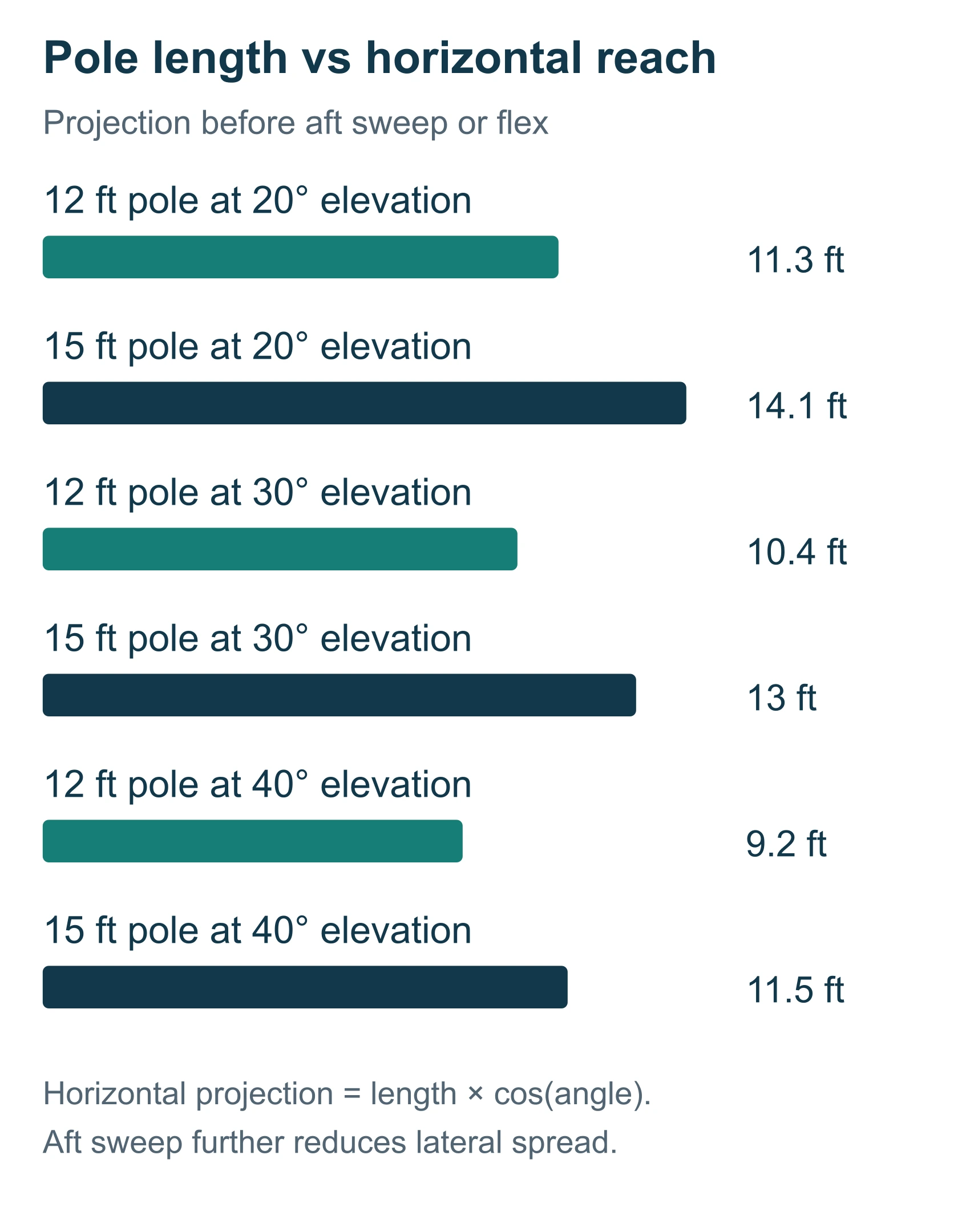
Almost no outrigger listing publishes this number, because it isn't a pole spec at all. It's a triangle, and it depends on an angle the buyer sets after the pole is mounted, not on anything printed at the factory.
This projection is our calculation, not a manufacturer figure, and the method is shown so you can rerun it at your own mount angle. For a straight pole raised to a given angle above horizontal, the horizontal projection equals the pole's length multiplied by the cosine of that angle. Raise the angle and the projection shrinks; lower it and the projection grows toward the pole's full length, at the cost of how much clearance the pole needs over the water and the cockpit beneath it.
| Illustrative pole length | Elevation above horizontal | Horizontal projection before sweep (ours) |
|---|---|---|
| 12 ft | 20° | About 11.3 ft |
| 12 ft | 30° | About 10.4 ft |
| 12 ft | 40° | About 9.2 ft |
| 15 ft | 20° | About 14.1 ft |
| 15 ft | 30° | About 13.0 ft |
| 15 ft | 40° | About 11.5 ft |
These figures assume a straight pole pointing directly outward, with no sweep toward the stern, no flex under load and no allowance for how far the pole sits inside its base socket. They are a starting geometry, not a promise of actual bait separation on the water. A 15-foot pole set at 30 degrees projects roughly 13.0 feet, which is only about 2.6 feet more reach than a 12-foot pole at the same angle, once you're comparing the same angle rather than one pole lying flat against another raised steeply.
Use a simple plan-view sketch of your own boat before you compare release positions between systems. Keep the boat's beam, the base positions and the pole angle consistent across every option you sketch. Comparing a flat 12-foot pole against a steep 15-foot pole on the strength of the length numbers alone will make the shorter system look worse than the geometry actually supports.
What extra pole length costs you before it touches the water
The 2.6 feet of extra projection a 15-foot pole buys you over a 12-foot pole at the same angle is not free, and none of the cost shows up on the length spec.
Extra length raises the structural question first. TACO's GS-170 installation instructions call for structural mounting provisions on a canvas T-top and describe a separate arrangement for a hardtop, because a canvas panel by itself is not the support structure an outrigger base needs. A longer, heavier pole loads that structure harder than a short one, which means the backing question that a 12-foot system might get away with skipping becomes a firm requirement at 15 feet.
Extra length also costs you reach at the helm. Rehearse the control operation ashore, standing where you'd actually stand underway, reaching for the proposed control with one hand while you consider what the other hand is doing to keep you steady. A control that's easy to reach beside the helm can be awkward across a console, a seat or a leaning post, and a longer pole's controls tend to sit further from where you're standing to run the boat.
Extra length costs you cockpit clearance while fishing. Trace the rod tip, the fishing line and the halyard path for the longer pole, including where the landing net or gaff lives and the space your crew needs to move around a hooked fish. If explaining the layout to a new crew member takes several exceptions to avoid crossed lines, the layout needs simplifying before you add the longer pole that made it more complicated in the first place.
The directive is simple: choose the shortest approved system that gives you the release-point positions your fishing actually requires, and only pay the structural, reach and clearance cost of extra length once you've confirmed you need the spread it buys.
The mount check almost nobody runs before drilling
Every section above assumes the top can carry an outrigger base. Almost no buyer actually confirms that before signing the installation quote, because the pole and the price are the parts that feel like the purchase.
The check that matters more than either number: before any hole is drilled, ask the installer to show you, in person, exactly where the GS-170's (or any base's) structural mounting provisions sit on your specific top, and press against that exact spot yourself. Put your palm flat against the underside of the mounting location while someone presses down on the top surface from above, or knock a knuckle against the panel near the intended bolt pattern and listen for the difference between a solid response and a hollow one. A solid, unyielding feel is consistent with the kind of backing plate or core reinforcement an outrigger base actually loads; noticeable flex or a hollow sound at the exact mounting point is a sign the top needs reinforcement before a base goes anywhere near it.
This is a five-minute question to ask before you pay for installation, not a substitute for the builder's or top manufacturer's own written approval of the load. A press test that feels solid does not certify an engineering rating, and a press test that feels soft is reason enough to get the structure assessed before you spend anything else on poles.
The best outriggers for a 20-foot center console
Category boundary, stated plainly: telescoping outrigger pole-and-base systems documented for boats in the 20-foot center console range, evaluated on published pole-to-base compatibility rather than on an installed price. None of the three systems below is a universal fit for every 20-footer. Each is a documented product combination to assess with your own installer, not an installation ReefReadyGear has tested on a specific boat.
TACO 15-foot Tele-Outriggers with GS-170 mount: documented aluminum starting point
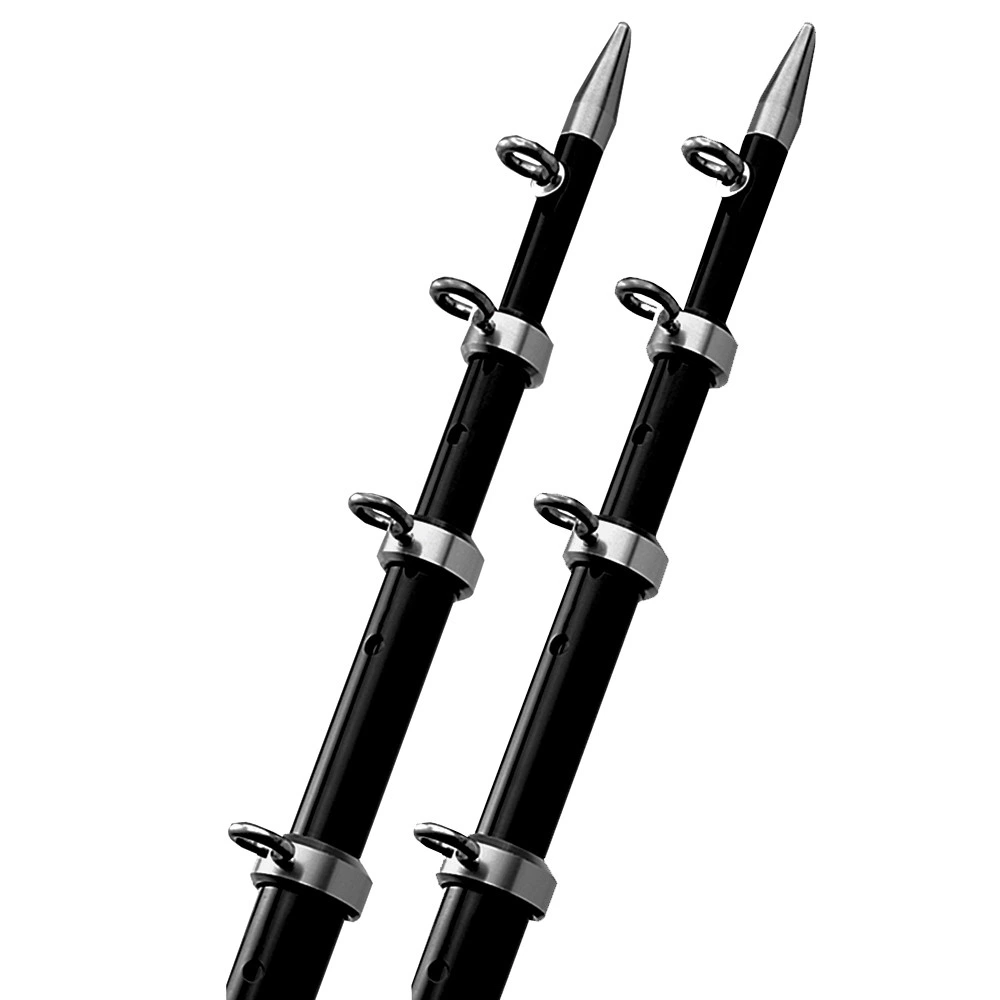
Check 15-ft / 1½-inch TACO poles on Amazon
This system wins on paperwork rather than on reach. TACO identifies the 1-1/8 inch aluminum pole as compatible with the GS-170 mount, publishes a 4-pound weight per pole and states a collapsed length under 6 feet, which means you can check storage and cover fit before you order rather than after the poles arrive. Pairing a named pole with a named base also gives an installer something concrete to quote against. The 15-foot length is the longest reviewed here, and the boat-size guidance behind it is the part buyers most often misread.
| Material | Aluminum, 1-1/8 in. diameter |
|---|---|
| Nominal pole length | 15 ft (OT-0442 series) |
| Weight per pole | 4 lb |
| Collapsed length | Under 6 ft, telescoping |
| Compatible mount | TACO GS-170 (Grand Slam 170) |
| Boat-size guidance | TACO's aluminum pole listing covers boats up to 30 ft; TACO's general sizing chart suggests 12 ft for boats 20 ft and under (see the disagreement above) |
Source: TACO OT-series aluminum outrigger pole specifications and GS-170 installation instructions, tacomarine.com, checked September 12, 2026. Complete installed-system weight, including base, rigging and hardware, is not published; confirm it with your installer.
Why the pole-to-base documentation is the thing you are actually buying
Most outrigger shopping ends up as a compatibility puzzle: a pole listed on one page, a base on another, and a buyer left to decide whether the two belong together. TACO closes that gap by stating the match itself, which removes the one assumption most likely to turn into a return or a re-drill.
The published collapsed length does similar work. Under 6 feet is a number you can measure against your garage door, your cover and your trailer before any money moves.
The GS-170 asks for structure the sizing chart never mentions
The 4-pound pole weight and the 15-foot length have more published support than anything else in the aluminum family, and neither of them tells you what your top can carry. The GS-170 installation instructions call for structural mounting provisions on a canvas T-top and describe a separate arrangement for a hardtop. That assessment is boat-specific and has to happen separately, no matter how well documented the pole is.
Reach is checked underway, not at the dock
A documented pole does not document your cockpit layout. Controls and halyards have to be confirmed reachable from the position you actually stand in while running the boat, on both sides.
Ask the installer to walk you through operating both poles while you stand securely in the cockpit, not while balancing on a seat to reach a control that was placed for a dockside demonstration. If one side works and the other needs a reach you would not attempt in a chop, the mounting position is the problem, not the pole.
Best for. An owner who wants a documented aluminum pole matched to a named base, on a top that has been or can be confirmed to accept the GS-170's structural mounting provisions.
Skip it if. Your top has not been assessed for the GS-170's backing requirements yet, because the pole is the easy part of this purchase.
Gemlux Coastal 12-foot hybrid poles: shorter, lighter alternative
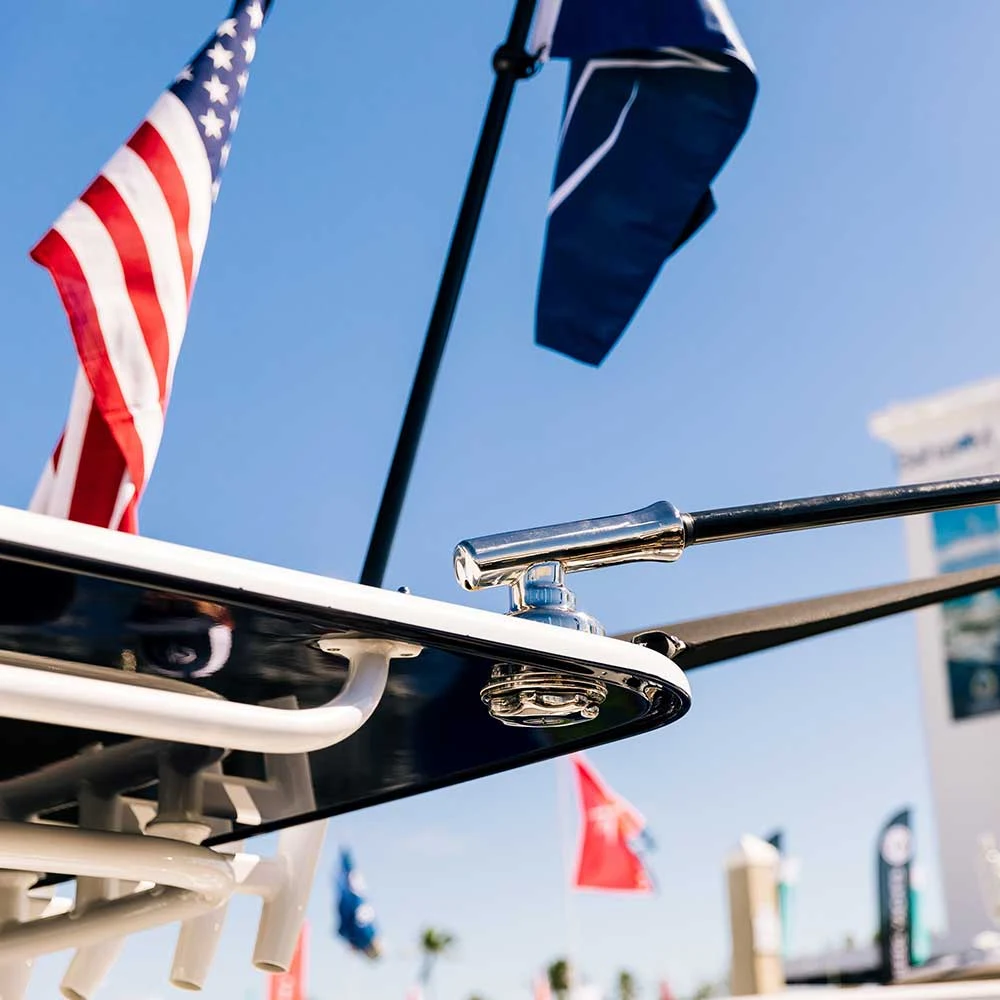
This is the option to price first if deck space or storage is already tight on your boat. It is a collapsible 12-foot pole pair built for Gemlux's Coastal base family, described by Gemlux as a proprietary carbon-fiber hybrid blend, so you are comparing a matched pole-and-base family rather than a poles-only listing with no stated base compatibility. The shorter length is a genuine option to weigh against a 15-foot system rather than a downgrade you settle for. What it does not come with is a published weight or collapsed length.
| Material | Proprietary carbon-fiber hybrid blend, per Gemlux's own product description |
|---|---|
| Nominal pole length | 12 ft |
| Format | Collapsible, paired with Gemlux Coastal bases |
| Base family | Gemlux Coastal |
| Weight per pole | Not published |
| Collapsed length | Not published; confirm before ordering |
Source: Gemlux Coastal 12-foot outrigger pole product page, gemlux.com, checked September 12, 2026.
Hybrid is not a shorter way of saying carbon
A hybrid construction is a distinct product from a full-carbon pole, and the word on the product page is a description rather than a performance claim. Nothing about one material justifies assuming the behaviour of the other.
What the product page leaves you to ask for
Collapsed length and weight per pole are not published on the listing as reviewed, and both are exactly the numbers you need to check cover fit, storage and added load on the mount. Get them from Gemlux or a dealer before ordering rather than after. A poles-only quote is also not a complete installation: bases, rigging, backing and installation labor are separate line items, and a low poles-only price is not comparable to an installed quote that includes them.
Where the shorter pole earns its place
Test this system first on a boat where deck space or a lighter overall setup matters more than maximum spread. Ask for the full Coastal system quote, bases included, and for a demonstration of how the release points position and retain the fishing line before you commit.
Best for. An owner prioritizing compact handling and a lighter pole over the extra reach a 15-foot system provides.
Skip it if. Your intended spread, calculated at your actual mount angle, needs more projection than a 12-foot pole delivers.
Gemlux Coastal 15-foot hybrid poles: the longer option, chosen for a reason
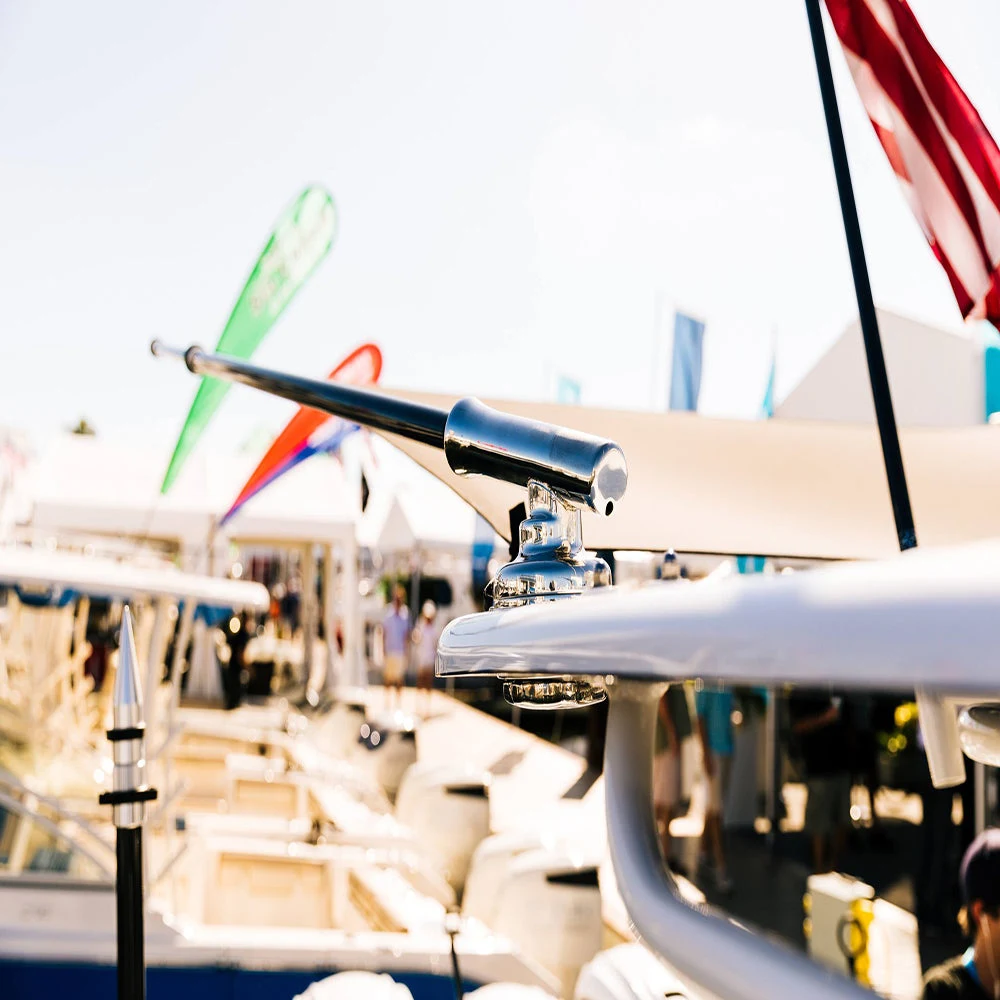
This pole belongs on a shortlist only as the answer to a question the 12-foot version has already failed. It runs the same Coastal base family in a 15-foot length, which buys more horizontal projection at a given mount angle, about 2.6 feet more than the 12-foot pole once both are compared at the same angle. That makes it useful for comparing spread geometry directly against the shorter Coastal poles and against TACO's 15-foot aluminum pole. Weight per pole is not published, and neither is an approved towing or trolling load.
| Material | Hybrid composite, same Coastal family construction description as the 12-foot pole |
|---|---|
| Nominal pole length | 15 ft |
| Format | Paired with Gemlux Coastal bases |
| Base family | Gemlux Coastal |
| Weight per pole | Not published |
| Approved towing or trolling load | Not established by the material description alone |
Source: Gemlux Coastal outrigger collection page, gemlux.com, checked September 12, 2026.
The extra 2.6 feet has to be earned
The price gap between the two Coastal lengths tends to look small, which is the worst possible reason to choose the longer pole. Extra length raises the same clearance and storage questions covered earlier in this guide, and here it does so without a published weight figure to evaluate the added load against.
Sketch where the release points actually sit at your intended mount angle, then work out how you will stow the longer pole at the end of a trip. If neither answer improves on the 12-foot system, the extra feet are cost without benefit.
A material description is not a load rating
The word hybrid on a product page establishes nothing about what the pole is approved to tow. If dredges or any load heavier than a standard trolling spread are part of the plan, that rating has to come from Gemlux or the installer in writing, for the exact pole, mount and installation.
Best for. An owner who has ruled out the 12-foot Coastal poles for their intended spread and whose mounting installation has been confirmed to support the longer pole.
Skip it if. That confirmation has not happened yet, or the only argument for the longer pole is the small price difference against the 12-foot pair.
When replacement poles alone make more sense
If your boat already carries approved, serviceable bases, buying poles alone can be the more sensible route rather than replacing the whole system. Identify the existing base and its condition first, then get written compatibility confirmation for the specific replacement poles and retention hardware you're considering. A pole that physically fits into the socket is not automatically the correct match: check the insertion arrangement, the locking mechanism and any approved adapter, not diameter alone.
Where each system sits on the length-versus-structure trade-off
| System | Pole length | Material | Weight per pole | Mount | Where it sits |
|---|---|---|---|---|---|
| TACO 15-ft Tele-Outrigger + GS-170 | 15 ft | Aluminum | 4 lb | GS-170, with documented structural mounting provisions | Longest documented projection reviewed here, paired with the most explicit structural homework before drilling |
| Gemlux Coastal 12-ft hybrid | 12 ft | Hybrid composite | Not published | Coastal base | Shortest projection of the three, and the most compact to handle, store and mount |
| Gemlux Coastal 15-ft hybrid | 15 ft | Hybrid composite | Not published | Coastal base | Matches the TACO pole's projection in a different material family, with weight and load figures the manufacturer hasn't published |
No system here gives you the longest reach and the smallest structural question mark at the same time. That trade is the point of laying these three out side by side, not a gap in the research: pick the row that matches the spread you calculated above, then take its structural and weight unknowns to the installer before you order.
Rig it so the small parts don't fail first
An outrigger system is more than the visible pole. TACO's separately listed standard rigging kit illustrates the role of the release clip, halyard material, stops and tensioning hardware that actually make the pole functional. See the TACO standard rigging kit.
| Component | Purchase check |
|---|---|
| Halyard | Correct material and length for the proposed rigging |
| Release clip | Suitable adjustment range and compatibility with your intended setup |
| Stops | Correct placement and secure attachment |
| Tensioning arrangement | Appropriate hardware, mounted somewhere you can actually reach it |
| Pole retention | The exact locking parts specified for your base |
| Storage provisions | A secure way to manage the poles and any loose rigging when they're not deployed |
Keep the fishing-line release and the pole retention conceptually separate, because they do different jobs. The release clip lets the fishing line leave its position when a fish takes the bait; the base has to keep retaining the pole the entire time, regardless of what the clip does. TACO describes that fishing-line release function directly in its trolling guidance; see the TACO Tele-Outrigger selection FAQ. There's no single tension figure worth printing here, because bait, lure, tackle and release hardware all differ; use the clip manufacturer's own adjustment procedure for your specific setup.
Check storage and trailering before you drill anything
A telescoping pole shortens for storage, but the finished boat still has a height, width and aft-clearance envelope once the poles are mounted, even collapsed. Measure that envelope with the system in its approved transport position before you commit to a location.
Check:
- The storage entrance and any overhead obstructions at your marina or garage
- Boat-cover fit with the poles mounted in their collapsed, stowed position
- Trailer parking clearance
- The route for removing and carrying detached poles, if that's part of your routine
- Where detached poles will be secured during transport
Follow the exact manufacturer's transport and underway instructions for your system. Guidance published for a specific Gemlux base does not authorize another maker's pole, or another maker's mount, to remain deployed while running; see the Gemlux outrigger installation guide. Write a short departure check into your normal boat checklist: poles secured, halyards contained, retention engaged. The details should reflect the specific system installed on your boat, not a generic photo from a product page.
What a complete outrigger quote should include
A complete quote covers both poles, both bases, any required structural support and adapters, complete rigging hardware, installation and an operating demonstration. Ask the seller to state exclusions explicitly. A low poles-only price is not directly comparable to an installed quote that includes fabrication, backing, sealing and the parts needed to actually fish the system.
Use a comparison sheet like this one rather than trusting a single unsupported "installed price" figure:
| Cost item | Quote A | Quote B |
|---|---|---|
| Pole pair and exact model | Record price | Record price |
| Base pair | Record price | Record price |
| Approved adapters and retention parts | Included or separate | Included or separate |
| Backing or structural work | Scope and price | Scope and price |
| Complete rigging | Contents and price | Contents and price |
| Installation and sealing | Scope and price | Scope and price |
| Operation and stowage demonstration | Included or separate | Included or separate |
If one quote reuses your existing bases and another replaces them, ask why directly. A lower quote can be perfectly sound, or it can be omitting work; the itemized scope is what tells you which question to ask the seller.
Do you actually need outriggers at all?
Not on every boat, and not for every trolling spread. If your normal trip runs a single line per side, or if the crossed-line problem shows up mainly on tight turns you could avoid by widening your turning radius or shortening the spread, a pair of rod holders angled further apart and a conservative single-line-per-side spread can solve the tangle that started this whole search, without the mount, backing and clearance questions a permanent outrigger installation adds to your boat.
Outriggers earn their cost and complexity once you're consistently running enough lines, or need enough separation between baits, that rod-holder angle alone can't keep them apart through a turn. If you're not there yet, the honest recommendation is to start with one outrigger line per side once you do install a system, prove the crew can clear it comfortably, and add complexity only after that. That's not the answer that sells a pole-and-base combination, but it's the one that keeps a 20-foot cockpit workable on the day you actually hook a fish.
Frequently asked questions
Can a 20-foot boat use 15-foot outriggers?
Potentially, but the pole length is the least important part of that question. TACO's published product range does include 15-foot poles for boats up to 30 feet, but that boat-size listing is not approval of your individual top or gunwale installation. Confirm the mounting structure and its load capacity with your installer before assuming a 15-foot system fits your specific boat.
What if my boat has no T-top?
Assess a manufacturer-supported gunwale mounting arrangement directly with your boat builder or installer. Confirm the structure beneath the intended mounting area and how the deployed poles will affect cockpit access before you buy anything, since a gunwale installation raises different structural and clearance questions than a T-top does.
Are the bases included with the poles?
Don't assume they are. Read the package contents on the specific listing and ask the seller for exact part numbers covering both poles and bases. The same caution applies to rigging kits and any backing or structural components; a "system" name on a product page doesn't guarantee every part ships in the box.
Can I pull a dredge from these poles?
Don't infer dredge approval from pole length or material alone. Obtain an explicit rating for the exact pole, mount and installation under your intended use before adding dredge loads to a system that was documented for a standard trolling spread. A published pole length says nothing about an approved towing load for heavier gear.
Will carbon or hybrid poles fix a weak T-top?
No. A material upgrade is not a structural approval, regardless of how the pole is marketed. Have the actual support problem assessed and corrected, or reinforced, before selecting replacement poles of any material. The mount check described earlier in this guide is the place to start.
Should I choose 12 feet if I usually fish alone?
It's worth comparing, but a shorter pole alone doesn't guarantee easier one-person operation. Run the control-reach test, the halyard retrieval and the storage sequence for the complete system before deciding length based on crew size alone; a 12-foot pole mounted somewhere awkward to reach solves nothing that a well-placed 15-foot pole wouldn't.
What's the best first purchase to make here?
Get the boat and top structurally assessed first, then compare a complete TACO aluminum quote against a complete Gemlux Coastal quote using the cost-item table above. Choose the approved arrangement that delivers the fishing positions your spread actually requires and an operating sequence your crew can manage comfortably underway, not the one with the longest pole on the spec sheet.
Final verdict
The number printed on an outrigger pole is not the spread it produces, and it is never the approval your top needs before a base goes on it. TACO's 15-foot Tele-Outriggers with a GS-170 mount are the strongest documented aluminum starting point once that structural approval is confirmed; the Gemlux Coastal 12-foot hybrid poles are the better call for a tighter cockpit or lighter handling; the Coastal 15-foot poles belong on the shortlist only once the shorter system has been ruled out for your intended spread. Run the projection math and the mount check before you compare a single price, and remember that a rod-holder spread and a single line per side can solve the crossed-line problem plenty of 20-foot boats never actually need a permanent outrigger installation to fix.
Related reading
Sources
Specifications on this page were taken from manufacturer product and installation pages, consulted September 12, 2026. Prices and specifications change; confirm current figures before buying.
- TACO Tele-Outrigger selection FAQ and general sizing guidance, tacomarine.com/product-knowledge/faq/tele-outrigger-selection, checked September 12, 2026
- TACO OT-series aluminum outrigger pole specifications, tacomarine.com/sport-fishing-outrigger-poles-ot-series, checked September 12, 2026
- TACO GS-170 (Grand Slam 170) mount installation instructions, tacomarine.com, checked September 12, 2026
- TACO standard rigging kit RK-0001SB, tacomarine.com/sport-fishing-rigging-kits-rk-0001sb, checked September 12, 2026
- Gemlux Coastal boat outriggers collection, gemlux.com/collections/coastal-boat-outriggers, checked September 12, 2026
- Gemlux Coastal 12-foot outrigger pole product page, gemlux.com/products/9172, checked September 12, 2026
- Gemlux outrigger installation guide, files.gemlux.com, checked September 12, 2026
Join The ReefReady Community
Get saltwater Fishing Guides, expert Buyers Guides, equipment recommendations, marine electronics insights, and practical gear tips delivered to your inbox.
No spam. Unsubscribe in one click.