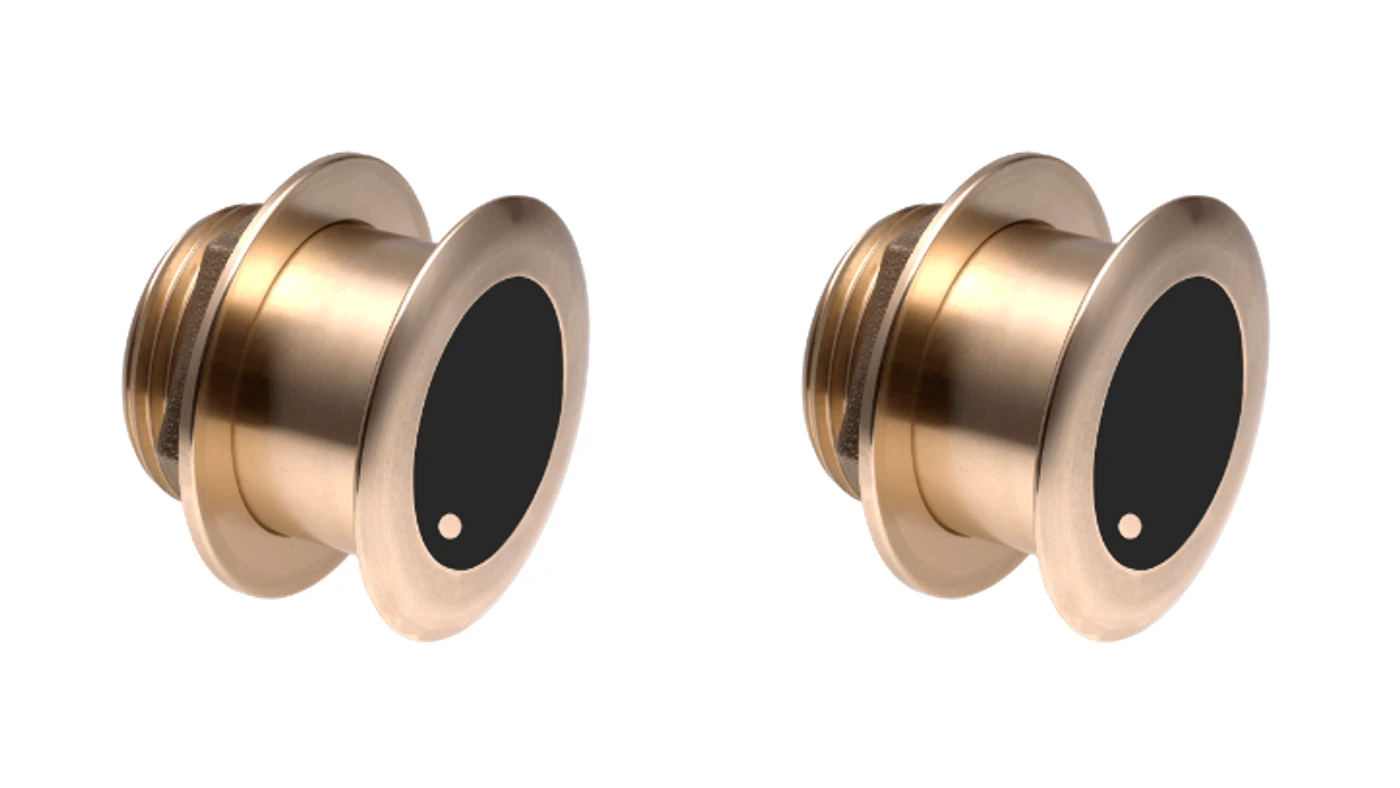
Airmar B175HW vs B175M: Choose by Depth, Beam Coverage and Fishing Task
These transducers can look similar while answering different fishing questions. Compare their beam coverage and documented depth limits before choosing the connector and tilt for your boat.
The quick answer
Choose B175HW for broader coverage within its stated depth envelope. Choose B175M for medium-band work with a narrower footprint and a deeper published ceiling. Neither specification proves a universal image-quality advantage; the fishing task and supported installation decide the shortlist.
Affiliate disclosure: As an Amazon Associate I earn from qualifying purchases. Read the disclosure. Amazon links on this page are model searches; match the exact package before ordering.
Quick picks
How we chose
Research basis: This is a researched buying guide, not a hands-on test. Manufacturer documents support specifications; recommendations and evaluation routines are editorial judgments. No matched sea trial or catch comparison is claimed. Exact regional offers and installation compatibility still need checking before purchase. About ReefReadyGear and its editorial standards.
- Compare the complete installation against the intended fishing job.
- Keep published limits separate from demonstrated performance.
- Identify compatibility and evidence gaps before making a purchase.
Find your situation
| Your priority | Starting point | Verify before buying |
|---|---|---|
| Wide coverage in the upper water column | Airmar B175HW | Working depth, sounder support and hull tilt |
| Medium CHIRP and deeper regular work | Airmar B175M | Connector, tilt and results at the intended depth |
These are editorial starting points. The detailed sections below explain the evidence and limits.
Specifications that matter
| Option | Published specification | Purchase check |
|---|---|---|
| Airmar B175HW | 1 kW; 150–250 kHz; fixed 25° beam; published maximum 500 feet | Working depth, sounder support and hull tilt |
| Airmar B175M | 1 kW; 85–135 kHz; 16°–11° beam; published maximum 1,500 feet | Connector, tilt and results at the intended depth |
Specifications: Airmar B175HW; Airmar B175M. Maximum figures are manufacturer claims, not results measured for this guide.
Products in detail
Airmar B175HW
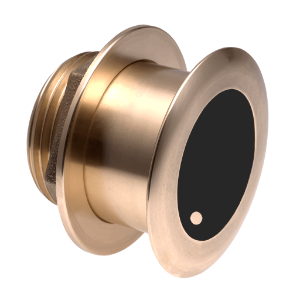
Check B175HW 20° — cable required
Model search, not a verified offer. Check the seller, exact components and availability.
The B175HW is a high-wide transducer with a fixed 25-degree beam. Airmar lists a 500-foot maximum. That makes it a candidate for covering bait and suspended targets within that envelope, rather than a general answer to every offshore depth. The bronze housing is specified for fiberglass or wood hulls.
Manufacturer specifications and package information
Pros
- The constant beam angle makes coverage calculations straightforward.
- A low-profile tilted-element installation avoids an external fairing.
Trade-offs
- Its published 500-foot limit does not cover regular bottom fishing at 600 feet.
- A broad footprint is not a measurement of target separation.
Buying verdict: Choose it when wide coverage is the priority and your regular fishing depth fits the published specification.
Airmar B175M
Check B175M 0° — cable required
Model search, not a verified offer. Check the seller, exact components and availability.
The B175M uses medium CHIRP with a beam that varies from 16 to 11 degrees across its band. Airmar lists a 1,500-foot maximum. Its narrower footprint and different frequency band make it a different tool from the B175HW, even though both belong to the same low-profile housing family.
Manufacturer specifications and package information
Pros
- A published depth ceiling beyond the B175HW’s 500-foot figure.
- Tilted-element variants allow the installer to account for hull deadrise.
Trade-offs
- Less geometric coverage than the high-wide model at an equal depth.
- The maximum-depth figure does not guarantee useful fish marks near that limit.
Buying verdict: Start here for medium-band work; require installation and local-depth evidence before treating the stated ceiling as your everyday result.
Compare coverage at the same depth
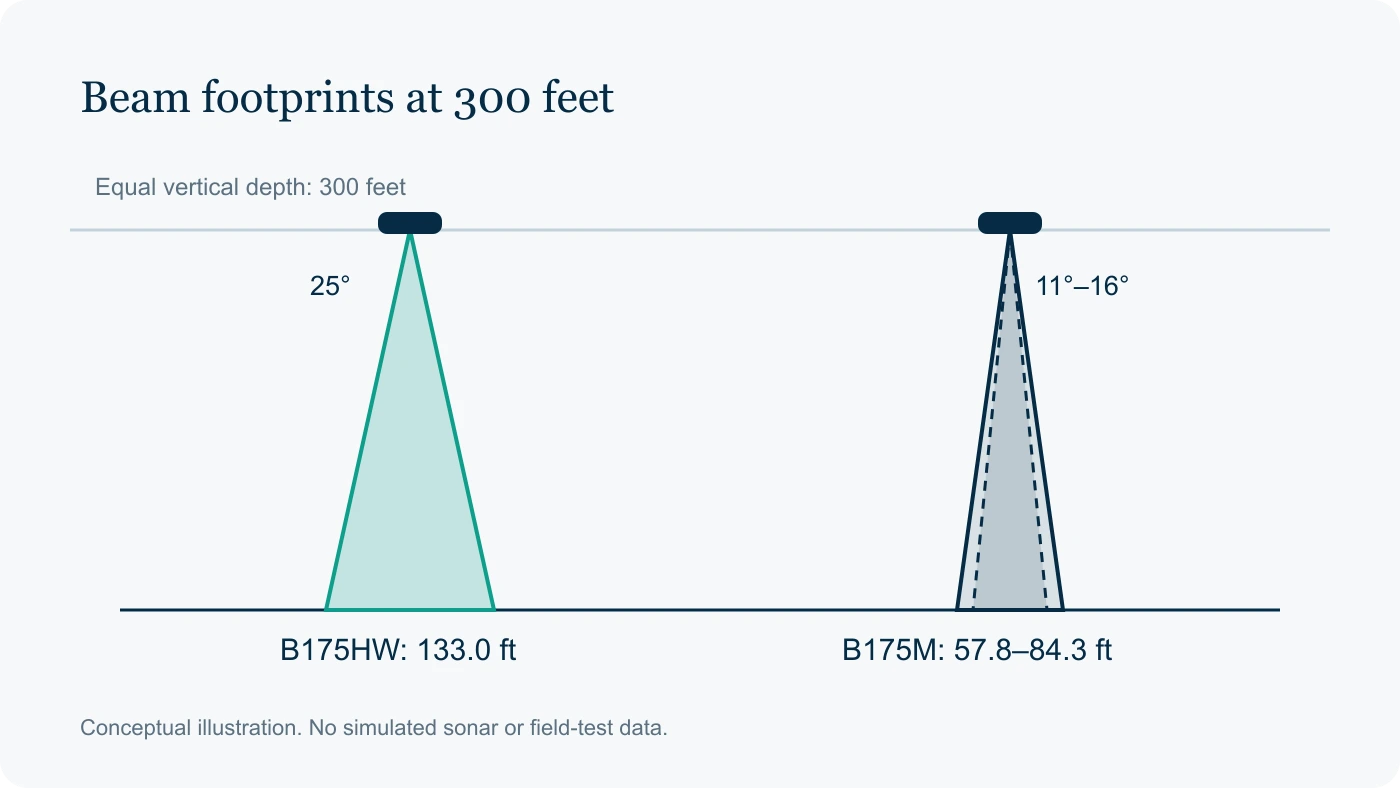
Use an ideal cone calculation: width = 2 × depth × tan(beam angle ÷ 2). At 300 feet, B175HW’s 25-degree cone is approximately 133 feet wide. The 11- to 16-degree endpoints associated with B175M give roughly 58 to 84 feet.
These are geometric widths at a horizontal plane, rounded to whole feet here. They are not measured detection areas. Airmar’s medium-band angle varies with frequency; do not present the two endpoints as simultaneous fixed cones or assume identical sensitivity across either footprint.
What the available evidence establishes
The linked specifications identify the equipment and its stated limits. They do not establish a controlled performance comparison on your boat. Use the suggested checks to resolve the purchase decision, and keep any future observations tied to their settings and conditions.
Separate the published limit from the regular task
Airmar lists 500 feet for B175HW and 1,500 feet for B175M. The difference makes depth an early screening question, but it does not demonstrate how a particular fish or small structure will appear near either ceiling.
For wide bait search in the upper water column, the high-wide geometry may be a relevant reason to shortlist HW. For deeper routine work, the medium-band option belongs in the discussion. State the actual target depth and task before using either recommendation.
Supporting documents: Exact high-wide specifications and installation choices; Exact medium-band specifications and installation choices; Cross-check beam and tilt information.
Order the exact variant the boat requires
The sounder must support the chosen band and transducer connection. Confirm the connector or adapter, cable length and model identification before purchase. Similar product photographs and a shared nominal power rating do not establish interchangeability.
Have the installer determine deadrise at the intended mounting position and check hull material, clean-water access and service space. Use the relevant Airmar dimensions and installation documents for the actual version. A replacement should not be assumed to fit an existing hole or cable arrangement without checking.
- Fishing task: Wide search or more depth-focused work.
- Compatibility: Supported band, connector and adapter.
- Hull work: Material, tilt, dimensions and cable route.
Compare ownership cost with the same scope
A transducer-only price leaves out adapters, mounting work, sealants and labor, and may leave out a sounder upgrade. Ask whether the existing display and module can be retained with documented support.
Use the worksheet to compare two completed installations. If the present system already answers the fishing question, include retaining it as a valid option rather than assuming one of these transducers must replace it.
| Record | What to check |
|---|---|
| Fishing task | Wide search or more depth-focused work |
| Compatibility | Supported band, connector and adapter |
| Hull work | Material, tilt, dimensions and cable route |
| Finished cost | Parts, labor and required sounder changes |
Buying Verdict
Choose it when wide coverage is the priority and your regular fishing depth fits the published specification.
Start here for medium-band work; require installation and local-depth evidence before treating the stated ceiling as your everyday result.
Does the wider beam find more fish?
It covers a larger ideal area at the same depth, but geometry alone does not establish a catch or detection result. Target strength, position and conditions still matter. Use the calculation to understand coverage rather than converting it into an unsupported performance percentage.
Should you install both?
Only after checking that the sounder, channels and mounting arrangement support the intended use. Price the complete arrangement and identify the distinct task each transducer serves. Two purchases are not automatically better than one well-matched installation.
Frequently asked questions
Should you choose B175HW or B175M?
Choose from your regular target depth and whether wider coverage or a different depth capability matters more to your fishing. Check Airmar’s exact specifications for both models before deciding. Then verify sounder support, hull suitability, tilt and connector. Treat the recommendation as a use-case fit rather than a claim of universal superiority.
Does the B175HW’s wider beam mean greater depth?
Beam width describes coverage geometry, not a guarantee of deeper operation. Compare the two models’ documented frequency bands and depth claims separately. A larger footprint at a stated depth does not establish better target separation or reliable detection everywhere inside the cone. Use calculated coverage to explain geometry, then use real evidence for performance.
What should you confirm before ordering either transducer?
Record the sounder model, supported transducer configuration, hull material, measured deadrise and required connector. Check the selected tilt and cable route against the installation manual. Include any adapter and labor in the quote. Do not assume two similar housings or matching plug shapes establish full compatibility with your existing electronics.
Final verdict
Before ordering, resolve working depth, sounder support and hull tilt for Airmar B175HW, or connector, tilt and results at the intended depth for Airmar B175M. Choose the documented installation that answers your regular fishing requirement. Leave the purchase open if a required compatibility or performance question remains unresolved.
Related reading
Sources
Manufacturer specifications and supporting documents. Consult the exact regional part number and manual before purchase.