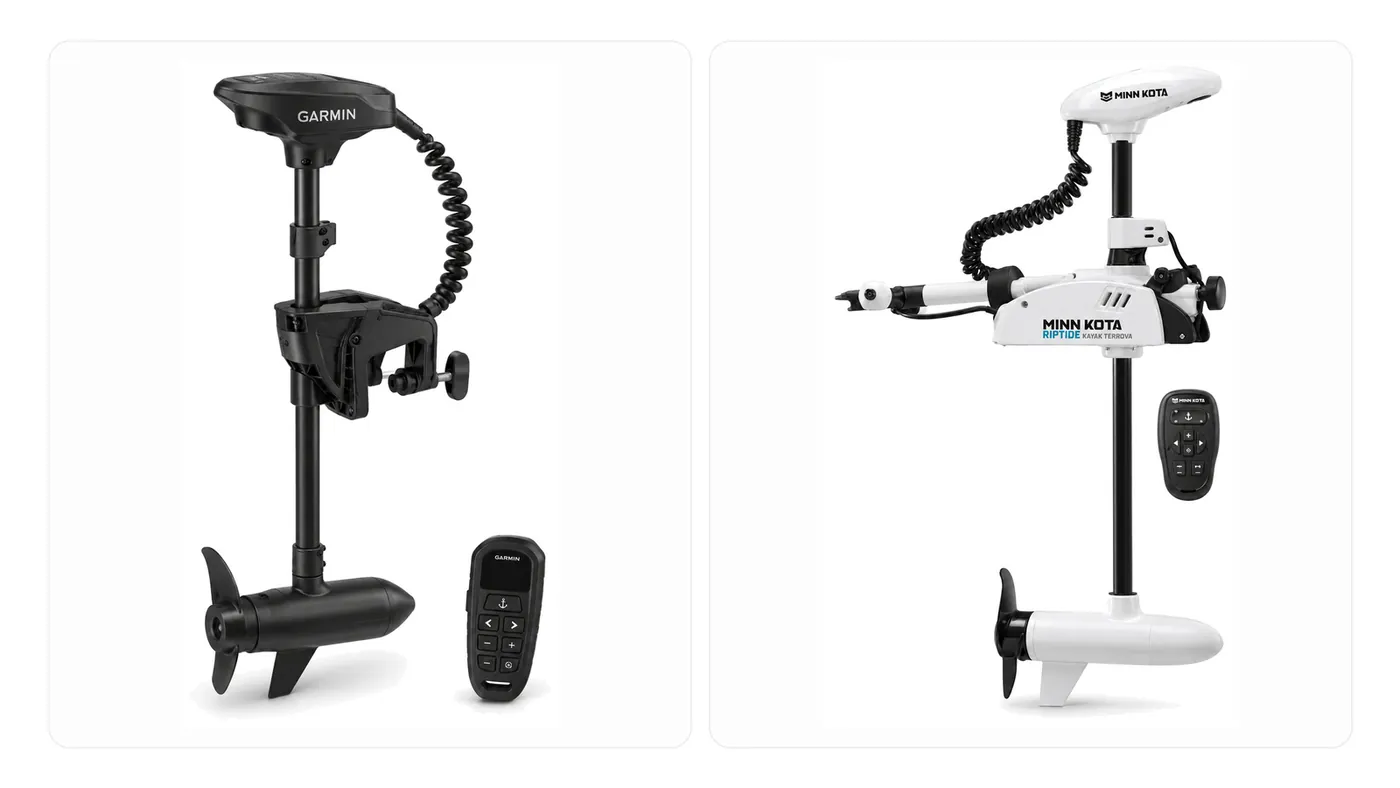
Best Saltwater Spot Lock Trolling Motors for Kayaks: Only Two Really Qualify
There’s a specific moment this article exists for. You’re sitting on a reef edge with a rod bent, the tide is moving, and you have no way to anchor. Structure below means you can’t drop a hook…
The quick answer
GPS anchoring is the feature anglers are actually shopping for when they search for a kayak trolling motor, and most products marketed into that search do not have it. A thrust number without its voltage attached tells you nothing, because the same motor can be a 50 lb motor or a 30 lb motor depending on how it is wired.
For most kayak anglers, the Minn Kota Riptide Kayak Terrova is the better starting point. It delivers 55 lb of thrust from a single 12V battery for $1,899.99, with Spot-Lock, Autopilot and Drift Mode built in. The Garmin Force Current is the premium option at $2,999.99, with multi-band GPS precision and a shaft that adjusts from 11.4 to 16.6 inches for a kayak’s low freeboard, but it needs a 24V system to reach its full 50 lb of thrust. At 12V it makes 30 lb, which is 25 lb less than the Minn Kota on the same battery voltage. Decide your battery budget first. The motor should follow it, not the other way around.
See both motors in full spec below, and the head-to-head comparison in our Garmin Force Current vs. Minn Kota Kayak Terrova guide.
Affiliate disclosure. Affiliate disclosure: ReefReadyGear earns a commission on some links below at no extra cost to you. We don’t accept payment for placement, and every product here was selected on published specifications and expert and owner feedback. Specifications verified September 2026.
What qualifies as spot lock, and what does not
A motor earns a place here only if it holds a GPS position without an anchor, is rated for salt water and fits a kayak’s shaft and mounting reality. Powerful electric motors without a positioning function are a different product class, and this page says so rather than blending the two.
Quick picks
 Best for most kayak anglers
Minn Kota Riptide Kayak Terrova
55 lb thrust on one 12V battery
 Best integration with Garmin electronics
Garmin Force Current
Anglers already running Garmin chartplotters
Not a spot lock motorNewport NK300 HD
Propulsion only, no positioning function
On this page
- The quick answer
- Quick picks
- How we chose
- What actually qualifies
- The two that qualify
- The voltage trap
- What the whole system costs and weighs
- Does GPS anchor hold in current?
- Shaft length on a kayak is not shaft length on a boat
- Mounting it without wrecking your hull
- The compromise options
- Saltwater care
- Do you still need the pedal drive?
- Frequently asked questions
- Final verdict
- Related reading
- Sources
How we chose
ReefReadyGear does not run a testing programme, and nothing on this page is presented as a first-hand test result. Every figure here is drawn from manufacturer and builder documentation, authorised retailer listings and published angler experience, verified in September 2026 and dated where it matters. Where a number is our calculation rather than a published figure, we label it and show the method.
- Category defined before products were chosen: saltwater rated, GPS position holding, kayak-appropriate shaft and mount
- Thrust always quoted with its voltage, since the same motor produces different figures at 12V and 24V
- Total system cost priced out, including the battery each motor requires rather than the motor alone
- Shaft length checked against kayak deck height using the published 12 to 18 inch propeller depth method
Where two authoritative sources disagree, both are quoted and attributed rather than blended, and where a maker publishes no figure at all we say so instead of estimating quietly.
There’s a specific moment this article exists for. You’re sitting on a reef edge with a rod bent, the tide is moving, and you have no way to anchor. Structure below means you can’t drop a hook without risking a snagged rode you’ll have to cut. The current is pushing you off the spot every fifteen seconds, and paddling back into position between casts is how you lose the bite instead of catching it. A GPS anchor motor is built for exactly that problem, and it’s the single most expensive accessory most saltwater kayak anglers will ever buy.
So this is where the trouble starts. Search for the best saltwater spot lock trolling motor for a kayak and you’ll find freshwater bass boat motors, discontinued models, and propulsion-only units with no GPS anchoring at all, all recommended as though they solve the same problem. Some of that content hasn’t been updated since the biggest launch in the category’s short history.
Here’s the filter this article applies, and it’s the reason the list is short. A product has to be rated by its manufacturer for salt water, hold position using genuine GPS anchoring rather than heading hold alone, and be sized and shafted for a kayak instead of a boat. As of September 2026, exactly two products on the market pass all three tests. That’s not a hedge or an oversight. It’s the honest shape of this category right now, and padding the list to seven would make this page less useful, not more.
What follows is the full system, not just the motor: what battery each one needs, what the complete rig costs and weighs, whether GPS anchoring actually holds in moving current, and how to get the shaft length right on a hull with almost no freeboard. That last part trips up more installs than anything else, and it has nothing to do with which motor you buy.
What actually qualifies
Three criteria decide whether a motor belongs in this list at all, and each one exists because a competing page routinely fails it.
- Manufacturer-rated for salt water. Not “works in salt water if you rinse it,” but rated for it. Freshwater bow-mount motors fitted to a saltwater kayak corrode faster than their design accounts for, and it’s typically a warranty violation on top of the corrosion problem.
- Genuine GPS position holding. Heading hold, which keeps the bow pointed a direction, is not the same thing as spot lock, which holds a fixed GPS position against drift. A motor that only does the first does not answer this query, no matter how often it shows up in results for it.
- Sized and shafted for a kayak. A boat-length shaft on a kayak either won’t reach the water correctly or puts the prop absurdly deep. A boat-class motor’s weight and mount also assume a fiberglass or aluminum hull with a battery compartment, not a rotomolded deck with a payload budget measured in pounds.
Run every product currently marketed against a “spot lock kayak” search through those three filters and two survive: the Garmin Force Current and the Minn Kota Riptide Kayak Terrova. Everything else fails at least one test, and the section below on compromise options names exactly which one, because silently excluding a product a reader has already heard of is less useful than explaining why it didn’t make the cut.
The two that qualify
Minn Kota Riptide Kayak Terrova — Best for most kayak anglers
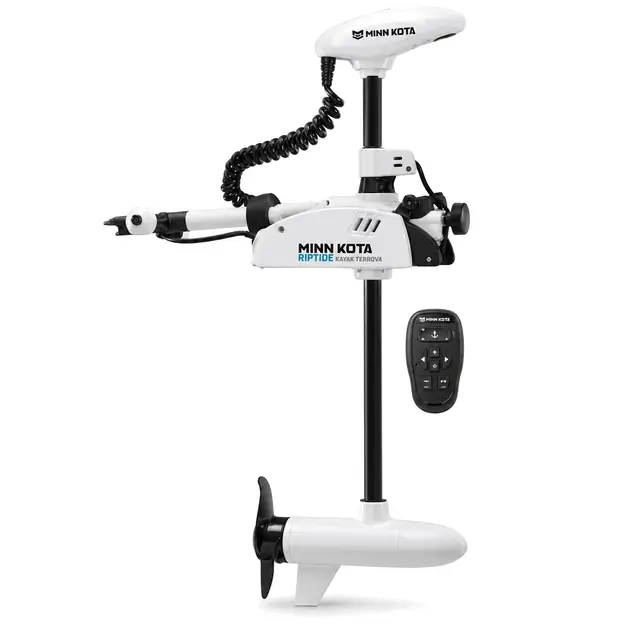
| Voltage | 12V |
|---|---|
| Thrust | 55 lb |
| Shaft length | 36 inches, composite |
| GPS features | Spot-Lock, Autopilot, Drift Mode, Follow Mode |
| Control | Micro Remote, One-Boat Network app, Humminbird integration |
| Corrosion protection | Grit-blasted aluminum-coated lower unit |
| Propeller | Weedless |
| Deployment | Stow-and-deploy lever |
| MSRP | $1,899.99 |
| Availability | From October 15, 2025 |
Best for
Anglers who want the most thrust for the simplest, lightest, least expensive battery system, and who fish primarily nearshore reefs, jetties and grass flats rather than treating precision boat control as the primary feature.
Key features
The number that matters most here is 55 lb of thrust from a single 12V battery. That’s more thrust than the Garmin Force Current makes at either of its voltage settings, on the simplest and cheapest power system available. Spot-Lock holds a GPS position, Autopilot holds a heading, and Drift Mode slows an assisted drift across structure rather than fighting it entirely, which is genuinely useful for working a grass flat or a bait school without repositioning every cast. The 36 inch composite shaft is purpose-built for a kayak’s low freeboard rather than adapted from a boat platform, and the stow-and-deploy lever lets you bring the motor up out of the water without leaving the seat, which matters more than it sounds like it should when you’re managing a rod, a paddle and a moving current at the same time. Minn Kota’s grit-blasted aluminum-coated lower unit is the brand’s specific answer to saltwater corrosion, and it’s a documented, purpose-built coating rather than a marketing claim with no process behind it.
Advantages
- 55 lb of thrust on a single 12V battery, the most thrust per volt in this category
- Lower total system cost than the Force Current by roughly $1,100, before batteries
- One battery instead of two, which is real weight and deck space saved
- Weedless prop and stow-and-deploy lever suit grass flats and structure fishing
- Humminbird integration if you already run that electronics ecosystem
Limitations
- Single-band GPS is less precise than the Force Current’s dual-frequency system, and in current you’ll notice it as slightly wider drift correction
- 36 inch shaft is fixed rather than adjustable, so mounting height needs to be right the first time
- No foot pedal or floating remote option, only the handheld Micro Remote
- Released October 2025, so long-term saltwater durability data is still accumulating
Real-world application
This is the motor for a bay boat sized down, holding a jetty edge in moderate current, working a grass flat on Drift Mode instead of paddling a repeated drift line by hand, or sitting on a bridge piling waiting on a tide change. The single 12V battery keeps total rigged weight down, which matters on a hull where every pound comes out of payload.
Who should buy it
Anglers who want the most thrust for the least battery weight and cost, who are comfortable with a fixed shaft length correctly measured before purchase, and who don’t need the Garmin’s GPS precision or adjustable shaft badly enough to pay $1,100 more for them.
Who should avoid it
Anglers running deep chop offshore who want the tightest possible GPS hold precision, and anyone whose kayak’s mounting height doesn’t suit a 36 inch fixed shaft without modification.
Garmin Force Current — Best integration with Garmin electronics
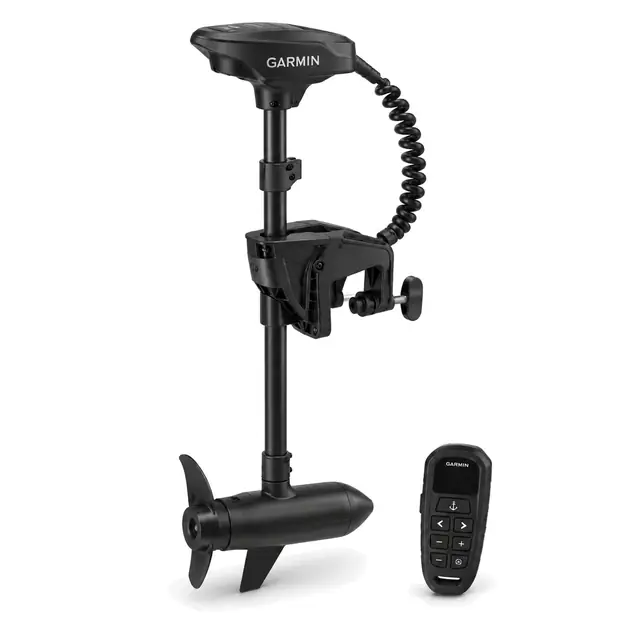
| Voltage | 24V (50 lb thrust) or 12V (30 lb thrust) |
|---|---|
| Thrust rating | ISO 13342, high-efficiency propeller |
| Shaft length | Adjustable, 11.4 to 16.6 inches |
| Water rating | Fresh, brackish and salt water |
| GPS features | Dual-frequency GPS anchor lock, autopilot, route following, heading hold, cruise control |
| Remote | Floating wireless, 1.2 inch color display, IPX7 rated |
| Price | Approximately $2,999.99, or $3,599.99 with Power Steer foot pedals |
Best for
Anglers who want the tightest GPS hold precision available on a kayak-scale motor, and whose kayak’s deck height suits a short, adjustable shaft better than a fixed 36 inch one.
Key features
Dual-frequency GPS is the headline capability. It reads position more precisely than a single-band receiver, which translates directly into a tighter, less wandering anchor hold, especially in current where correction quality matters most. The adjustable 11.4 to 16.6 inch shaft is arguably the more practically important feature for kayak anglers: it lets you dial in the exact prop depth for your specific hull’s freeboard instead of committing to one fixed length at purchase. The floating wireless remote with an IPX7 rating and a 1.2 inch color display gives you route following, cruise control and heading hold from a compact controller that won’t sink if it goes overboard. The tradeoff for all of this is thrust economics: 50 lb of thrust requires 24V, meaning two batteries wired in series, and the same motor wired to a single 12V battery drops to 30 lb, 25 lb less than the Minn Kota on the identical single-battery system.
Advantages
- Dual-frequency GPS gives the tightest anchor hold precision in this category
- Adjustable 11.4 to 16.6 inch shaft fits a wider range of kayak freeboard without a fixed commitment
- Floating IPX7 remote survives going overboard
- Rated across fresh, brackish and salt water in one product line
- Route following and cruise control add capability beyond simple position holding
Limitations
- Full 50 lb thrust requires a 24V system, meaning two batteries, more weight and more cost
- At 12V, thrust drops to 30 lb, 25 lb less than the Minn Kota on the same single battery
- Roughly $1,100 more than the Riptide Kayak Terrova before batteries
- Frequently dealer-only, so confirm availability and lead time before planning around it
Real-world application
This is the motor for an angler who has already decided to run a 24V system, values the tightest possible GPS lock on a reef edge in moving current, and has a kayak whose mounting height doesn’t line up neatly with a 36 inch fixed shaft. The adjustable shaft and dual-frequency GPS are genuine, measurable advantages. They just aren’t free, in dollars or in battery weight.
Who should buy it
Anglers who want the best available GPS precision on a kayak, who are willing to commit to a 24V battery system for full thrust, and whose kayak’s freeboard benefits from a shaft that adjusts rather than one that’s fixed at 36 inches.
Who should avoid it
Anyone budgeting a single 12V battery, since the Force Current gives up 25 lb of thrust against the Minn Kota under that exact condition. Anyone for whom $1,100 and a second battery aren’t worth GPS precision they may not need on a nearshore reef edge in light current.
For the full like-for-like breakdown of these two motors, including hold behavior, remote comparison and total cost across battery configurations, see our companion Garmin Force Current vs. Minn Kota Kayak Terrova head-to-head. This roundup summarizes; that article is where the deep comparison lives.
The voltage trap
On a kayak, 12V is usually the better choice. A single 12V lithium battery is lighter, cheaper and takes less deck space than a 24V pair, and payload is the constraint that governs almost every other decision on a kayak build. The Garmin Force Current makes 50 lb of thrust at 24V but only 30 lb at 12V, so choosing the lighter, cheaper voltage on that specific motor costs 40 percent of its rated thrust.
Lay the numbers side by side and the trap becomes obvious:
| Configuration | Thrust | Battery system |
|---|---|---|
| Force Current at 24V | 50 lb | Two 12V batteries in series, or one 24V pack |
| Force Current at 12V | 30 lb | One 12V battery |
| Riptide Kayak Terrova | 55 lb | One 12V battery |
The same Garmin motor is a 50 lb motor or a 30 lb motor purely depending on how it’s wired, and the cheaper Minn Kota beats both of those figures while running on the simpler, single-battery system. If thrust per battery dollar is the whole decision, the Minn Kota wins it clearly.
It isn’t the whole decision, though, and it’s worth being fair to Garmin here. Dual-frequency GPS, an adjustable shaft built specifically for the range of freeboard heights kayaks come in, and a floating remote are real capabilities that a single thrust number doesn’t capture. An angler who values hold precision on a moving reef edge more than raw thrust may reasonably pay the $1,100 premium and accept the 24V system that comes with it.
Decide the voltage before the motor. On a kayak, the battery system is the actual constraint, in cost, weight and deck space. Pick the voltage tier your build can support first, then choose the motor that fits it, rather than falling for a headline thrust number that assumes a battery configuration you haven’t budgeted for yet.
What the whole system costs and weighs
The motor is not the purchase. The purchase is the motor, the battery, the mount, the charger and the wiring, and on a kayak every one of those items comes out of a payload budget measured in a few hundred pounds rather than a boat’s dedicated battery compartment.
| Component | Riptide Kayak Terrova system | Force Current system (24V) |
|---|---|---|
| Motor | $1,899.99 | $2,999.99 |
| Battery | One 12V 100Ah LiFePO4, approx. $700, 27.5 lb | Two 12V 100Ah LiFePO4, approx. $1,400, 55 lb |
| Mount and hardware | Approx. $150, 4 lb | Approx. $150, 4 lb |
| Charger | Approx. $150, 2 lb | Approx. $300 (dual-bank), 3 lb |
| Wiring and connectors | Approx. $60, 1 lb | Approx. $90, 1.5 lb |
| Total | Approx. $2,960, 34.5 lb (plus motor weight) | Approx. $4,940, 63.5 lb (plus motor weight) |
Motor weights and exact battery capacity needs vary by build and should be confirmed against current manufacturer specifications before purchase; the battery line above uses a 100Ah pack as a comfortable full-day reference point, matching the sizing used in our big anglers load stack. The pattern that matters is the gap: the 24V Force Current system costs roughly $2,000 more and weighs roughly 30 lb more in batteries alone, before the motor’s own weight is added.
What that costs you in payload. A trolling motor system in the 60 to 100 lb range, once the motor itself is included, is a meaningful bite out of most saltwater kayaks’ usable capacity. Our big anglers offshore kayak guide covers the full method for calculating a kayak’s real usable payload (rated capacity minus fully rigged hull weight), and it applies directly here: work out your hull’s usable capacity first, then check whether a 12V or 24V motor system still leaves room for your rods, tackle, safety gear and the fish on the way home. On a kayak with 350 to 450 lb of usable capacity, a 24V system consuming 90-plus pounds before you’ve stepped aboard is a materially different proposition than a 12V system consuming roughly 60.
Does GPS anchor hold in current?
Yes, within limits, and the limits are the part nobody explains clearly. GPS anchoring is a closed correction loop, not a fixed mooring. The motor’s onboard GPS detects that the kayak has drifted from its saved position, calculates a correction, applies thrust to push back toward that position, and repeats the cycle continuously. Hold quality is bounded by how much thrust is available relative to the combined force of current, wind and chop working against it.
That has a direct, practical consequence: hold performance degrades progressively as current increases, rather than failing suddenly. In light current, the kayak barely appears to move, correcting so quickly and by such a small margin that it looks locked in place. As current builds, you’ll notice the boat start to swing gently off the mark before correcting. Push further and it begins to walk visibly, drifting further before the motor pulls it back. Past a certain point, thrust simply can’t out-muscle the current, and the boat loses station entirely rather than holding a slightly looser position.
A kayak’s low mass changes how this feels compared to a bass boat. A lighter hull gets pushed off station faster by the same current, but it also responds faster once the motor corrects, so the hold behavior on a kayak reads differently from a boat rather than simply reading as worse. Anglers coming from boat experience with spot lock sometimes read this quicker, twitchier correction as the system malfunctioning. It isn’t. It’s physics doing exactly what you’d expect on a lighter platform.
Two other factors quietly worsen hold over the course of a day. Battery voltage sags as the pack depletes, which reduces the thrust actually available late in a trip compared to what you had on the first cast that morning, so a spot that held rock solid at 7 a.m. may drift more by 3 p.m. on the same battery. And prop ventilation, where the propeller draws air instead of biting clean water in chop, is one of the most common real-world causes of poor hold on a kayak, and it’s a shaft length problem rather than a motor problem, which is exactly what the next section covers.
A note on how we’re presenting this. We haven’t run controlled current-strength tests against these motors ourselves. The framework above (thrust available against current strength as the governing variable, and progressive rather than sudden degradation) is our editorial model, built from how GPS correction loops function and from owner reports in kayak fishing forums describing exactly this behavior. Treat it as a reasoned explanation of the mechanism, not a lab-tested performance claim.
Do not treat GPS anchoring as a substitute for a genuine anchor in a running tide near hard structure. It is a positioning aid with a power budget, and that budget runs out well before an anchor rode would.
Shaft length on a kayak is not shaft length on a boat
This is the single most common and most avoidable installation mistake in this category, and it has nothing to do with which motor you buy.
The method itself is simple and it’s the same one used across the trolling motor industry generally: measure from the mounting surface down to the waterline, then add 12 to 18 inches so the propeller runs well below the surface even in chop. When your calculation lands between two available shaft lengths, choose the longer one. A shaft that’s slightly too long is a minor inconvenience. A shaft that’s too short costs you thrust and hold quality every single trip.
- Measure the vertical distance from where the motor mounts (bow deck, gunwale track or dedicated mount plate) straight down to the waterline with the kayak loaded the way you’ll actually fish it.
- Add 12 inches as the minimum target propeller depth below the surface, or up to 18 inches if you regularly fish in chop or a running tide.
- Compare the result against the shaft options available. The Riptide Kayak Terrova ships with a fixed 36 inch composite shaft, so confirm your mounting height suits it before buying. The Force Current adjusts from 11.4 to 16.6 inches, which covers a wider range of kayak deck heights without a fixed commitment.
- If your number falls between two available lengths, go longer. A shallow prop causes real, repeated problems. A slightly deep one rarely causes any.
Why does the kayak number come out so much smaller than a boat’s? Freeboard. A center console might mount a motor four or five feet above the waterline. A kayak’s bow deck typically sits well under two feet above it, sometimes closer to one. Run the same “12 to 18 inches of prop depth” rule on that much lower mounting surface and you get a dramatically shorter shaft than any boat spec sheet would suggest, which is exactly why the Force Current’s adjustment range tops out under 17 inches and why the Riptide Kayak Terrova’s fixed shaft is only 36 inches total rather than the 42-inch-plus lengths common on boat-class motors.
A shallow-set propeller ventilates in chop, meaning it draws air instead of biting clean water. When that happens you’ll read it as a weak motor or a failing GPS lock. It’s neither. Ventilation kills thrust instantly and intermittently, drains the battery faster because the motor is working against an unstable load, and degrades anchor hold precisely because the correction loop needs consistent thrust to function. Get the shaft length right the first time and this entire failure mode disappears.
Mounting it without wrecking your hull
Where the motor physically attaches matters almost as much as which motor you chose, and it’s the part of the install a spec sheet won’t warn you about.
Bow mounting is the most common configuration and mirrors how these motors work on a boat, giving the most intuitive steering feel and the clearest sightline to structure ahead. It also puts the most weight furthest from your seat, which changes trim and increases windage on a hull that’s typically light to begin with. Stern mounting keeps weight closer to your body and reduces the trim change, but sightlines and steering feel are less intuitive, and cable routing to a bow-mounted remote gets longer. Gunwale or track mounting works on kayaks with accessory track systems already installed, and it’s usually the least structurally demanding option since it distributes load across an existing rail rather than a single deck point.
Whichever position you choose, a rotomolded polyethylene deck was not engineered to be a structural mounting point on its own. A 20-plus pound motor cantilevered off a bow well, especially one that’s also absorbing wave impact, needs a backing plate spreading the load across a wider area than the mount’s bolt pattern alone provides, not just bolts driven straight into the hull. Confirm your specific kayak has the deck area, track length and factory mounting provisions the motor’s hardware assumes; not every hull that “can technically hold a trolling motor” was designed with one in mind.
A quick pre-install checklist:
- Confirm deck or track real estate matches the mount’s footprint before ordering hardware
- Add a backing plate on any bow-well or unsupported deck mount
- Route cabling with strain relief, away from foot traffic and scupper holes
- Expect a measurable trim and windage change with weight added forward, and test it in calm water before your first real trip
- Re-torque all mounting hardware after the first few outings, since a new install settles
The compromise options
Every product a bad listicle lists under this search term belongs somewhere. It just isn’t here. This table names the exact compromise each one carries.
| Product | What it’s good at | The exact compromise | Who it actually suits |
|---|---|---|---|
| Newport NK300 HD and similar electric outboards | 110 lb thrust, genuine range and speed, 36V system | No GPS anchoring of any kind. It’s a propulsion motor, not a position-holding motor | Anglers who need to cover distance or get home, not hold a spot |
| Bixpy jet motors | Light, modular, mounts easily on a very light hull | No GPS anchoring | Anglers prioritizing minimal weight and simple propulsion over position holding |
| Freshwater bow-mount motors fitted to a kayak | Lower upfront price than a purpose-built saltwater unit | Faster corrosion, and typically voids the manufacturer’s saltwater warranty coverage entirely | Nobody fishing salt water regularly. It’s a false economy |
| Full-size saltwater boat motors (Riptide Instinct, Garmin Force Kraken) | More total capability and thrust than any kayak-class motor | Too heavy and too long-shafted for a kayak’s freeboard and payload | Boat owners, not kayak anglers |
| Rhodan Marine GPS anchor motors | A genuine saltwater GPS-anchor specialist brand | Current kayak-suitable model availability, shaft options and pricing should be confirmed directly before ruling in or out, since the lineup is worth watching as the category grows | Worth checking with the manufacturer directly if you want a broader search before committing |
If your real need is range and speed rather than holding a fixed position, our Garmin Force Current vs. Newport NK300 comparison covers that decision directly, including where GPS anchoring fits against pure propulsion.
Saltwater care
Both motors qualify for this list specifically because they’re rated for salt water, but rated for it and maintenance-free are two different things. Follow each manufacturer’s own published schedule; the checklist below is the general shape both brands’ documentation follows.
- Rinse the motor and lower unit with fresh water after every trip, before anything dries
- Flush and fully dry the lower unit rather than just spraying the exterior
- Check the sacrificial anode and fasteners for corrosion at regular intervals through the season
- Inspect the propeller and weed guard for damage or fouling before each trip
- Clean and dielectric-grease electrical connectors to prevent corrosion at the contact points
- Store the motor dry, and out of direct sun when possible, between trips
Do you still need the pedal drive?
In most cases, yes, and not just as a backup. A trolling motor with GPS anchoring solves position holding. It doesn’t replace the redundancy, the silent approach, or the get-home capability a pedal drive provides. Carrying both adds weight, no question, but a dead battery three miles offshore is a very different problem with a working pedal drive aboard than without one.
The practical case for keeping the pedal drive: it’s your backup propulsion if the motor’s battery fails or the electronics glitch, it lets you close the final approach to structure without the motor’s noise and prop wash spooking fish, and it costs you nothing in ongoing power draw while the trolling motor does its job holding position once you’re on the spot. For most anglers, the trolling motor and the pedal drive aren’t competing purchases. They’re doing two different jobs, and the weight of carrying both is the price of not being stranded.
Frequently asked questions
Yes, within limits. GPS anchoring is a correction loop: the motor detects drift and pushes back, so its ability to hold is bounded by available thrust against the combined force of current, wind and wave. A kayak with 50 to 55 lb of thrust holds well in light to moderate current and degrades progressively as flow increases, rather than failing suddenly.
On a kayak, 12V is usually better. A single 12V lithium battery is lighter, cheaper and takes less deck space than a 24V system, and payload is the binding constraint on a kayak. The Garmin Force Current produces 50 lb of thrust at 24V but only 30 lb at 12V, so choosing the lower voltage on that motor costs 40 percent of its thrust.
Measure from the mounting surface to the waterline, then add 12 to 18 inches so the propeller runs well below the surface. Kayaks have very low freeboard, so the result is far shorter than any boat figure. When the answer falls between two available lengths, choose the longer one, since a shallow prop ventilates in chop, which destroys both thrust and anchor hold.
A 12V LiFePO4 battery of 50 to 100Ah suits most kayak trolling motors, with 100Ah giving a comfortable full day at moderate use. Match the voltage to the motor first: a 24V motor needs a 24V pack or two 12V batteries in series, which roughly doubles the weight and cost that comes out of your payload.
Minn Kota’s published sizing guidance calls for at least 2 lb of thrust per 100 lb of fully loaded weight. A kayak, angler and gear loaded to 350 to 450 lb falls comfortably within what either motor on this list provides at their higher-thrust configurations, though current strength and wind matter more to real-world hold than the raw sizing number does.
Not without accepting real consequences. Freshwater motors aren’t built with the same corrosion protection, saltwater exposure typically accelerates failure well beyond the manufacturer’s expected service life, and using a freshwater-rated motor in salt water commonly voids the warranty outright.
Not safely. The hull needs adequate deck or track area for the mount, sufficient structural support (often a backing plate on an unsupported deck), and enough usable payload capacity to carry the added weight without pushing the boat past a safe load. Confirm all three before buying rather than after.
Runtime depends heavily on battery capacity, motor duty cycle and how much correction the GPS lock is doing against current, so there’s no single universal number. A 100Ah 12V LiFePO4 battery is a reasonable full-day reference point for moderate use; heavier current or wind-fighting shortens it.
In many states, yes. Adding a motor of any kind can move a kayak into the registered vessel category, and the specific rules vary by state. Check with your state boating and wildlife agency before mounting anything.
Not for most anglers. A GPS anchor motor solves position holding; a pedal drive provides backup propulsion, a quiet final approach to structure, and a way home if the motor’s battery or electronics fail. Most serious kayak anglers running a motor keep the pedal drive rather than remove it.
No. The NK300 is a genuine propulsion motor with strong thrust and range, but it has no GPS anchoring of any kind, so it doesn’t answer this specific search. See our Garmin Force Current vs. Newport NK300 comparison for where it fits instead.
For some anglers, yes. The Force Current’s dual-frequency GPS gives tighter hold precision, and its adjustable shaft fits a wider range of kayak deck heights. Whether that’s worth the premium, plus the second battery a 24V system requires, depends on how much you value hold precision over raw thrust per dollar. Our full head-to-head comparison walks through that decision in more depth than a roundup can. —
Final verdict
Never trust a thrust figure without its voltage attached, because the same motor can be a 50 lb motor or a 30 lb motor depending on how it’s wired. For most kayak anglers, the Minn Kota Riptide Kayak Terrova is the right starting point: more thrust on a simpler, cheaper single-battery system. The extra $1,100 for the Garmin Force Current buys real things, dual-frequency GPS precision and an adjustable shaft, and it’s worth spending if those specific capabilities matter to how and where you fish. Either way, get the shaft length right before you mount anything. It’s the free part of this decision, and it’s the one that determines whether the motor you bought actually performs the way its spec sheet promised.

Larry Murray
Editor, ReefReadyGear
Larry edits ReefReadyGear, a research-led saltwater gear publication. Recommendations here are built from manufacturer specifications, authorised retailer listings and published angler experience, and we say so plainly rather than implying a testing programme we do not run. Where a claim comes from a manufacturer, we attribute it. Where we have not verified something, we do not print it.
Related reading
Force Current vs Kayak Terrova
The $1,100 question, settled on published specs and thrust per volt.
X vs YForce Current vs Newport NK300
Position holding against plain propulsion, and when a stake-out pole wins.
X vs YRecon vs Force Kraken
Fit the shaft before you compare thrust, and verify Lowrance’s own numbers.
Best OfBest Pedal Fishing Kayaks For Surf Launches
Seven pedal platforms judged at the breakers, not offshore.
Complete SetupComplete Saltwater Kayak Fishing Setup
Nine components in build order, with the reasoning for each.
Sources
Specifications on this page were taken from manufacturer and authorised retailer listings and the regulatory and safety sources below, consulted September 2026. Prices and specifications change; confirm current figures before buying.
- Garmin Force Current: 50 lb thrust (ISO 13342, high-efficiency propeller) at 24V, 30 lb at 12V, shaft adjustable 11.4 to 16.6 inches, rated for fresh, brackish and salt water, dual-frequency GPS anchor lock with autopilot, route following, heading hold and cruise control, floating wireless remote with 1.2 inch color display, IPX7, approximately $2,999.99 standard and $3,599.99 with Power Steer foot pedals. Source: Garmin product page and authorized retailer listings.
- Minn Kota Riptide Kayak Terrova: 12V, 55 lb thrust, 36 inch composite shaft, Spot-Lock, Autopilot, Drift Mode and Follow Mode, Micro Remote, One-Boat Network app, Humminbird integration, grit-blasted aluminum-coated lower unit, weedless propeller, stow-and-deploy lever, MSRP $1,899.99, available from October 15, 2025. Source: Minn Kota launch material and authorized retailer listings.
- Minn Kota thrust guidance: at least 2 lb of thrust per 100 lb of fully loaded boat weight; 12V systems up to 55 lb thrust, 24V for 70 to 90 lb, 36V for 112 to 115 lb. Source: Minn Kota published sizing guidance.
- West Marine trolling motor advisor: propeller should run approximately 12 to 18 inches below the surface, and when between shaft sizes, choose the longer. Source: West Marine trolling motor advisor.
- Rhodan Marine kayak-suitable model availability, shaft options and pricing were not independently verified during this drafting pass and are flagged as such in the compromise table. Confirm directly with the manufacturer before the next quarterly review, since this could move Rhodan into the qualifying list rather than the compromise table.
Join The ReefReady Community
Get saltwater Fishing Guides, expert Buyers Guides, equipment recommendations, marine electronics insights, and practical gear tips delivered to your inbox.
No spam. Unsubscribe in one click.
Premium Gear. Smarter Fishing. Endless Ocean Adventures.
Independent saltwater gear research, buying guides and fishing education for anglers who fish kayaks, boats, flats, surf and offshore.
Categories
Affiliate disclosure. ReefReadyGear is a participant in the Amazon Services LLC Associates Program. As an Amazon Associate I earn from qualifying purchases. Links to products on this page are affiliate links, and they never change what you pay.
© 2026 ReefReadyGear.com. All rights reserved.