Best 7-Inch Fish Finders for Saltwater Kayaks: Why the Screen Size Is a Trade-Off, Not an Upgrade
You launch before first light, rod already in one hand, and there is exactly enough flat space beside your knees for a seven-inch display and nothing else.
The quick answer
The Garmin ECHOMAP UHD2 74sv is the best 7-inch fish finder for most saltwater kayak anglers. It puts coastal chartplotting and sonar on one seven-inch screen, which is the only reason worth giving up that much console space in the first place, provided the exact SKU, bundled transducer and regional chart package match your coast. Anglers with a dated plan to add live sonar should buy the Lowrance Elite FS 7 instead, since it is the only unit here officially built around Active Imaging HD through an added S3100 module.
Everything below is judged on one question: what seven inches costs you in mounted footprint and battery draw, not how it looks in a product photo.
Affiliate disclosure. ReefReadyGear earns a commission on some links below at no extra cost to you. This guide draws on manufacturer product and specification pages, installation manuals and lifecycle notices, checked September 12, 2026, and it is a researched buying guide rather than a claim of first-hand testing.
Screen size is a three-way trade-off
Seven inches is a specific compromise point among three things that all cost something on a hull with no dashboard to hide them behind: how readable the screen is from your actual seat distance, how much mounted footprint it takes beside your knees and pedals, and how much it draws from a battery you're also carrying, paddling or pedaling around. Push any one of those in your favor and one of the other two gets worse.
The four awards
The four at a glance
| If you want | Consider | Why |
|---|---|---|
| A single seven-inch unit built around coastal charting | Garmin ECHOMAP UHD2 74sv | Chart and sonar functions in one package, provided the exact transducer and regional chart package match your coast |
| Room to add live sonar later without buying a new head unit | Lowrance Elite FS 7 | Officially supports the Active Imaging HD system through an added S3100 module, per Lowrance's own listing |
| The simplest standalone imaging setup with keypad control | Lowrance Eagle 7 TripleShot HD | A defined imaging-and-transducer package, though its US mapping emphasizes inland coverage over coastal charts |
| Sonar, waypoints and recorded contours without a full chartplotter | Garmin STRIKER Vivid 7sv | Built around GPS, waypoints and Quickdraw contour recording rather than detailed coastal chart coverage |
On this page
- The quick answer
- The four awards
- The four at a glance
- How we chose
- Is bigger always better on a kayak console?
- What a 7-inch fish finder actually costs your battery
- What a 7-inch screen costs you against a 9-inch display
- The mount and glare check almost nobody runs before buying
- Does built-in GPS mean coastal charts are included?
- Choosing the right transducer for your fishing
- The best 7-inch fish finders for a saltwater kayak
- Garmin ECHOMAP UHD2 74sv
- Lowrance Elite FS 7
- Lowrance Eagle 7 TripleShot HD
- Garmin STRIKER Vivid 7sv
- Humminbird HELIX 7 CHIRP MEGA SI GPS G4
- Where each 7-inch fish finder sits on the trade-off
- Buy the system, not just the screen
- When a 7-inch screen isn't enough, and you should size up
- Frequently asked questions
- Final verdict
- Related reading
- Sources
How we chose
ReefReadyGear does not run a testing programme, and nothing in this guide is presented as a first-hand result. Every specification is drawn from manufacturer product and specification pages, verified September 12, 2026. Where a figure is our calculation rather than a published spec, it is labeled as ours with the method shown.
- Mount footprint and seated-position readability are checked before nominal screen size, since a seven-inch screen you cannot read from your seat is not a seven-inch advantage
- Chartplotting, sonar-and-waypoint functions and live-sonar expansion are treated as different jobs, never as interchangeable features of the same screen size
- Power draw is calculated explicitly against planned hours on the water, not left for the reader to discover mid-trip
- A discontinued model is flagged as a remaining-stock decision rather than folded into the current shortlist as if nothing had changed
Move the mount forward an inch to catch better light and the screen sits too far away to read the sonar return without leaning in. Pull it back an inch for reach and your paddle stroke, or your pedal drive on the upstroke, starts clipping the bracket. Nothing about that gap changes once you're on the water. You either solved it at the workbench or you're solving it again every trip.
Every listing in this class sells the seven inches as a size grade, a step up from a five-inch handheld and a step down from a nine-inch chartplotter. That framing is the thing this guide exists to test, because on a kayak console the number on the box is not a size grade at all.
Seven inches is a specific compromise point among three things that all cost something on a hull with no dashboard to hide them behind: how readable the screen is from your actual seat distance, how much mounted footprint it takes beside your knees and pedals, and how much it draws from a battery you're also carrying, paddling or pedaling around. Push any one of those in the reader's favor and one of the other two gets worse. Bigger is not automatically better here, because bigger is not free.
This guide publishes the power-draw math nobody puts on the spec sheet, a mount-and-glare test you can run in about thirty seconds before you order anything, an honest look at what staying at seven inches costs you against a nine-inch screen, and the point at which the right answer is to size up instead of buying anything reviewed below.
Is bigger always better on a kayak console?
No. On a kayak, screen size trades directly against mount footprint and battery draw, and seven inches is the point where a specific angler's readability need stops outrunning the space and power they actually have to spend. A nine-inch screen wins on split-screen legibility. A five-inch handheld wins on footprint and power. Seven inches is neither extreme, and treating it as a smaller version of the nine-inch class, rather than its own compromise point, is how buyers end up with a unit that's the wrong shape for their kayak.
Readability is the variable the demo loop hides. A bright, high-contrast full-screen sonar demonstration in a store does not establish whether small chart labels stay comfortable in a split view from your actual seat distance, wearing your usual glasses, at your normal seat height. Test the screen arrangement you'll actually fish with, not the one on the demo loop.
Footprint is the variable the spec sheet hides, because the seven-inch figure describes the diagonal of the glass, not the mounted assembly. Garmin's own installation documentation for its chartplotter line distinguishes the device and cradle dimensions from the full assembly in a bail mount, and calls for clearance behind the unit for connectors. Garmin's mounting dimension guidance makes that distinction in writing, which is the whole reason a seven-inch diagonal is insufficient as a fit check on its own.
Power is the variable nobody puts a number on until the trip is already planned. A brighter, larger display and any added module draw current on the same battery your propulsion and lighting may share, and the honest way to size that is arithmetic, not a runtime claim from the box. The next section runs that arithmetic in full.
Before you shortlist a unit, rehearse the tasks you'll actually run on the water at the planned mounting distance: mark a position, change sonar range, return to the current position, switch between chart and sonar, adjust brightness, and restore a familiar starting view. If any of those requires leaning forward to read the screen, change the mounting plan or move up a screen size before you buy, rather than after.
What a 7-inch fish finder actually costs your battery
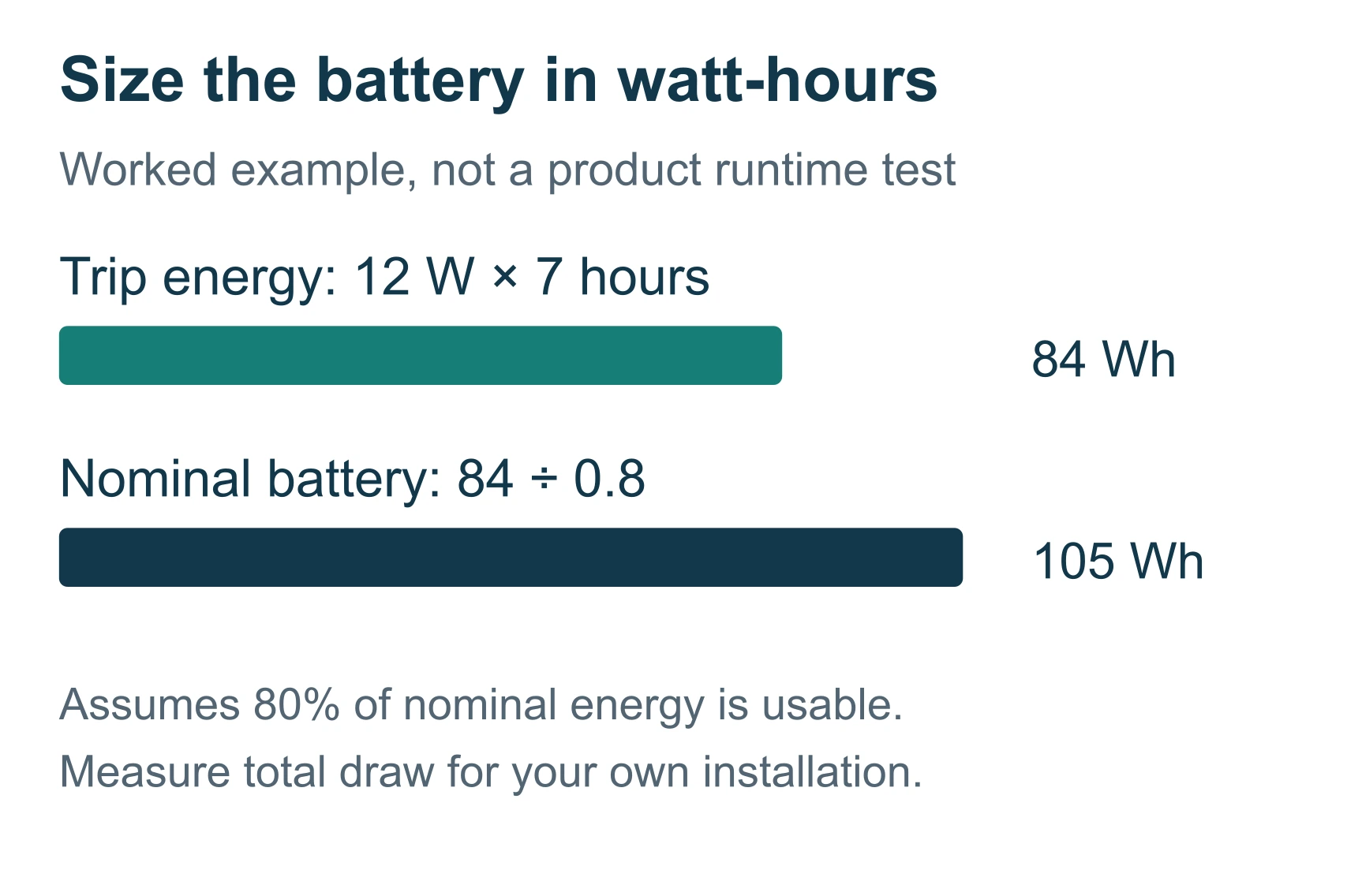
A fish finder's power draw is answered by watts multiplied by hours, not by its sonar transmit rating, and none of the manufacturer pages cited in this guide publish a measured runtime for these four units. Sonar transmit power describes the signal sent into the water, not the current the display and electronics pull continuously from your battery, and treating the two as interchangeable is a common and costly mistake at the planning stage.
The method
- Add the display's rated current draw at its operating voltage to any other device sharing the same battery, such as a live-sonar module or a GPS puck, to get total watts.
- Multiply total watts by your planned hours on the water to get total watt-hours (Wh) needed before any reserve.
- Divide that figure by a reserve allowance. Planning to use no more than 80 percent of a battery's nominal rating is a common, conservative allowance, and it exists because usable capacity in practice runs below the printed nominal number.
- Round up to the nearest commonly stocked battery capacity, then confirm the battery's discharge rating, connector and voltage match your unit's actual power draw before ordering.
The battery-sizing table
| Input | Illustrative value | How it's used |
|---|---|---|
| Completed installation's draw | 12 W | Step 1: total continuous draw at the display's operating voltage |
| Planned hours on the water | 7 hr | Step 2: multiplied against draw |
| Energy needed before reserve | 84 Wh | Step 2 result: 12 W × 7 hr |
| Reserve allowance | 80% of nominal | Step 3: a conservative planning figure, not a manufacturer spec |
| Nominal battery size to buy | 105 Wh | Step 3 result: 84 Wh ÷ 0.8 |
Every figure in this table is our calculation, using an illustrative 12-watt draw and a 7-hour trip, and it is not a measured or published runtime for any of the four units compared in this guide. Rerun the same four steps with your specific unit's rated draw and your own typical trip length before buying a battery.
Battery size is not the only electrical decision that matters. Keep power connections accessible, follow the exact unit's fuse and wiring instructions, and confirm the battery is restrained with its terminals protected as the installation requires. If you plan to add sonar hardware later, run its future draw through a separate version of this same calculation rather than buying a battery sized around an upgrade that hasn't been specified, or assuming today's battery will silently absorb it.
What a 7-inch screen costs you against a 9-inch display
A seven-inch screen costs you split-screen legibility and, on two of the four units compared here, a smaller published resolution, in exchange for a smaller mounted footprint and a lighter draw on your kayak's battery. Lowrance's own listings put both the Elite FS 7 and the Eagle 7 TripleShot HD at an 800 × 480 display. Elite FS 7 specifications and the Eagle 7 specifications both confirm that figure. Garmin's cited catalog and product pages do not publish a matching resolution figure for the ECHOMAP UHD2 74sv or the STRIKER Vivid 7sv, so treat that spec as unconfirmed until a dealer states it in writing rather than assuming parity with the Lowrance units.
Push the same resolution into a smaller physical panel and every chart label, sonar return and split-screen pane gets physically smaller before you touch a single setting. That is the direct cost of staying at seven inches once you start splitting the screen between chart and sonar, or chart and side imaging, rather than running one full view at a time. It is not a defect specific to any unit reviewed here; it is what the size class trades away.
Our 9-inch fish finder guide covers that larger class directly, including its own resolution and split-screen comparison, rather than repeating that analysis here. If your fishing routine depends on reading two or three panes at once in bright sun, that guide is the better one to finish reading. Choose by which screen habit you will actually run more often on the water, a full-screen single view or a working split screen, rather than by which unit looks larger in a product photo.
The mount and glare check almost nobody runs before buying
Almost every buying guide for this category stops at screen size and sonar features. The check that actually determines whether a seven-inch unit works on your specific kayak is whether its mounted assembly, not its screen diagonal, clears your paddle stroke or pedal drive and your normal reach, and whether you can read it without glare at your actual seat distance. Both are rarely mentioned before the sale.
Build a mock-up using the mounted dimensions, not the screen diagonal. Include the full cradle, knobs, mounting base and a marked area behind it for connector clearance, following the distinction Garmin's own mounting dimension guidance draws between the device and cradle and the complete bail-mount assembly. Then check each of the following before you commit to a mounting position:
| Fit check | What should remain possible |
|---|---|
| Paddle stroke | Normal stroke without catching the display |
| Pedal movement | Full movement without contacting the bracket |
| Entry and exit | Clear movement past the installation |
| Fishing line | No unavoidable snag path across cables |
| Net use | Space to bring a fish alongside |
| Screen adjustment | Usable tilt without crushing cables |
The thirty-second check almost nobody runs before buying: from your actual seated position, mimic a full paddle stroke or pedal cycle toward the mount, then tilt the screen to the angle you'll genuinely use on a bright midday crossing and check for glare off the housing or a reflected sun line across the display. If either motion catches the bracket, or the screen washes out at that tilt, change the mount position or reconsider the unit before you commit to it for a season. Do not solve either problem by moving the seat into a position you won't actually hold while fishing.
Does built-in GPS mean coastal charts are included?
No. GPS position, waypoint storage, a basemap, recorded contours and detailed coastal charts are different functions, and a unit can include some without including all of them. Check the exact regional chart package and supported chart products for the specific SKU you're quoted, and confirm whether the coverage you need is included, sold separately, or subject to update terms. A "GPS included" label alone does not answer any of those questions.
The contrast between the STRIKER Vivid 7sv's waypoint and Quickdraw contour functions and the Eagle 7's stated chart support makes the distinction visible in the manufacturers' own documentation. Garmin STRIKER Vivid 7sv and Lowrance Eagle 7 TripleShot HD describe genuinely different mapping roles at the same nominal screen size.
Check one familiar area closely before you check anywhere else. Use a place you already know: the launch, a nearby channel, the shoreline you fish and the route between them, and ask to inspect the proposed charts at several zoom scales. A familiar area makes missing coverage or a misunderstood chart function easier to spot than an unfamiliar one. Then inspect a less familiar destination you expect to visit before assuming the same coverage extends there. Do not buy an inland mapping bundle and assume every coastal upgrade is available or included; have the exact chart product and coverage area added to the quote in writing.
Choosing the right transducer for your fishing
A seven-inch head unit can support genuinely different sonar packages, and the display size tells you nothing about which one you're getting. Decide first whether you mainly need the water column beneath the hull, lateral structure search along the sides, or a planned live-sonar addition aimed at a specific target.
| Fishing task | Package feature to investigate |
|---|---|
| Tracking bottom depth and bait beneath the hull | Suitable traditional sonar |
| Looking along the sides for structure | Compatible side-imaging equipment |
| Interpreting structure directly below | Appropriate down-imaging view |
| Aiming live sonar at a target | Exact compatible live-sonar system and mount |
These are functions to confirm on the spec sheet, not guarantees of performance at a specific depth. For deeper saltwater fishing, use the transducer and sounder frequency guidance to make the purchase decision; Garmin's own sonar-frequency guidance explains why frequency choice and application matter, and display size is never the deciding depth specification.
Verify the complete mount before you verify the transducer's capability. Confirm whether the transducer has an approved fit in your kayak's transducer recess or needs a separate mounting method, and include its full body, bracket and cable run in that assessment, not only the electronics behind it. For a side-mount arm, rehearse raising and securing it before landing a fish. For a fixed arrangement, check how the kayak sits on its cart or support and whether the transducer could contact the ground. Do not drill the hull or alter a cable to force an unverified package to fit; choose supported mounting hardware or get installation advice specific to your hull.
The best 7-inch fish finders for a saltwater kayak
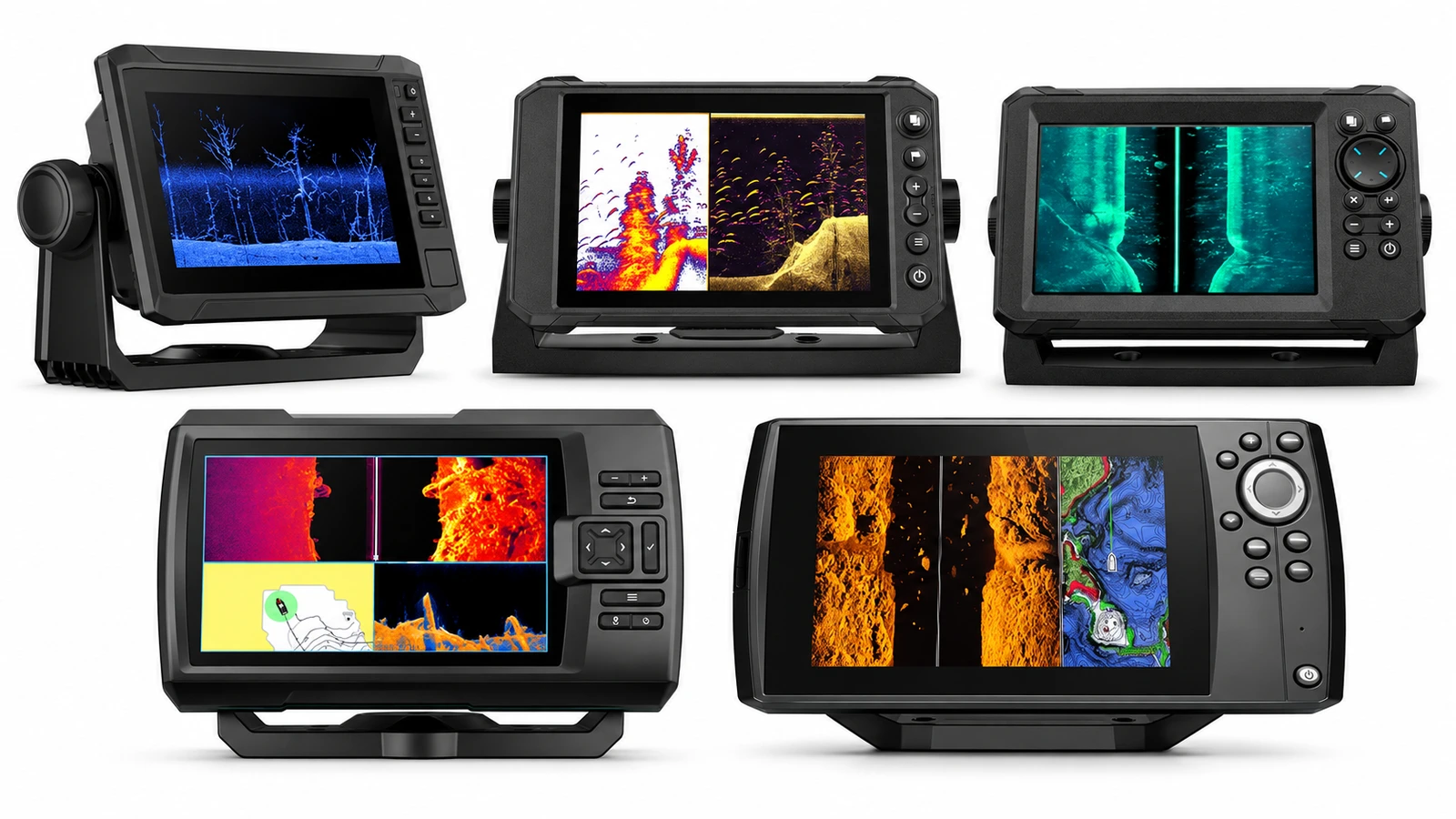
Category boundary, stated plainly: standalone and chartplotter-integrated fish finder head units with a nominal seven-inch diagonal screen, evaluated for mounting on a single-angler saltwater kayak. Four current units are compared directly, and one discontinued model is addressed separately as a remaining-stock decision rather than a current-model recommendation.
A note on the overlap with our 9-inch guide. A seven-inch and a nine-inch unit from the same product family often share the same sonar and chart software, and the decision between them is really a decision about mount footprint, power draw and split-screen habit, not sonar capability. This guide is written for the buyer whose console space and power budget favor the smaller footprint. Our 9-inch fish finder guide is written for the buyer who needs the larger legible split-screen area and has the console space and battery capacity to spend on it. Read both if you're genuinely unsure which buyer you are; the sonar and chart software behind the two screen sizes may be closer than the size difference suggests.
Prices and current dealer promotions are not published in this guide. Confirm current pricing, exact SKU and bundled transducer with a dealer before ordering any unit below.
Garmin ECHOMAP UHD2 74sv - Chartplotter-First
Check Garmin ECHOMAP UHD2 74sv on Amazon
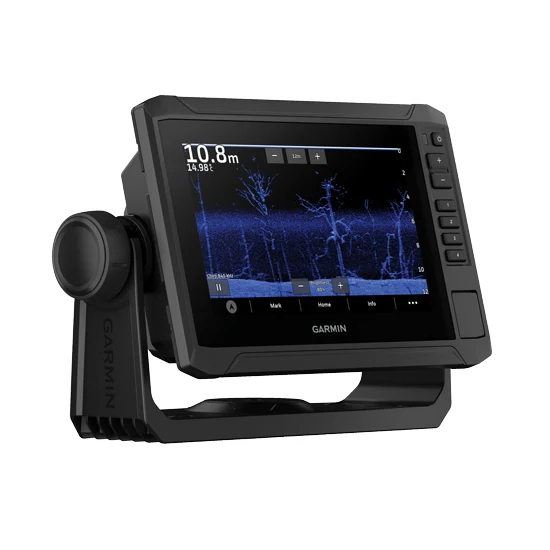
The 74sv wins the chartplotter-first award because it is the only unit here that treats coastal charting and sonar as one job on one seven-inch screen rather than two jobs you assemble later. Garmin's catalog sells it in versions with and without a bundled transducer, so the model name alone does not tell you what arrives in the box. The suffix carries real weight too: UHD2 74sv is not an older UHD model, and it is not a cv-suffix variant. Get those three things settled and this is the strongest starting point on the shortlist for a coastal buyer.
| Nominal screen size | 7 in |
|---|---|
| Configuration | Sold in versions with and without a bundled transducer, per Garmin's product catalog |
| Chart and sonar integration | Coastal chartplotting and sonar functions in one unit |
| Display resolution | Not published in the cited catalog; confirm with dealer |
| Generation and suffix | UHD2 74sv; distinct from older UHD models and from cv-suffix variants |
Source: Garmin marine electronics catalog, reviewed September 2026. Exact part number, bundled transducer and chart region vary by SKU; require them in writing on the quote.
Why the SKU matters more than the model name
Garmin lists the 74sv across multiple package configurations, which means two units sold under the same model name can carry different bundled sonar hardware. That is useful if you already own a compatible transducer and want the display alone, and it is a trap if you assume the package quoted to you is the one you read about. Ask the dealer to put the complete product name, generation, chart region and transducer part number on the quote in writing before you pay for anything.
Then ask them to show your actual home coast on the exact package quoted, not a generic demo region.
The transducer is a separate decision from the head unit
A supplied transducer still needs a mounting method your kayak actually supports, and that decision has nothing to do with the display you just chose. Work out where the transducer body, bracket and cable run will sit before you commit, the same way you would size the head unit's mounted footprint rather than its screen diagonal.
What the missing resolution figure means
Garmin's cited catalog does not publish a display resolution for the 74sv. Treat that spec as unconfirmed until a dealer states it in writing, rather than assuming parity with the Lowrance units in this guide, which both publish 800 × 480.
Best for. An angler who wants chart and sonar working together from one seven-inch screen and is willing to confirm the exact SKU before ordering.
Skip it if. The seller cannot or will not confirm the product name, chart region and transducer in writing, or offers an older UHD model as though it were interchangeable with the UHD2.
Lowrance Elite FS 7 - Expansion-Ready
Check Lowrance Elite FS 7 on Amazon
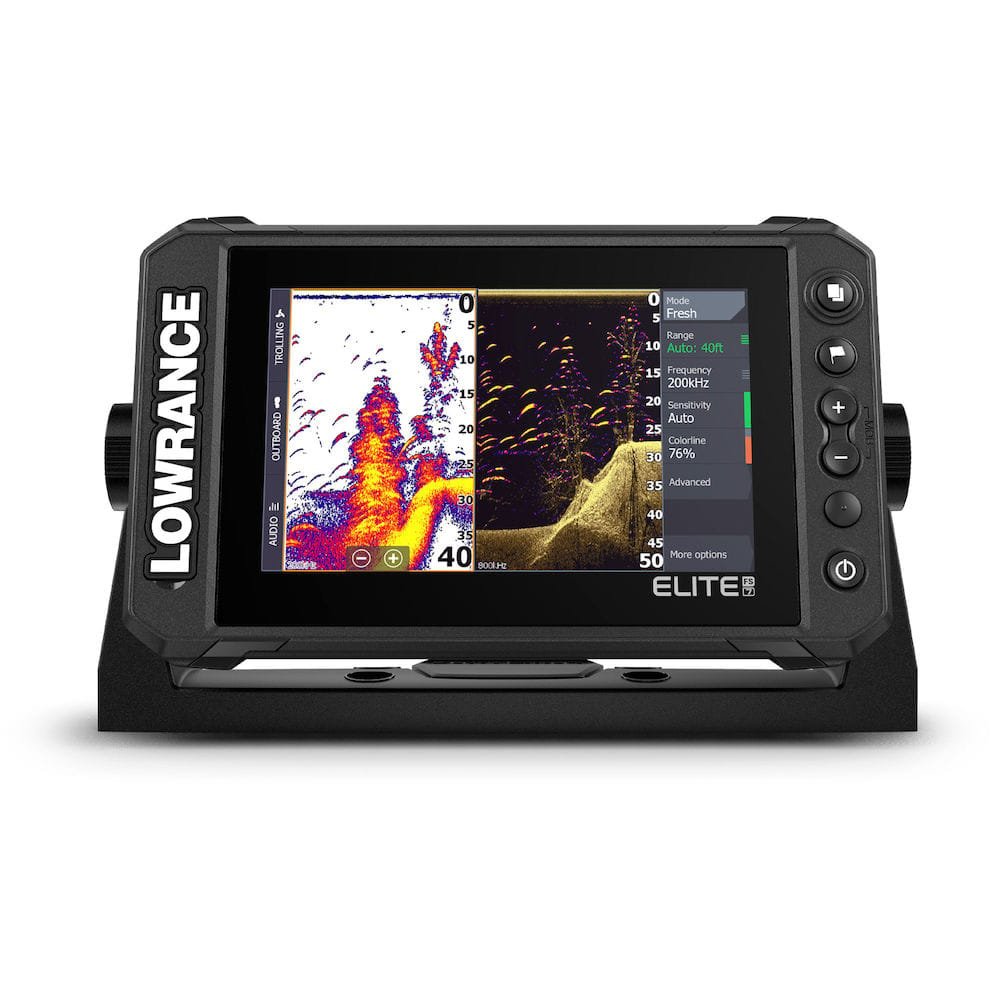
The Elite FS 7 earns its award on one published fact: Lowrance's own listing states that Active Imaging HD runs through an added S3100 module on this head unit. No other seven-inch unit compared here is built around a stated live-sonar expansion path. The base package is a 800 × 480 seven-inch display with networking support, so a multi-unit setup stays on the table as well. That is worth paying for when the upgrade is a real plan with a date on it, and worth nothing when it is a maybe.
| Nominal screen size | 7 in |
|---|---|
| Display resolution | 800 × 480 |
| Live-sonar expansion | Active Imaging HD requires an added S3100 module, per Lowrance's listing |
| Networking | Supported, per the reviewed listing |
Source: Lowrance Elite FS 7 product specifications, reviewed September 2026.
Why the S3100 module is the whole argument
"Ready for live sonar" describes compatibility, not hardware in the box. The module, its transducer, the space to mount both and the extra current they pull all sit outside the base price, and the extra draw belongs in the battery arithmetic earlier in this guide rather than in an assumption that today's battery will quietly absorb it. Write the upgrade onto the quote by its exact module and transducer part numbers, so the price you are comparing is the price of the finished system.
What a seven-inch panel has to show once you add a third pane
800 × 480 is a published figure, and it does not change when you split the screen three ways. Ask for a realistic multi-view demonstration, chart plus sonar plus live sonar, at your seated distance before you assume the finished system is comfortable to read.
Chart options for your intended coast can be assessed now, ahead of the sonar upgrade, rather than after it.
Best for. An angler with a defined live-sonar plan who wants a head unit that officially supports that expansion.
Skip it if. Live sonar is only a vague possibility, in which case price a simpler complete setup first rather than paying now for capability you may never install.
Lowrance Eagle 7 TripleShot HD - Standalone Simplicity
Check Lowrance Eagle 7 TripleShot HD on Amazon
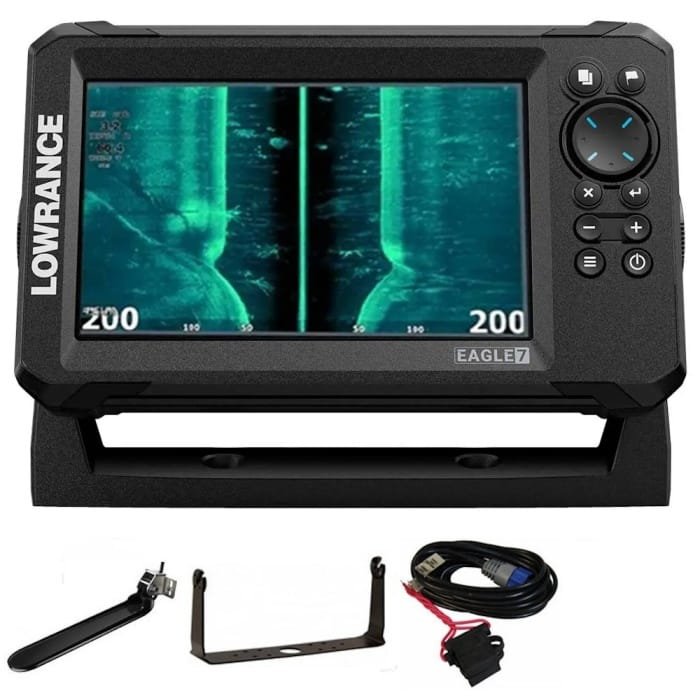
The Eagle 7 is the standalone pick because it is sold as a finished package rather than the first purchase in a series. The TripleShot transducer and the 800 × 480 IPS display arrive as one defined imaging system, operated by a physical keypad and supporting C-MAP DISCOVER mapping. Nothing about the line is positioned around later hardware expansion, which is exactly the appeal for a buyer who does not want an upgrade path hanging over the decision.
| Nominal screen size | 7 in |
|---|---|
| Display | 800 × 480 IPS |
| Controls | Keypad |
| Mapping support | C-MAP DISCOVER |
| US package mapping | Emphasizes inland coverage, per the reviewed listing |
Source: Lowrance Eagle 7 TripleShot HD specifications and mapping, reviewed September 2026. Confirm coastal chart availability for your region separately before buying.
The inland mapping is the catch for a saltwater buyer
Lowrance's reviewed listing says the US package emphasizes inland coverage. That is a mapping statement, not a coastal-chart promise, and a saltwater buyer has to verify the required coastal chart product and its coverage area separately before ordering. Have the exact chart product added to the quote in writing, then inspect your launch, the nearby channel and the shoreline you fish at several zoom scales.
Why a keypad is a real argument, not a downgrade
Physical controls may suit you better than a touchscreen with wet hands or in bright sun. Test the interface on the water rather than accepting either control style as universally better.
Price the transducer mount before checkout
A package's price advantage matters less if its transducer needs an awkward installation beside your paddle stroke. Confirm the mounting method your hull supports, including the cable run, before you treat the bundle as the cheaper option.
Best for. An angler who wants a focused standalone imaging system with keypad control rather than a touchscreen or an expansion platform.
Skip it if. You are assuming it upgrades the way an Elite-family unit does, because it is not sold or supported that way.
Garmin STRIKER Vivid 7sv - Sonar and Waypoint
Check Garmin STRIKER Vivid 7sv on Amazon
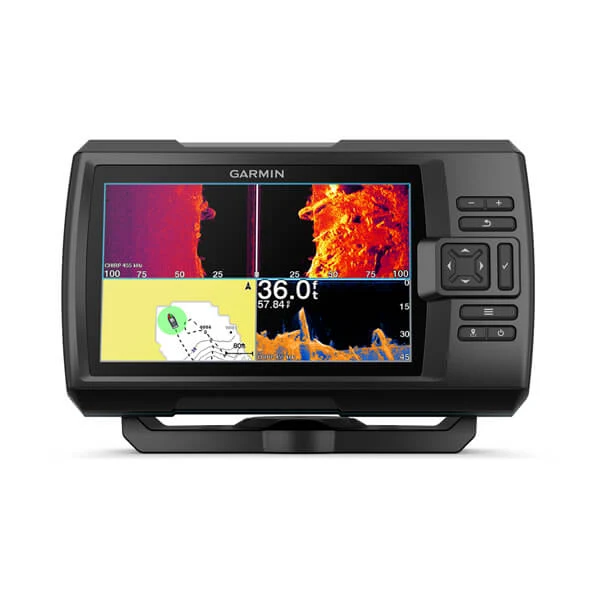
The STRIKER Vivid 7sv is on this list for what it genuinely does rather than what its GPS label implies. Garmin describes waypoint marking, GPS speed and route tracking, and Quickdraw contour recording, which is a functionally different set of capabilities from detailed coastal chartplotting. For an angler whose charts already live somewhere else, that narrower brief is the point: you are not paying for chartplotting features you will not use.
| Nominal screen size | 7 in |
|---|---|
| GPS functions | Waypoint marking, speed and routes |
| Contour recording | Quickdraw, per Garmin's product page |
| Display resolution | Not published on the cited product page; confirm with dealer |
Source: Garmin STRIKER Vivid 7sv product page, reviewed September 2026.
Why "GPS included" is not the same as charts included
Position fixing, waypoint storage, a basemap, recorded contours and detailed coastal charts are separate functions, and this unit has some of them without having all of them. It does not meet a requirement for detailed coastal chart coverage the way the chartplotter-integrated options above do. Ask the seller to demonstrate the exact map-related screen you expect to use, not a chart demo from a different model.
Confirm the package, not the family name
The STRIKER family name should not be assumed to carry the same bundled transducer across every package, so pin down the specific SKU. Garmin's cited product page also does not publish a display resolution for this unit; treat that figure as unconfirmed until a dealer puts it in writing.
Best for. A buyer whose real requirement is sonar and position marking, with detailed chartplotting handled elsewhere in the trip plan, such as a phone-based chart app.
Skip it if. You are picturing detailed shorelines, hazards and charted depth information, because those expectations belong with the chartplotter-integrated units above.
Humminbird HELIX 7 CHIRP MEGA SI GPS G4 - Discontinued, Remaining Stock Only
Check HELIX 7 MEGA SI G4 on Amazon
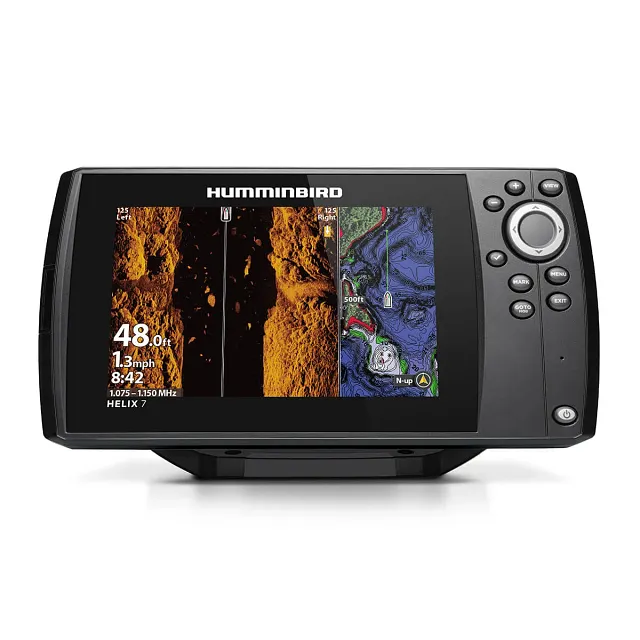
This one is listed as a warning label rather than a recommendation. Humminbird's own lifecycle notice states that item 411620-1 is no longer sold, which removes it from any current-model shortlist even though dealer inventory may still exist. It sits in the nominal seven-inch class this guide covers, and remaining new-old stock can carry a genuine price advantage. What it cannot carry is the assurance the four current units above come with.
| Model and item number | HELIX 7 CHIRP MEGA SI GPS G4, item 411620-1 |
|---|---|
| Current availability | No longer sold, per Humminbird's own lifecycle notice |
| Supplied transducer, warranty and chart support | Not confirmed by the cited notice; verify directly with the seller |
Source: Humminbird lifecycle notice, reviewed September 2026. This does not prove all dealer inventory has disappeared, but it removes the model from a default current-model recommendation.
What a discontinued listing actually removes
The manufacturer's page now states discontinuation instead of continuing specifications, so there is no current published spec sheet to check a seller's claims against. Service terms, warranty cover and replacement parts availability cannot be assumed to match a current-production unit either. Every feature a seller quotes is a claim to verify independently, and borrowing specifications from another HELIX variant does not count as verification.
The confirmation list before any remaining-stock purchase
Get the full model code and generation, the supplied transducer and cables, the warranty terms attached to that specific sale, the supported chart products, and the availability of service and replacement parts, all in writing. Then compare the completed cost, including any accessories you would have to replace, against the current units shortlisted above. A discounted head unit that needs a new transducer and mount is not necessarily the least expensive installation.
Best for. A buyer specifically evaluating a remaining-stock or used unit, not a buyer shopping the current lineup.
Skip it if. The seller cannot produce the model code, transducer and warranty terms in writing.
Where each 7-inch fish finder sits on the trade-off
| Model | Charting strength | Expansion or upgrade room | Where it sits |
|---|---|---|---|
| Garmin ECHOMAP UHD2 74sv | Built-in coastal chartplotting is the strongest published case here | Not marketed around a live-sonar expansion path | The charting-first buyer |
| Lowrance Elite FS 7 | Chart options exist, but the unit isn't positioned as a chartplotter-first purchase | Officially supports Active Imaging HD through an added S3100 module | The expansion-first buyer |
| Lowrance Eagle 7 TripleShot HD | Ships with US inland mapping; coastal chart coverage is a separate purchase | Sold as a complete standalone package, not marketed around later expansion | The standalone-simplicity buyer |
| Garmin STRIKER Vivid 7sv | Waypoint marking and Quickdraw contour recording, not detailed coastal charts | Built around sonar and GPS rather than an expansion platform | The sonar-and-waypoint buyer |
No single seven-inch unit compared here is simultaneously the strongest coastal chartplotter and the strongest live-sonar expansion platform. That is the actual trade this screen class makes, not a gap in this guide's research. Pick the axis that matches how you actually fish, then accept that the other axis will be weaker on the unit you choose.
Buy the system, not just the screen
| Purchase component | Detail to put on the order |
|---|---|
| Display | Exact model, generation and region |
| Transducer | Included part number or approved separate choice |
| Mapping | Exact coverage and update terms |
| Display mount | Full cockpit fit, using the mounted assembly, not the screen diagonal |
| Transducer mount | Supported hull or arm arrangement |
| Power | Compatible battery, charger and protection, sized with the method above |
| Installation | Any dealer work required |
Keep manufacturer product links as a way to check the configuration you're being quoted, not as a substitute for the fit assessment above. The most useful final response from a dealer is a complete parts list that matches your specific kayak and fishing task, not a single SKU number.
When a 7-inch screen isn't enough, and you should size up
Some buying situations genuinely argue against every unit in this guide. If your fishing routine depends on reading chart, sonar and side or live imaging simultaneously in bright midday sun, a seven-inch screen splits that information into panes small enough to undercut the reason you bought the sonar in the first place. That's not a flaw in any specific unit reviewed above; it's a mismatch between the screen class and the task.
Three honest paths exist, and none of them is the answer that sells the unit you were about to buy.
Size up to a nine-inch or larger unit in the same product family. You pay for it in mounted footprint and a heavier draw on the battery-sizing math above, but you get back the split-screen legibility a seven-inch panel can't provide once you're running three panes at once. Our 9-inch fish finder guide covers that class directly.
Keep the seven-inch head unit and run one full-screen view at a time. You accept slower toggling between chart and sonar instead of a permanent split, and in exchange you keep the smaller footprint and lighter power draw this guide is built around.
Buy a simpler unit than any reviewed here. If you already carry a phone-based or console chartplotter and only need the kayak unit for depth and structure, a sonar-only unit without chartplotting may cost and draw less than any of the four compared above.
If your trips are genuinely longer offshore runs rather than nearshore reef and pass fishing, our offshore kayak fish finder guide is written for that specific buyer and covers deeper-water sonar and range requirements this guide does not address. The honest version of this section is that a seven-inch screen is the wrong buy for an angler who has already decided, before ever sitting in the kayak, to run three panes open in bright sun. Size up before you order, not after the first trip when the split screen turns out to be unreadable.
Frequently asked questions
Is a seven-inch screen too small for side imaging?
It depends on viewing distance and the layout you choose, not on the screen size alone. Try the actual side-imaging view at the range and seat distance you expect to use before deciding, using the readability checks earlier in this guide, rather than judging it from a bright store demo.
Does more screen resolution guarantee a better sonar image?
No. Resolution is one display specification among several. The transducer, sonar settings, water conditions and the quality of the installation all determine what information actually reaches the screen, regardless of how many pixels the panel has.
Are touchscreen controls better than buttons on a kayak?
Choose by the operations you can perform comfortably with wet hands or in bright sun, not by treating either control style as universally superior. The Eagle 7 TripleShot HD's keypad and a touchscreen unit both work; test the exact interface on the water before deciding.
Is the Garmin STRIKER the same as an ECHOMAP with fewer extras?
No, and it shouldn't be framed that way. Compare the actual mapping, sonar and expansion functions against your specific requirements; the STRIKER's waypoint and contour-recording functions are not a lighter version of the ECHOMAP's coastal chartplotting, they're a different job.
Can I use a freshwater or inland chart package in saltwater?
Check the equipment's permitted use, transducer requirements and chart coverage separately before assuming it's fine. An inland mapping package is a mapping issue specifically; it does not by itself describe every component's suitability for saltwater use.
Which seven-inch unit should I buy?
Choose the ECHOMAP UHD2 74sv for a coastal-chartplotter package, the Elite FS 7 for a defined live-sonar expansion plan, the Eagle 7 TripleShot HD for a simpler standalone imaging setup, or the STRIKER Vivid 7sv for its more limited sonar-and-waypoint role. Make the final call only after the mount-and-glare check and the complete system price, not the head unit price alone.
Final verdict
The seven-inch figure on any of these units describes a screen diagonal, not a mounting footprint and not a power budget, and this guide exists because those three things get sold as one number. The Garmin ECHOMAP UHD2 74sv is the strongest starting shortlist for chart-and-sonar integration once the exact SKU and chart region match your coast. The Lowrance Elite FS 7 earns its place only for a buyer with a real, dated plan to add live sonar.
The Lowrance Eagle 7 TripleShot HD is the better standalone choice once the coastal chart is confirmed separately from its inland-leaning package. The Garmin STRIKER Vivid 7sv belongs on the list for its actual sonar-and-waypoint functions, not for a GPS label that sounds like chartplotting. A discontinued HELIX 7 G4 is a remaining-stock decision, never a default recommendation. Run the mount-and-glare test and the battery math before you order any of them, and size up to a nine-inch unit if your fishing genuinely depends on reading three panes at once in bright sun.
Related reading
Sources
Specifications on this page were taken from manufacturer product and specification pages and the sources below, reviewed September 2026. Prices and specifications change; confirm current figures with a dealer before buying.
- Garmin marine electronics catalog (PDF), www8.garmin.com/marine/PDF/master.pdf, reviewed September 2026
- Lowrance Elite FS 7 product specifications, lowrance.com, reviewed September 2026
- Lowrance Eagle 7 TripleShot HD specifications and mapping, lowrance.com, reviewed September 2026
- Garmin STRIKER Vivid 7sv product page, garmin.com.sg, reviewed September 2026
- Garmin mounting and installation dimension guidance, www8.garmin.com/manuals, reviewed September 2026
- Garmin sonar-frequency guidance, www8.garmin.com/manuals, reviewed September 2026
- Humminbird HELIX 7 CHIRP MEGA SI GPS G4 lifecycle notice, humminbird.johnsonoutdoors.com, reviewed September 2026
Join The ReefReady Community
Get saltwater Fishing Guides, expert Buyers Guides, equipment recommendations, marine electronics insights, and practical gear tips delivered to your inbox.
No spam. Unsubscribe in one click.