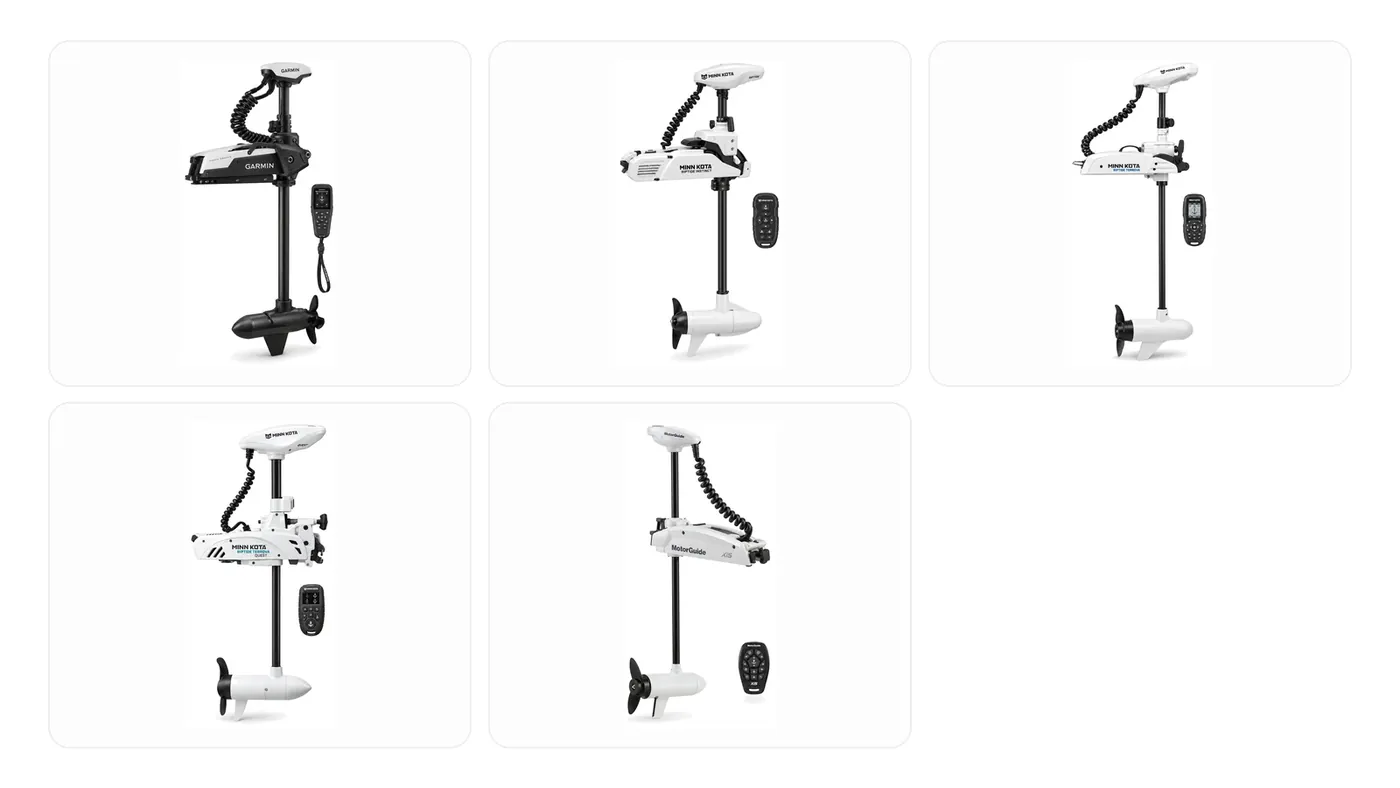
The saltwater trolling motors reviewed below. Manufacturer product photography.
Best Trolling Motors for 20 to 22 Foot Bay Boats: 24V or 36V, and Why Windage Decides It
Fifteen knots across a falling tide, holding a bar edge on an open bay, and the motor is slowly walking off station. Not failing outright, just losing a foot at a time, correcting, losing another…
By Larry MurrayUpdated 6 September 202620 min readBuyer’s Guide
The quick answer
Weight gets you most of the way to a thrust figure, and then a T-top, a leaning post and a raised bow catch wind that a low-profile hull of the same weight does not. Published thrust rules count pounds and ignore the sail area sitting above the waterline.
Most 20 to 22 foot bay boats load to between 3,500 and 4,800 lb once you count the engine, fuel, batteries, anglers and gear, which puts published minimum thrust at 70 to 112 lb depending on where your boat falls. For a boat with a T-top fishing open water, size toward the top of that range: 100 to 112 lb of thrust on a 36V system is the safer specification. For a lighter, lower-profile boat fished mostly in protected water, 70 to 82 lb on 24V is usually enough.
For a typical T-topped 21 footer working open bays and channel edges, the Minn Kota Riptide Terrova QUEST 112 in 36V is our top pick. If your boat is lighter and fished in protected water, the MotorGuide Xi5 in 24V covers it for meaningfully less money and one fewer battery.
Affiliate disclosure. Affiliate disclosure: ReefReadyGear earns a commission on some links below at no extra cost to you. We don’t accept payment for placement, and every motor here was selected on published specifications and expert and owner feedback. Specifications verified September 2026.
Windage is the variable the rules leave out
Two bay boats at the same loaded weight can need different motors because one carries a T-top and the other does not. The windage adjustment on this page is ReefReadyGear’s own editorial model, not an industry standard, and it is labelled that way wherever it appears.
ReefReadyGear does not run a testing programme, and nothing on this page is presented as a first-hand test result.
Every figure here is drawn from manufacturer and builder documentation, authorised retailer listings and published
angler experience, verified in September 2026 and dated where it matters. Where a number is our calculation rather
than a published figure, we label it and show the method.
Loaded weight taken from the skiff guide’s worksheet rather than rebuilt here
A windage adjustment applied on top of the weight-based figure, labelled as an editorial model
Voltage stated as an applied conclusion for this hull class, with the underlying 24V against 36V analysis linked out
Shaft length method adapted for raised bow decks, where a bay boat differs from a skiff
Where two authoritative sources disagree, both are quoted and attributed rather than blended, and where a maker
publishes no figure at all we say so instead of estimating quietly.
Fifteen knots across a falling tide, holding a bar edge on an open bay, and the motor is slowly walking off station. Not failing outright, just losing a foot at a time, correcting, losing another foot, until the boat is fifty yards from where it started.
That motor was probably sized correctly for the boat’s weight. It just wasn’t sized for the boat.
Every published trolling motor rule, Minn Kota’s included, is a function of how much the boat weighs. None asks what it looks like above the waterline. A 21 foot bay boat with a T-top, a raised casting deck and eighteen inches of freeboard presents a different problem to the wind than a low-profile hull of the same weight, and in open water that difference often decides whether the motor holds or loses.
This article calculates what your boat weighs loaded, adjusts for how much wind it catches, and turns that into a thrust figure, a voltage and a shaft length you can order with confidence.
At a glance
Best for
Motor
Voltage
Thrust
Price
Best overall for a T-topped bay boat
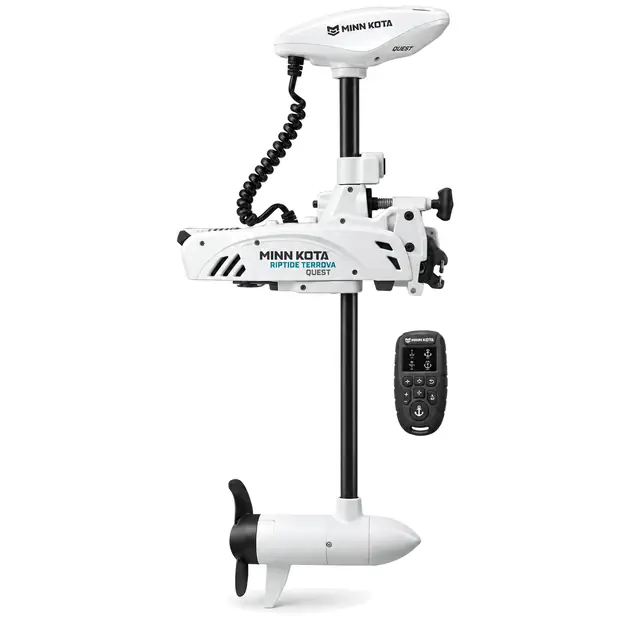
Minn Kota Riptide Terrova QUEST 36V
36V
up to 115 lb
~$4,700 to $5,400
Best 36V value
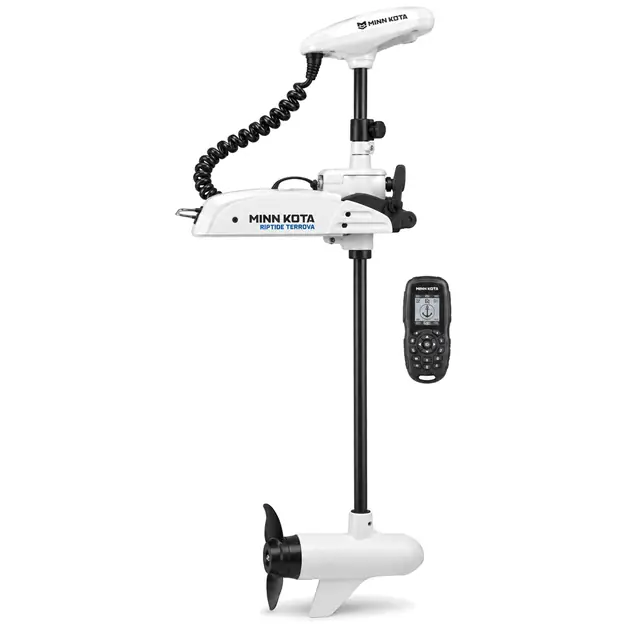
Minn Kota Riptide Terrova 112
36V
112 lb
~$3,800 to $4,300
Best for open water and rougher chop
Garmin Force Kraken
36V
up to 150 lb
~$5,000 to $5,800
Best 24V for protected water
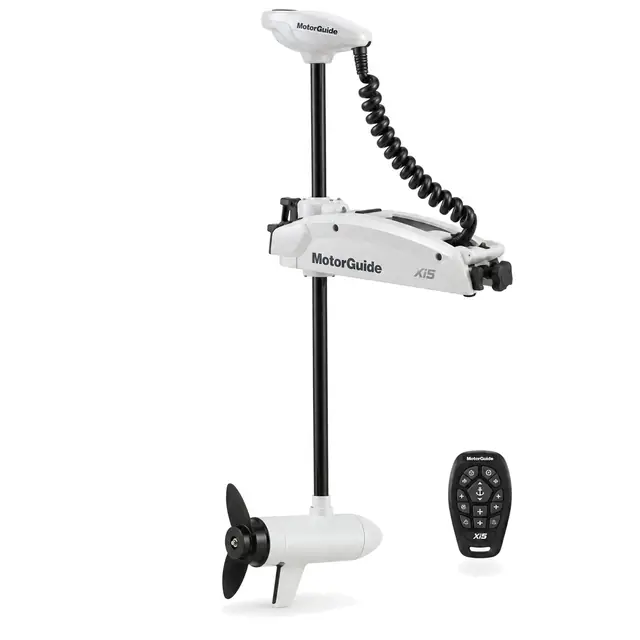
MotorGuide Xi5 Saltwater
24V
up to 82 lb
~$2,300 to $2,700
Best 24V with GPS anchoring
Minn Kota Riptide Instinct 24V
24V
80 lb
~$2,500 to $2,900
Pricing moves constantly and several of these are dealer-installed with the price varying by shop, so treat these as bands, not quotes.
What your bay boat weighs loaded
Dry weight tells you almost nothing about what a motor has to move, because a rigged bay boat carries a lot that never shows up on a spec sheet.
Typical dry weights for this class run 2,200 to 3,200 lb before an engine or gear goes aboard. Add the rest of what actually leaves the dock with you:
Item
Typical weight
Dry hull, 20 to 22 ft bay boat
2,200 to 3,200 lb
Four-stroke outboard, 200 to 300 hp
450 to 650 lb
Fuel, 50 to 60 gal at 6.1 lb per gallon
305 to 366 lb
Cranking battery
40 to 50 lb
Trolling motor battery bank, two or three batteries
100 to 220 lb
T-top and leaning post
100 to 200 lb
Three to four anglers
600 to 800 lb
Tackle, rods, ice, coolers
100 to 200 lb
Livewell, filled with seawater at ~8.5 lb per gallon
85 to 170 lb
Safety gear and miscellaneous
30 to 60 lb
Run those totals and a light 20 footer with two anglers on a mild afternoon lands close to 3,500 lb loaded. A heavier 22 footer with a T-top, three anglers, a full livewell and a topped-off tank pushes 4,700 to 4,800 lb. That spread straddles two voltage tiers, which is exactly why boat length alone can’t tell you which motor to buy.
We’re not rebuilding the full worksheet here. For the itemized, room-by-room method for calculating your own loaded weight, the loaded weight worksheet in our skiff trolling motor guide walks through it and applies directly to a bay boat.
Why weight is only half the answer
Here’s where the published guidance runs out. Minn Kota’s rule is at least 2 lb of thrust for every 100 lb of fully loaded boat weight. West Marine’s advisor works out to roughly 2.5 lb per 100 lb and calls it a minimum, with a range of 80 to 112 lb of thrust for boats in the 3,000 to 5,000 lb operating weight band. Both are solid, published, and both stop at weight.
Wind doesn’t care about weight. It cares about surface area, and it scales roughly with the square of wind speed, so a jump from 10 to 15 knots isn’t a 50 percent increase in load, it’s closer to double. A bay boat with a T-top and eighteen inches of freeboard catches meaningfully more wind than a low hull at the same displacement. Two boats of identical loaded weight, one low profile and one with a full T-top, are not fighting the same problem in the same breeze, and the weight rule treats them as if they were. That’s why so many bay boat owners undersize a motor, fish it a season, and replace it.
The ReefReadyGear windage-adjusted thrust framework. This is our own editorial model, built on top of the published weight rules, not a manufacturer standard or tested benchmark. We start from the West Marine and Minn Kota weight-based minimums, then step up based on how much windage your boat’s profile adds:
Loaded weight
Low profile, console only
T-top, no tower
T-top plus tower or full hardtop
3,500 to 4,000 lb
70 to 80 lb, 24V
80 to 90 lb, 24V or entry 36V
90 to 100 lb, 36V
4,000 to 4,500 lb
80 to 90 lb, 24V or entry 36V
90 to 100 lb, 36V
100 to 112 lb, 36V
4,500 to 4,800 lb
90 to 100 lb, 36V
100 to 112 lb, 36V
112 lb and up, 36V
Read it as a starting point, not a final answer. It moves the base weight-driven figure up roughly one step for a T-top and a full tier for a T-top with a tower or hardtop, where exposed area and the weathervane effect concentrate.
Expert tip: if you fish open water on windy afternoons, size up a tier from what the table shows. Nobody has ever regretted buying too much thrust; plenty of owners have replaced a motor that was exactly enough on a calm morning.
Read down for weight, across for the sail area above your gunwales. Both move the answer.
24V or 36V for this boat?
36V for most 20 to 22 foot bay boats, particularly with a T-top or in open water, because it delivers 100 to 115 lb of thrust and sags less under sustained load. 24V covers roughly 70 to 90 lb and saves the weight and cost of a third battery. The decision is really about the third battery, not about the motor.
Published voltage bands from Minn Kota and West Marine land in the same place: 24V tops out around 70 to 90 lb of thrust, and 36V starts around 100 lb and runs to 112 to 115 lb. Line that against the windage table above and the pattern is clear: a light, low-profile boat in protected water can stay on 24V, while anything with a T-top fishing open bays, or crossing 4,000 lb loaded, is a 36V boat.
Configuration
Total weight (batteries)
Approx. cost, batteries only
Charge time, typical
Effect on trim and draft
24V, 2x AGM group 31
130 to 145 lb
$400 to $600
4 to 8 hrs
Minor, forward
24V, 2x lithium
55 to 70 lb
$1,200 to $1,800
1.5 to 3 hrs
Negligible
36V, 3x AGM group 31
195 to 220 lb
$600 to $900
6 to 10 hrs
Noticeable, forward
36V, 3x lithium
80 to 105 lb
$1,800 to $2,700
2 to 4 hrs
Minor, forward
That’s the applied answer for this hull class, not the full case for 24V versus 36V as a technology decision, which involves voltage sag, motor control differences and how each system performs late in a long day. That comparison lives in its own article: see our 24V versus 36V trolling motor deep dive for the full reasoning. What matters here is where your boat falls, and for most bay boats over 4,000 lb with any real superstructure, that’s 36V.
What the third battery really costs
Choosing 36V over 24V isn’t really choosing a motor. It’s choosing to carry a third battery, and that decision has consequences that rarely make it into a spec comparison.
Weight, and where it sits. A three-battery AGM bank commonly exceeds 150 lb, mounted forward in a bow or under-console compartment. On a hull marketed partly on shallow draft, adding 150 to 220 lb forward measurably affects static draft and can flatten hole shot until the boat gets on plane. Lithium roughly halves the weight at two to three times the price.
Space and cost. Bay boats aren’t built with three group 31 batteries in mind from the factory, so a third battery often means giving up a forward rod locker or splitting the bank across two compartments. Budget for a matched charger too: a 36V bank needs a true 36V multi-bank charger, not a 24V unit with an extra bay bolted on. These typically run $200 to $450, and skipping a proper one is how a bank ends up unevenly charged and degrades faster.
Charge time between trips. This is the constraint nobody talks about, and the one that decides some owners’ choice. A standard AGM bank on a modest charger can take 6 to 10 hours to top off, an overnight charge with no margin for back-to-back fishing days. Lithium with a matched charger commonly cuts that to 2 to 4 hours.
The honest lithium case: roughly half the weight of AGM, meaningfully faster charging, a longer service life, and considerably more money up front. For an owner who fishes often and cares about draft and turnaround time, it pays for itself. For occasional use with room to spare, AGM remains a reasonable, cheaper choice.
The third battery is the real cost of 36V, and on a bay boat it lands in the bow where you feel it.
Shaft length for a raised bow
This is where generic sizing charts fail bay boat owners, and it’s an expensive mistake to make once.
The method comes from West Marine’s advisor: measure from the mounting surface on the bow down to the waterline, then add 12 to 18 inches so the propeller stays submerged in chop. When you land between two standard lengths, take the longer one. A short shaft is the failure mode that shows up most often here, because a raised bow puts the mounting surface much higher above the water than owners expect.
How to measure it, step by step:
Measure vertically from the flat mounting surface on the bow deck down to the static waterline, with the boat loaded close to how you’ll actually fish it.
Add 12 inches as a minimum propeller depth allowance for calm water, or 18 inches if you regularly fish chop or a running tide.
Round up to the nearest available shaft length. Never round down.
If your figure lands within an inch or two of two standard lengths, choose the longer one without hesitation.
Worked examples from real bay boat bow heights:
20 foot boat, bow mounting surface 34 inches above the waterline: target of 46 to 52 inches rounds up to a 60 inch shaft, since 45 inch shafts are built for lower freeboard boats.
21 foot boat with a raised casting deck, mounting surface 40 inches up: target of 52 to 58 inches, again pointing to 60 inches.
22 foot boat with a high bow and a jack plate to clear, mounting surface 46 inches up: target of 58 to 64 inches, which puts a 72 inch shaft firmly in play, especially in rough water.
That’s why 60 to 72 inches is the common answer for this hull class, well past what most owners assume coming from a smaller boat or a skiff.
Warning: a short shaft ventilates in bay chop. The propeller breaks the surface on every trough, the motor loses bite intermittently, and it presents exactly like a weak motor or an unreliable GPS anchor lock. It’s a measurement error, not a product failure, and it’s one of the most common complaints in bay boat forum threads on this topic.
The best trolling motors for 20 to 22 foot bay boats
Organized by voltage tier so you can shop from the recommendation you worked out above. Confirm specifications at the manufacturer’s page before ordering, since lineups and pricing change during the model year.
36V picks
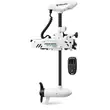
Minn Kota Riptide Terrova QUEST 36V
Published specifications
Thrust
up to 115 lb
Voltage
36V
Shaft lengths
60 in, 72 in, 87 in
Saltwater rating
Yes, saltwater series composite construction
GPS features
Spot-Lock, Advanced GPS routes and tracks, wireless remote
Mount
Bow, quick-release
Price
~$4,700 to $5,400
Best for
A T-topped 21 to 22 foot bay boat fishing open bays and structure, where you want the latest GPS anchoring feature set and integration with a compatible chartplotter.
Key features
The QUEST platform is Minn Kota’s current top-tier bow mount, with a wireless charging remote, an in-motor screen, and tighter Humminbird integration through the One-Boat Network. At 115 lb on 36V, it sits comfortably inside the range our windage table recommends for a T-topped boat over 4,000 lb.
Advantages
Thrust and voltage match what most T-topped bay boats over 4,000 lb need
Spot-Lock and Advanced GPS routes hold up well within the motor’s thrust envelope
72 inch shaft option covers the raised-bow worked examples above
Limitations
Premium price relative to the prior-generation Terrova
Wireless remote and screen add complexity some owners don’t need
Composite shaft, not the rugged option some heavy-use owners prefer
Real-world application
Holding a bar edge or channel drop in wind against tide, and repositioning along a shoreline without touching a foot pedal.
Who should buy it
Owners of a T-topped 21 to 22 foot bay boat over 4,000 lb loaded, fishing open water regularly.
Who should avoid it
Lighter, lower-profile boats under 4,000 lb in protected water, where the extra thrust and cost aren’t earning their keep.
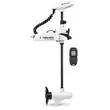
Minn Kota Riptide Terrova 112
Published specifications
Thrust
112 lb
Voltage
36V
Shaft lengths
60 in, 72 in, 87 in
Saltwater rating
Yes, saltwater series
GPS features
Spot-Lock, i-Pilot routes and tracks
Mount
Bow, quick-release
Price
~$3,800 to $4,300
Best for
The same bay boat profile as the QUEST, for an owner who wants proven 36V thrust and GPS anchoring without paying for the newest platform.
Key features
The standard Terrova 112 has been the default bay boat 36V motor for several seasons, with a strong reliability record and full saltwater construction, delivering nearly the same thrust and shaft options as the QUEST at a meaningfully lower price.
Advantages
112 lb of thrust covers nearly the full windage-adjusted range for this hull class
Long, established reliability record in saltwater
Same shaft length range, including 72 inch, at a lower price than the QUEST
Limitations
Lacks the wireless remote and console screen of the QUEST generation
i-Pilot ecosystem is being phased toward newer platforms over time
Real-world application
Everyday bay boat use: holding structure, working tide lines, and covering a grass flat.
Who should buy it
Bay boat owners who want proven 36V performance at a lower price than the current flagship.
Who should avoid it
Owners who specifically want wireless charging or the newest console integration.
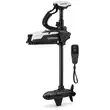
Also worth a look: the Garmin Force Kraken pushes up to 150 lb of thrust, well beyond most competitors at the same voltage, with deep Garmin electronics integration. It’s the pick for the heaviest, highest-windage boats in this class, at the highest price here (~$5,000 to $5,800). For boats where the windage table points to 100 to 112 lb, it’s unused capacity at a premium.
24V picks
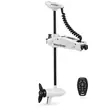
MotorGuide Xi5 Saltwater
Published specifications
Thrust
up to 82 lb
Voltage
24V
Shaft lengths
54 in, 60 in
Saltwater rating
Yes, saltwater series
GPS features
Pinpoint GPS anchoring
Mount
Bow
Price
~$2,300 to $2,700
Best for
A lighter, lower-profile 20 foot bay boat fished mostly in protected water, where the windage table points to 70 to 82 lb.
Key features
The Xi5 delivers a genuinely solid 82 lb of thrust on 24V, at a lower price and with two fewer batteries than any 36V option here, and Pinpoint GPS handles holding in modest wind and current well within the motor’s envelope.
Advantages
Two-battery bank keeps weight, cost and charge time down
82 lb of thrust covers the top of the 24V band for this hull class
Limitations
Not enough margin for a T-topped boat in open water or wind over roughly 12 to 15 knots
Shorter shaft options than the 36V motors here, worth checking against your bow height
Real-world application
Working grass flats, protected shorelines and calmer bay water on a boat under about 4,000 lb loaded.
Who should buy it
Owners of a lighter, lower-profile bay boat who mostly fish protected water.
Who should avoid it
Anyone with a T-top fishing open bays regularly, where the windage table points toward 36V.
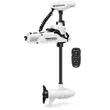
Also worth a look: at 24V, the Minn Kota Riptide Instinct (80 lb thrust, ~$2,500 to $2,900) trims Minn Kota’s feature set to core Spot-Lock anchoring at a lower price than the i-Pilot lineup, though 80 lb sits at the edge of the 24V band for any boat with real windage. The Lowrance Ghost (24V or 36V, up to 105 lb) runs a fully wireless helm with no pedal cable, and Rhodan Marine’s HD GPS Anchor (24V or 36V, up to 100 lb) is a saltwater specialist with a jack-plate mount some layouts handle better than a standard bracket.
Will it hold in a running tide and a fresh breeze?
Usually, if the motor is sized correctly, and the margin is narrower than most owners expect.
GPS anchoring, whatever brand’s name is on it, is a correction loop: the motor reads position drift, applies thrust to correct it, reads again, and repeats, bounded by how much thrust is left after the environment takes its share. Wind load rises sharply with wind speed, current adds a steady pull that never lets up, and wave action adds intermittent demand on top of both. A T-top adds substantial exposed area to that equation, the whole reason the windage adjustment above exists.
Hold performance degrades progressively, not suddenly: first the boat starts swinging a few extra degrees on each correction, then it begins walking, drifting a foot or two before each correction catches up. If wind, current and wave together exceed what the motor has left, it loses station outright. Nothing breaks, it simply runs out of thrust budget.
Battery state matters too. A bank run down over a long day holds voltage less well under load, so hold late in the afternoon is often noticeably weaker than at 8 AM on a full charge, one more reason the sizing above builds in margin.
Warning: do not rely on GPS anchoring alone near hard structure, a bridge piling or a channel marker, in a running tide. Sizing a trolling motor correctly is a safety decision as well as a fishing one, and the failure mode near structure is not gradual drift, it’s contact.
If you already have a Power-Pole or Talon
A shallow water anchor doesn’t replace a trolling motor, but it changes what you need from one. Where one is already fitted, the trolling motor’s job shifts from holding position everywhere to positioning the boat in deeper water, covering ground between spots, and approaching quietly, while the anchor takes over absolute holding once you’re in its depth range.
A Power-Pole or Talon holds a boat rock solid in shallow water with zero ongoing power draw, something no GPS-anchored motor can match, because it’s a mechanical spike into the bottom rather than a correction loop. Most units on boats this size cover roughly 6 to 10 feet of water depending on model.
An owner whose anchor already covers the skinny water they fish most may reasonably choose a slightly lighter motor than the windage table’s top recommendation, since its real job becomes repositioning rather than holding station all day. Without one, size to the full windage-adjusted figure. Beyond the anchor’s depth limit, or on a bar or bridge piling in ten feet or more, the trolling motor is the only option.
Mounting, wiring and charging
Getting the motor right doesn’t end with the purchase. This checklist covers the rigging reality specific to a boat this size.
Backing plate. A 100 to 115 lb thrust motor imposes real loads on the bow deck. Confirm one is fitted, or add one, to avoid stressing the gel coat and deck core.
Cable gauge and circuit protection. Size wire to run length and current draw per ABYC guidance, and fit a properly rated breaker between bank and motor. Undersized wire on a long bow-to-stern run is a common source of voltage sag.
Plug and connector selection. Marine-rated, sealed connectors, with dielectric grease on every connection exposed to salt spray.
Onboard charger sizing. Match the charger to the bank, not just the voltage, and size it for realistic overnight charging given your fishing schedule.
Anodes and rinse discipline. Inspect sacrificial anodes regularly in salt use, and rinse the motor, shaft and prop with fresh water after every trip.
Jack plate clearance. Confirm the shaft and prop clear the outboard’s range of travel at the shaft lengths this hull class typically requires.
36V for most 20 to 22 foot bay boats, particularly with a T-top or in open water, because it delivers 100 to 115 lb of thrust and sags less under sustained load. 24V covers roughly 70 to 90 lb and saves a battery, its weight and its cost. The decision is really about the third battery, not the motor.
Three 12V batteries wired in series, or a single 36V pack. Three group 31 AGM batteries typically weigh over 150 lb combined; an equivalent lithium bank is usually around half that at two to three times the price, and that weight sits forward, affecting trim and draft.
Measure from the mounting surface on the bow down to the waterline, then add 12 to 18 inches so the propeller stays submerged. A raised bow puts the answer at 60 to 72 inches, longer than most owners expect. When between two lengths, take the longer one; a short shaft ventilates in bay chop.
Usually, if the motor is sized correctly, and the margin is narrower than owners expect. GPS anchoring is a correction loop bounded by available thrust, and wind load rises sharply with speed while a T-top adds substantial exposed area. Holding degrades progressively, first swinging, then walking off station, rather than failing outright.
No, not for long. Freshwater motors lack the corrosion-resistant alloys and marine-grade coatings that saltwater-rated motors use. Every motor in this article is saltwater rated.
Yes, measurably. A 150 to 220 lb AGM three-battery bank mounted forward affects static draft and hole shot on a boat sold partly on shallow draft; lithium cuts that weight roughly in half.
Not required, but useful if you already run a compatible brand’s electronics. See our chartplotter guide for 18 to 22 foot center consoles for how the ecosystems compare. —
Final verdict
Weight gets you most of the way to a thrust figure, but a T-topped bay boat fights wind harder than a low-profile hull of the same weight, the variable the published rules leave out. Most 20 to 22 foot bay boats with any real superstructure belong on 36V with 100 to 112 lb of thrust, while lighter, lower-profile boats in protected water can stay on 24V. Whichever you choose, measure your bow height rather than guessing the shaft length: 60 to 72 inches is normal here, and getting it wrong reads exactly like a weak motor.
Larry Murray
Editor, ReefReadyGear
Larry edits ReefReadyGear, a research-led saltwater gear publication. Recommendations here are built from manufacturer specifications, authorised retailer listings and published angler experience, and we say so plainly rather than implying a testing programme we do not run. Where a claim comes from a manufacturer, we attribute it. Where we have not verified something, we do not print it.
Specifications on this page were taken from manufacturer and authorised retailer listings and the advisory sources below, consulted September 2026. Prices and specifications change; confirm current figures before buying.
Minn Kota product specifications, minnkotamotors.johnsonoutdoors.com
Garmin trolling motor specifications, garmin.com/en-US/p/trolling-motors
MotorGuide product specifications, motorguide.com
Lowrance trolling motor specifications, lowrance.com
West Marine trolling motor advisor, used for propeller depth and shaft length guidance
Minn Kota published thrust selection guidance: at least 2 lb of thrust per 100 lb of fully loaded boat weight
ABYC wiring standards, referenced for cabling and circuit protection guidance
Thrust, voltage, shaft length and pricing move within a model year and must be re-verified against current manufacturer product pages before publishing
Join The ReefReady Community
Get saltwater Fishing Guides, expert Buyers Guides, equipment recommendations,
marine electronics insights, and practical gear tips delivered to your inbox.
 Best overall for a T-topped bay boat
 Best 36V value
 Best for open water and rough conditions
 Best 24V for protected water
 Best 24V with GPS anchoring