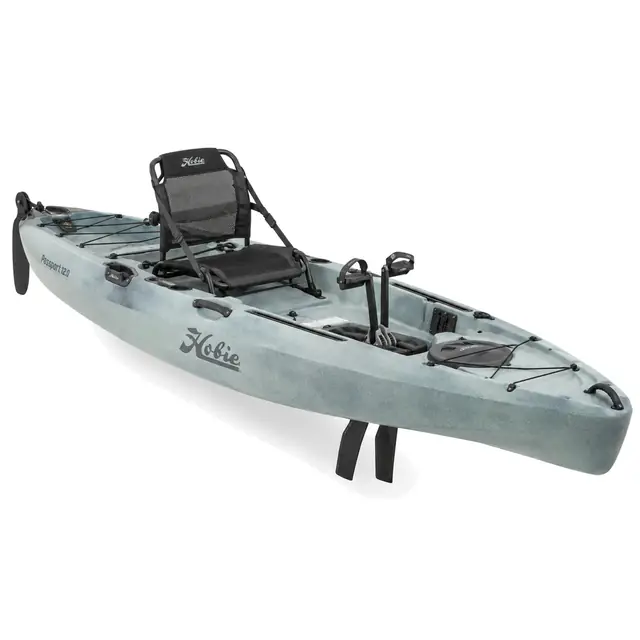
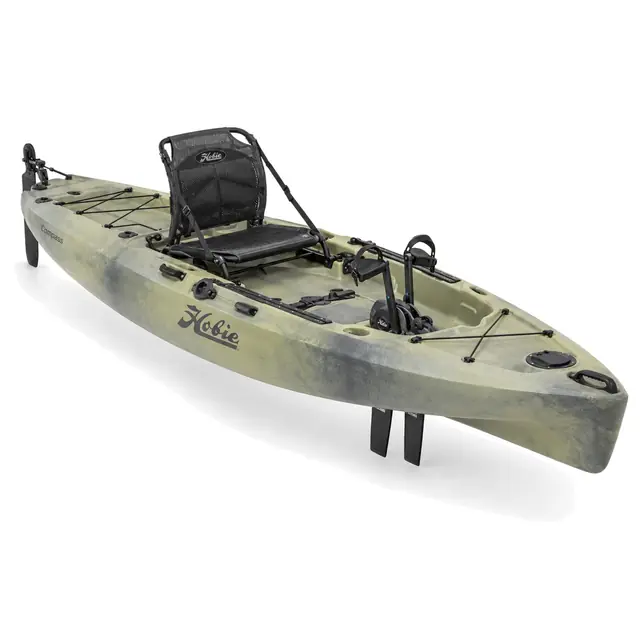
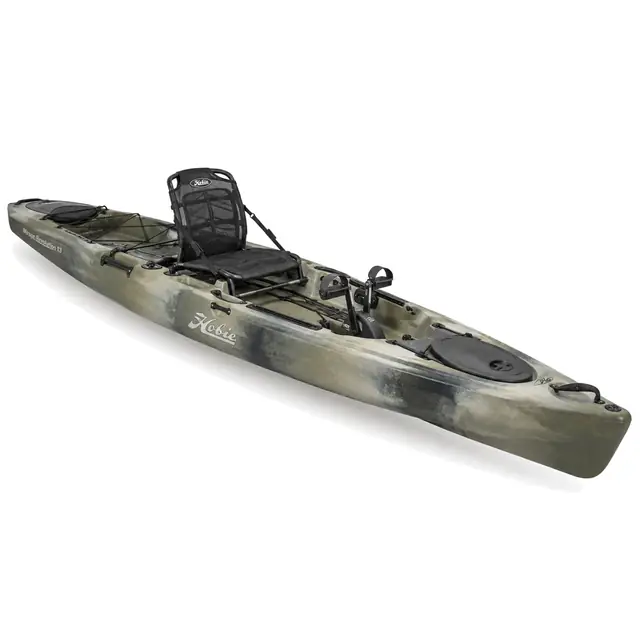
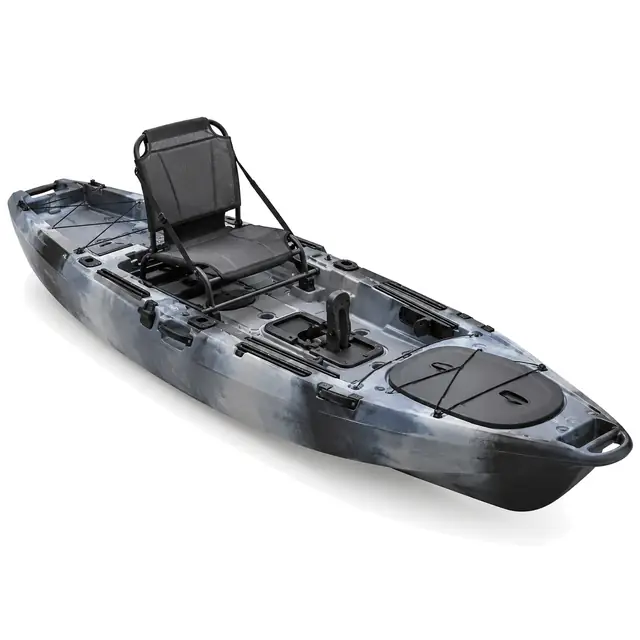
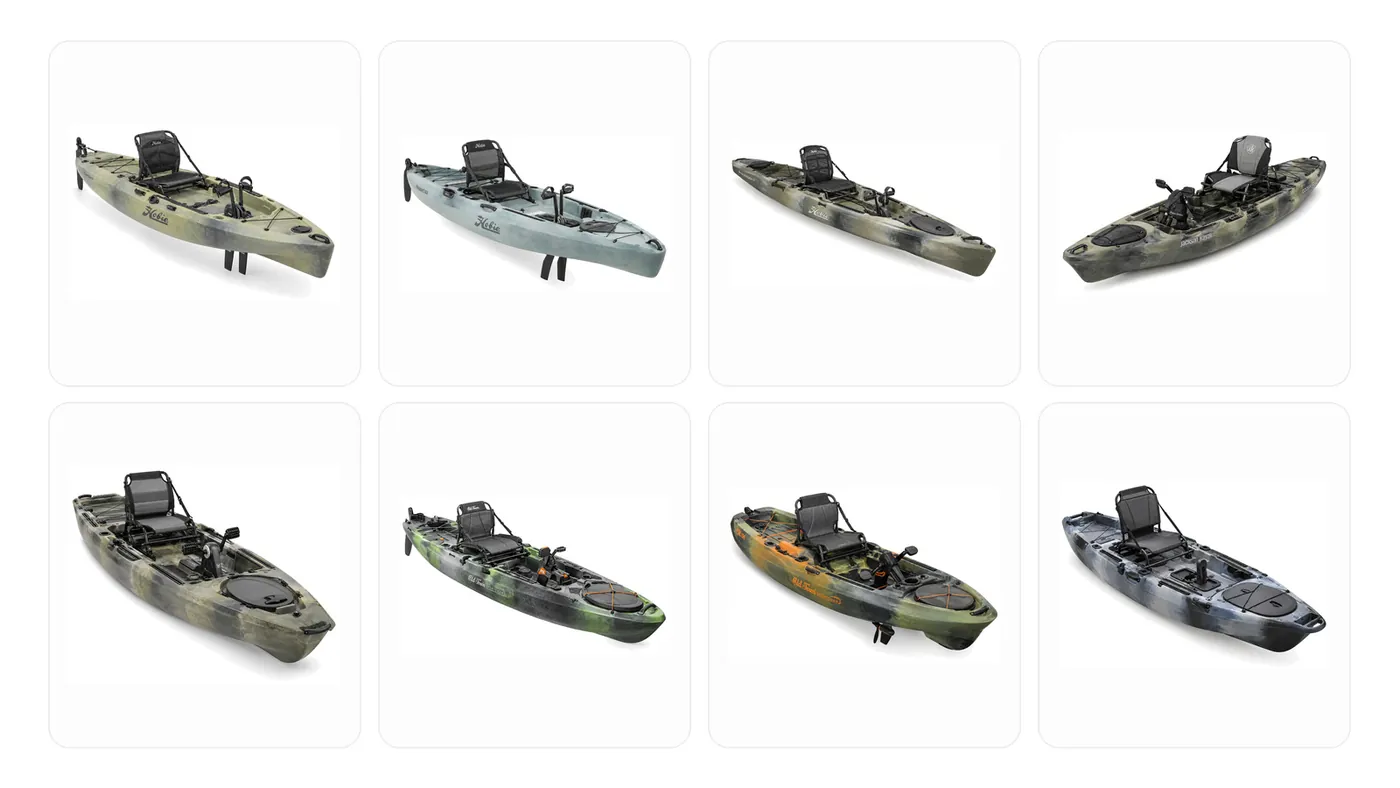
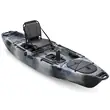
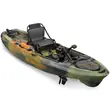
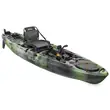
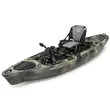
The four lightweight pedal kayaks reviewed below: Hobie Mirage Passport 12.0 R, Hobie Mirage Compass, Hobie Mirage Revolution 13 and Vibe Shearwater 125. Manufacturer product photography.
Best Lightweight Pedal Fishing Kayaks for Saltwater: Every Boat Under 100 lb
There’s a specific moment when a pedal kayak stops getting used. Nothing has broken and the season isn’t over. It’s just that loading it alone has become the thing that decides whether a trip…
By Larry MurrayUpdated 6 September 202622 min readBuyer’s Guide
The quick answer
Kayak weight is published in at least four different ways, and the terms are not interchangeable. Bare hull weight sells boats; assembled or fully rigged weight is what you lift onto a roof rack, drag across sand and load alone at the end of a long day.
Lightest overall: the Hobie Mirage Passport 12.0 R, at 83 lb fully rigged, the lightest genuine saltwater pedal kayak currently on the market.
Best balance of light and capable: the Hobie Mirage Compass, 87 lb fully rigged with a wider, more stable hull than the Passport.
Best for a reader who needs payload as well as portability: the Vibe Shearwater 125, which clears 100 lb only as a bare hull but carries more weight and costs less than any Hobie on this list.
Affiliate disclosure. Affiliate disclosure: ReefReadyGear earns a commission on some links below at no extra cost to you. We don’t accept payment for placement, and every boat here was selected on published specifications and expert and owner feedback. Specifications verified September 2026.
Which weight are you actually reading?
Bare hull, fitted hull, assembled and fully rigged can differ by 25 lb on the same boat. Every figure on this page carries the term its maker uses, and the ranking uses one term throughout so the boats are comparable.
ReefReadyGear does not run a testing programme, and nothing on this page is presented as a first-hand test result.
Every figure here is drawn from manufacturer and builder documentation, authorised retailer listings and published
angler experience, verified in September 2026 and dated where it matters. Where a number is our calculation rather
than a published figure, we label it and show the method.
One weight term used for ranking, with every published figure labelled by the term its maker uses
Paddle-only hulls and inflatables excluded, since this is a pedal-kayak shortlist
Boats over 100 lb named in the exclusions rather than quietly dropped
The payload cost of a light hull stated plainly, with the capacity method credited to the guide that owns it
Where two authoritative sources disagree, both are quoted and attributed rather than blended, and where a maker
publishes no figure at all we say so instead of estimating quietly.
There’s a specific moment when a pedal kayak stops getting used. Nothing has broken and the season isn’t over. It’s just that loading it alone has become the thing that decides whether a trip happens, and lately the answer keeps landing on no. A car roof instead of a truck bed, a solo launch with no one around to grab the other end, a long carry across soft sand, a back that’s done arguing with a wet hull. The boat that gets used is the boat that gets loaded, and most anglers work that out the hard way.
Here’s the trap waiting for anyone shopping their way out of that problem. The weight printed on a product page is often not the weight you’ll carry. Manufacturers publish at least four different figures for the same boat, and they don’t publish the same one as each other. The Vibe Shearwater 125 is sold as an 82 lb kayak, and it’s also sold as a 109 lb kayak, and both numbers are true. The Old Town Sportsman PDL 106, routinely recommended as a light pedal boat, weighs 107 lb assembled. Compare a bare hull weight against an assembled weight and the resulting ranking has nothing to do with what actually gets lifted onto a roof rack.
This guide defines the weight term before ranking anything, applies one consistent measurement throughout, and states plainly which saltwater pedal kayaks clear 100 lb, which popular boats don’t (and by how much), and what going lighter costs in payload. One note up front: this is a portability guide, not a budget guide. The lightest genuine saltwater pedal kayaks are mostly Hobies, and Hobies aren’t the cheapest boats on the water. Light and cheap diverge sharply in this category, and this guide isn’t going to pretend otherwise.
Which weight are we talking about?
Hull weight is the bare plastic shell with no seat and no drive. Assembled or fully rigged weight includes the seat, the drive, and the fitted hardware, which is what you actually lift and carry to the water. The Vibe Shearwater 125 is published at 82 lb as a hull and 109 lb fully loaded, and both figures are correct; they just describe different objects.
Manufacturers use four terms, more or less interchangeably, and competing kayak roundups treat them as one number:
The gap between “hull weight” and “fully rigged” is not small. On the Shearwater it’s 27 lb, or roughly a filled tackle crate. A reader comparing an 82 lb figure against a 107 lb figure believes they’re seeing a 25 lb difference in what they’ll carry. They’re actually seeing an apples-to-oranges comparison where the “lighter” boat, once rigged, weighs about the same as the boat it’s being compared against.
The rule for this entire article: rank by assembled or fully rigged weight, because that’s the number that describes what leaves your hands when you set the boat down. Where a manufacturer publishes only a bare hull figure and no rigged weight, we say so rather than quietly treating it as comparable.
What you actually carry
Every saltwater-capable pedal kayak we could verify, normalized to a single “what you carry” column.
Kayak
Published term
Published weight
What you carry
Hobie Mirage Passport 12.0 R
Fully rigged
83 lb
83 lb
Hobie Mirage Compass
Fully rigged
87 lb
87 lb
Hobie Mirage Revolution 13
Fully rigged
88 lb
88 lb
Vibe Shearwater 125 (bare hull)
Hull weight
82 lb
82 lb (hull only, no drive or seat)
Vibe Shearwater 125 (rigged)
Fully loaded
109 lb
109 lb
Old Town Sportsman PDL 106
Assembled
107 lb
107 lb
Old Town Sportsman BigWater PDL 132
Assembled
122 lb
122 lb
Jackson Kayak Coosa FD
Fully rigged
128.5 lb
128.5 lb
Native Watercraft Titan X Propel 12.5
Fully rigged
172 lb
172 lb
Expert tip: if a dealer quotes you a weight and can’t tell you which term it is, assume it’s the hull weight. It’s the smallest, most flattering number, and it’s the one salespeople default to when they haven’t been asked to specify.
Bare hull to fully rigged is up to 27 lb on the same kayak. This guide ranks on the bottom step only.
Why the light boats are nearly all fin drives
A MirageDrive is a comparatively light assembly: fins, a linkage, and a housing that mounts into a well. A prop-drive console is a heavier proposition, because it packs a gearbox, a motor mount for forward and reverse, and a sealed housing built to spin a propeller. Old Town publishes the weight of its PDL console on its own, separate from the hull: 21 lb. That single component is most of the difference between a boat that clears 100 lb and one that doesn’t.
Run the arithmetic on the Sportsman PDL 106. Strip the console out and the hull, seat, and remaining hardware come in well under the 100 lb line. Leave the console in and the assembled weight is 107 lb. It isn’t that Old Town builds a heavier hull than Hobie. It’s that a forward-and-reverse prop drive costs weight that a fin drive doesn’t, and that cost lands almost entirely in one component.
This is a design trade, not a defect. A prop-drive console gives you instant reverse and stronger low-speed thrust than most fin drives, and some anglers will take that capability over the weight saving every time, especially for backing off structure or holding against current. The point isn’t that fin drives are better. It’s that if weight is your hard constraint, you’re shopping mostly inside Hobie’s fin-drive lineup whether you intended to or not, and understanding why saves you from being disappointed that “everyone’s other favorite pedal boat” keeps missing the cut.
What going light costs you
Lighter hulls have less volume, and less volume means less rated capacity. That’s not a flaw in any particular boat, it’s displacement, and it applies to every hull on the water. The Hobie Mirage Passport 12.0 R is rated at 400 lb, respectable for a 12 ft hull, but it’s still a smaller number than you’d get from a longer, wider, heavier platform built around carrying capacity instead of carrying weight off the beach.
The number that actually matters isn’t rated capacity, it’s usable capacity: rated capacity minus the boat’s own rigged weight. We calculate and explain usable capacity in full, with an itemized gear-weight breakdown for a pedal drive, battery, electronics, and a livewell, in our guide to offshore kayaks for big anglers. Rather than re-deriving that method here, the short version for this article: subtract the boat’s rigged weight from its rated capacity, and don’t plan a loaded payload above about 80 percent of what’s left for offshore trips.
Applied to the boats in this shortlist, that math gets tight fast. A 400 lb-rated boat weighing 83 lb rigged leaves 317 lb of usable capacity, which sounds generous until you add a 200 lb wet angler, a PFD, a rod, a crate, and a battery. If you’re over roughly 250 lb, run the payload numbers before the weight numbers. The lightest boat that can’t carry you and your gear isn’t a candidate, no matter how easy it is to load. For a full walk-through of that calculation and the load-stack itemization behind it, see the big-anglers guide linked above; this article’s job is transport, not payload.
The saltwater pedal kayaks that clear 100 lb
Four boats made this list, and only four. That’s a short shortlist by roundup standards, and it’s short on purpose: this is every current saltwater-capable pedal kayak we could verify at an assembled or fully rigged weight under 100 lb, using one consistent measurement. The exclusions section immediately below names everything a reader might expect to see here and explains, with figures, why it isn’t.
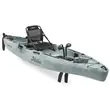
Hobie Mirage Passport 12.0 R — Lightest fully rigged
Published specifications
Dimensions
12’0″ x 34″
Fully rigged weight
83 lb
Rated capacity
400 lb
Drive
MirageDrive GT with Kick-Up fins
Price
check current dealer pricing
Best for
Anglers whose vehicle, storage, or physical constraint is the deciding factor, and who want the lightest genuine saltwater pedal kayak available without stepping down to a paddle boat.
Key features
The Passport is Hobie’s entry point into the MirageDrive lineup, and the GT drive is the mechanism doing the work here: a light, efficient fin-drive assembly that pushes the whole rigged weight down to 83 lb. Kick-Up fins fold back on contact with the bottom or with structure, which matters on a beach launch and around shallow reef. At 34 inches wide it’s narrower than the pontoon-style boats built for standing, which is the trade Hobie is making: this hull prioritizes carry weight and paddling efficiency over maximum stability.
Advantages
Lightest fully rigged saltwater pedal kayak currently verified, at 83 lb
MirageDrive GT is proven, simple to service, and easy to remove for cleaning
Kick-Up fins suit beach and surf launches
Hobie’s dealer network and parts availability lead the category
Limitations
400 lb rated capacity is the lowest in this shortlist, and usable capacity gets tight for heavier anglers or heavy electronics builds
34 inches is workable for standing but not as stable as a wider hull
Price sits well above Old Town’s excluded PDL 106, for a lighter boat with less capacity
Hobie dealer-only in most markets, so Amazon-style one-click buying isn’t available
Real-world application
This is the boat for the angler who has already decided the vehicle and the solo carry are non-negotiable: a small SUV, an apartment with stairs, a beach access point with no cart trail, or simply a back that’s done arguing with a 130 lb hull. It handles nearshore reef, jetty, and inlet fishing well, and it’s light enough to load and unload multiple times in a day without dreading it.
Who should buy it
Anglers under about 230 lb whose binding constraint is weight, not payload, and who fish mostly nearshore rather than running heavy electronics offshore.
Who should avoid it
Anglers over about 250 lb, or anyone planning a full electronics and battery build. Run the payload math first; the big-anglers guide shows exactly how tight it gets.
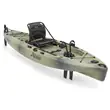
Hobie Mirage Compass — Best light premium hull
Published specifications
Dimensions
12’0″ x 34″
Fully rigged weight
87 lb
Rated capacity
400 lb
Drive
MirageDrive 180 with Kick-Up fins
Price
check current dealer pricing
Best for
Anglers who want a light pedal boat but also want forward-and-reverse pedaling without leaving the fin-drive weight class.
Key features
The Compass carries the same footprint as the Passport but steps up to the MirageDrive 180, which pedals forward and reverse without a hand-operated reverse lever, at a cost of only 4 lb over the Passport’s GT drive. For an angler who backs off structure or holds position against a light current regularly, that’s a meaningful capability gain for a small weight penalty. The rest of the platform, hull dimensions, capacity, and Kick-Up fins, mirrors the Passport closely.
Advantages
87 lb fully rigged keeps it comfortably in single-person-carry territory
Forward and reverse pedaling without switching to a heavier prop-drive console
Same 400 lb capacity and Kick-Up fin durability as the Passport
Strong resale value, typical of the Hobie lineup
Limitations
Same 400 lb capacity ceiling as the Passport, so the payload math doesn’t improve
4 lb heavier than the Passport for the reverse capability, a real trade if you’re shopping at the margin
Dealer-only distribution
34 inch beam is not a standing-stability platform on par with wider hulls
Real-world application
Good around docks, channel markers, and current-swept passes where backing off without a paddle stroke matters. Otherwise it fishes the same water as the Passport: nearshore reef, jetties, and protected coastal runs.
Who should buy it
Anglers who want the lightest possible boat but don’t want to give up reverse pedaling, and who fish areas with current or structure where backing off matters.
Who should avoid it
Anyone who doesn’t need reverse and would rather save the 4 lb and the marginal cost difference by choosing the Passport instead.
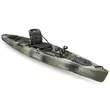
Hobie Mirage Revolution 13 — Best light distance hull
Published specifications
Dimensions
13’5″ x 28.5″
Fully rigged weight
88 lb
Rated capacity
350 lb
Drive
MirageDrive with Kick-Up fins
Price
check current dealer pricing
Best for
Anglers who prioritize covering distance efficiently over standing stability, and who fish spread-out water where a fast, efficient hull earns its keep.
Key features
The Revolution 13 is the outlier in this shortlist: longer and narrower than the Passport or Compass, at 13’5″ and only 28.5″ wide. That shape trades standing room for waterline speed and tracking, and at 88 lb fully rigged it stays inside the sub-100 lb group despite the extra length. It’s the boat for a reader whose priority is closing distance to structure or a bait ball efficiently, not one who plans to stand and sight-cast.
Advantages
Longest hull in this shortlist while still clearing 100 lb rigged
Tracks and holds speed better than the shorter, wider boats here
MirageDrive with Kick-Up fins for shallow and surf-adjacent launches
Genuinely efficient for covering water under pedal power alone
Limitations
350 lb rated capacity, the lowest in the shortlist, which tightens the payload math further
28.5 inches is narrow; standing stability is the weakest of the four boats here
The longer hull needs more storage and roof space despite the light weight
Dealer-only distribution
Real-world application
Best suited to open water where the extra length pays off in tracking and speed: longer runs to a reef or a pass, or covering a stretch of shoreline efficiently between stops. Less suited to anglers who want to stand and cast from a stable platform.
Who should buy it
Anglers who fish spread-out water, value pedaling efficiency, and are comfortable fishing seated rather than standing.
Who should avoid it
Anyone who wants to stand and sight-cast regularly, or anyone near the low end of this shortlist’s capacity ceiling once gear and body weight are added up.
Vibe Shearwater 125 — Best convertible platform
Published specifications
Dimensions
12’6″ x 35″
Hull weight
82 lb
Fully loaded weight
109 lb
Rated capacity
475 lb
Drive
Versa Pod: paddle, Impulse or X-Drive pedal (7 lb), or Bixpy jet motor (9 lb with battery)
Price
around $1,800 base
Best for
Anglers who need more payload than the Hobie shortlist offers, want to spend less, and are willing to accept that this boat clears 100 lb only as a bare hull.
Key features
We’re including the Shearwater with the caveat stated plainly: at 82 lb it’s a bare hull with no seat and no drive, and once it’s rigged to fish it’s 109 lb, which is over this article’s threshold. It earns its place here for two reasons. First, the Versa Pod system means the actual pedal unit only adds 7 lb, among the lightest pedal drives on the market, so the “extra weight” over a Hobie fin drive isn’t the drive itself, it’s the heavier hull and seat underneath it. Second, 475 lb of rated capacity is meaningfully more than any Hobie in this shortlist, which matters if your payload needs outrun your weight constraint. The Versa Pod also swaps between a paddle, the Impulse or X-Drive pedal, or a 9 lb Bixpy jet motor without hardware changes, which is genuinely useful if you’re not certain yet which propulsion you’ll settle on.
Advantages
475 lb rated capacity, well above the Hobie boats in this shortlist
7 lb pedal drive is one of the lightest on the market
Versa Pod swaps propulsion types without a new hull
Meaningfully less expensive than any Hobie on this list
Limitations
109 lb fully loaded is over the 100 lb threshold this article is built around; only the bare hull clears it
Amazon or big-box distribution isn’t universal; check current retailer availability
Seat weight rating not published
Versa Pod flexibility adds a small amount of complexity versus a fixed drive well
Real-world application
A strong fit for a reader who’s already decided a load-assist bar or a truck bed solves the weight problem, and who wants the payload and price to go further than a Hobie allows. It’s also the practical choice for an angler who isn’t sure yet whether they’ll want to pedal or add a small motor later.
Who should buy it
Anglers who need more usable payload than the Hobie shortlist provides, have a loading method that can handle 100 to 110 lb, and want to keep the price under a Hobie.
Who should avoid it
Anyone whose hard ceiling is a bare-hands cartop carry under 100 lb with no loading aid. For that reader, the three Hobie boats above are the honest answer.
Three boats clear 100 lb in their maker’s own term. The near-misses are named rather than quietly dropped.
The near-misses, and their real numbers
These are the boats a reader expects to see on a “lightweight” list, because they’re recommended everywhere else. Here’s why each one is absent, with the published figure.
Old Town Sportsman PDL 106. 107 lb assembled, light for a prop-drive boat but still 7 lb over the threshold. Strip out the 21 lb PDL console and the remaining carry drops to roughly 86 lb, a legitimate two-trip strategy covered below.
Old Town Sportsman BigWater PDL 132. 122 lb assembled. A larger hull built around capacity rather than portability; it belongs in the big-anglers guide, not here.
Jackson Kayak Coosa FD. 128.5 lb fully rigged (109 lb hull, 115 lb with seat, 128.5 lb with the upper drive), verified on Jackson’s own product page.
Native Watercraft Titan X Propel 12.5. 172 lb fully rigged. Superb for standing stability, but the heaviest boat referenced anywhere in this article.
Bonafide pedal kayaks. The lineup (XTR130, PWR129) is paddle- and motor-based; Bonafide currently has no pedal-drive model, so it doesn’t compete here.
Pelican Catch PWR 100. Despite the name, a paddle kayak built for motor mounting, not a pedal-drive kayak, with a 350 lb capacity, the lowest referenced here. It doesn’t qualify on drive type, independent of weight.
Feelfree Overdrive-series pedal kayaks (Lure, Moken, Big Fish). Feelfree doesn’t publish an assembled or fully rigged weight for these on its current product pages. Rather than guess, we’re leaving them out until that figure is published, in keeping with this site’s rule that no weight gets compared without a source.
How you load decides how light you need
The honest reframe here is that “how light must it be” is the wrong question. The right one is “how light must it be, given how I load it.” A $300 loading aid can do more for your usable weight ceiling than a $2,000 lighter boat.
Loading method
Realistic weight ceiling, solo
Cartop, bare hands, no aid
70 to 80 lb
Cartop with a roller or load-assist bar
90 to 100 lb
Cartop with a suction-cup loading pad
90 to 110 lb, technique-dependent
Truck bed, no extender
100 to 130 lb
Truck bed with a bed extender
130 lb and up
Kayak trailer
Effectively no ceiling for one person
Cart, hard ground (ramp, pavement)
100 lb and up, limited by strength to lift onto the cart
Cart, soft sand, standard wheels
Sinks under any boat; wheel size matters more than hull weight here
Cart, soft sand, balloon or beach wheels
100 lb and up across sand
Expert tip: check your vehicle’s published dynamic roof load before you shop. It’s a real number in the owner’s manual, and it frequently rules out boats your back would otherwise have managed. A roof rated for 100 lb dynamic load doesn’t get more forgiving because you found a boat that weighs 90.
Drive removal as a weight strategy
Pulling the drive out of the well and carrying it separately is a legitimate way to change the number, and it’s covered nowhere else on the competing SERP.
Kayak
Carry weight assembled
Drive weight, verified
Carry weight, drive removed
Old Town Sportsman PDL 106
107 lb
21 lb (PDL console, published)
~86 lb, plus a second 21 lb trip
Vibe Shearwater 125, rigged
109 lb
7 lb (Impulse/X-Drive pedal, published)
~102 lb, plus a second 7 lb trip
Hobie Mirage Passport / Compass / Revolution
83 to 88 lb
Not published as a standalone figure
Estimated 15 to 20 lb saving based on comparable fin-drive assemblies; treat as an estimate, not a spec
For some readers, that 21 lb console coming out is the entire difference between “can’t load it” and “loads it every time.” Two manageable trips beats one trip that doesn’t happen. And for some readers, the honest answer is simpler still: a $300 load-assist bar solves the problem better than a new boat does.
How a light hull behaves in salt water
Weight isn’t only a land problem, and every competing article treats it that way. On the water, a lighter hull carries less momentum through chop, which means it rides over a wave train rather than punching through it. That’s an advantage in following seas and a liability heading into a steep chop, where a heavier hull’s momentum would carry it through a face that a light one gets knocked around by.
A light boat is also more affected by wind, both while you’re pedaling and while you’re carrying it across an open beach with the wind broadside. It accelerates quickly, which helps in a surf launch when you need to get through the impact zone before the next set arrives, and it turns easily, which helps working around structure. Expect more hull flex under a concentrated load than you’d feel in a heavier, thicker-walled hull, and remember that a light boat with a full-size angler aboard sits noticeably deeper than the empty specification sheet implies.
None of this makes a light boat unsafe in salt water. It makes it a different tool with different handling, and an angler who buys light expecting it to behave exactly like the 130 lb boat they’re replacing is in for a surprise the first time the wind picks up. For technique on getting a light hull through breaking water specifically, see our surf launch guide, which covers hull behavior in the impact zone in more depth than belongs here.
Saltwater care on a light boat
Rinse the drive with fresh water after every trip, before it dries. Salt that dries in a fin-drive housing works on the seals and pivots.
Pull the drive from the well to rinse it. Water and residue sit in the well itself and don’t flush out on their own.
Dry the drive before storage. Trapped salt water accelerates corrosion at fasteners faster than exposure alone.
Check track hardware, fin pivots, and fasteners monthly during the season.
Mind the roof-rack ride home. Salt spray reaches a roof-carried kayak at highway speed, onto hardware that was clean when you loaded it.
Store the boat rinsed and dry, out of direct UV. Thinner, lighter layups show UV fade and stiffness loss faster than heavier hulls with more material margin.
No. Old Town publishes the Sportsman PDL 106 at 107 lb assembled, which places it over the 100 lb threshold this article uses, despite its reputation as a light pedal kayak.
Not inherently. Stability comes primarily from hull width and shape, not weight. A narrow, light hull like the Mirage Revolution 13 is less stable standing than a wider, heavier pontoon-style boat, but that’s a function of its 28.5 inch beam, not its 88 lb weight. Compare beam and hull shape for stability, and weight for portability; they’re separate variables.
Check your vehicle owner’s manual for the published dynamic roof load, a figure set by the vehicle manufacturer and separate from the roof rack’s own weight rating. It’s frequently lower than either the kayak’s weight or the rack’s rated capacity would suggest, and it’s worth confirming before you shop rather than after.
Not for anything in this shortlist. All four boats here are realistically cartop- or truck-bed-loadable by one person, especially with a roller bar or load-assist system. A trailer becomes worth considering for boats over roughly 120 to 130 lb, which is outside this article’s scope.
Sometimes, and sometimes a $300 loading aid solves the same problem for far less. If your vehicle and your body can already manage 100 to 110 lb with a roller bar, the Vibe Shearwater 125 gives you more payload and a lower price than any Hobie here. If your ceiling is genuinely under 90 lb no matter what you add to the truck or roof, the Hobie shortlist is the honest answer, and it costs what it costs. —
Final verdict
Rank saltwater pedal kayaks by assembled or fully rigged weight, never by bare hull weight, or the comparison isn’t valid. The lightest genuine option is the Hobie Mirage Passport 12.0 R at 83 lb fully rigged. If your payload needs outrun your weight constraint, the Vibe Shearwater 125 carries more, costs less, and clears 100 lb only as a bare hull, which is an honest trade worth making for the right reader.
And before you buy anything: check your vehicle’s dynamic roof load and price a load-assist bar. For a meaningful share of readers, that’s the cheaper fix.
Larry Murray
Editor, ReefReadyGear
Larry edits ReefReadyGear, a research-led saltwater gear publication. Recommendations here are built from manufacturer specifications, authorised retailer listings and published angler experience, and we say so plainly rather than implying a testing programme we do not run. Where a claim comes from a manufacturer, we attribute it. Where we have not verified something, we do not print it.
Specifications on this page were taken from manufacturer and authorised retailer listings and the regulatory and safety sources below, consulted September 2026. Prices and specifications change; confirm current figures before buying.
Vibe Shearwater 125: vibekayaks.com, hull weight and fully loaded weight, drive weights for Impulse/X-Drive (7 lb) and Bixpy (9 lb with battery).
Old Town Sportsman PDL 106: oldtownwatercraft.johnsonoutdoors.com, 107 lb assembled, and the PDL console weight of 21 lb as published in the Sportsman BigWater PDL 132 specification breakdown.
Old Town Sportsman BigWater PDL 132: oldtownwatercraft.johnsonoutdoors.com, 122 lb assembled.
Jackson Kayak Coosa FD: jacksonkayak.com, hull weight 109 lb, with seat 115 lb, fully rigged with upper drive 128.5 lb, verified directly during this drafting session.
Pelican Catch PWR 100: confluenceoutdoor.com and Academy Sports product listings, confirmed as a motor-ready paddle kayak (not a pedal-drive model) with 350 lb capacity, verified directly during this drafting session.
Feelfree Overdrive-series pedal kayaks: feelfreeus.com collection page, current model names confirmed, but no assembled or fully rigged weight is published on the collection or individual product pages as of this verification pass; models are excluded on that basis rather than compared using an unverified figure.
eCFR, 33 CFR Part 183 Subpart B, section 183.21: kayaks are exempt from federal capacity-plate rules, cited for context on why capacity figures are manufacturer declarations rather than standardized ratings.
Join The ReefReady Community
Get saltwater Fishing Guides, expert Buyers Guides, equipment recommendations,
marine electronics insights, and practical gear tips delivered to your inbox.
 Lightest fully rigged
 Best light premium hull
 Best light distance hull
 Best convertible platform
 Old Town Sportsman PDL 106
 Old Town Sportsman BigWater PDL 132
 Jackson Kayak Coosa FD
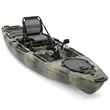 Native Watercraft Titan X Propel 12.5