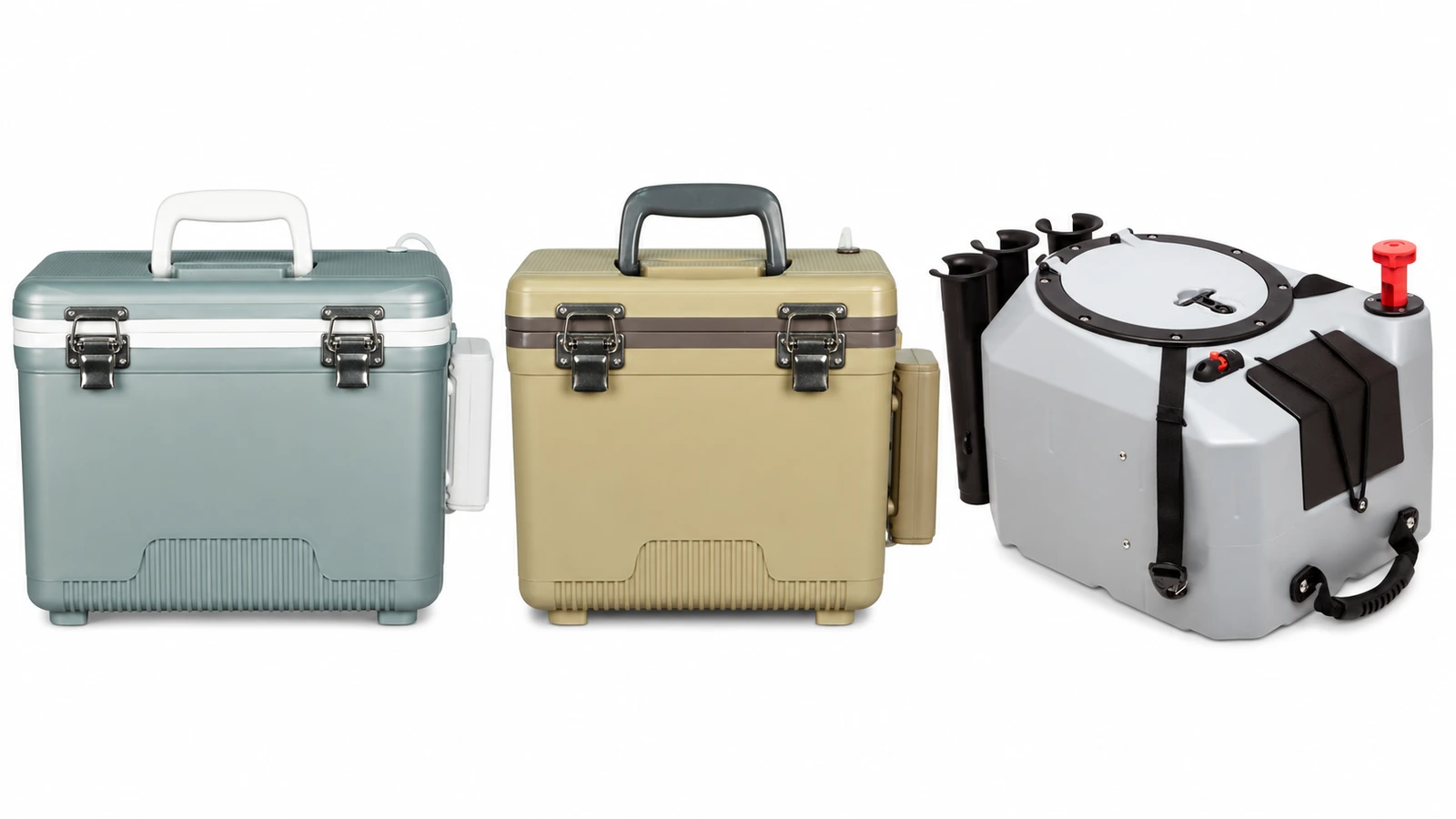
Best Portable Livewells for Saltwater Kayak Fishing: Why the Quart Rating on the Box Isn't the Number That Decides It
Every livewell listing sells you a quart number, and none of them sell you the thirty fumbling seconds behind the seat that actually decide whether the box gets used.
The quick answer
The Engel 13Qt Live Bait Pro is the best portable livewell for most saltwater kayak anglers. It puts 13 US quarts of nominal volume, a removable net and the rechargeable AP3 aerator into a 15 x 10 x 11 in box that lists at 3.5 lb empty and asks nothing of your hull. Anglers fighting for rear deck space should buy the Engel 7.5Qt Live Bait Pro instead, which runs the same AP3 aerator in a 12.25 x 8 x 10 in shell for a deliberately smaller bait load.
Everything below is judged on one question: whether you can work the box from your seat, loaded, with a rod already in one hand.
Affiliate disclosure. Affiliate disclosure: ReefReadyGear earns a commission on some links below at no extra cost to you. This guide draws on manufacturer product pages, installation manuals and government water-science sources, checked September 12, 2026, and it is a researched buying guide rather than a claim of first-hand testing.
The quart rating is not the number that decides fit
Loaded weight, the lid's opening direction, hose routing, and whether a box adds a hull intake to a kayak that did not have one determine whether a specific livewell works on a specific kayak, and none of them show up in the headline number on the product page.
The three awards
The three at a glance
| If you want | Consider | Why |
|---|---|---|
| A removable, aerated bait box for most kayaks | Engel 13Qt Live Bait Pro | More nominal volume than the compact model, in a self-contained format with no hull intake to align |
| The smallest footprint for a crowded deck | Engel 7.5Qt Live Bait Pro | Same rechargeable aerator in a smaller exterior box, for a deliberately smaller bait load |
| True water exchange on a compatible Hobie | Hobie Livewell V2 | A documented intake and drain system, conditional on confirming fit with your exact kayak model and year |
On this page
- The quick answer
- The three awards
- The three at a glance
- How we chose
- Aerated cooler or flow-through livewell?
- How much weight does a kayak livewell actually add?
- What portability costs you in capacity
- The overlooked check: hose and net position
- The best options, with the compromises explained
- Engel 13Qt Live Bait Pro
- Engel 7.5Qt Live Bait Pro
- Hobie Livewell V2
- Compare physical size before nominal capacity
- Rig it so you can use it from the seat
- Keeping saltwater bait healthy in a portable livewell
- Troubleshooting before replacing the livewell
- Accessories that solve a real problem
- Do you need a dedicated livewell at all?
- Frequently asked questions
- Final verdict
- Related reading
- Sources
How we chose
ReefReadyGear does not run a testing programme, and nothing here is presented as a first-hand result. Every specification is drawn from manufacturer product and manual pages, verified September 12, 2026. Where a claim is our calculation rather than a published figure, it's labelled as ours with the method shown.
- Fit and access are checked before tank size, since a box you can't reach from your seat is unfinished rigging regardless of its rating
- Water weight is calculated explicitly, not left for the reader to discover after loading the kayak
- Aerated coolers and flow-through systems are never compared as if they were interchangeable, because they solve different problems
- Manufacturer bait-count guidance is treated as a starting point, not a verified stocking limit
The first stop of a morning trip is a draining creek, bait dimpling along the grass edge, and just enough current to carry a shrimp past the point. You reach behind the seat for the bait box. The lid catches a rod holder. The air hose stretches tight. Getting one shrimp onto a hook suddenly takes both hands, and the fish you were reading the water for are gone by the time you have solved it.
Every livewell listing sells you a quart number. None of them sell you that thirty seconds behind the seat, and it's the thirty seconds that decides whether the box actually gets used.
A kayak livewell has to work from a seated position, loaded, with a rod already in one hand. Tank capacity is one input. The loaded weight, the lid's opening direction, the hose routing and whether the box adds a hull intake to a kayak that did not have one are the inputs that actually determine whether a specific box works on a specific kayak, and none of them show up in the headline number on the product page.
This guide separates the two genuinely different jobs a livewell gets asked to do, publishes the water-weight math nobody puts on the spec sheet, and walks through the rigging check that matters more than the tank size before you order anything.
Aerated cooler or flow-through livewell?
Buy an aerated cooler when portability and simple setup suit your bait plan. Choose a compatible flow-through system only when you specifically need to bring outside water into the tank. An air pump does not replace tank water, and recirculating existing water is not the same thing as a functioning intake and overflow. Treating a livewell as one product category is the first mistake this guide exists to correct.
That distinction follows directly from how each system physically operates. Engel's boxes supply air through a diffuser into water you loaded once. Hobie's manual describes an intake, a pump and a drain, moving outside water through the tank continuously. Hobie's Livewell V2 manual documents that operating sequence in full before you buy the unit.
| System | What it moves | What it does not automatically solve |
|---|---|---|
| Aerated bait cooler | Air into water you already loaded | Water replacement, or removing accumulated waste |
| Recirculating tank | Existing tank water through a pump circuit | Exchange with the surrounding water |
| Flow-through livewell | Outside water into the tank, with an outlet for the displaced volume | Poor intake water quality, blockage, or incorrect installation |
An air pump simplifies the removable setup. For an angler carrying bait from the shop to the launch and then onto the water, a self-contained box is the practical starting point. There is no hull intake to align, and your fit questions concern the box, its attachments and your ability to service it from the seat, not plumbing.
Water exchange adds real installation requirements. Hobie's manual instructs the user to align the intake and drain with cargo scuppers, adjust the intake for the specific kayak, and prime the system by moving the kayak forward. Those are meaningfully different obligations from setting a cooler in a tank well. Before buying a used or remaining-stock unit, ask for an operating demonstration on the intended kayak. A seller showing that the pump makes noise has not shown that the system fills, holds its level and drains correctly.
How much weight does a kayak livewell actually add?
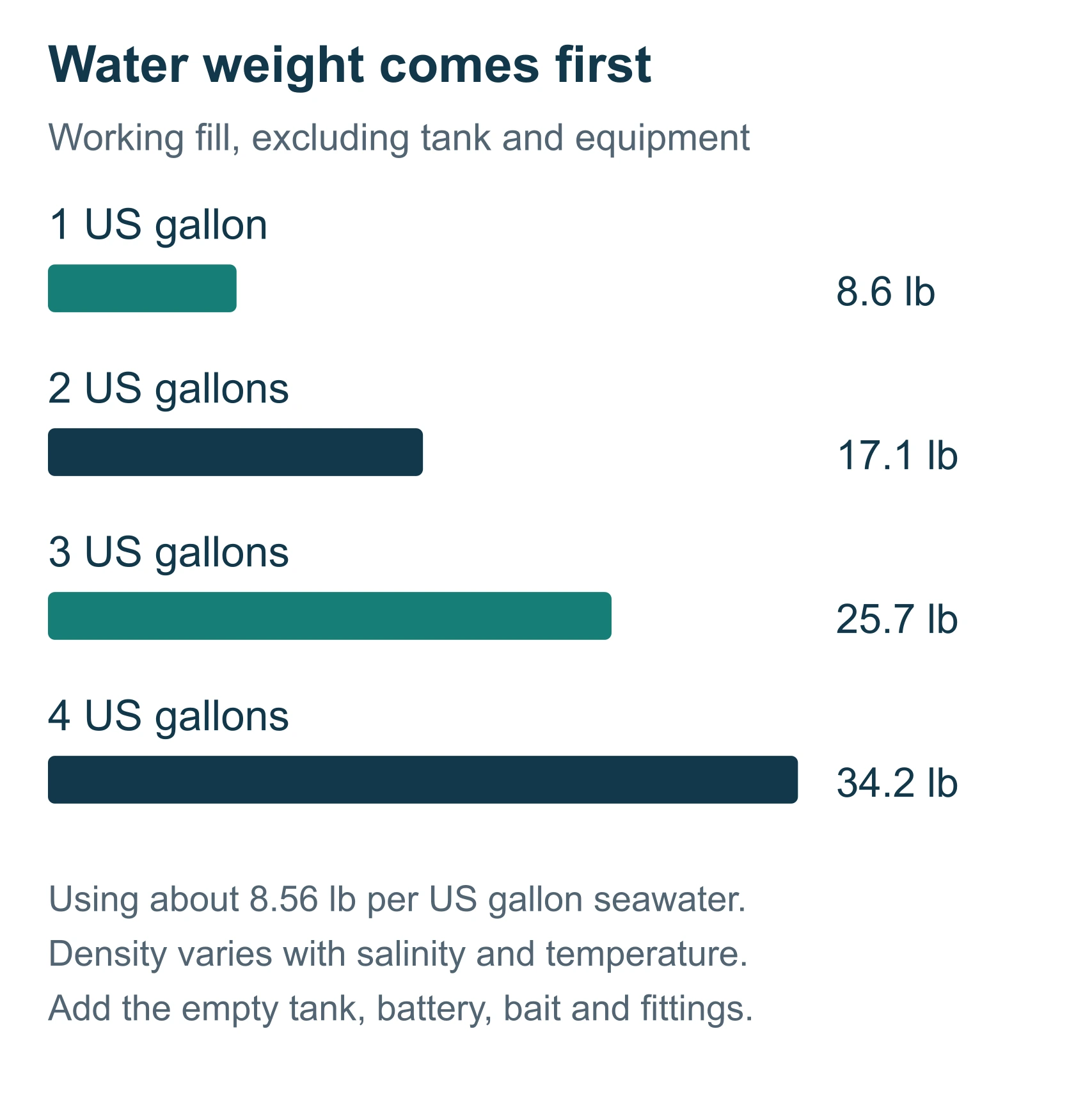
Water usually accounts for most of the added load, and it's the number the quart rating never mentions. Using an illustrative seawater density of 1.025 kilograms per liter, each US gallon of seawater weighs approximately 8.55 pounds, calculated as 1 US gallon times 3.7854 liters per gallon times 1.025 kilograms per liter times 2.2046 pounds per kilogram. Add the container, battery, hardware and bait on top of that figure before you evaluate whether a box fits your kayak's stated capacity.
This is our calculation, using an illustrative seawater density, not a measurement of your actual bait water. Seawater density varies with temperature and salinity; NOAA discusses typical seawater density ranges in its ocean-data FAQ.
| Measured working fill | Approximate water weight alone |
|---|---|
| 1 US gallon | 8.6 lb |
| 1.5 US gallons | 12.8 lb |
| 2 US gallons | 17.1 lb |
| 3 US gallons | 25.7 lb |
| 4 US gallons | 34.2 lb |
The last two rows are general load-planning examples, not suggested fill levels for either Engel model reviewed below.
Kayak capacity terminology is not a universal payload formula. Old Town, for one, distinguishes total boat capacity from usable capacity in its own product documentation. Read the definition published for your exact kayak model rather than applying another maker's method. Old Town Topwater 106 specifications.
Build a full load sheet, not just a livewell estimate. Add the angler, normal clothing and safety equipment, propulsion gear, batteries, tackle and the complete livewell at its working fill, using actual measured weights where you can get them. Recheck handling with the intended load in controlled conditions before extending the trip.
What portability costs you in capacity
Every advantage of a self-contained aerated box is paid for somewhere else. A bigger box holds more nominal volume, and it also weighs more once loaded, sits higher in the tank well, and takes a wider reach to service from a seated position. A box small enough to disappear behind the seat buys you clearance and low weight, and it buys those at the direct cost of how much bait you can reasonably carry.
Neither trade is a defect in a specific product. It's the trade every portable bait box makes, and the honest response is to size the box to the bait load you will actually carry on a typical trip, not to the largest number available at a given price point. A box that is oversized for your normal trip adds water weight and deck intrusion you will pay for every outing, in exchange for capacity you will use rarely.
The overlooked check: hose and net position
Almost every buying guide for this category stops at capacity and aerator runtime. The check that actually determines whether the aerator keeps working over a full trip is where the diffuser and hose physically sit inside the box, and it's rarely mentioned before the sale.
Engel specifically instructs users to place the diffuser stone inside the removable net, because positioning it below the net can kink the hose and interfere with circulation. Make that check after reinstalling the net following a bait change, not only during first setup. A box can look correctly rigged until the next bait change shifts the hose position. Engel's bait-storage guidance.
The thirty-second check almost nobody runs before buying: hold a rod in your normal hand. With the other hand, open the box, lift the net as needed, and close the lid again, from your actual seated position. If that sequence requires rearranging half the rear deck, the box's position needs to change, or the equipment around it does, before you commit to it for a season.
The best options, with the compromises explained
Category boundary, stated plainly: portable and semi-permanent livewell systems sized for a single kayak, evaluated for saltwater bait fishing. Two of the three are self-contained aerated coolers; the third is a kayak-specific flow-through system with hull-level installation requirements. They are grouped by function, not treated as interchangeable competitors.
Engel 13Qt Live Bait Pro: Best for Most Kayaks
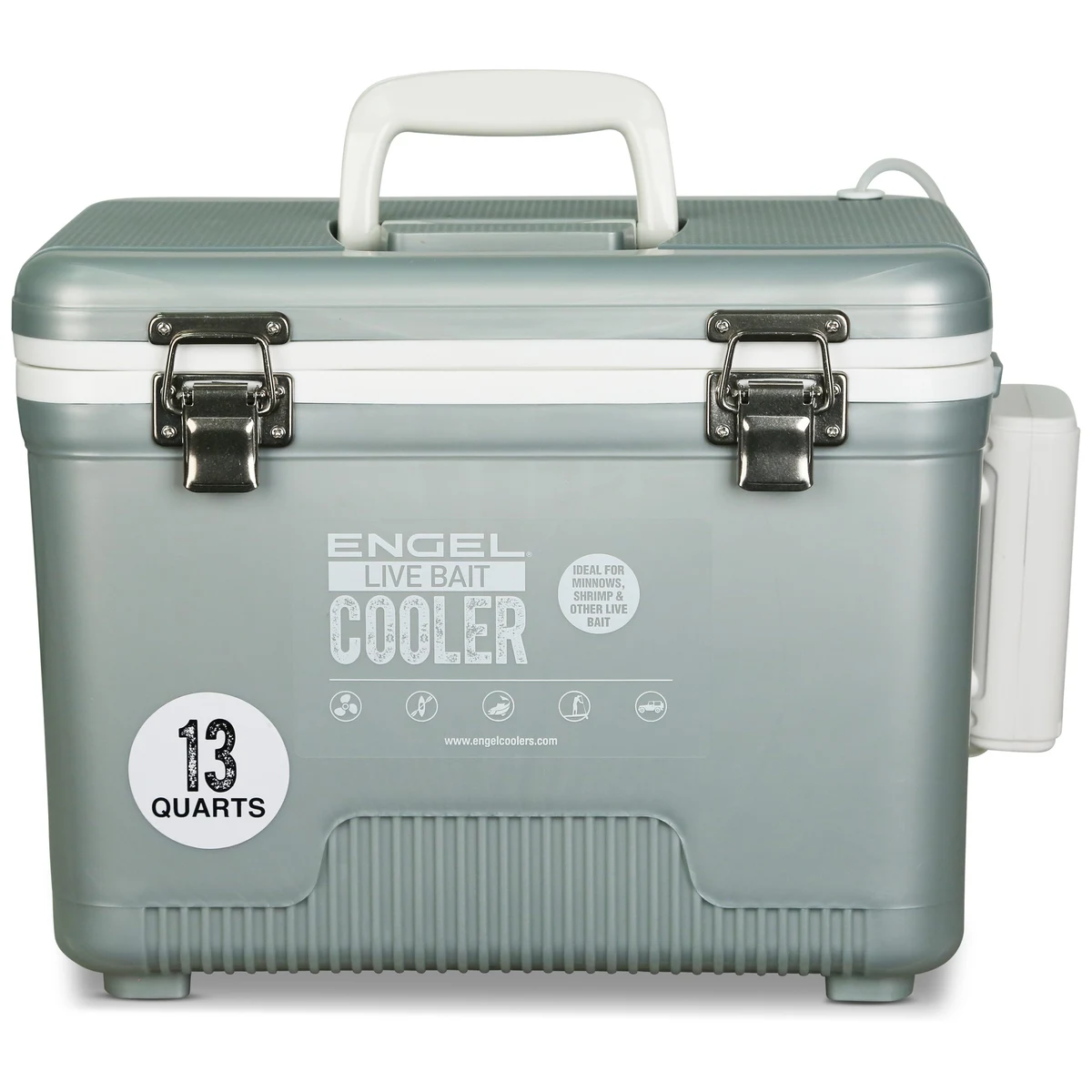
Check Engel 13Qt Pro on Amazon
The 13Qt Pro earns the default recommendation because it adds capacity without adding a plumbing project. You get 13 US quarts of nominal volume, which is 3.25 US gallons, inside a 15 x 10 x 11 in shell listed at 3.5 lb empty, with the rechargeable AP3 aerator, a removable net and stainless hardware supplied in the package. Nothing about it is bolted to the kayak, so it travels from the vehicle to the launch to the tank well and back out again for cleaning. That is the whole argument for a self-contained box, and this is the size that suits the widest range of kayaks.
| Exterior dimensions | 15 x 10 x 11 in |
|---|---|
| Listed empty weight | 3.5 lb |
| Nominal volume | 13 US quarts (3.25 US gallons) |
| Aerator | Rechargeable AP3, included |
| Included hardware | Removable net, stainless hardware |
Source: Engel 13Qt specifications. Working water fill is not published; set and measure it for your own installation.
Why the 3.5 lb empty weight is the least useful number here
Water is the load, not the box. By our calculation, using an illustrative seawater density of 1.025 kilograms per liter, a single US gallon of seawater weighs roughly 8.6 lb, so even a working fill well short of the 3.25 gallon nominal figure outweighs the empty shell several times over. Engel does not publish a working water fill for this model, which means you set it and measure it for your own installation rather than reading it off the box.
Add the battery, hardware and bait on top of that figure before you decide the 13Qt fits your kayak.
The footprint test to run before you order
Cut a cardboard rectangle to 15 x 10 in, set it where the tank will actually sit, and mark which way the lid swings. Then sit in the seat with a rod in your normal hand and reach for it. A lid that opens easily on a garage floor can be awkward under rod holders and rigging on a loaded deck, and that is the failure mode that leaves a box unused after two trips.
If the reach test needs half the rear deck rearranged, move the box or move the gear around it before you commit to a season with it.
What it will not do for you
The AP3 supplies air to water you loaded once. It does not replace that water, and it does not carry waste out of the tank. An angler whose bait plan genuinely depends on exchanging water with the surrounding sea is looking at the wrong category of product, not the wrong size of Engel.
Best for. The angler who wants a removable aerated bait box and has confirmed the loaded footprint clears their kayak's rear storage.
Skip it if. Your rear storage cannot take the loaded footprint, or your bait plan needs water exchange rather than aeration.
Engel 7.5Qt Live Bait Pro: Best for Tight Deck Space
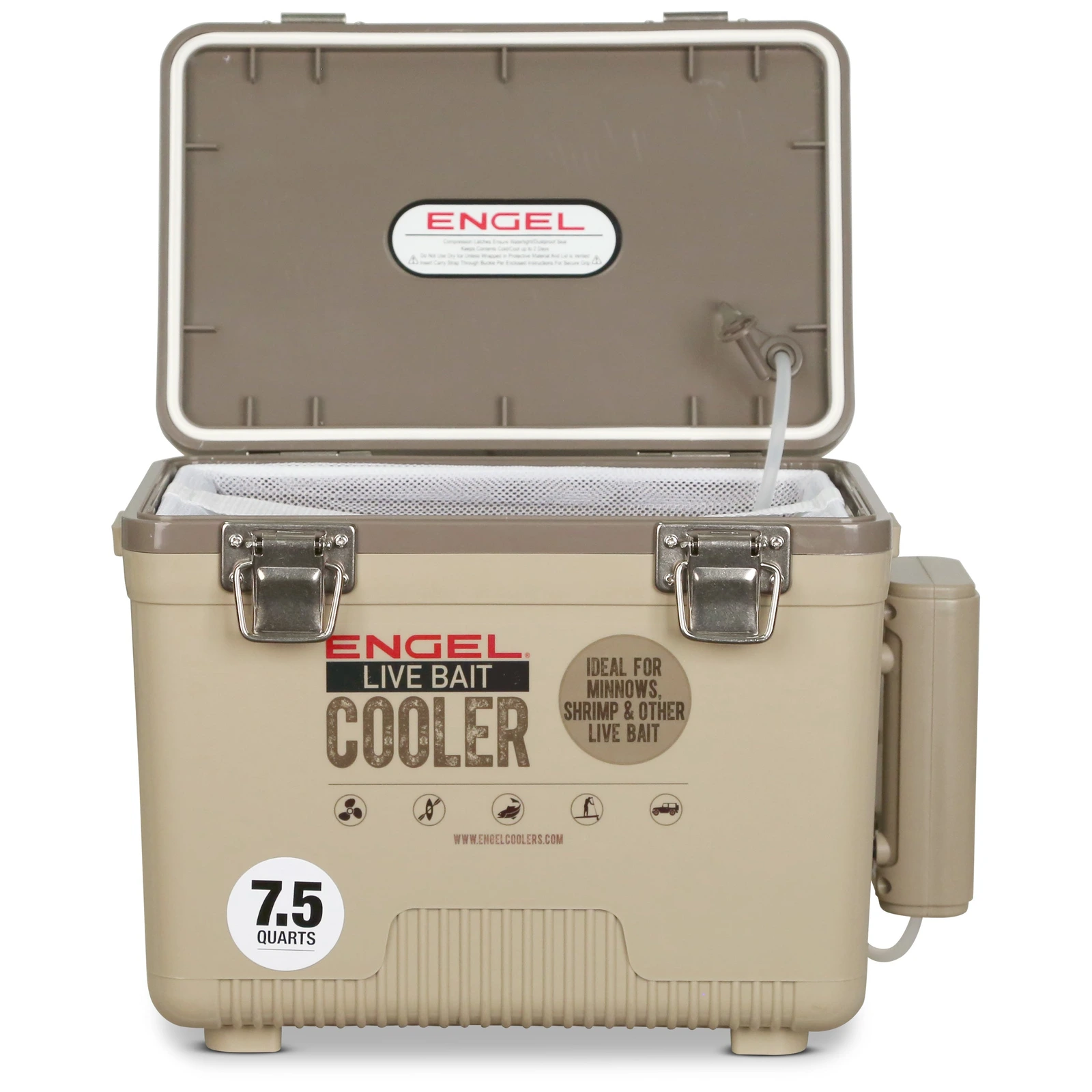
Check Engel 7.5Qt Pro on Amazon
The 7.5Qt Pro is the same system in a smaller shell. It carries 7.5 US quarts of nominal volume, which is 1.875 US gallons, in a 12.25 x 8 x 10 in box listed at 2.5 lb empty, driven by the same rechargeable AP3 aerator fitted to the 13Qt model. The award is for fit, not for value: this is the size that goes in beside rod holders, an anchor trolley and safety gear instead of displacing them.
| Exterior dimensions | 12.25 x 8 x 10 in |
|---|---|
| Listed empty weight | 2.5 lb |
| Nominal volume | 7.5 US quarts (1.875 US gallons) |
| Aerator | Rechargeable AP3, included |
| Claimed aerator battery life | Up to 36 hours (manufacturer maximum) |
Source: Engel 7.5Qt specifications. The 36-hour figure is a manufacturer maximum claim, not a verified runtime or a bait-survival guarantee.
Buy it for the footprint, not to economise on bait
Choosing the small box is a decision about deck space and carrying weight, and it only works when the bait plan shrinks with it. Less nominal volume also leaves less margin if that plan grows mid-season, so the honest way to buy this model is to size it to the bait load you actually carry on a typical trip.
Buying the small box and then relying on the aerator to make an overcrowded tank acceptable is not a saving.
What the 36 hour figure does and does not tell you
Engel lists the aerator battery life at up to 36 hours. That is a manufacturer maximum claim rather than a verified runtime, and it is certainly not a bait-survival guarantee. Oxygen supply is one input among several, alongside temperature, water quality and stocking density, so treat the number as a ceiling for planning charge intervals and nothing more.
Where the diffuser sits matters more on a small box
Engel instructs users to place the diffuser stone inside the removable net, because sitting it below the net can kink the hose and interfere with circulation. In a 12.25 x 8 x 10 in shell there is less room for the hose to find a clean route, so run that check again after every bait change, not only during first setup.
Best for. A crowded deck where the 13Qt footprint does not clear, paired with a deliberately smaller bait load.
Skip it if. You are trying to fit a large bait order into a small box and expecting the aerator to compensate.
Hobie Livewell V2: Conditional, for Compatible Water Exchange
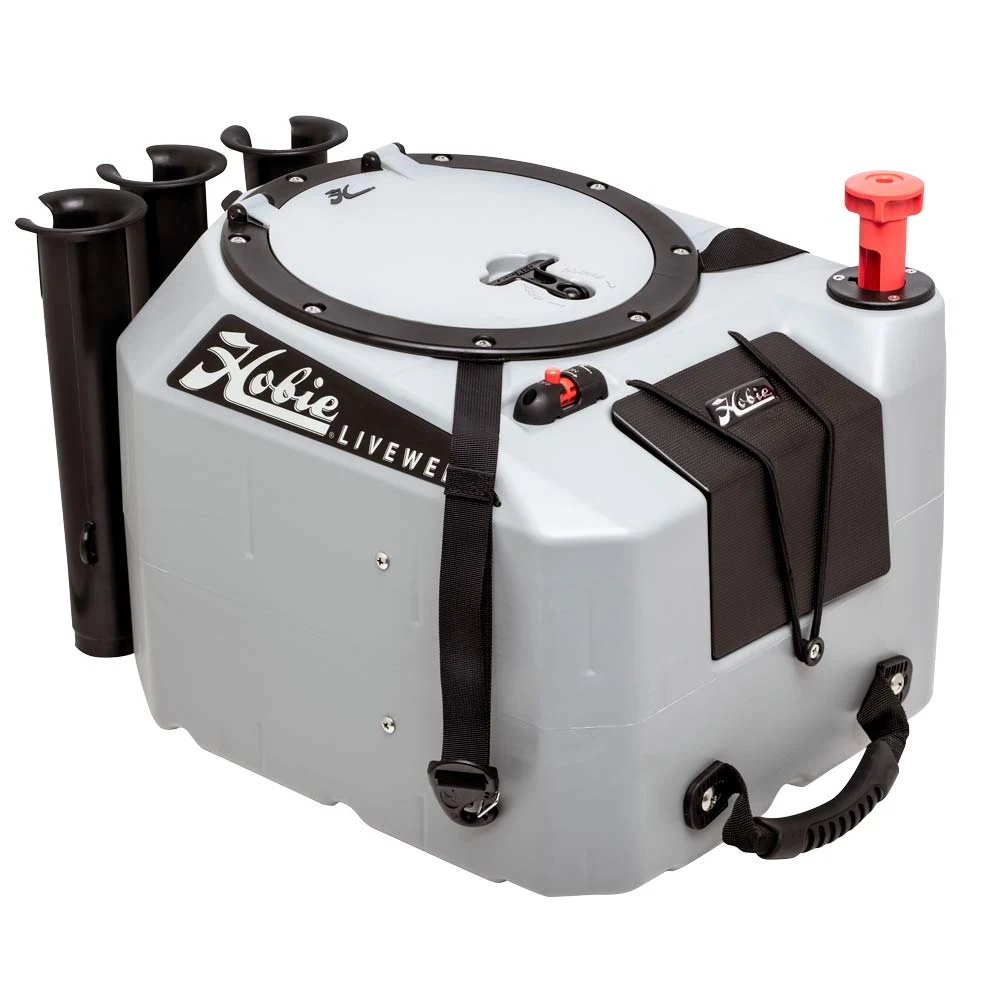
The Livewell V2 is in this guide because it does a job neither Engel box attempts. Hobie's manual describes an intake, a pump and a drain that move outside water through the tank, installed through the kayak's cargo scuppers and primed by moving the kayak forward, with a battery and charger supplied. The award is deliberately conditional: compatibility is model and year specific, and this is not a universal portable box you can drop into any tank well.
| System type | Flow-through: intake, pump, drain |
|---|---|
| Installation | Aligns with kayak cargo scuppers |
| Priming | Manual describes priming by moving the kayak forward |
| Power | Battery and charger, per manual |
| Compatibility | Model- and year-specific; not universal |
Source: Hobie Livewell V2 manual. Current new-unit availability and fit across every present Hobie model cannot be confirmed from this documentation alone.
Exchange and aeration are not the same purchase
An air pump pushes air into water you already loaded. This system replaces the water itself, with an outlet for the displaced volume. If your fishing routine specifically needs that, no aerated cooler substitutes for it, and if it does not, you are buying installation obligations you will never use.
Confirm the kayak before you confirm anything else
The intake and drain arrangement is tied to scupper placement and to an intake adjustment made for the specific model, so fit is the first question and the only one worth asking early. Ask a dealer to confirm your exact kayak model and year rather than assuming that a Hobie badge means compatibility.
A unit that fits nothing you own is not a bargain at any price.
How to inspect a used or remaining-stock unit
Inventory the parts against the manual before paying, and confirm the intake and drain hardware are complete and the battery is healthy. Then ask for an operating demonstration on the kayak it will live on. A seller showing that the pump makes noise has not shown that the system fills, holds its level and drains correctly, which is the whole reason to buy a flow-through tank in the first place.
Best for. An angler on a confirmed-compatible Hobie whose fishing genuinely needs outside-water exchange rather than aeration of a fixed volume.
Skip it if. You cannot verify model and year fit, or cannot confirm the intake and drain hardware are complete on the unit in front of you.
Compare physical size before nominal capacity
| Published specification | Engel 7.5Qt Pro | Engel 13Qt Pro |
|---|---|---|
| Nominal volume | 7.5 US quarts | 13 US quarts |
| Nominal volume in US gallons | 1.875 | 3.25 |
| Exterior dimensions | 12.25 x 8 x 10 in | 15 x 10 x 11 in |
| Listed empty weight | 2.5 lb | 3.5 lb |
| Aerator | Rechargeable AP3 | Rechargeable AP3 |
| Working water fill | Set and measure for the installation | Set and measure for the installation |
Specifications come from the two Engel product listings linked above. Gallon figures are calculated by dividing US quarts by four. Nominal box volume is not an instruction to carry that much water. Bait access, clearance above the water and the complete loaded installation still need separate evaluation. A tank well's length and width are only the first measurements; inspect the full height, lid movement, hose route, attachment points and how the box comes out for cleaning.
Rig it so you can use it from the seat
A secure box you cannot comfortably open is unfinished rigging. Run a dry rehearsal with the rest of your fishing equipment already in place, not on an empty deck.
| Check | What to demonstrate |
|---|---|
| Lid movement | Opens without moving rods or unplugging equipment |
| Bait access | Hand or net reaches the water from the normal seated position |
| Attachments | Box stays in its intended position without pinching the hose |
| Aerator access | Controls and connections are reachable |
| Drainage | Intended drains and scuppers remain functional |
| Other equipment | Paddle, steering, net and safety equipment remain accessible |
| Removal | The loaded box can be handled without an awkward lift |
Keep attachment straps and hose routing separate. Use attachments appropriate to the kayak and container, and never treat the air hose itself as a tether. Route it away from lid edges and any strap that could pinch it.
Keeping saltwater bait healthy in a portable livewell
Match the bait load to the species, working water volume, temperature and holding time. Keep aeration running, monitor water condition, and use a water-exchange plan when the trip genuinely requires one. Visible bubbles are not proof of adequate oxygen, and a published container capacity is not a survival guarantee for every bait species.
USGS explains that aquatic organisms depend on dissolved oxygen, and that warmer water holds less oxygen than colder water. That is why temperature belongs in the bait plan alongside the air pump; it does not establish a single safe temperature or stocking limit for all marine bait. USGS: dissolved oxygen and water.
Treat published bait counts as starting guidance, not a verified result. Engel publishes a field guide with species groups and suggested quantities, and that is manufacturer guidance, not a controlled result for your salinity, bait size, temperature or trip length. Engel's live-bait field guide. Ask your bait supplier about the specific species and its holding conditions, start conservatively, and record what actually happens.
| Trip record | Useful detail |
|---|---|
| Bait | Species, approximate size, and count |
| Water | Measured starting fill and source |
| Temperature | Start and later readings |
| Time | Loading, launch, and end of holding |
| Aeration | Mode, interruptions, and diffuser condition |
| Maintenance | Water changes or other actions |
| Result | Bait condition and losses, without guessing the cause |
Avoid sudden, improvised changes. Follow bait-specific guidance for temperature and salinity rather than dropping loose ice into saltwater because the box feels warm; Engel specifically warns against loose ice in its storage guidance. If bait condition declines, inspect the system and conditions promptly. A larger air pump is not a confirmed fix for crowding, unsuitable water or a pinched hose.
Troubleshooting before replacing the livewell
| Symptom | First checks | Buying lesson |
|---|---|---|
| Aerator stops | Charge, connections, switch, manufacturer troubleshooting | Carry a verified backup plan rather than relying on maximum runtime |
| Air output appears reduced | Hose routing and diffuser condition | Inspect consumable parts before replacing the box |
| Flow-through tank does not fill | Intake alignment, priming, the manual's procedure | A running pump does not prove water delivery |
| Water level is wrong | Drain arrangement, blockage, specified adjustment | Confirm operation at the intended working level |
| Bait declines despite bubbles | Temperature, load, water condition, species requirements | Aeration is one part of holding bait, not the whole plan |
| Access becomes awkward | Lid direction, rods, straps, seat position | Correct the layout before buying a larger tank |
These are inspection priorities, not a diagnosis of every possible failure. Use the exact pump and tank instructions for servicing, and do not improvise battery substitutions or run a water pump outside its approved operating conditions.
Accessories that solve a real problem
| Accessory | Reason to consider it | What to verify |
|---|---|---|
| Compatible spare aerator | Backup for an aerated system | Connection, intended environment, tested operation |
| Spare hose and diffuser | Replaces a damaged or obstructed component | Correct fit and the maker's installation guidance |
| Suitable attachment hardware | Secures the container in its chosen position | Approved mounting points, unobstructed access |
| Thermometer | Adds a measured condition to bait care | Suitable range and use instructions |
| Power supply or charger | Supports the exact installed pump | Voltage and charging compatibility |
Don't buy a large marine lithium battery for a self-contained rechargeable aerator simply because other kayak electronics use one. The correct power solution follows the device's own instructions; high-ticket equipment only belongs in the purchase when it solves a documented requirement.
Do you need a dedicated livewell at all?
Not every trip justifies one. If your normal outing carries a small handful of bait for an hour or two, a simple insulated bucket with a battery-powered aerator can hold that load without adding a dedicated box, its water weight and its deck footprint to a kayak that's already carrying a full day's gear. The honest answer for a short, light-bait trip is often less equipment, not a bigger box.
Buy a dedicated livewell when your bait load, trip length or species genuinely requires sustained aeration or water exchange that a bucket cannot provide, and size it to that actual requirement rather than to the largest box that fits the budget.
Frequently asked questions
Can I use an ordinary cooler as a kayak livewell?
Potentially, but the conversion needs a complete plan for aeration or water exchange, bait access, attachments, power and cleaning. A container holding water does not establish that the finished system suits your intended bait or kayak.
Is 7.5 quarts enough for saltwater bait?
That is 1.875 US gallons of nominal volume, not a verified bait allowance. Suitability depends on the working fill and the species, quantity, temperature and holding time you actually plan for. Choose the small box only when a conservative bait plan fits it.
Does a bigger air pump keep more bait alive?
Not by itself. Oxygen supply is only one part of holding conditions, alongside temperature, water quality and stocking density. Pump size should not be used to justify an otherwise unverified stocking load.
Can I mix shrimp and baitfish in the same livewell?
There is no universal recommendation covering every species pairing. Ask for advice on the actual species and holding conditions you are working with, and do not assume that sharing a water source means two species should share a small container.
Does every portable livewell need a 12 volt battery?
No. The Engel Pro models reviewed here use their own listed rechargeable aerator; a different system may have different voltage and battery requirements entirely. Follow the instructions supplied with your specific unit.
Will the Hobie Livewell V2 fit any fishing kayak?
No. Its documented intake and drain arrangement is tied to compatible scupper placement and adjustment on specific models. Confirm the exact kayak model and year with a dealer before buying.
Final verdict
The quart number on a livewell's box tells you almost nothing about whether it will work from your seat, loaded, on the water you actually fish. The Engel 13Qt Live Bait Pro is the strongest starting shortlist for a removable aerated box once its footprint clears your kayak's rear storage; the 7.5Qt model is the better call when deck space or loaded weight rules the larger box out. The Hobie Livewell V2 solves a genuinely different problem, water exchange rather than aeration, and belongs only on a shortlist for a confirmed-compatible Hobie. Run the reach test and the water-weight math before you order any of them, not after.
Related reading
Sources
Specifications and guidance on this page were taken from the manufacturer, retailer, and government sources listed below, consulted September 12, 2026. Specifications and pricing change; confirm current figures before buying.
- Engel 13Qt Live Bait Pro product specifications, engelcoolers.com, reviewed September 2026
- Engel 7.5Qt Live Bait Pro product specifications, engelcoolers.com, reviewed September 2026
- Engel live-bait field guide and storage guidance, engelcoolers.com/pages/live-bait-storage
- Hobie Livewell V2 owner's manual, hosted by ManualsLib, reviewed September 2026
- Old Town Topwater 106 capacity terminology, oldtownwatercraft.johnsonoutdoors.com
- NOAA ocean-data FAQ on seawater density, nodc.noaa.gov
- USGS, "Dissolved oxygen and water," usgs.gov/water-science-school
Join The ReefReady Community
Get saltwater Fishing Guides, expert Buyers Guides, equipment recommendations, marine electronics insights, and practical gear tips delivered to your inbox.
No spam. Unsubscribe in one click.