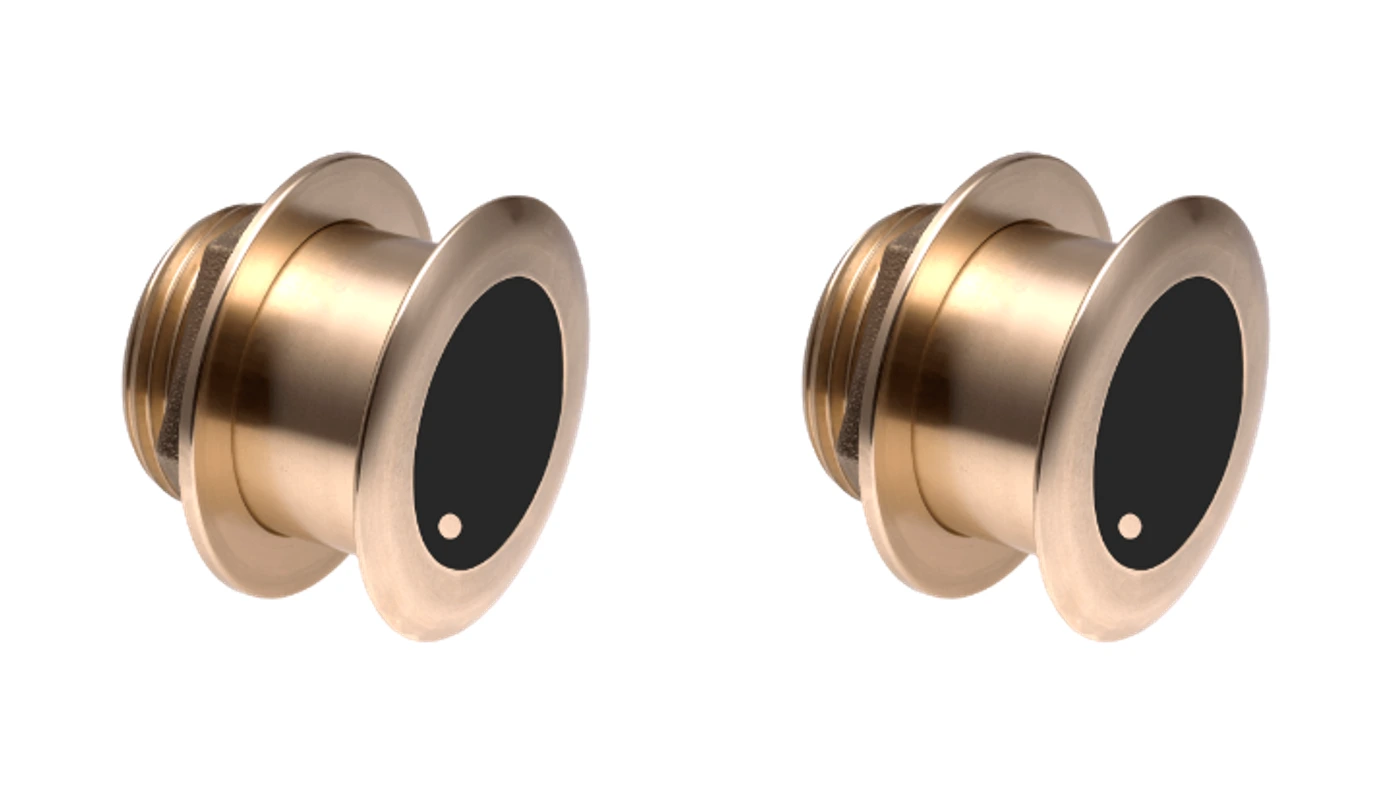
Best Transducers for 200–600 Feet in Saltwater: Depth, Coverage and Fit
The upper end of this depth band changes the shortlist. B175M covers a different documented envelope from B175HW, even though both are one-kilowatt tilted-element transducers.
The quick answer
Start with B175M for regular work across the deeper part of the 200–600-foot band. Consider B175HW for wide coverage within its stated 500-foot limit. Confirm sounder support and hull fit before ordering either, and evaluate a supported dual-band route separately if the fishing requires it.
Affiliate disclosure: As an Amazon Associate I earn from qualifying purchases. Read the disclosure. Amazon links on this page are model searches; match the exact package before ordering.
Quick picks
How we chose
Research basis: This is a researched buying guide, not a hands-on test. Manufacturer documents support specifications; recommendations and evaluation routines are editorial judgments. No matched sea trial or catch comparison is claimed. Exact regional offers and installation compatibility still need checking before purchase. About ReefReadyGear and its editorial standards.
- Compare the complete installation against the intended fishing job.
- Keep published limits separate from demonstrated performance.
- Identify compatibility and evidence gaps before making a purchase.
Find your situation
| Your priority | Starting point | Verify before buying |
|---|---|---|
| Medium CHIRP and deeper regular work | Airmar B175M | Connector, tilt and results at the intended depth |
| Wide coverage in the upper water column | Airmar B175HW | Working depth, sounder support and hull tilt |
These are editorial starting points. The detailed sections below explain the evidence and limits.
Specifications that matter
| Option | Published specification | Purchase check |
|---|---|---|
| Airmar B175M | 1 kW; 85–135 kHz; 16°–11° beam; published maximum 1,500 feet | Connector, tilt and results at the intended depth |
| Airmar B175HW | 1 kW; 150–250 kHz; fixed 25° beam; published maximum 500 feet | Working depth, sounder support and hull tilt |
Specifications: Airmar B175M; Airmar B175HW. Maximum figures are manufacturer claims, not results measured for this guide.
Products in detail
Airmar B175M
Check B175M 0° — cable required
Model search, not a verified offer. Check the seller, exact components and availability.
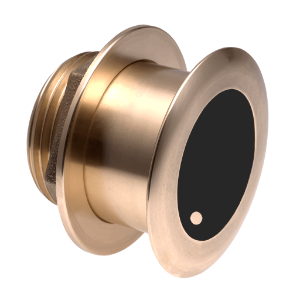
The B175M uses medium CHIRP with a beam that varies from 16 to 11 degrees across its band. Airmar lists a 1,500-foot maximum. Its narrower footprint and different frequency band make it a different tool from the B175HW, even though both belong to the same low-profile housing family.
Manufacturer specifications and package information
Pros
- A published depth ceiling beyond the B175HW’s 500-foot figure.
- Tilted-element variants allow the installer to account for hull deadrise.
Trade-offs
- Less geometric coverage than the high-wide model at an equal depth.
- The maximum-depth figure does not guarantee useful fish marks near that limit.
Buying verdict: Start here for medium-band work; require installation and local-depth evidence before treating the stated ceiling as your everyday result.
Airmar B175HW
Check B175HW 20° — cable required
Model search, not a verified offer. Check the seller, exact components and availability.
The B175HW is a high-wide transducer with a fixed 25-degree beam. Airmar lists a 500-foot maximum. That makes it a candidate for covering bait and suspended targets within that envelope, rather than a general answer to every offshore depth. The bronze housing is specified for fiberglass or wood hulls.
Manufacturer specifications and package information
Pros
- The constant beam angle makes coverage calculations straightforward.
- A low-profile tilted-element installation avoids an external fairing.
Trade-offs
- Its published 500-foot limit does not cover regular bottom fishing at 600 feet.
- A broad footprint is not a measurement of target separation.
Buying verdict: Choose it when wide coverage is the priority and your regular fishing depth fits the published specification.
Choose from regular depth rather than an occasional trip
Separate 200–350-foot work, fishing nearer 500 feet and routine use near 600 feet in your notes. These are planning bands, not abrupt boundaries in acoustic behavior. The important point is whether the deepest routine task fits the candidate’s published specification.
For a boat regularly approaching 600 feet, do not build the primary recommendation around the B175HW’s 500-foot ceiling. If upper-water coverage is the main task above deeper bottom, state that distinction explicitly rather than implying the transducer is being chosen for the seabed depth.
What the available evidence establishes
The linked specifications identify the equipment and its stated limits. They do not establish a controlled performance comparison on your boat. Use the suggested checks to resolve the purchase decision, and keep any future observations tied to their settings and conditions.
Understand what beam width does and does not tell you
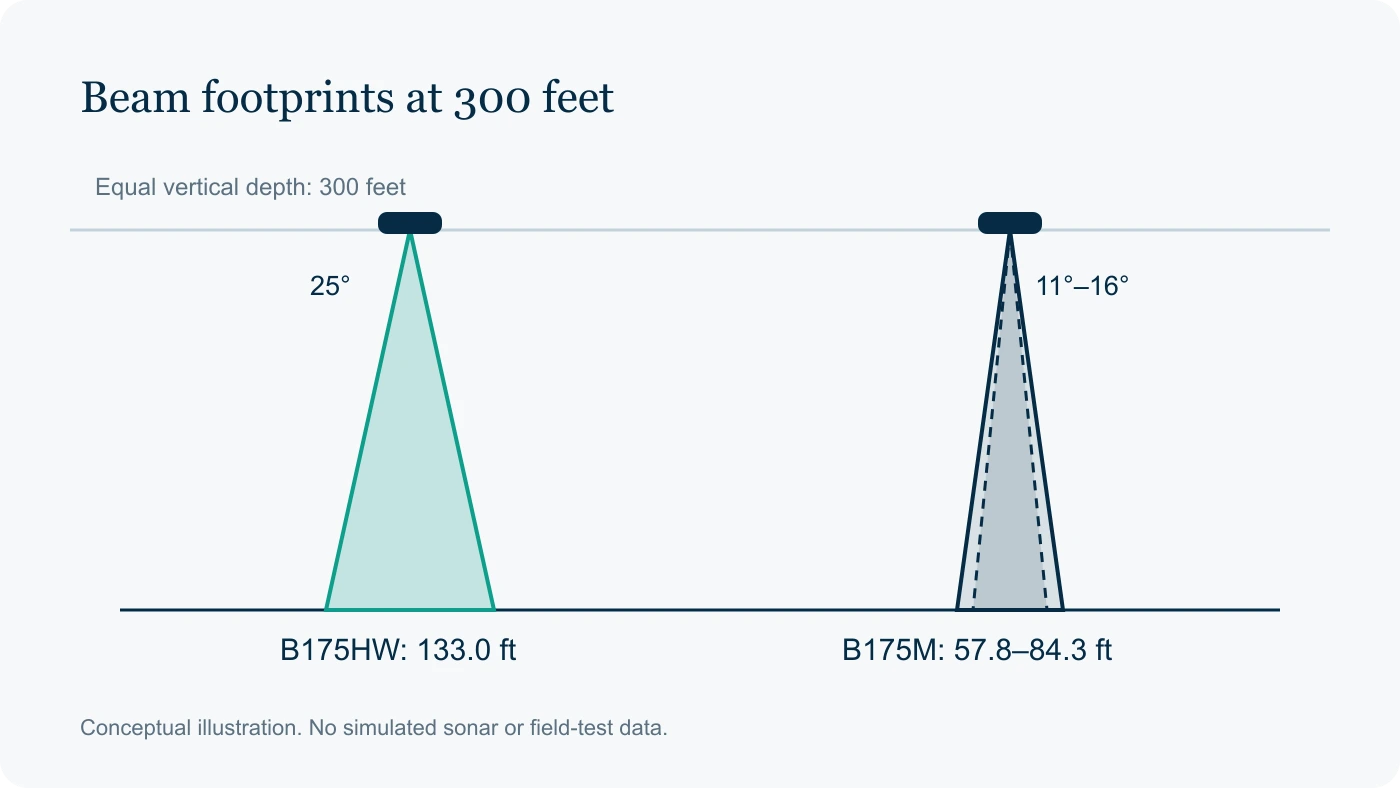
At an equal depth, a wider geometric cone covers a larger area. Use width = 2 × depth × tan(half the full beam angle) to calculate an ideal footprint. At 300 feet, 25 degrees gives about 133 feet; 11 to 16 degrees gives about 58 to 84 feet.
The B175M angle varies across its frequency band. Those endpoints are not two simultaneous fixed beams. The calculation also does not measure fish detection, bottom separation or sensitivity at the edge. Use it to explain coverage, then assess actual target evidence separately.
Supporting documents: Medium CHIRP candidate and installation options; High-wide candidate and its published operating limit; Dual-band candidate and fairing requirements; Band, beam and tilt references.
Check the sounder and hull before ordering
Confirm output, frequency support, exact connector and any adapter against the sounder manufacturer’s documentation. Matching a nominal kilowatt number is insufficient if the system does not support the chosen transducer or band. Put the exact combination in the installer’s written quote.
Airmar offers different tilt versions to account for deadrise. Have the installer verify hull material, angle at the actual mounting position and access for the cable. Do not select the tilt from a broad boat-category description or a measurement taken elsewhere on the hull.
- Depth and task: Bottom continuity or a known target.
- Equipment: Display, sounder, transducer and connector.
- Installation: Tilt, mounting position and cable route.
Document the installed result
Start with a baseline at rest and repeat observations during the fishing movement you normally use. If performance changes at speed, record the pattern for the installer instead of immediately replacing the display or increasing power.
The record below is a practical acceptance worksheet. It does not claim that these transducers have been tested by ReefReadyGear at any of the listed depths.
| Record | What to check |
|---|---|
| Depth and task | Bottom continuity or a known target |
| Equipment | Display, sounder, transducer and connector |
| Installation | Tilt, mounting position and cable route |
| Observation | Settings, speed, successful and unsuccessful returns |
Buying Verdict
Start here for medium-band work; require installation and local-depth evidence before treating the stated ceiling as your everyday result.
Choose it when wide coverage is the priority and your regular fishing depth fits the published specification.
Can one transducer cover every trip?
Possibly, but the choice should be made from the most frequent task and the documented limits. If shallow bait search and deeper bottom work carry equal importance, price a supported dual-band or multi-transducer arrangement instead of pretending the trade-off disappears.
When does B265LH deserve a separate quote?
Consider a dual-band route when the supported sounder and hull can accommodate it and both bands serve regular work. Check Airmar’s installation requirements and the fairing space before treating it as an interchangeable alternative to the low-profile B175 family.
Frequently asked questions
What is the best transducer for 200–600 feet in saltwater?
Choose according to the deepest depth you fish regularly and whether you need bait coverage or bottom-focused detail. The full range does not suit every high-frequency candidate. Compare a transducer’s documented band and depth rating with your sounder’s support, then verify hull material, tilt and connector before choosing an exact part number.
Is a high-wide transducer the best choice across the whole depth band?
A high-wide transducer deserves consideration where its documented operating role matches your target depth and coverage needs. Do not extend a model’s published depth limit to cover the whole article range. For regular fishing near the deep end, compare appropriately rated alternatives and seek evidence from a similar installation before choosing a model for that task.
Does a 1 kW transducer make an existing fish finder more powerful?
A transducer’s power rating does not establish the output supplied by the connected sounder. Check the display or sonar module’s supported output, frequencies and exact transducer compatibility. Include the connector and any required adapter in the verification. Treat a suitable transducer as one component of the system rather than a guaranteed power upgrade.
Final verdict
Before ordering, resolve connector, tilt and results at the intended depth for Airmar B175M, or working depth, sounder support and hull tilt for Airmar B175HW. Choose the documented installation that answers your regular fishing requirement. Leave the purchase open if a required compatibility or performance question remains unresolved.
Related reading
Sources
Manufacturer specifications and supporting documents. Consult the exact regional part number and manual before purchase.