Best Fishing Kayaks for Two Trolling Motors: Redundancy Is the Wrong Word for What a Second Motor Buys You
You run the flat on a stern motor built for distance, then deploy a bow motor to hold your position on the sweet spot without paddling off it between casts, the sales pitch behind every two-motor kayak build.
The quick answer
The Bonafide PWR129 is the platform to assess first for a dedicated two-motor kayak build. Bow and stern motorization is part of its documented design rather than a retrofit, and its 500-pound capacity is stated plainly as kayak, paddler and gear combined, which gives you a real number to build a load ledger against once the 102-pound rigged weight comes out of it. Anglers who need a working pedal drive to survive the installation should buy the Native TitanX Propel 12.5 instead, which layers bow and stern motor provisions onto a retained pedal drive rather than replacing it.
Everything below is judged on one question: whether a second motor earns the word "redundant" once the wiring is checked.
Affiliate disclosure. ReefReadyGear earns a commission on some links below at no extra cost to you. This guide draws on manufacturer product pages, motor and battery documentation, and small-craft stability guidance, checked September 12, 2026, and it is a researched buying guide rather than a claim of first-hand testing.
Redundancy is not the same claim as two jobs
Two motors get marketed as redundancy, the idea that a second motor is also a backup for the first. A second propeller does not automatically mean a second usable propulsion system, and the difference between two separated jobs and true redundancy is the actual subject of this guide.
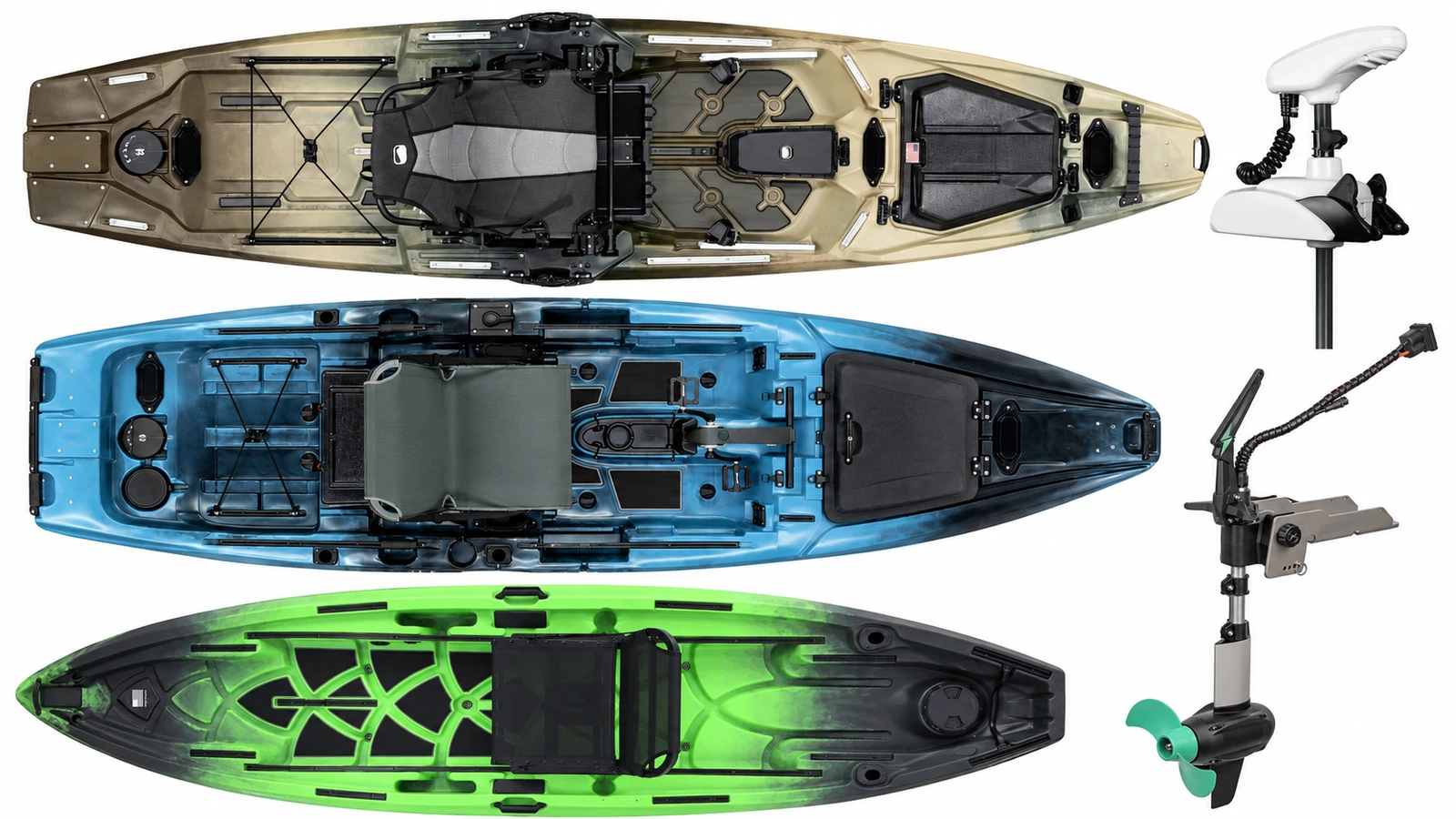
Three platforms and two motors
The five picks at a glance
| If you want | Consider | Why |
|---|---|---|
| A dedicated powered build with no retained pedals | Bonafide PWR129 | Bow and stern motorization built into the documented design, with a stated capacity definition covering kayak, paddler and gear |
| A pedal drive kept in the build alongside two motors | Native TitanX Propel 12.5 | Bow and stern motor provisions layered onto a retained pedal drive rather than replacing it |
| A manufacturer-supported motor package instead of mixed-brand parts | NuCanoe UNLIMITED | Model-specific complete and component propulsion systems, including Newport options, published directly by the builder |
| GPS position holding at the bow | Minn Kota Riptide Kayak Terrova | Spot-Lock on a 12-volt supply, built for holding position rather than covering distance |
| Dedicated travel power at the stern | Newport NK300 HD | A bundled 36-volt, 30-Ah battery and charger matched to the motor's 36-volt input |
On this page
- The quick answer
- Three platforms and two motors
- The five picks at a glance
- How we chose
- What running two motors actually buys you
- Calculate the energy budget before you calculate the boat
- What a second motor costs you in weight, deck space, wiring and price
- The overlooked check: battery label and circuit map before a second motor
- The best platforms and motors for a two-motor build
- Minn Kota Riptide Kayak Terrova
- Newport NK300 HD
- Bonafide PWR129
- Native TitanX Propel 12.5
- NuCanoe UNLIMITED
- Where each platform sits on the trade-off
- When one motor is the better purchase
- Frequently asked questions
- Final verdict
- Related reading
- Sources
How we chose
ReefReadyGear does not run a testing programme, and nothing here is presented as a first-hand result. Every specification is drawn from manufacturer product, manual and installation pages, verified September 12, 2026. Where a claim is our calculation rather than a published figure, it is labelled as ours with the method shown.
- Platform motorization provisions are checked against the manufacturer's own stated capacity definition before any payload math starts, since a headline number and a usable number are frequently different figures
- Bow and stern motors are evaluated against the different jobs they are built for, positioning and travel, rather than pooled as if a buyer were choosing one motor for one job
- Energy and weight are calculated separately for each motor and printed as our worked method, not blended into a single shared-battery recommendation
- A build is never credited with redundancy on the strength of having two propellers alone; redundancy is checked against shared power, shared controls and documented shutdown procedure
You idle out from the launch on the stern motor, the one built to cover distance, and run the flat until the first piece of structure shows on the sonar. You stop, deploy the bow motor, and ask it to hold your position while you work a bait through the sweet spot without paddling off it between casts. That is the sales pitch for a two-motor kayak, and for the specific job of separating travel from position holding, it is an accurate one.
Now picture the part nobody photographs for the listing. Both motors need securing before you run the surf back in. Both batteries need handling on a hull that is already carrying rods, a cooler and the fish you kept. The kayak still has to cross the sand or climb onto its trailer with all of that attached. A build that only solves the trip out is half a build.
Two motors get marketed as redundancy, the idea that a second motor is also a backup for the first. That claim needs testing before you spend on it, because a second propeller does not automatically mean a second usable propulsion system. Redundancy and having two jobs handled by two pieces of equipment are different claims, and the difference is the actual subject of this guide.
What follows is not a speed or range comparison ReefReadyGear ran on the water. It is the energy math nobody publishes for running two motors on separate jobs, the weight and wiring cost a second motor adds that the thrust numbers never mention, and the literal check on your existing electrical setup that decides whether a second motor is even wireable before you buy one.
What running two motors actually buys you
Two motors on a kayak generally buy you two separated jobs, travel and position holding, and redundancy only if the wiring and controls are built to survive one motor's failure. Confusing those two claims is the single most common mistake in how this category gets marketed.
Travel propulsion is the stern motor's job. A stern-mounted electric motor such as the Newport NK300 HD is a current candidate for covering the distance from the launch to the fishing grounds. Newport's own bundle for this motor includes a 36-volt, 30-Ah battery and a compatible charger, and the motor's listing specifies 36-volt input, which tells you the whole point of this system is moving the kayak, not holding it still.
Position holding is the bow motor's job. A GPS-equipped bow motor is the candidate when the requirement is powered position control once you have arrived. The saltwater Minn Kota Riptide Kayak Terrova provides Spot-Lock and uses a 12-volt supply, a different voltage and a different purpose entirely from the stern travel motor above. Evaluate it against where you actually fish, and ask the dealer how it deploys, how it is stopped and how it is secured before travel or landing. A remote in your hand does not resolve a difficult physical deployment.
Redundancy is not automatic from having two motors, and it needs its own check. Two motors provide backup only if the remaining propulsion stays usable after the other one fails. That means checking shared power, shared controls, shared mounting and shared deployment dependencies, not counting propellers. Two motors being installed also does not mean they should both apply thrust at the same time. A GPS-positioning controller and a manually commanded travel motor need an agreed operating sequence, so have the installer document the intended modes, travel, positioning, transition and shutdown, and follow the equipment instructions rather than experimenting with competing controls near a dock.
| Possible problem | Question the build must answer |
|---|---|
| One battery becomes unavailable | Does the other motor have its own usable supply? |
| A remote or controller stops working | What approved control or stopping method remains? |
| Stern propeller is obstructed | Can it be stopped and secured without compromising the bow system? |
| Bow motor cannot deploy | Can travel propulsion and steering still be used? |
| Electrical propulsion is unavailable | Is the paddle accessible, and can the loaded kayak be handled manually? |
This is a systems-planning principle, not a claim that any specific product named in this guide is unreliable. Have the dealer demonstrate approved shutdown and isolation procedures ashore where possible, rather than creating a fault on the water just to complete a checklist. Treat two motors as two separate purchases solving two separate jobs, and treat any redundancy claim as an outcome you verify against the failure table above, not a feature you assume from the box.
Calculate the energy budget before you calculate the boat
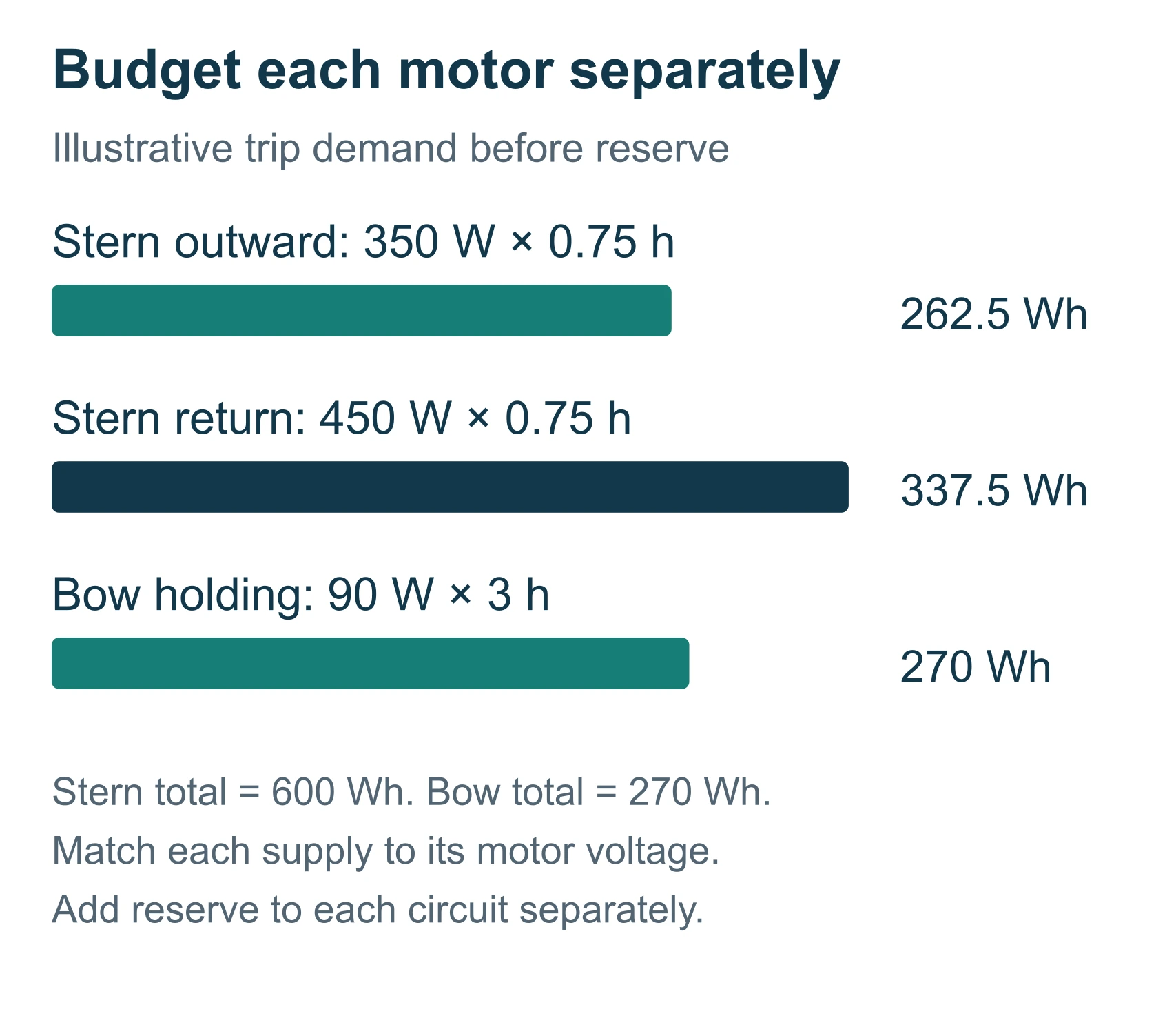
This is the number a two-motor listing routinely skips, because pooling both motors into one battery spec looks simpler on a product page than it is on the water. The motors have different jobs, so the energy planning has to start separately too.
The method
- Separate the two jobs by energy, not by battery. Estimate the average power draw and expected duration for stern travel legs and for bow positioning time, independently of each other.
- Multiply average watts by hours for each leg to get watt-hours. Energy equals average watts times hours.
- Apply a conservative usable-capacity margin. Illustrated here at 80 percent of nominal stored energy, divide each raw watt-hour figure by 0.8 rather than reporting the battery's full rated capacity as the plan.
- Assign each result to its own supply rather than adding the two totals together and shopping for one shared battery by the combined number.
| Assumed use | Average input | Time | Energy |
|---|---|---|---|
| Stern travel outward | 350 W | 0.75 hour | 262.5 Wh |
| Stern travel return | 450 W | 0.75 hour | 337.5 Wh |
| Bow positioning | 90 W | 3 hours | 270 Wh |
The assumed stern requirement comes to 600 Wh across both legs, and the bow requirement comes to 270 Wh. Every figure in this table is our worked planning example, not a measurement of the Riptide Kayak Terrova or the NK300 HD, and not a substitute for logging your own kayak's actual consumption.
Applying the illustrative 80 percent usable-capacity margin gives 750 Wh for the stern example and 337.5 Wh for the bow example. That 20 percent reserve is an editorial planning choice, not a manufacturer requirement and not a guarantee against adverse conditions. Replace these assumed loads with measured use from your completed kayak as soon as you can, recording speed over ground, route, conditions and equipment state alongside consumption so the eventual number has context.
Range is a measured outcome
Do not calculate offshore range by multiplying an advertised maximum speed by an advertised maximum runtime. Those two figures may describe different operating conditions and were never meant to be combined that way. For your own build, calculate watt-hours per mile for a known leg, then compare later trips under similar conditions, and keep a return plan that does not depend on repeating a best-case result.
What a second motor costs you in weight, deck space, wiring and price
Every advantage a second motor buys you is paid for somewhere else on the kayak. None of the trades below are a defect in a specific product. They are the trade every two-motor build makes, and the honest response is to size the build to the fishing problem you actually have, not to the longest motor list a platform can technically support.
Weight is the first cost, and it has to be measured against the platform's actual capacity definition, not its headline number. Build a component ledger using the capacity definition published for your chosen hull. Include both motors, brackets, steering hardware, batteries, wiring, electronics, tackle and any bait water, using actual component weights where you can get them, and keep the same definition when comparing boats, since a bare hull and a rigged kayak are not equivalent starting points.
Bonafide, for one, defines its PWR129's 500-pound capacity as including the kayak, paddler and gear together, which changes the arithmetic: the full 500 pounds is not available for the angler and accessories once the kayak itself is accounted for. NuCanoe publishes a comparable distinction for the UNLIMITED, a 650-pound maximum with scuppers plugged against a 400-pound self-bailing capacity with scuppers open, both stated as passenger-plus-gear weight. Do not carry a headline capacity number into a load decision without also carrying its stated condition.
Deck space is the second cost, and it shows up during a sheltered-water demonstration, not on a spec sheet. During that demo, evaluate the proposed load distribution, and observe drainage, seated reach and normal handling with a qualified instructor or knowledgeable dealer assessing the setup in appropriate conditions. Do not interpret a comfortable dockside sit as evidence of secondary stability in swells; the American Canoe Association distinguishes primary and secondary stability specifically in its boat-selection guidance.
Draw the space each motor occupies when deployed, turned and stowed, add rod holders, display brackets and any sonar pole, and check for overlapping spaces before choosing final mount positions. Then rehearse the fishing transition itself: stop travel, secure equipment as instructed, deploy positioning power and resume fishing, then reverse the sequence for departure. The controls should have an obvious order you can repeat without looking around for loose cords.
Price is the third cost, and it is easy to underestimate by pricing the motors alone. Compare complete build quotes, not just the combined price of two motors and a bare hull.
| Quote line | What must be specified |
|---|---|
| Hull | Exact model and capacity definition |
| Bow system | Motor, approved mount, deployment and controls |
| Stern system | Motor, steering, lift and stopping provisions |
| Power | Separate requirements, batteries and chargers |
| Wiring | Protection, connectors and service access |
| Transport | Cart or trailer suitability and removable parts |
| Commissioning | Load, controls, operation and manual handling checks |
Request the completed cost and a list of exclusions, and ask who supports the whole installation if a problem occurs between components made by different manufacturers. Finally, treat manual handling as a purchase requirement rather than an afterthought: test the cart or trailer plan with the load you will actually move, decide which parts come off at the vehicle and where they are stored during transport, and accept that a build requiring several heavy components to be removed at every launch may still suit you. The point is to know that routine before buying, not after the first difficult recovery.
The overlooked check: battery label and circuit map before a second motor
Almost every two-motor buying guide stops at thrust and price. The check that actually decides whether a second motor is safe and functional to add is whether your existing electrical setup can be read and verified in under a minute, and it is rarely mentioned before the sale.
Two motors sharing one battery is possible only when the exact electrical design and both manufacturers' requirements support it. Do not assume compatibility from battery capacity alone. A 12-volt bow motor and a 36-volt stern motor, the exact pairing the Riptide Kayak Terrova and the NK300 HD illustrate above, require different supplies, and connecting either motor to the wrong voltage is not an acceptable way to simplify the installation or save weight. Separate, appropriately specified supplies are the straightforward configuration to assess with your installer; this guide does not prescribe an improvised conversion system.
| Electrical term | Meaning for the build |
|---|---|
| Voltage | Must match the equipment's permitted input |
| Amp-hours | Charge capacity at the stated voltage |
| Watt-hours | Useful basis for comparing stored energy |
| Continuous current capability | Must support sustained demand |
| Peak capability | Must accommodate permitted transient demand |
| Circuit protection | Must follow the complete wiring and equipment requirements |
Minn Kota's own lithium-battery guidance includes battery-management-system considerations, and the sizing rule it points to is to choose a battery against the motor's stated requirements, not simply the largest amp-hour label on the shelf. Ask the rigger to label every circuit and connector clearly, and get battery restraint, protected terminals, service access and charging into the drawing from the beginning rather than as a retrofit. Your build record should identify each battery, its associated motor, the protection, the cable route and the stopping control, and should also show any equipment the two systems share. Do not let an attractive hidden-wire installation become impossible to inspect; ask how you will reach the connections after a season of use, and how a technician can isolate one part without dismantling everything else. The NK300 HD manual is the authority for that specific motor's installation and operation, and its requirements should not be transferred to another Newport model or to the bow motor.
The thirty-second check almost nobody runs before buying a second motor: open the battery compartment or fuse panel on your existing system, read the voltage and amp-hour rating printed on the case or manual, and confirm out loud which motor each circuit and connector actually feeds. If you cannot answer both of those questions in under a minute, the wiring is not ready for a second motor yet, regardless of how good the deal on it looks.
The best platforms and motors for a two-motor build
Category boundary, stated plainly: three fishing kayak platforms with manufacturer-documented bow and stern motorization or motor provisions, evaluated for a build intended to carry two separate propulsion systems, plus the two current motor candidates most often paired with them for the specific bow-positioning and stern-travel split this guide describes. These are platform and component recommendations for a properly assessed build, not a claim that every combination fits every hull, and not a claim that any finished system has undergone comparative speed, range or handling tests here.
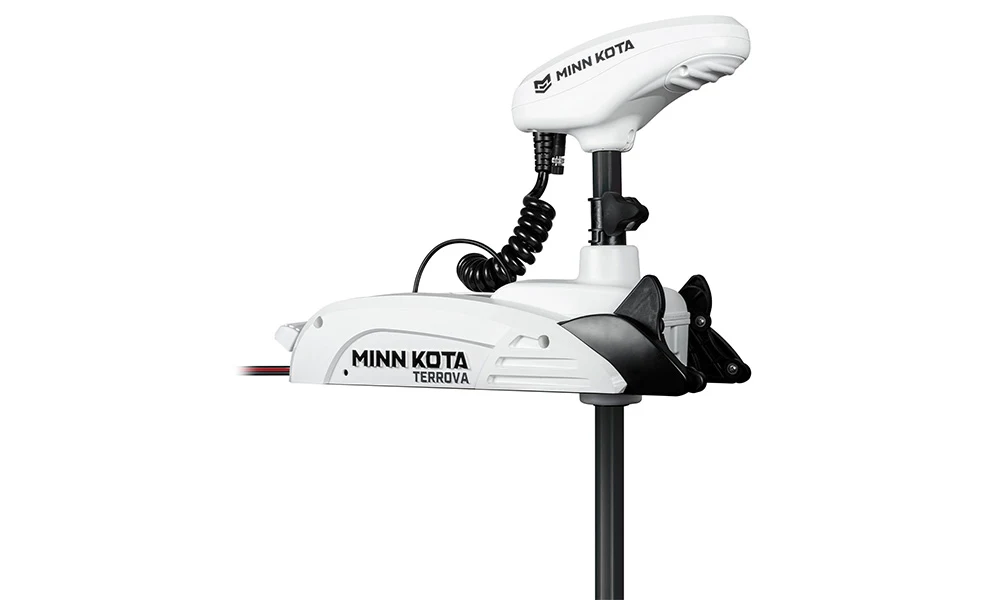
Minn Kota Riptide Kayak Terrova - Bow Motor for Positioning
Check Minn Kota Riptide Kayak Terrova on Amazon
This is the positioning half of the build, and it is on the list because it is sold for exactly that job and nothing more. Spot-Lock runs off a 12-volt supply, the lighter and simpler of the two systems compared here, and it holds the kayak on a piece of structure while the stern motor sits idle. Judge it against the water you actually fish rather than against a travel motor's thrust figure, because the two are not competing for the same work. The documentation reviewed for this guide does not publish thrust, shaft length or price, so part of the comparison has to happen at a dealer.
| Job on this build | Bow, GPS position holding |
|---|---|
| GPS feature | Spot-Lock |
| Voltage | 12V |
| Deployment, stopping and securing | Not detailed in the documentation reviewed for this guide |
Source: Minn Kota product specifications page, checked September 12, 2026. Thrust rating, shaft length and price are not detailed in the documentation reviewed for this guide; confirm current figures with a dealer before ordering.
Why the 12-volt supply matters more than the missing thrust figure
The point of this motor on a two-motor build is that it runs on a different, lighter supply from the stern system. A 12-volt bow motor and a 36-volt stern motor cannot share a battery, which sounds like a complication until you notice it also means the positioning half of the build never has to be sized around the travel half. Thrust, shaft length and price are not stated in the documentation reviewed here, so a like-for-like comparison against the stern motor's numbers cannot be completed from this source alone. That gap matters less than it first looks, because the two motors are not doing the same job.
The deployment sequence is the part a product photo will not show you
A remote in your hand does not resolve a difficult physical deployment. Ask the dealer to demonstrate deployment, stopping and securing on your exact kayak, then ask them to repeat the demonstration as if the bow motor had just failed, so you can see what remains usable.
Best for. The angler who wants powered position control at the bow once the kayak has reached structure, judged against the water they actually fish.
Skip it if. The dealer cannot show you the stow and stop sequence in person, or you need published thrust and shaft figures to finish your own load and control planning.
Check Minn Kota Riptide Kayak Terrova on Amazon
Newport NK300 HD - Stern Motor for Travel

Check Newport NK300 HD on Amazon
The NK300 HD is here as the travel half of the split, and the reason to start with it is the bundle rather than the motor alone. Newport sells it with a matched 36-volt, 30-Ah battery and a compatible charger against a motor listing that specifies 36-volt input, so the voltage-matching decision covered in the overlooked check above is already made for this one system. That removes the most expensive mistake available in a two-motor build. What it does not do is tell you how far your kayak will actually go.
| Job on this build | Stern, travel propulsion |
|---|---|
| Battery bundle | 36V, 30-Ah, with compatible charger |
| Motor input | 36V, per the motor listing |
| Advertised maximum range | Not to be applied to an unfamiliar hull and load |
Source: Newport NK300 HD bundle listing and owner's manual, checked September 12, 2026. Thrust rating, weight and price are not detailed in the documentation reviewed for this guide.
The advertised maximum range is a ceiling, not a trip plan
The advertised maximum range should not be applied to an unfamiliar hull and load. Establish measured consumption during controlled use with conservative trip plans before trusting this motor beyond sight of the launch, and keep logging until you have a watt-hours-per-mile figure for a known leg under known conditions. That number, not the listing, is what a return plan gets built on.
What the manual covers, and what it does not
A documented owner's manual exists, and it is the authority for this specific motor's installation and operation. Do not transfer its requirements to another Newport model or to the bow motor, which is a separate system on a separate supply. Thrust rating, weight and price are not detailed in the documentation reviewed for this guide, so confirm those with the seller before you finalise a load ledger.
Best for. An angler who needs dedicated stern travel power and is prepared to establish their own measured range figure rather than relying on an advertised maximum.
Skip it if. You need a manufacturer-verified range figure today rather than one you build yourself on the water.
Check Newport NK300 HD on Amazon
Bonafide PWR129 - Dedicated Powered Platform
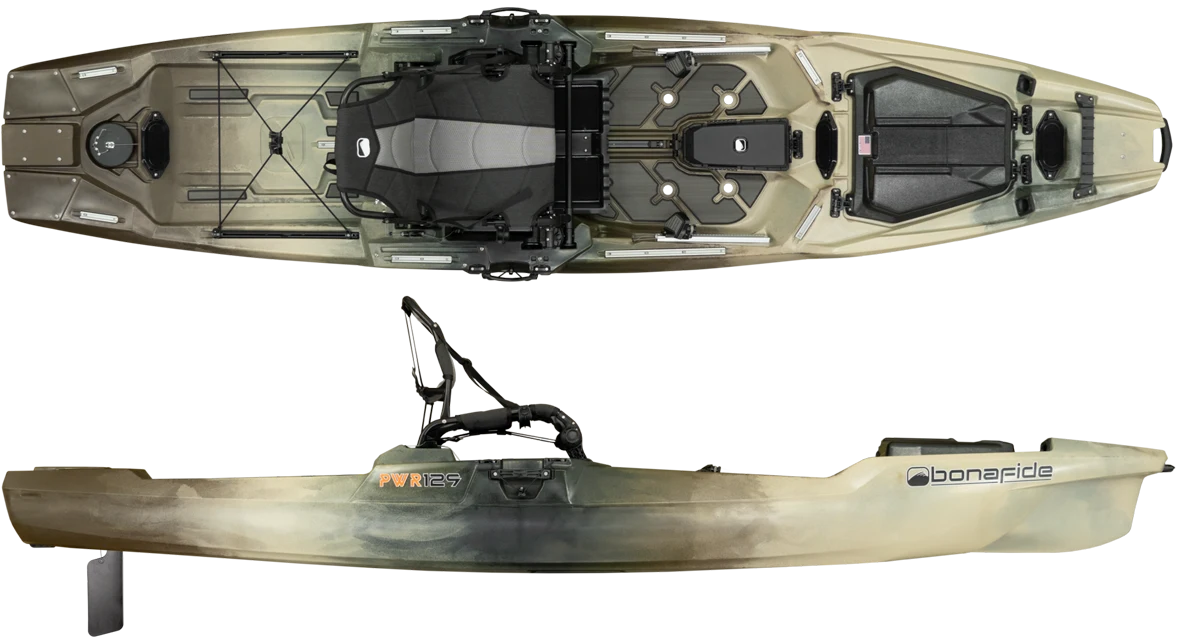
The PWR129 earns the dedicated-platform award because motorization is part of the documented design rather than an aftermarket retrofit, and because Bonafide states what its capacity number actually covers. The 500-pound figure is defined as kayak, paddler and gear combined, which means the 102-pound rigged weight comes out of it before you have loaded a single battery. That is a less flattering number than most capacity headlines and a far more useful one. At 12 ft 9 in by 35 in, this is a powered fishing platform first, with no pedal drive to work around.
| Length | 12 ft 9 in |
|---|---|
| Width | 35 in |
| Fitted hull weight | 78 lb |
| Rigged weight | 102 lb |
| Capacity | 500 lb, defined as kayak, paddler and gear combined |
Source: Bonafide PWR129 product specifications page, checked September 12, 2026.
Where the 500 pounds actually goes
Subtract the 102-pound rigged weight and the allowance left has to absorb both motors, both batteries, brackets, steering hardware, wiring, electronics, tackle and the angler. Build that ledger with actual component weights before you commit, and keep the same capacity definition when you compare this hull against another one, since a bare hull and a rigged kayak are not equivalent starting points. Documented bow and stern provisions do not by themselves establish that any specific motor combination fits.
Ask for the layout drawing before the quote
Request a drawing that shows both installed motors, battery restraint, controls and the paddle's storage position. If the proposed motor battery occupies the stern tankwell, put the tackle crate or bait system on the same drawing, so you do not discover after installation that two essential items were assigned the same space.
Best for. The angler who wants a dedicated powered rig with no pedal drive to design around, and who will lay out both motors, batteries and controls before committing.
Skip it if. Your load plan cannot fit both motors, their batteries and your fishing gear inside the stated 500-pound definition.
Native TitanX Propel 12.5 - Pedal-Retained Platform
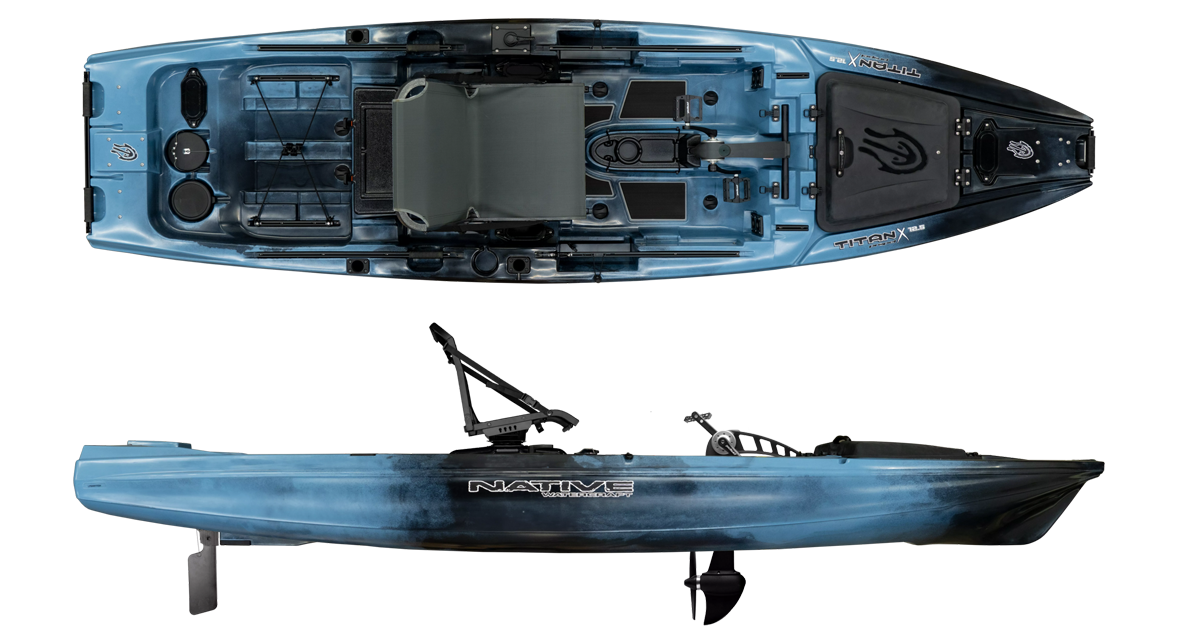
The TitanX is on this list for one reason: it treats a retained pedal drive as part of the buying decision instead of something a motor build replaces. Documented bow and stern motor provisions sit alongside the pedals, with designated motorization and power-storage areas rather than improvised mounting. Dimensions, weight and capacity are not detailed in the documentation reviewed for this guide, so the load ledger that decides everything else has to be built from figures you get directly from Native or an authorised dealer.
| Propulsion | Pedal drive, plus documented bow and stern motor provisions |
|---|---|
| Dimensions, weight and capacity | Not detailed in the documentation reviewed for this guide |
Source: Native TitanX product page, checked September 12, 2026. Confirm current dimensions, weight and capacity figures directly with Native or an authorised dealer before ordering.
Pedals only count if they still work with both motors fitted
A pedal drive you cannot use is dead weight with extra steps. Extra propulsion equipment adds clearance checks against the drive's own moving parts, so verify the manual pedal return sequence with both motors secured in place, not with the deck empty. That demonstration is the whole test for this platform.
The Hammer 1210 belongs in the same appointment
A newer Native alternative, the Hammer 1210, explicitly describes dual-motor arrangements in its own materials, and it is worth requesting alongside a TitanX demonstration if its drive transition suits your routine. It is not automatically the better coastal hull, and its own dimensions and capacity figures are not detailed in the documentation reviewed for this guide either.
Best for. The angler who wants powered travel and positioning added to a pedal drive that stays genuinely usable.
Skip it if. You have already decided the pedals will not survive the finished build's clearance and weight.
NuCanoe UNLIMITED - Manufacturer-Supported Motor Package
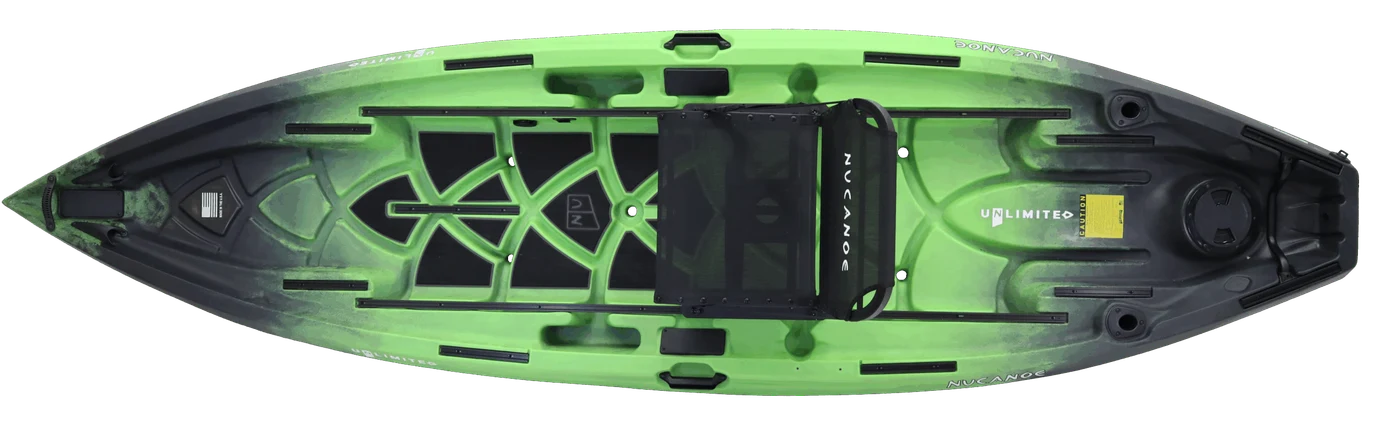
The UNLIMITED wins the manufacturer-supported award because NuCanoe publishes a propulsion route for it, complete and component-based systems using named motors including Newport options, rather than leaving you to assemble a parts list from unrelated listings. It also publishes its capacity with the operating condition attached: 650 pounds with the scuppers plugged, 400 pounds self-bailing with the scuppers open, both stated as passenger-plus-gear weight. Two conditional numbers are more useful than one unconditional headline, and they are the numbers your load plan has to respect.
| Maximum capacity | 650 lb, scuppers plugged |
|---|---|
| Self-bailing capacity | 400 lb, scuppers open |
| Capacity basis | Passenger-plus-gear weight |
| Propulsion route | Complete and component-based systems, using named motors including Newport options |
Source: NuCanoe UNLIMITED EPS packages page and UNLIMITED ratings page, checked September 12, 2026.
The scupper condition is the whole capacity question
A maximum-capacity headline misleads the moment its condition is left out of the load decision. If your launches keep the scuppers open, 400 pounds is your number, the 650-pound figure is not available to you, and that single mismatch can undo the rest of the build.
A supported stern package is not approval for a second motor
A documented propulsion package covers the configuration NuCanoe sells, not a second, separately sourced motor bolted on beside it. Request a manufacturer-supported complete build, and confirm the chosen configuration against current power limits and operating instructions before you order anything.
Best for. The angler who wants a documented, model-specific propulsion package rather than a mixed-brand assembly.
Skip it if. Your load plan depends on the 650-pound figure while your actual launches keep the scuppers open.
Where each platform sits on the trade-off
| Platform | Pedal drive retained | Motor provisions | Capacity definition | Where it sits |
|---|---|---|---|---|
| Bonafide PWR129 | No | Bow and stern, documented | 500 lb, kayak, paddler and gear combined | Dedicated powered build; full load and manual handling still need verifying |
| Native TitanX Propel 12.5 | Yes | Bow and stern provisions alongside pedals | Not detailed in reviewed documentation | Practical pedal option; more equipment and clearance to check |
| NuCanoe UNLIMITED | No | Model-specific complete and component systems | 650 lb scuppers plugged, 400 lb self-bailing scuppers open | Manufacturer-supported build route; capacity depends on scupper condition |
No platform here retains pedals, publishes a single unconditional capacity figure and offers a dedicated single-source powered layout all at once. That is not a gap in this research. It is the actual shape of the category right now, and it is why the layout drawing and the load ledger matter more than the marketing copy on any one of these three hulls.
When one motor is the better purchase
Keep a one-motor build on the comparison sheet before you commit to two. If travel assistance is the main need, a second positioning system may not justify its added mass and cost. If you mainly fish close to the launch and want position control once you arrive, the stern travel system may be the part you can skip.
Ask yourself what actually happened on recent trips that a second motor would have changed. Name the specific task and how often it occurs. If the honest answer is mostly that it would be nice to have, weigh that benefit against the equipment you would then carry and maintain on every single outing, not just the trips where it would have helped.
This is not an argument against a two-motor kayak. It is how you make sure the completed rig solves your actual fishing problem instead of solving a problem the marketing invented for you.
Frequently asked questions
Will two motors double a kayak's speed?
No doubling claim is supported by the documentation this guide draws on. Speed is the outcome of the complete hull, propulsion and operating conditions together, not a simple sum of two motors' individual numbers. Here, the two motors are primarily being compared for the different jobs they do, travel and positioning, not for combined speed.
Can I put any electric outboard on a motor-ready stern?
No. Confirm the specific motor, bracket, steering and power limits for your exact kayak before buying anything. A stern advertised as motor-ready is not manufacturer approval for every motor on the market, and "motor-ready" and "approved for this motor" are two different claims.
Can a 36-volt battery power a 12-volt motor?
Do not connect it directly under any circumstance. Match the permitted supply stated by the motor's own manufacturer. Any voltage-conversion setup requires a properly specified design with confirmed manufacturer compatibility, and this guide does not prescribe an improvised way to bridge the two voltages.
Should electronics share a motor battery?
Follow the equipment instructions and a reviewed electrical plan rather than improvising. Do not connect a display, sonar unit or other electronics to a motor battery merely because an accessible terminal happens to be nearby; that decision belongs in the wiring drawing, checked against both devices' actual current requirements.
Is retaining pedals worthwhile on a two-motor build?
It can be, provided the pedals remain practical once the completed installation is in place around them. Compare their benefit against the added deck space and weight the motors already consume, then verify the manual pedal return sequence with both motors secured during a demonstration, not just on an empty deck.
Which platform should I inspect first?
Inspect the Bonafide PWR129 first for a dedicated powered build, the Native TitanX or Hammer 1210 when retained pedals matter to you, and the NuCanoe UNLIMITED when its documented, model-specific propulsion packages suit your plans. Choose only after reviewing an exact build quote and trying its complete operating routine in person.
Final verdict
A second motor buys you two separated jobs, travel at the stern and position holding at the bow, and it only buys you redundancy on top of that if the wiring, controls and shutdown procedure are built and verified to survive one motor's failure. The Bonafide PWR129 is the strongest starting point for a dedicated powered build, the Native TitanX Propel 12.5 is the better call when a working pedal drive has to survive the finished installation, and the NuCanoe UNLIMITED is worth requesting when a manufacturer-supported motor package matters more to you than assembling parts yourself. Run the energy math, the weight ledger and the thirty-second wiring check before you order a second motor, not after, and keep a one-motor build on the comparison sheet until the numbers actually justify the second one.
Related reading
Sources
Specifications on this page were taken from manufacturer, builder and advisory sources below, verified September 2026. Prices and specifications change; confirm current figures before buying.
- Bonafide PWR129 product specifications and capacity definition, bonafidefishing.com, reviewed September 2026
- Native TitanX Propel 12.5 platform page, nativewatercraft.com, reviewed September 2026
- Native Hammer 1210 product page, nativewatercraft.com, reviewed September 2026
- NuCanoe UNLIMITED EPS propulsion packages, shop.nucanoe.com, reviewed September 2026
- NuCanoe UNLIMITED capacity ratings, nucanoe.com/unlimited-2024, reviewed September 2026
- Minn Kota Riptide Kayak Terrova product specifications, minnkota.johnsonoutdoors.com, reviewed September 2026
- Minn Kota lithium battery selection and recommendations, minnkota-help.johnsonoutdoors.com, reviewed September 2026
- Newport NK300 HD 36V 30Ah battery bundle listing, newportvessels.com, reviewed September 2026
- Newport NK300 HD electric kayak motor owner's manual, hosted via cdn.shopify.com, reviewed September 2026
- American Canoe Association, boat-selection and stability guidance, americancanoe.org, reviewed September 2026
Join The ReefReady Community
Get saltwater Fishing Guides, expert Buyers Guides, equipment recommendations, marine electronics insights, and practical gear tips delivered to your inbox.
No spam. Unsubscribe in one click.