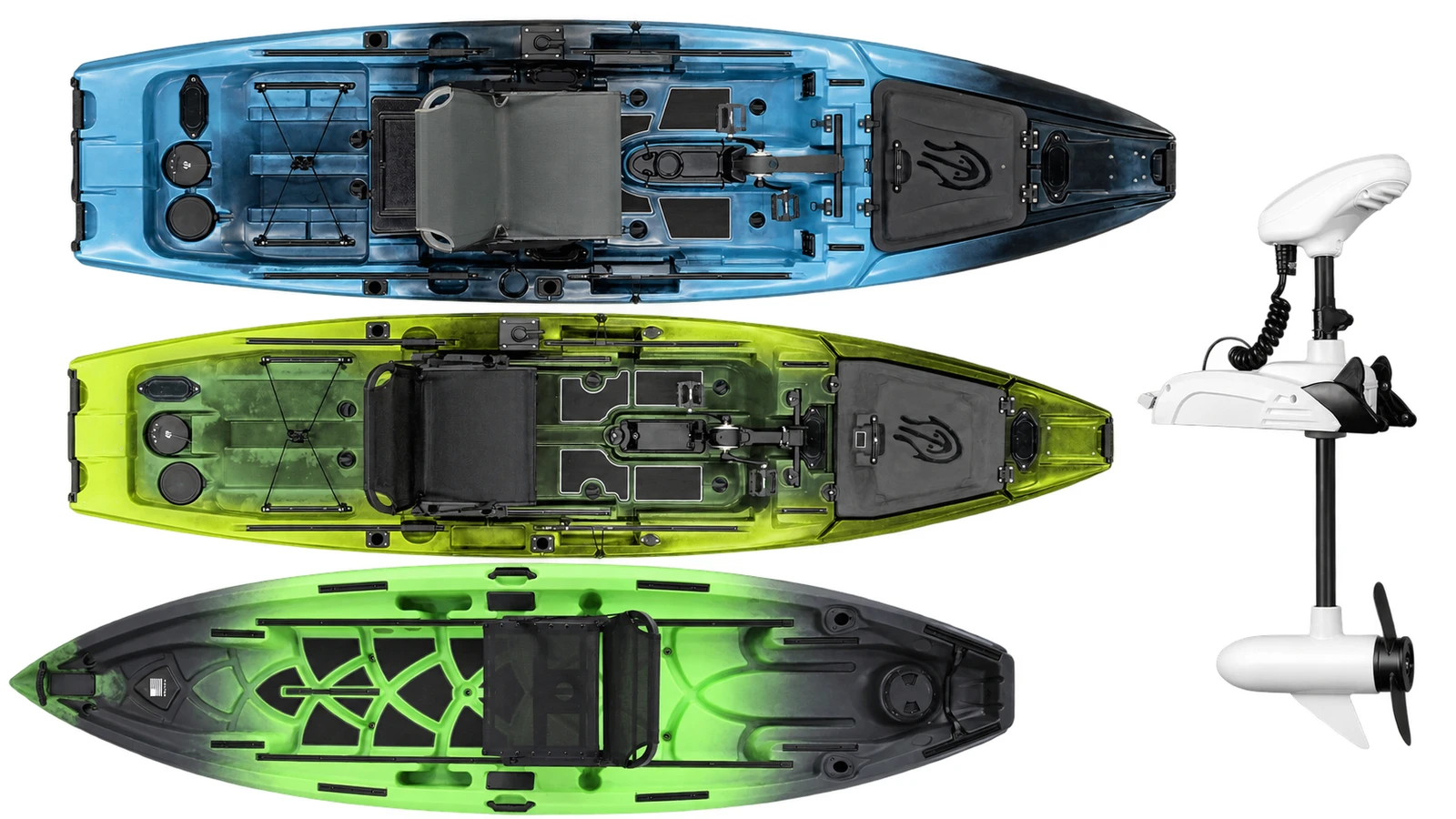
Best kayaks for running pedals and a trolling motor together: what "motor-ready" doesn't mean
The spot you want to fish sits a mile and a half across open water, past a channel that turns ugly on an outgoing tide, and pedaling there alone burns the light you came to fish in.
The quick answer
The Native TitanX Propel 12.5 is the strongest documented starting hull for a build that keeps its pedals and adds a separate motor. Native publishes the Propel drive, a bow mounting provision, a stern motor mounting provision and two dedicated battery-storage areas in one spec block, on a hull listed at 138 lb fitted and 172 lb fully rigged. Anglers who switch between motor travel and pedaling several times a trip should buy the Hammer 1210 instead, since its X-Range drive is documented to fold onto the bow deck and the hull is 110 lb fitted rather than 138 lb.
Everything below is judged on one question: do the pedals stay usable once the motor is bolted on?
Affiliate disclosure. ReefReadyGear earns a commission on some links below at no extra cost to you. This guide draws on manufacturer product pages, installation documentation and paddlesport safety-education sources, checked September 12, 2026, and it is a researched buying guide rather than a claim of first-hand testing.
A motor-ready listing describes a mounting pattern, not a finished arrangement
The kayak that photographs well with both a pedal drive and a motor bracket, and the kayak that actually lets you deploy either one from your seat with a rod already in hand, are frequently different kayaks. This guide is built around finding the second one.
The four picks, and the job each one does
The four at a glance
| If you want | Consider | Why |
|---|---|---|
| A documented starting hull for a pedal-plus-motor build | Native TitanX Propel 12.5 | Published Propel drive, bow motor provision, stern motor provision and two battery-storage areas, in one spec block |
| The hull built around frequent switching between motor travel and pedaling | Native Hammer 1210 | X-Range drive folds onto the bow deck, with both bow and stern motor provisions documented alongside it |
| A GPS-positioning motor to pair with either hull | Minn Kota Riptide Kayak Terrova | 55 lb of thrust, Spot-Lock, and a 36-inch shaft sized for a kayak's low freeboard, on Minn Kota's own spec page |
| You already own the equipment | NuCanoe UNLIMITED with PIVOT Drive | Existing-owner route only, since NuCanoe discontinued PIVOT in March 2025, with support continuing on remaining units |
On this page
- The quick answer
- The four picks, and the job each one does
- The four at a glance
- How we chose
- What "motor-ready" actually means
- The combined-load ledger nobody totals for you
- What running both costs you in deck space and complexity
- The overlooked check: stow the drive, reach the motor, without standing up
- Stability is not a spec you can read off a table
- The best kayaks and motor for a pedal-plus-motor build
- Native TitanX Propel 12.5
- Native Hammer 1210
- NuCanoe UNLIMITED with PIVOT Drive
- Minn Kota Riptide Kayak Terrova
- Where each hull sits on the equipment-versus-transport trade-off
- How shallow can a pedal-and-motor kayak actually operate
- Choose the battery after the motor, not before
- Check the controls before you pay for the build
- Budget the whole build, not just the kayak
- Do you actually need both aboard, or is one enough
- Frequently asked questions
- Final verdict
- Related reading
- Sources
How we chose
ReefReadyGear does not run a testing programme on finished, motorized kayak builds, and nothing here is presented as a first-hand result. Every specification is drawn from manufacturer product pages and installation documentation, verified September 12, 2026. Where a figure is our calculation rather than a published number, it is labeled as ours with the method shown.
- The motor's intended job is checked before either hull is compared, since a travel motor and a positioning motor have almost nothing in common beyond both being electric
- Fitted hull weight and fully rigged weight are kept as two separate, clearly sourced numbers rather than blended into one estimate
- Every added-weight figure that is not published by the manufacturer is flagged as not published, not filled in with a plausible-sounding guess
- A hull's motor provisions are checked against whether the pedal drive remains usable with the motor installed, not treated as a single "motorization" checkbox
This comparison draws on manufacturer product pages and installation documentation rather than a testing programme ReefReadyGear runs on finished, motorized builds. A kayak that can physically accept a motor is a different question from a kayak that keeps its pedals usable with that motor installed, and confusing the two is the most common expensive mistake in this category.
The spot you want to fish sits a mile and a half across open water, past a channel that turns ugly on an outgoing tide. Pedal that distance and you arrive with your legs already spent and twenty minutes of good light burned just getting there. Run a motor instead and you cover the same stretch in a third of the time, legs fresh for whatever the flat throws at you once you arrive.
Then a red drum eats a soft plastic forty feet off a mangrove root and turns hard back toward the structure it just left. You need the hull to hold its angle against that turn, not track a straight line, and a hand on a motor throttle does that job better than a foot doing double duty on a pedal crank while your other hand is already committed to the reel. Two different jobs, on the same ten-foot deck, both wanting the same space between your knees.
Every dealer will call a kayak that accepts a motor bracket "motor-ready," as though the label settles the question. It settles almost nothing. A hole for a motor mount and a bow provision for a battery describe a hull that can physically carry both systems. They say nothing about whether the pedals stay usable once the motor is bolted on, whether you can reach the stow lever without leaning past your seat, or whether the published hull weight has any relationship to what you'll actually be lifting off the roof rack.
This guide is built from manufacturer specification pages and installation documentation, not a testing programme ReefReadyGear runs on finished builds. What it does that a spec sheet doesn't: it separates a travel motor from a positioning motor, because that distinction decides almost everything else in the build. It totals the load a "motor-ready" listing never adds up for you. And it gives you a literal reach test to run at the dealer before you commit to a hull, rather than a feeling to trust from a showroom sit.
What "motor-ready" actually means
The real either-or in this category is not which motor is better. It is whether the motor you're adding is your primary propulsion or an auxiliary, position-holding tool, and that answer changes almost every other decision in the build. A motor bought to cover distance and a motor bought to hold a spot on structure ask for different mounting positions, different controls and, often, a different relationship with the pedals you're keeping.
Travel assistance. If your priority is the run between the launch and the fishing grounds, compare an approved stern installation against a bow installation on that specific basis: steering feel, stopping distance, shallow-water stowage, and how you get home if the electrical system fails partway through the trip. Do not start this comparison with a top-speed number. Start with your normal route, its exposure to wind and current, and your manual-return plan if the motor becomes unavailable.
GPS positioning. If you mainly want to hold near a dock, an edge or a piece of structure while casting, a GPS-positioning motor is likely the intended purchase, and the Minn Kota Riptide Kayak Terrova is the saltwater bow-mount candidate documented for this job below. Positioning motors solve a completely different problem than travel motors, and buying one to cover distance, or the reverse, is a common and avoidable mismatch.
Trolling along a shoreline. If the aim is steady, sustained movement while fishing rather than a fixed position, compare how the proposed motor is controlled from your seat. Rehearse adjusting speed while holding a rod, and stopping the motor without hunting through a menu or a pocket. It's entirely possible the pedals already handle this job well enough on their own; the motor has to earn the extra weight and deck space it brings aboard, not simply exist because the hull can carry one.
Keep the categories in the table below separate when you compare packages. A single powered drive unit can be an excellent product and still fail your specific requirement for retained manual pedals plus a separate GPS-positioning motor.
| Configuration | What it means | Question to resolve |
|---|---|---|
| Pedals plus a separate motor | Two physically distinct propulsion systems sharing one hull | Can the pedals remain fully usable with the motor installed? |
| Electrically assisted pedal system | Electrical assistance built into the pedal drive itself | Does it provide the controls and positioning you actually want? |
| Interchangeable drive well | One drive unit swaps into the opening in place of another | Are both units available to you without rebuilding the boat on the water? |
| Two separate electric motors | Often different equipment for travel and for positioning | Is the added complexity and weight actually justified by your fishing? |
The combined-load ledger nobody totals for you
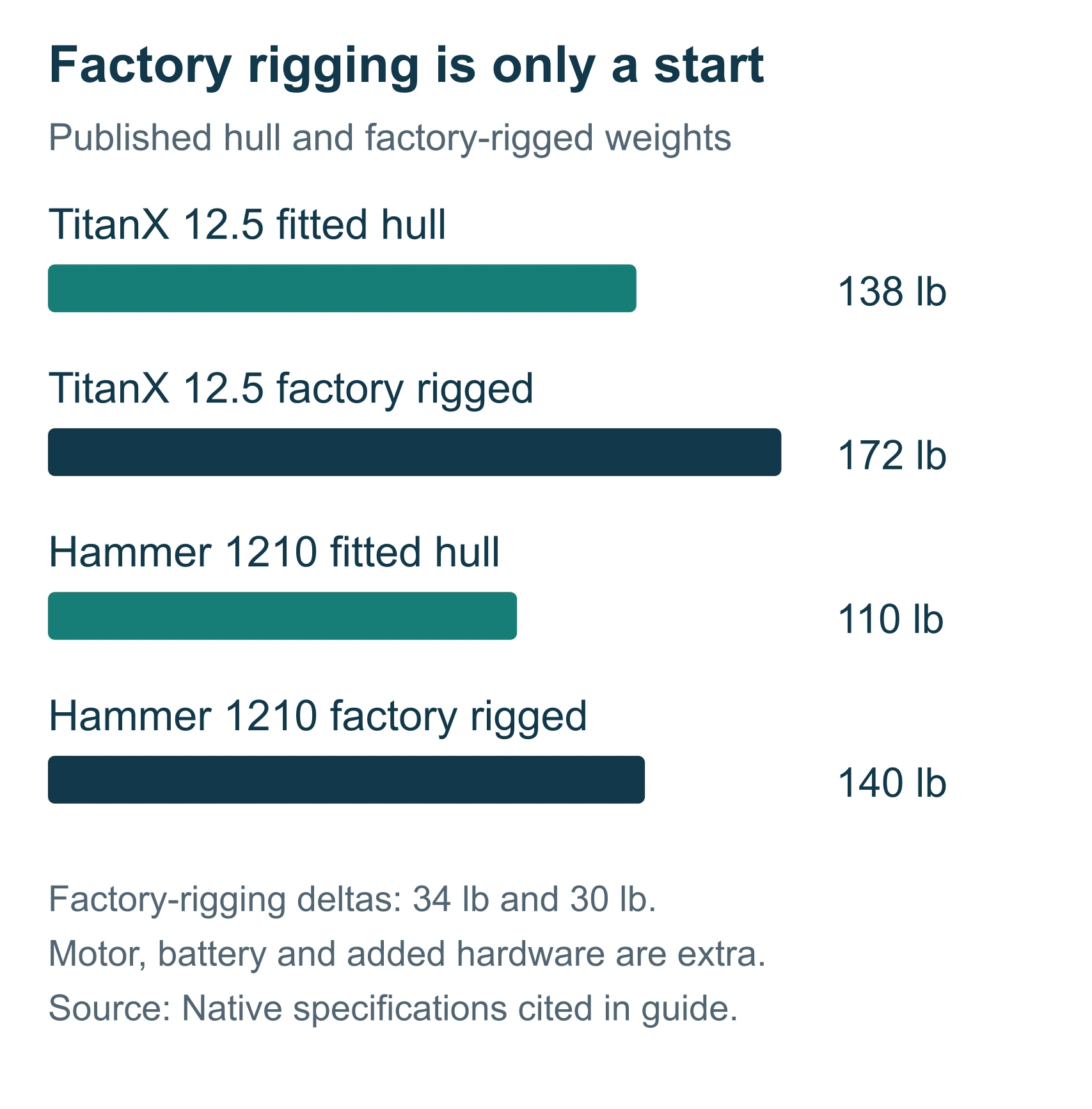
Every "motor-ready" listing publishes a hull weight. None of them total the complete carried load once a motor, a battery and a mount join the pedal drive already aboard, and that total is the number that actually decides whether the build fits your kayak's capacity and your ability to move it.
The method, and what it can and cannot tell you
- Start with the manufacturer's published fully rigged weight, which for both Native hulls reviewed already includes the hull and the factory pedal drive.
- Subtract the fitted hull weight from that fully rigged figure. The remainder is the published weight of the pedal drive and factory rigging, since both numbers come from the same manufacturer spec block.
- Add the trolling motor's own weight. Neither Native's kayak pages nor Minn Kota's Riptide Kayak Terrova page publishes a bare motor weight for the model reviewed here, so this line has to come from the dealer or the motor's full specification sheet before you order any hardware.
- Add the battery, mount, bracket and wiring weight for your chosen setup. None of these are published for a specific combined build either, and they are the second unpublished line in every quote.
- Compare the resulting total against your kayak's own stated capacity, using that manufacturer's own definition rather than a blanket percentage rule applied across brands.
This ledger is deliberately incomplete, and that's the point. The two heaviest, most consequential additions in a pedal-plus-motor build, the motor itself and the battery, are the two figures no manufacturer page publishes for a specific combined installation. That's the number every "motor-ready" listing invites you to skip, not because it's unknowable, but because it isn't flattering to print next to a hull weight.
What is actually published
| Component | Native TitanX Propel 12.5 | Native Hammer 1210 | Status |
|---|---|---|---|
| Fitted hull weight | 138 lb | 110 lb | Published by Native |
| Fully rigged weight (hull plus factory pedal drive) | 172 lb | 140 lb | Published by Native |
| Delta attributable to pedal drive and factory rigging | 34 lb | 30 lb | Ours, calculated by subtracting the two published figures above |
| Trolling motor weight | Not published for the model reviewed | Not published | Confirm with the dealer or the motor's full spec sheet |
| Battery, mount, bracket and wiring weight | Not published for a specific combined build | Not published | Confirm with the installer before ordering |
Native's own TitanX specification page also contains inconsistent length descriptions, so confirm the exact hull dimensions with the dealer before planning transport around a number pulled from the listing alone. Native TitanX Propel 12.5 specifications
Use the manufacturer's own capacity definition to finish the comparison, not a shortcut. NuCanoe, for one, distinguishes maximum capacity with scuppers plugged from self-bailing capacity with them open on its own UNLIMITED product page, and that distinction has to travel with any capacity number you quote for that hull. NuCanoe UNLIMITED capacity definitions
What running both costs you in deck space and complexity
Every advantage of carrying a motor alongside your pedals is paid for somewhere else on the same ten-foot deck. A stern-mounted travel motor buys you speed and range and it also claims the space you'd otherwise use for a stringer, a net or a second rod holder, and it adds a stow-and-deploy step you'll repeat every time you cross from open water into skinny structure. A bow-mounted positioning motor buys you a locked spot on a reef edge and it also sits directly in the forward workspace where a fish-finder bracket, an anchor trolley and your first two casts of the morning already compete for room.
Neither trade is a flaw in a specific product. It's the trade every pedal-plus-motor build makes, and the honest response is to size the addition to the fishing you actually do most often, not to the hull with the most mounting points advertised. A motor added for the occasional long crossing, then left rigged for every short-range trip, is deck space and weight you're paying for on trips that never needed it.
The overlooked check: stow the drive, reach the motor, without standing up
Almost every buying comparison in this category stops at the spec block: thrust, shaft length, pedal drive name. The check that actually determines whether the build works is whether you can operate both systems, in sequence, from your actual seated position, and it's rarely demonstrated before the sale.
Native describes the Hammer's X-Range drive as folding onto the bow deck, with both bow and stern motor provisions documented alongside it. That folded space has to be checked against every other piece of bow equipment you're planning to carry, not assumed clear because the spec sheet lists a motor provision. Native Hammer 1210 specifications
The thirty-second check almost nobody runs before buying: sit in the demonstration kayak wearing your actual PFD, with a rod in one hand. With the other hand, release the pedal drive and stow it, then reach the motor's stow-and-deploy control and bring the motor up, then reverse both steps and put the pedal drive back down. Time yourself. If that full sequence takes noticeably longer than thirty seconds, or requires you to lean past your comfortable reach or set the rod down, the layout needs to change before you commit to that hull for a season, either by relocating equipment or by choosing a different hull entirely.
Ask the dealer to walk through the same sequence with the motor bracket, the pedal drive and the cable routing all physically represented, not an empty hull. Can you release and secure the pedal drive without reaching through the motor mount? Does the folded drive occupy the same space as a motor's pull cord or stow lever?
Can you confirm the drive is fully retained without leaning beyond a comfortable seated reach? Those are the questions worth answering in person. Pedal resistance, seat comfort and mechanical play under load are better assessed on the actual demonstration kayak than described secondhand.
Stability is not a spec you can read off a table
Primary stability concerns how a hull responds near upright; secondary stability concerns how it behaves as it heels further. The American Canoe Association draws this distinction explicitly in its paddling safety guidance, and it applies directly to a hull carrying more equipment than its base configuration. American Canoe Association, critical judgment guidance
A wide platform that feels settled beside the dock does not establish how it behaves in a beam swell, and a marketing stability rating does not establish how the complete powered build responds once your actual load is aboard. For a useful demonstration, ask a qualified instructor or an experienced dealer to assess the intended configuration in appropriate sheltered conditions: seated movement, normal turns, and equipment access, not an improvised capsize test with an unfamiliar powered rig.
The best kayaks and motor for a pedal-plus-motor build
Category boundary, stated plainly: kayaks with documented factory provisions for retaining a pedal drive while adding a separate motor, plus the one saltwater bow-mount motor most commonly paired with them for GPS positioning. Products here are grouped by the specific job they do in a combined build, not ranked as interchangeable competitors.
A note on the overlap with our spot-lock trolling motor guide. If your real question is which GPS-positioning motor to buy rather than which hull to build around, our Best Saltwater Spot Lock Trolling Motors for Kayaks guide covers that decision in more depth, including the second qualifying motor and the full system cost and weight for each. This guide summarizes the Riptide Kayak Terrova's fit for a pedal-plus-motor build specifically; that one is where the deeper motor-to-motor comparison lives.
Native TitanX Propel 12.5: Equipment-focused build
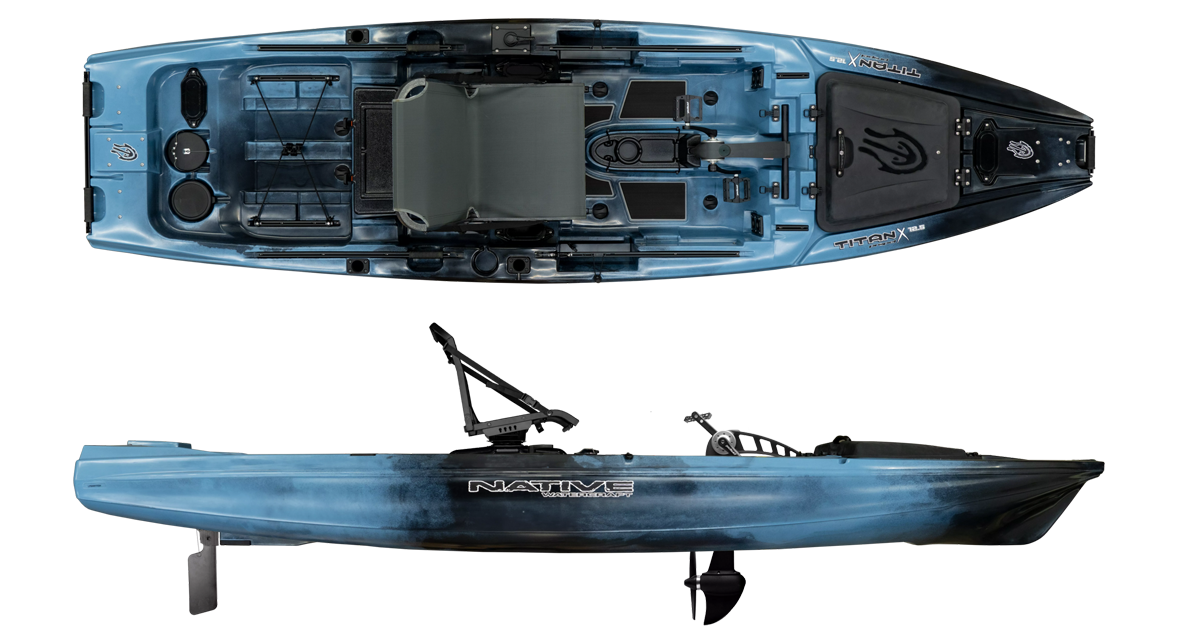
The TitanX earns this spot because Native documents the whole combination rather than leaving you to infer it. The current specification page lists the Propel drive, a bow mounting provision, a stern motor mounting provision and two separate battery-storage areas, which is a fuller set of factory-documented accommodations than a hull with no stated motor provisions at all. The 40-inch beam gives the forward workspace room for a fish-finder bracket without immediately fighting the bow mount for it. What the page does not do is include your motor and your battery in the 172 lb fully rigged figure, and that omission is the one to plan around.
| Pedal system | Propel |
|---|---|
| Width | 40 in |
| Fitted hull weight | 138 lb |
| Fully rigged weight | 140 lb published rigging plus published battery and motor mounting provisions, listed at 172 lb total |
| Motor provisions | Bow mounting provision, stern motor mounting provision |
| Battery storage | Two dedicated storage areas, per Native's specification page |
Source: Native TitanX Propel 12.5 product page. Battery and motor weight are not published for a specific combined build; confirm with the installer.
Two documented battery areas are a starting point, not a guarantee of fit
Having two dedicated areas to evaluate means you are choosing between placements and wiring routes rather than improvising storage on a bare deck. That is worth real money on an install. It does not mean every battery case on the market drops into either one, so take the actual case you intend to buy to the dealer and set it in both positions before you order anything else.
Transport is the decision, not an afterthought
138 lb fitted and 172 lb fully rigged is already a two-person lift or a serious cart for most anglers, and the published weights climb from there once the motor and the battery go aboard. Neither of those two additions is published for a specific combined build, which means the number you will actually be moving off the roof rack does not exist on any page you can read before buying. Settle the launch and transport plan first. A hull you cannot get to the water alone is an expensive way to discover that the spec sheet was never describing your Saturday.
Native's own TitanX page also carries inconsistent length descriptions, so confirm the exact hull dimensions with the dealer rather than planning a rack or a trailer around a number pulled from the listing.
What a showroom sit will not tell you
Do not accept an empty-hull sit as the whole evaluation. Wear your PFD, bring the footwear you actually fish in, and check the seat position you need for a full pedal stroke with the motor bracket physically present. Then add a mock-up of the fish-finder bracket before deciding the forward workspace is clear.
Best for. The angler building around equipment capacity who already has a workable launch and transport plan in hand.
Skip it if. No dealer near you will demonstrate the intended motor installation with the pedal drive still in place, loaded and seated, before you commit.
Native Hammer 1210: Drive-transition build
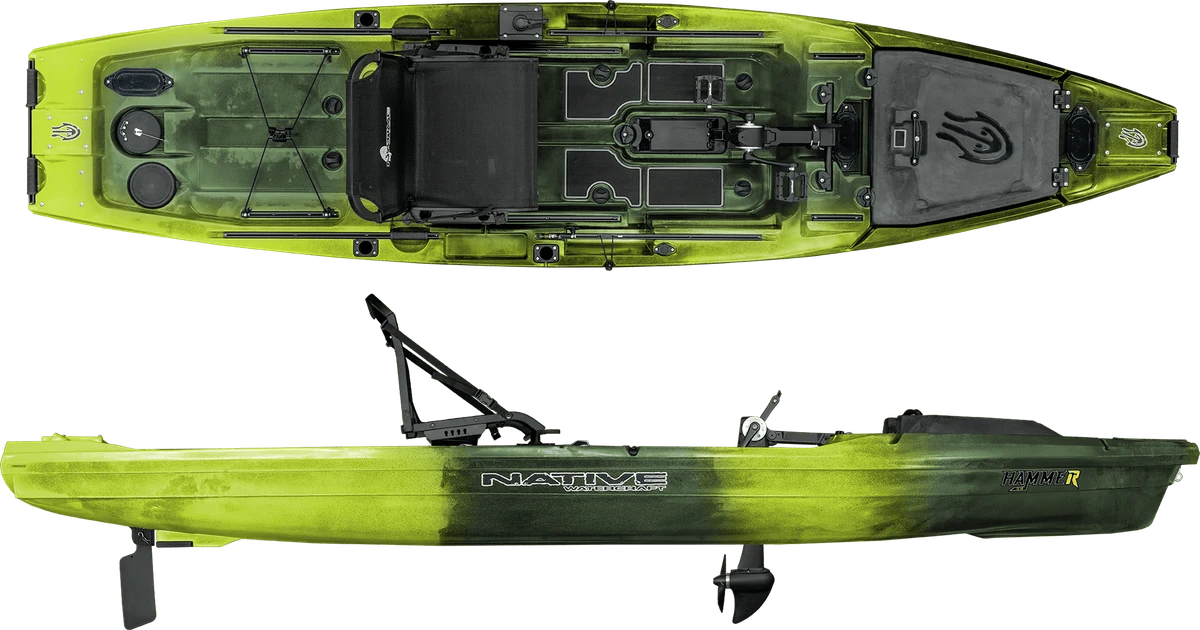
The Hammer is the answer when the problem is not carrying both systems but switching between them. Native describes the Propel X-Range drive as folding onto the bow deck, with bow and stern motor provisions documented alongside it, so drive stowage is part of the factory design rather than an aftermarket workaround. It is also the lighter hull of the two Natives here, 110 lb fitted against the TitanX's 138 lb, and 140 lb fully rigged against 172 lb. At 12 ft 10 in by 36 in it gives up some of the TitanX's provision depth and beam in exchange for that.
| Pedal system | Propel X-Range, documented to fold onto the bow deck |
|---|---|
| Dimensions | 12 ft 10 in by 36 in |
| Fitted hull weight | 110 lb |
| Fully rigged weight | 140 lb |
| Motor provisions | Bow and stern motor provisions, per Native's specification page |
Source: Native Hammer 1210 product page. Motor and battery weight are not published for a specific combined build.
Why the folding drive is the whole argument for this hull
A drive that folds onto the bow deck turns the transition from a two-handed wrestle into a single seated movement, and on a trip with several motor-to-pedal changes that difference compounds. The catch is that the folded drive lands in the same forward real estate as everything else you carry up there. Check it against your anchor trolley, your display bracket and your bow bungee storage before assuming the spec line has cleared the space for you.
Published dimensions do not describe how it handles for you
12 ft 10 in by 36 in tells you what fits on the rack and roughly how the hull was drawn. It says nothing about whether the pedal reach suits your legs or whether the seated transition works with a rod in one hand. Work the actual sequence with the motor bracket, display and cable routes physically represented, not an empty hull with the dealer describing where things would go.
Best for. The angler who expects frequent transitions between motor travel and pedaling on the same outing rather than one mode for the whole trip.
Skip it if. The folded drive competes for bow space with equipment you are not willing to relocate.
NuCanoe UNLIMITED with PIVOT Drive: Existing-owner route
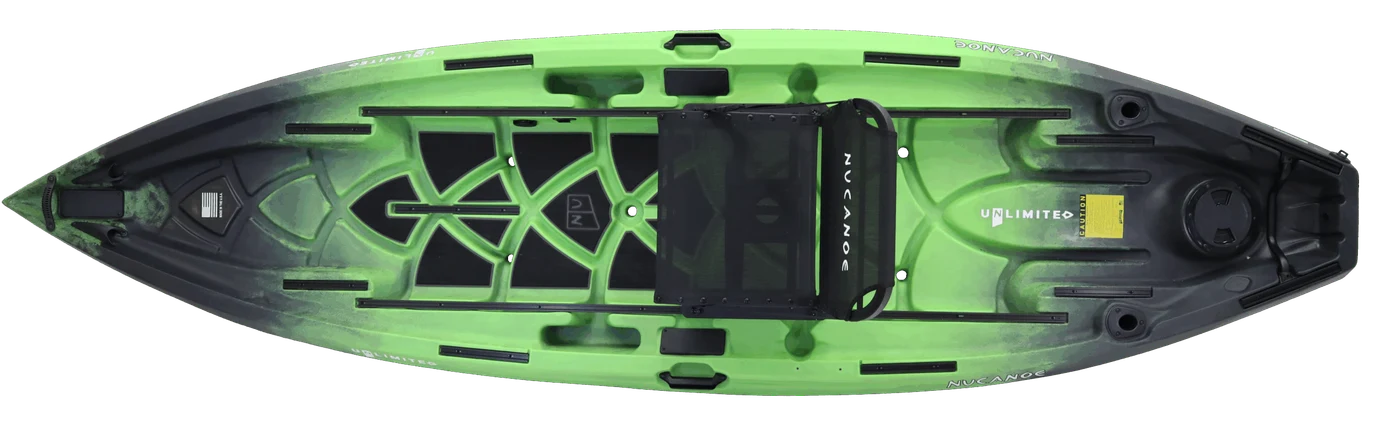
This one is here for completeness and for the people who already own it, not as a current-production recommendation. NuCanoe announced the PIVOT Drive discontinued on March 7, 2025, and new availability is now limited to remaining stock and dealer inventory. The same announcement states that parts, warranty support, service and repair will continue, which is why the hull is still worth assessing rather than writing off. An existing PIVOT owner adding a compatible bow motor is in a genuinely different position from a new buyer starting a pedal-first build.
| Pedal system | PIVOT Drive |
|---|---|
| Production status | Discontinued, announced March 7, 2025 |
| Availability | Remaining stock and dealer inventory only |
| Manufacturer commitments | Parts, warranty support, service and repair stated to continue |
| Capacity terminology | UNLIMITED page distinguishes maximum capacity, scuppers plugged, from self-bailing capacity, scuppers open |
Source: NuCanoe PIVOT Drive discontinuation announcement and NuCanoe UNLIMITED product page. Combined motor installation is not confirmed by these pages alone.
What the discontinuation does and does not change
Stated support commitments are not the same as indefinite support, so raise future parts availability with NuCanoe or a dealer before you buy rather than assuming it. The combined motor-plus-PIVOT installation also still needs confirming case by case; neither the discontinuation announcement nor the UNLIMITED product page confirms it on their own.
Capacity on this hull is two numbers, not one
NuCanoe's UNLIMITED page distinguishes maximum capacity with the scuppers plugged from self-bailing capacity with them open. That distinction has to travel with any capacity figure you quote for this hull, especially in a load comparison against a brand that publishes a single number. Quote the wrong one into your ledger and the whole combined-load total is wrong.
Best for. An existing PIVOT Drive owner weighing a compatible bow motor, or a buyer who has located a complete, supported remaining-stock package with an operating demonstration included.
Skip it if. You are starting a new pedal-first build; compare the two current Native hulls above first.
Minn Kota Riptide Kayak Terrova: The GPS-positioning motor to pair with either hull
Check Minn Kota Riptide Kayak Terrova on Amazon
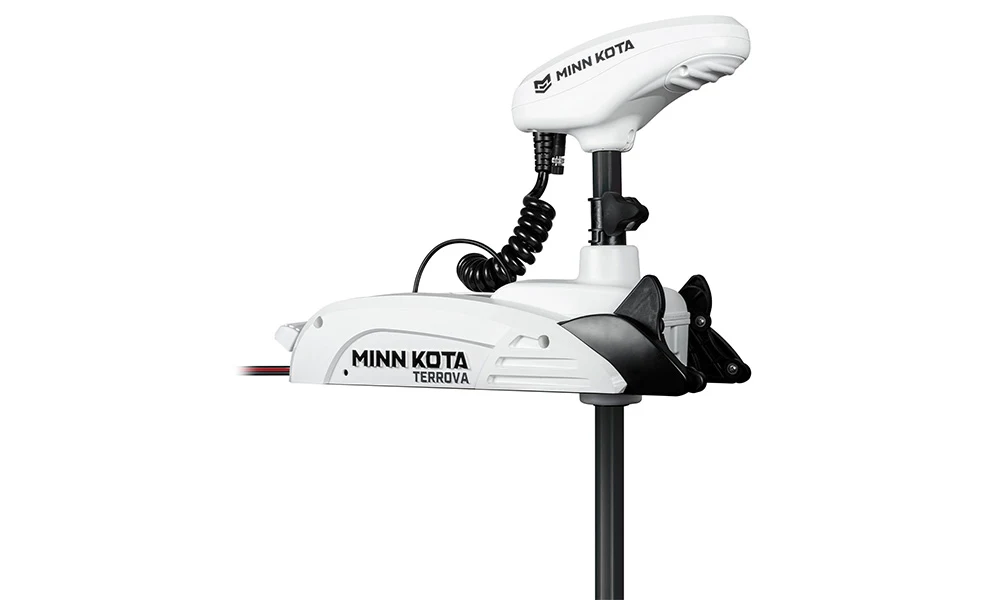
Spot-Lock solves the one job pedals genuinely do not do well, which is holding a fixed position on a dock edge, a reef lip or a piece of structure while both your hands are busy. Minn Kota lists 55 lb of thrust, 12-volt operation and a 36-inch composite shaft for the Riptide Kayak Terrova. That shaft length is the spec that makes it a kayak motor rather than a boat-class motor adapted downward, since a kayak's low freeboard needs the propeller close under the hull rather than hanging deep. Remote control is documented. Automatic stow and deploy is not.
| Voltage | 12V |
|---|---|
| Thrust | 55 lb |
| Shaft length | 36 in, composite |
| Positioning feature | Spot-Lock |
| Remote control | Yes, per Minn Kota's specification page |
| Automatic stow and deploy | Not listed as a feature |
Source: Minn Kota Riptide Kayak Terrova product page. These specifications confirm the motor's own rating; they do not confirm fit on either Native hull above without an installation quote using the exact model number.
Remote steering is not remote stowing
Those two capabilities get conflated constantly, and the difference matters every time you cross from open water into skinny structure. You can steer this motor from the remote, but lifting it out of the water is a manual step, done by hand, every single time. On a bow mount that means leaning forward past your display and your anchor trolley with a rod somewhere, which is exactly the sequence the thirty-second reach test earlier in this guide is designed to expose.
A matching bolt pattern is not an installation quote
These specifications confirm the motor's own rating. They do not confirm bracket fit, weight loading or deployment path on either Native hull. Ask for an installation quote using the exact model number, and make sure it addresses the motor's weight on the hull and its deployment path with the pedal drive already installed, not just whether the holes line up.
Best for. The angler whose main need is holding position on structure while casting, paired with either Native hull as the pedal-retaining platform.
Skip it if. Your real need is covering distance rather than holding a spot. That is a different motor's job, and our spot-lock trolling motor guide covers the alternatives.
Check Minn Kota Riptide Kayak Terrova on Amazon
Where each hull sits on the equipment-versus-transport trade-off
| Platform | Fitted hull weight | Fully rigged weight | Pedal drive stowage | Motor provisions | Best suited to |
|---|---|---|---|---|---|
| Native TitanX Propel 12.5 | 138 lb | 172 lb | Propel drive, standard | Bow and stern, plus two battery-storage areas | An equipment-focused build with a settled transport plan |
| Native Hammer 1210 | 110 lb | 140 lb | Propel X-Range, folds onto bow deck | Bow and stern | Frequent transitions between motor travel and pedaling |
| NuCanoe UNLIMITED with PIVOT | Not directly comparable, discontinued drive | Not directly comparable | PIVOT, discontinued for new production | Bow motor, existing-owner assessment only | Existing owners or a fully verified remaining-stock package |
No hull here occupies the lightest transport weight and the fullest motor accommodation at once, and that is the actual shape of this category rather than a gap in the research. The TitanX carries more published rigged weight for more documented motor and battery provisions; the Hammer trades some of that provision depth for a lighter hull and a drive built specifically around folding out of the way.
How shallow can a pedal-and-motor kayak actually operate
Operating depth depends on the loaded hull and whichever component, drive, propeller, rudder or transducer, extends deepest at any given moment. A hull-only draft figure does not describe the complete fishing setup once a motor and a pedal drive are both aboard. Establish separate clearances for pedals deployed, motor deployed, and everything stowed, and follow each device's own instructions before approaching shallow water or attempting a landing.
For your own build record, use a simple diagram measured from the actual waterline downward:
| Configuration | Measurement to establish |
|---|---|
| Hull with normal load | Loaded hull draft |
| Pedal drive deployed | Lowest drive component below the waterline |
| Motor deployed | Lowest motor or propeller position |
| Both stowed | Any remaining rudder, bracket or transducer projection |
Do not convert an advertised draft figure into permission to cross an oyster bar. Conditions, loading and every appendage on the hull need to be considered together, not read off a single spec line. Before your first landing, rehearse the full sequence in a controlled setting: stop the motor, stow it as instructed, secure the pedal drive, and use the appropriate manual approach, with the paddle kept reachable throughout.
Choose the battery after the motor, not before
Battery fit has several distinct meanings that get flattened into one word on a spec sheet. The case has to fit its compartment, the voltage has to suit the motor, the output capability has to meet the load, and the energy capacity has to support the trip you're actually planning.
Minn Kota's own battery guidance distinguishes amperage capability from amp-hour capacity explicitly, since a battery can carry plenty of stored energy on paper and still be unsuitable for the output a given motor demands. Minn Kota trolling motor power considerations
Ask the installer to specify each of the following individually, not as a single bundled line item:
- Approved battery voltage and chemistry for your specific motor
- Required continuous and peak output capability
- Cable size, route and protection
- A compatible charger
- Battery restraint and terminal protection appropriate to a kayak's motion
Use energy arithmetic as a starting estimate, labeled ours
This is our calculation, using an illustrative battery, not a measured runtime for any named build. Nominal energy in watt-hours equals nominal voltage multiplied by amp-hours. As an illustration only, a battery labeled 12.8 V and 50 Ah stores approximately 640 Wh nominally.
If a planning calculation reserves 20 percent of that capacity, it leaves roughly 512 Wh available. At an assumed average load of 150 W, the arithmetic gives 512 divided by 150, or about 3.4 hours. Neither the reserve percentage nor the assumed load is a measured recommendation for any specific motor and battery combination. Confirm actual battery guidance from the manufacturer, and record real consumption under representative conditions on your own build before you plan a trip around this number. Do not turn this illustration into an offshore range claim; route, weather, speed and available manual propulsion all belong in that separate calculation.
Check the controls before you pay for the build
With the intended installation physically represented, not an empty hull, check each of the following in person:
- Full pedal stroke without contacting cables or brackets
- Motor steering through its full intended range
- Motor stow and deployment from your normal seated position
- Reachable stopping controls for both the motor and the pedal drive
- Paddle access with the drive and motor both secured
- A clear route for fishing line and a landing net that doesn't cross either system
Ask the dealer to demonstrate the response to an unavailable motor: how it's stopped, secured, and kept clear of manual propulsion. Do not assume that retained pedals remain usable after every possible electrical fault; confirm it in the specific build you're buying.
Budget the whole build, not just the kayak
| Purchase | What the quote should identify |
|---|---|
| Kayak and pedal drive | Exact model year and supplied equipment |
| Motor | Saltwater-approved model and its intended job, travel or positioning |
| Mount and steering | Exact compatible kit for that specific hull |
| Power system | Battery, charger, wiring and protection, individually specified |
| Electronics | Display and transducer placement clear of both propulsion systems |
| Transport | A suitable cart, loading arrangement or trailer for the fully rigged weight |
| Commissioning | Fit, controls and a loaded, seated demonstration |
Native's own motorization-kit range is a useful place to identify supported parts, but a kit listing still has to be matched to the exact hull and motor you've chosen rather than assumed universal. Native motorization kits Compare two complete dealer quotes covering the same scope. Ask what's excluded from each, what can be removed for transport, and what you'll have to assemble yourself at the launch.
Do you actually need both aboard, or is one enough
The honest alternative to this entire build is not buying it. If your fishing is mostly short paddles to nearby structure, the pedal drive you already have is likely doing the job a motor would otherwise be added to do, and adding a motor, a battery and a mount to that trip buys you weight and deck intrusion you'll pay for on every outing in exchange for capability you'll rarely use.
If your fishing is genuinely travel-heavy, covering real distance to reach grounds you can't comfortably pedal to and back within your fishing window, a travel-oriented motor earns its place, and the weight trade in the ledger above is the honest cost of that capability.
If your fishing is genuinely positioning-heavy, holding a fixed spot on structure in current where drifting off the bite costs you fish, a GPS-positioning motor like the Riptide Kayak Terrova solves a problem pedals alone don't, and it's worth the added complexity for that specific need.
If your fishing is neither, a motor added because the hull can carry one is the expensive version of a decision that a longer pedal session or a different launch point would solve for free. Our companion guide on saltwater spot-lock trolling motors makes a related point directly: for most anglers who do add a positioning motor, the pedal drive stays aboard as backup propulsion rather than getting removed, because a dead battery three miles offshore is a very different problem with working pedals than without them. That argument cuts the other way just as honestly here: if you're not sure you need the motor at all yet, the pedal drive you already have is the backup plan for a trip you haven't taken yet, not a reason to add the motor sooner.
This isn't the answer that sells a motor, a battery and a mounting kit. It's the answer this category actually supports for a meaningful share of readers, and it deserves to be said before you spend the money, not after.
Frequently asked questions
Can I pedal and run the motor at the same time?
Installation compatibility is not the same thing as operating approval. Follow the specific instructions published for your exact drive, motor and combined build, including any stated position or speed restrictions. Don't infer that a hull documented to hold both systems has cleared you to run both simultaneously without checking the manufacturer's actual guidance.
Is a motor-ready kayak supplied with everything needed to run a motor?
Not necessarily, and this is the single most common misunderstanding in this category. Confirm mounts, steering hardware, wiring, battery and charger individually with the dealer. A documented hull provision for a motor is a different thing from a fully installed, working system, and the gap between the two is where most budgets go wrong.
Is the TitanX automatically better offshore because it's wide?
No. Width alone doesn't establish suitability for your conditions, your loading, or your own skills on the water. This guide does not certify either the TitanX or the Hammer for offshore or surf use, and a stability rating on a spec sheet is not a substitute for the seated, sheltered-water demonstration described above.
Should I choose bow or stern power?
Choose based on the motor's actual job and the manufacturer's approved installation, not a general preference. GPS positioning, straightforward travel, and easy stowage can each point toward a different mounting position, so decide the job first, then the position.
Can I still pedal if the motor's battery dies?
That's a benefit to verify in your complete, specific setup, not assume. Confirm with the dealer that the motor can be secured out of the way and that the pedal drive remains fully usable, rather than assuming every electrical failure leaves the rest of the build unaffected.
What should I try first?
Book loaded, seated demonstrations of the TitanX and the Hammer with the intended motor layout physically installed, not described. Compare the entire launch-to-recovery routine on each, including the thirty-second stow-and-reach test above. Buy the hull whose controls, pedal reach and transport demands actually suit you after that comparison, not the one with the longer spec list.
Final verdict
A "motor-ready" listing tells you a hull can physically carry both a pedal drive and a motor. It doesn't tell you whether the pedals stay usable once the motor's installed, what the complete rig actually weighs once the two unpublished lines, the motor and the battery, are filled in, or whether you can run the whole sequence from your seat in thirty seconds without standing up. The Native TitanX Propel 12.5 is the stronger starting hull for an equipment-focused build with a settled transport plan; the Hammer 1210 is the better call if your fishing genuinely involves frequent transitions between pedaling and motor travel. Pair either with the Minn Kota Riptide Kayak Terrova if positioning on structure, not covering distance, is the actual job. And before any of that, run the reach test and total the ledger this guide lays out, not the one printed on the box.
Related reading
Sources
Specifications on this page were taken from manufacturer product pages and installation documentation, plus the paddlesport safety-education source below, checked September 12, 2026. Specifications and availability change; confirm current figures before buying.
- Native TitanX Propel 12.5 product specifications, nativewatercraft.com, reviewed September 2026
- Native Hammer 1210 product specifications, nativewatercraft.com, reviewed September 2026
- Native motorization kits collection, nativewatercraft.com/collections/motorization-kits, reviewed September 2026
- Minn Kota Riptide Kayak Terrova product specifications, minnkota.johnsonoutdoors.com, reviewed September 2026
- Minn Kota, "Trolling Motor Power Considerations," minnkota-help.johnsonoutdoors.com, reviewed September 2026
- NuCanoe PIVOT Drive discontinuation announcement, nucanoe.com/pivot-drive, reviewed September 2026
- NuCanoe UNLIMITED product and capacity page, nucanoe.com/unlimited-2024, reviewed September 2026
- American Canoe Association, critical judgment paddling guidance, americancanoe.org, reviewed September 2026
Join The ReefReady Community
Get saltwater Fishing Guides, expert Buyers Guides, equipment recommendations, marine electronics insights, and practical gear tips delivered to your inbox.
No spam. Unsubscribe in one click.