Garmin Force Current vs Newport NK300: One Holds You, One Moves You
Shop for a kayak motor and you’ll find the Garmin Force Current and the Newport NK300 sitting in the same category pages, the same “best kayak trolling motor” roundups, sometimes the same comparison…
By Larry MurrayUpdated 6 September 202619 min readBuyer’s Guide
The quick answer
These two motors appear in the same roundups and the same comparison charts, and they answer different questions. One holds a boat on a GPS point; the other moves a boat a long way at speed. Newport’s own product documentation lists no positioning, anchoring or autopilot function on the NK300.
Buy the Garmin Force Current if holding a precise GPS position is genuinely the job, and buy the Newport NK300 if you need range and speed. If position holding matters but the budget does not stretch to $3,000, a stake-out pole solves the shallow-water half of the problem for a fraction of the price.
Affiliate disclosure. Affiliate disclosure: ReefReadyGear earns a commission on some links below at no extra cost to you. We don’t accept payment for placement, and this comparison was built from published manufacturer specifications, expert reviews, and owner feedback. Specifications verified September 2026.
Positioning and propulsion are different purchases
A 110 lb thrust motor with no anchor lock will not hold you on a wreck edge, and a 50 lb thrust positioning motor will not give you 60 miles of range. Deciding which of the two jobs you are actually buying for settles this comparison before any specification does.
ReefReadyGear does not run a testing programme, and nothing on this page is presented as a first-hand test result.
Every figure here is drawn from manufacturer and builder documentation, authorised retailer listings and published
angler experience, verified in September 2026 and dated where it matters. Where a number is our calculation rather
than a published figure, we label it and show the method.
Feature presence verified against each maker’s own product documentation rather than retailer copy
The absence of GPS anchoring on the NK300 checked directly, since it is the claim the comparison turns on
Battery, charger and payload cost included for both systems
Cheaper non-motor alternatives priced honestly where they solve the same problem
Where two authoritative sources disagree, both are quoted and attributed rather than blended, and where a maker
publishes no figure at all we say so instead of estimating quietly.
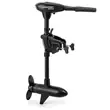
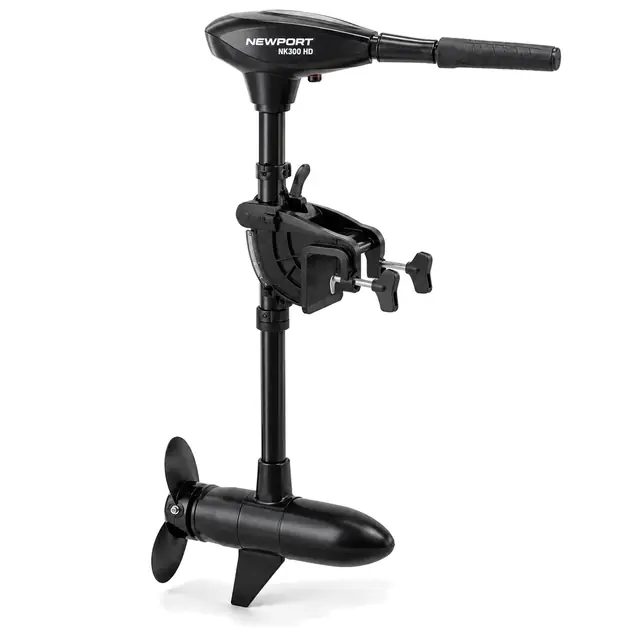
Shop for a kayak motor and you’ll find the Garmin Force Current and the Newport NK300 sitting in the same category pages, the same “best kayak trolling motor” roundups, sometimes the same comparison charts, ranked against each other like two versions of the same purchase. They are not. The Newport NK300 HD produces 110 lb of thrust, tops out around 6.5 mph, and is rated for up to 66 miles of range. It has no GPS anchoring, no spot lock, and no autopilot function of any kind, a fact confirmed in Newport’s own product documentation as of September 2026. The Garmin Force Current produces 50 lb of thrust at 24V, less than half the Newport’s number, and it holds your kayak on a single spot using GPS anchor lock, for roughly $2,999.99, twice the Newport’s $1,499.99.
If you read only the thrust figures and the price tags, the Garmin looks like a poor deal. Less power for more money is not usually how “better” works. But thrust and price are answering two different questions here, because these are two different kinds of motor. One is built to move you. One is built to hold you still. This article separates those jobs, gives you a fast way to figure out which one you actually need, prices both systems completely, and includes the honest answer competitors leave out: a reader who wants to hold position on a budget usually doesn’t need either of these motors at all.
Two motors, two jobs
A kayak motor either does propulsion, moving the boat from one place to another, or positioning, holding the boat where it already is. Few motors do both well, and neither of these two even attempts the other’s job.
Propulsion is a straightforward engineering problem: convert battery power into thrust, push water, move the hull. More thrust means faster acceleration, higher top speed, and the ability to run against wind and tide. A propulsion motor’s whole value proposition is distance covered per dollar and per pound of battery.
Positioning is a different problem entirely. A positioning motor has to sense drift using GPS, calculate a correction, and fire the motor in small bursts to counteract current and wind, dozens of times a minute, without you touching a control. That requires GPS receivers, a closed-loop correction system, autopilot logic, and a remote sophisticated enough to set and release a spot on command. None of that produces extra thrust. It produces control.
Job
What it optimizes
What it needs
Which motor here does it
Propulsion
Distance, speed, range per charge
A powerful, efficient motor and propeller
Newport NK300 HD
Positioning
Holding a fixed GPS point without input
GPS receivers, control loop, autopilot software
Garmin Force Current
Some trolling motors on other boats do attempt both, bundling strong thrust with GPS anchoring in one unit. Neither of these two does. The Force Current caps out at 50 lb of thrust, plenty for holding a kayak against light to moderate current but modest for covering distance. The NK300 has no anchoring function at any price. Once you know which job you need, the rest of this comparison is easy. If you’re not sure yet, the diagnostic below sorts it out in under a minute. And if you already know you want positioning and are choosing between GPS-anchoring motors specifically, our Force Current versus Minn Kota Kayak Terrova comparison is the like-for-like matchup, since the NK300 was never a candidate for that job.
Nothing sits in the top right corner, which is why these two are not competitors.
Does the NK300 have spot lock?
No. The Newport NK300 has no GPS anchoring, spot lock, or autopilot function of any kind. It is a propulsion motor, built to move a kayak, with 110 lb of thrust, a 6.5 mph top speed, and a published range of up to 66 miles. If holding position automatically is what you need, the NK300 cannot do it, and no accessory adds it after the fact.
This is the single fact that resolves most searches for this comparison, and it’s worth stating plainly because several roundup articles that list both products never mention it. Newport’s own product documentation, reviewed September 2026, describes the NK300 as a direct drive brushless motor with speed control and a digital battery display. Nowhere in that documentation is a positioning, anchoring, or autopilot feature listed.
Some NK300 owners believe they’ve found a workaround: holding roughly steady against light current by working the remote by hand, nudging the throttle up and down to counter drift. It can be done, badly, for short stretches, and it drains the battery the entire time you’re doing it, since the motor is running continuously rather than firing in the brief, efficient bursts a GPS control loop uses. It is not a substitute for spot lock. It’s closer to treading water with a motor instead of your legs.
Which job do you need?
Answer these honestly and the right category falls out on its own.
Do you mostly fish structure, current seams, or a specific piece of bottom, or do you mostly cover open water? Structure and current point toward positioning. Open water points toward propulsion.
Do you troll for kingfish, mahi, or wahoo? Trolling is a propulsion job. Speed control and sustained thrust matter more than holding power.
Do you drift fish and simply want to slow or stop the drift at a spot, without steering? That’s positioning, and it’s the exact job the Force Current is built for.
How far is your typical run from the launch to where you fish? Under a mile or two, either motor works. Three miles or more, particularly against wind, favors the NK300’s thrust and range.
Do you fish moving tide against a bridge piling, jetty, or reef edge where holding a precise spot matters to the bite? That’s positioning, and it’s a harder case to fake with a propulsion motor and a hand on the throttle.
Do you already anchor, and does it work for how you fish? If a stake-out pole or anchor already does the job, you may not need either motor. See the alternatives section below before you spend anything.
How far offshore do you go, and would getting home against wind or a running tide ever be a real concern? That’s a propulsion and safety question, and it’s a genuine argument for the NK300 regardless of whether you also want positioning.
Reading the answers: mostly holding and structure fishing means you’re in the market for a positioning motor, and the Force Current or a comparable GPS-anchoring motor is the right shortlist. Mostly covering water, trolling, or running distance means the NK300 or a similar propulsion motor is the right shortlist, at half the price of the Garmin. If you genuinely need both, skip to “Can you have both?” below, because buying one expensive motor to do two jobs is rarely the cheapest way to get both jobs done.
The honest budget answer is not a motor at all.Garmin Force CurrentNewport NK300 HD
The specifications, side by side
Every figure below carries its source and its date. Voltage is listed next to every thrust number because thrust without voltage is close to meaningless on these motors.
Published specifications
Thrust
50 lb at 24V, 30 lb at 12V
110 lb at 36V
Horsepower equivalent
Not published by Garmin
3 HP equivalent
Peak watts
Not published by Garmin
1,300W
Top speed
Not applicable, station-keeping motor
6.5 mph
Published range
Not applicable
Up to 66 miles
Published runtime
Hours of hold time, condition-dependent, not a single published figure
Up to 30 hours, depending on battery and conditions
Motor weight
Not published by Garmin for the head unit alone
25.5 lb
Shaft length
Adjustable, 11.4 in to 16.6 in
21.7 in, fixed
GPS anchoring
Yes: dual-frequency GPS with anchor lock
No: not present in Newport’s product documentation
Autopilot / route following
Yes
No
Heading hold / cruise control
Yes
No
Control
Floating wireless remote, autopilot modes
Speed control dial, digital battery display
Water rating
Fresh, brackish, and salt water
Saltwater rated per Newport specifications
Battery requirement
24V for full thrust (30 lb available at 12V)
36V, LiFePO4 pack of at least 30Ah specified by Newport
MSRP
Approximately $2,999.99 (approximately $3,599.99 with Power Steer foot pedals)
$1,499.99
Sources: Newport Vessels NK300 HD product page and documentation, and Garmin Force Current product page and manual, both reviewed September 2026. This table stays focused on what this comparison needs. For the deeper, like-for-like Force Current specification breakdown against another positioning motor, see the Force Current versus Minn Kota Kayak Terrova comparison.
The GPS anchoring row is the whole decision for a lot of readers. Everything above and below it is detail.
Why the cheaper motor has more thrust
Thrust is comparatively cheap to build. Precise position holding is not. The NK300’s price buys you a powerful brushless motor and a propeller. The Force Current’s price buys GPS receivers, a closed-loop control system, autopilot software, a floating remote, and the engineering to integrate all of it. You’re paying for control, not power.
Put another way, a motor manufacturer can chase bigger thrust numbers mostly by scaling up a well-understood design: a bigger motor, a bigger prop, more current. It’s expensive to manufacture at volume but not conceptually hard, and Newport has clearly chosen to put its engineering budget there. Garmin took a different approach with the Force Current. Producing 50 lb of thrust reliably is a solved problem for any competent motor manufacturer. Making that motor correct its position automatically, dozens of times a minute, in wind and current, without dragging the kayak off a two-foot piece of structure, is a software and sensor problem layered on top of the motor, and that’s where the Force Current’s price actually goes.
Expert tip: if you ever see a positioning motor and a propulsion motor priced close together, look hard at the thrust figure on the positioning motor. Something is usually being traded to hit that price, most often battery efficiency, remote quality, or the sophistication of the correction software.
What each system costs and weighs
The motor’s sticker price is not the number that matters. Neither motor runs on a single 12V battery, and the battery, charger, and mount add real dollars and real pounds to whichever system you build.
Component
Garmin Force Current system (24V)
Newport NK300 HD system (36V)
Motor
~$2,999.99
$1,499.99
Battery
24V LiFePO4 pack, roughly $700 to $1,000 depending on capacity
36V LiFePO4 pack, minimum 30Ah as specified by Newport, roughly $900 to $1,300
Charger
24V-compatible charger, roughly $150 to $250
36V-compatible charger, roughly $150 to $250
Mount and wiring
Roughly $100 to $200
Roughly $100 to $200
Approximate system total
$3,950 to $4,450
$2,650 to $3,250
Motor weight
Not published by Garmin
25.5 lb
Approximate battery weight
20 to 30 lb depending on pack size
25 to 35 lb depending on pack size, larger due to the 36V requirement
Battery weights and prices are calculated from published battery manufacturer specifications at each voltage and are approximate, since pack size varies by desired runtime. See our guides on 24V versus 36V lithium trolling motor systems and best 36V lithium batteries for saltwater trolling motors for choosing a specific pack, and best onboard chargers for 36V systems for the charging side.
The NK300 motor costs $1,500 less than the Force Current, but it also needs a larger 36V pack rather than a 24V one, which narrows the total system gap somewhat once the battery is factored in. Compare the totals, not just the motors, before deciding either one is the budget option. Both systems also eat meaningfully into your kayak’s usable payload once the motor, battery, mount, and wiring are added together. If you haven’t calculated what your hull can actually carry once a motor system is on board, our payload method from the big-angler kayak guide walks through how usable capacity gets calculated and where a motor system fits into the load stack.
Range, runtime, and what reduces both
Newport publishes up to 66 miles of range and up to 30 hours of runtime for the NK300 HD, depending on battery capacity and conditions. Those are real, manufacturer-stated figures, and they’re worth quoting because range is the NK300’s headline strength.
They’re also measured under favorable conditions, which is true of essentially every published range figure on any electric propulsion product. Wind, chop, a fully loaded hull, running at higher throttle settings to make headway against current, and cold battery temperatures all reduce real-world range below the published maximum. Voltage sag late in the day, as the pack draws down, further reduces both available thrust and remaining range at the exact point in the trip when you may need it most to get home.
Warning: never plan a return trip on a published maximum range figure. Treat 66 miles as a laboratory number and plan your day around a fraction of it, particularly if wind or tide will be against you on the way in.
The equivalent runtime question for the Force Current isn’t distance at all, it’s hours of station keeping against current, and that figure depends entirely on how hard the current is making the motor work to hold the spot. A calm flat with light drift asks very little of the motor and the battery lasts a long day. A hard-running tide against a piling asks a great deal more, continuously, and will drain a pack faster than the same motor holding a calm bay. These are not comparable runtime numbers, and treating them as though they measure the same thing is a mistake several competing pages make.
Holding position without a GPS motor
Here’s the section that costs us a sale, and it’s the most useful thing on this page for a specific reader: someone who wants to hold position on the water and does not have $3,000 to spend on a motor to do it.
You don’t need GPS anchoring to hold a kayak in place. Mechanical alternatives have done the job for decades, they cost a small fraction of a positioning motor, and for a lot of the water saltwater kayak anglers actually fish, they work just as well.
Method
What it does
Depth or condition limit
Weight
Approximate cost
Where it fails
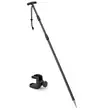
Stake-out pole
Pins the kayak to the bottom through a scupper or side mount
Shallow water only, generally under 6 to 8 ft, firm bottom needed
2 to 4 lb
$40 to $120
Deep water, soft mud or sand that won’t hold the point, hard current
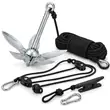
Anchor and trolley
Holds the kayak from a fixed point on a rope, adjustable along the hull with a trolley
Works in deeper water where conditions allow, needs room to swing
3 to 6 lb for anchor, rope, and trolley
$50 to $150
Strong current or wind can drag a light anchor, and swing radius changes your position relative to structure
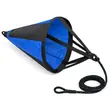
Drift chute
Slows a drift without stopping it, useful for working a piece of structure slowly rather than holding dead still
Open water, wind and current dependent
1 to 2 lb
$30 to $70
Does not hold a fixed spot, only slows movement across one
Pedal drive worked against current
Uses continuous light pedaling to counter drift manually
Any depth, limited by angler stamina
Varies by drive, already on the boat for many anglers
$0 additional if you already own a pedal kayak
Requires continuous physical effort, not hands-free, tiring over a full session
None of these matches the convenience of GPS anchoring, where you press a button and the boat holds itself while both your hands stay free to fish. That convenience is real and it’s part of what the Force Current’s price buys. But for a shallow-water angler working a flat, a jetty, or a piece of structure in six feet of water, a stake-out pole costs $40 to $120 and does the job the Force Current does, without the $2,999.99 price tag, the 24V battery, or the added payload. Together, a stake-out pole and an anchor trolley cover most of the situations a recreational saltwater kayak angler runs into, for well under $300 combined.
If your honest answer to “which job do you need” was positioning, and your budget is the obstacle rather than the concept, start here before you start saving for a motor.
Can you have both?
Frequently, yes, and it’s often the better answer than either motor alone.
A propulsion motor handles the get-there and get-home part of the day, where thrust, speed, and range genuinely matter. A stake-out pole or an anchor trolley handles the hold-still part, where the water is shallow enough for a pole to reach bottom, which covers a large share of saltwater kayak fishing. Pair the NK300 for propulsion with a stake-out pole and, if you already pedal, your existing pedal drive for the deeper spots, and you’ve covered both jobs for less money and less added weight than a single Force Current system.
Build
What it does
Approximate total cost
Approximate added weight
NK300 system alone
Propulsion only, no holding
$2,650 to $3,250
25.5 lb motor plus 25 to 35 lb battery
NK300 system plus stake-out pole plus anchor trolley
Propulsion, plus shallow-water holding
$2,780 to $3,520
Above, plus 5 to 8 lb combined
Force Current system alone
Positioning only, modest thrust
$3,950 to $4,450
Motor weight not published, plus 20 to 30 lb battery
The both-motors build isn’t free, and it isn’t hands-free positioning in deep water, where only GPS anchoring genuinely competes. But for the angler who mostly runs to a spot, fishes shallow structure once there, and occasionally needs to get home against a building sea breeze, adding a stake-out pole to a propulsion motor covers more real fishing situations than the numbers alone suggest, and it does it for less than a single Force Current.
Who this suits: anglers who fish a mix of shallow structure and open water, and who are willing to carry one extra piece of gear rather than pay for one motor to do everything.
Who this doesn’t suit: anglers who fish deep water where a pole can’t reach bottom and need hands-free holding regardless of depth. That reader is buying a positioning motor, full stop, and should compare the Force Current against other GPS-anchoring options in our Force Current versus Minn Kota Kayak Terrova comparison.
Shaft length and mounting
The two motors diverge sharply here, and it affects where each one can go on your kayak.
The standard method for sizing a trolling motor shaft, per West Marine’s trolling motor advisor, is to measure from the mounting point down to the waterline, then add roughly 12 to 18 inches so the propeller sits at that depth below the surface. When you’re between two sizes, choose the longer one.
Measure from your intended mount point (transom, bow, or stern-mounted plate) down to the waterline with the kayak loaded roughly as you’ll fish it.
Add 12 to 18 inches to that measurement for target propeller depth.
Compare the result against each motor’s shaft range.
The NK300 HD uses a fixed 21.7 inch shaft, which suits a stern or transom mount on most saltwater kayaks with typical freeboard, and it’s not adjustable, so measure before you buy rather than after. The Force Current adjusts from 11.4 to 16.6 inches, giving more flexibility for bow mounts, lower-freeboard hulls, or kayaks where a shorter shaft keeps the prop clear of shallow structure while still holding depth for the GPS correction system to work properly.
Stern mounting suits a propulsion motor well, since thrust generally works better applied straight back from a fixed point. Bow mounting suits a positioning motor well, since holding a spot often benefits from the correction thrust being applied from the front of the hull, closer to where the current first pushes the bow off line. Whichever mount you choose, a motor’s added weight shifts trim, and on a light hull that shift is noticeable enough to plan around rather than discover on the water.
Which should you buy?
There’s no single winner here, and pretending otherwise would mislead half the readers this article is trying to help. Find your row.
Reader type
Recommendation
Structure and current angler, holds spots on pilings, jetties, or reef edges
Garmin Force Current, or a stake-out pole and anchor trolley if the water is shallow enough and the budget is tight
Distance and trolling angler, covers open water, trolls for pelagics
Newport NK300 HD, by a wide margin. Thrust, speed, and range are exactly what trolling needs
Offshore angler wanting get-home capability
Newport NK300 HD. Range and sustained thrust against wind or tide is a propulsion and safety question, not a positioning one
Budget-constrained angler who needs to hold position
Stake-out pole plus anchor trolley, well under $300 combined, not either motor
Angler who already owns a pedal drive
Add a stake-out pole before adding a motor of either kind. You may already have most of what you need
Angler running Garmin chartplotter and electronics already
Garmin Force Current, for the integration with existing Garmin gear, if positioning is genuinely the job you need
Newport publishes up to 66 miles and up to 30 hours of runtime, depending on battery capacity and conditions. Real-world range under wind, chop, and a loaded hull runs lower than the published maximum, so plan trips around a conservative fraction of that figure rather than the headline number.
The Newport NK300, plainly. Trolling is a propulsion job that rewards sustained thrust and speed control, both of which the NK300 is built for and neither of which the Force Current prioritizes.
Depends entirely on the job. If you need hands-free GPS position holding, yes, because nothing about the NK300 substitutes for it at any price. If you need to cover water, troll, or get home against wind and tide, the extra money buys control you won’t use, and the NK300 does the job you actually need for half the cost.
In many states, adding any motor, electric or otherwise, can move a kayak into the registered vessel category. Requirements vary by state, so check with your state boating agency before mounting either motor.
Newport rates the NK300 for saltwater use. As with any electric motor used in salt water, rinse it with fresh water after every trip and follow the manufacturer’s maintenance schedule to protect against corrosion.
Measure from your mount point to the waterline, loaded as you’ll fish, then add 12 to 18 inches for target propeller depth, per West Marine’s trolling motor advisor. The NK300 HD’s fixed 21.7 inch shaft suits most stern mounts. The Force Current’s 11.4 to 16.6 inch adjustable range suits a wider variety of mounts and freeboards. —
Final verdict
The Garmin Force Current and the Newport NK300 aren’t competing products, they’re answers to different questions: do you need to stay somewhere, or do you need to get somewhere. Buy the Force Current if holding a precise GPS spot is genuinely the job, buy the NK300 if covering distance and getting home against wind or tide is the job, and if your real need is holding position on a budget, buy a stake-out pole before you buy either motor. That last option is the one every roundup skips, and it’s the one that will actually save a reader money without costing them the fishing they wanted to do.
Larry Murray
Editor, ReefReadyGear
Larry edits ReefReadyGear, a research-led saltwater gear publication. Recommendations here are built from manufacturer specifications, authorised retailer listings and published angler experience, and we say so plainly rather than implying a testing programme we do not run. Where a claim comes from a manufacturer, we attribute it. Where we have not verified something, we do not print it.
Specifications on this page were taken from manufacturer and authorised retailer listings and the advisory sources below, consulted September 2026. Prices and specifications change; confirm current figures before buying.
Newport Vessels NK300 HD product page and documentation (110 lb thrust, 36V, speed control and digital battery display; no positioning, anchoring or autopilot feature listed), reviewed September 2026
Garmin Force Current product page and manual (50 lb thrust at 24V, dual-frequency GPS anchor lock), reviewed September 2026
West Marine trolling motor advisor, used for the shaft length method
Battery manufacturer specifications for 24V and 36V pack weights and pricing
Join The ReefReady Community
Get saltwater Fishing Guides, expert Buyers Guides, equipment recommendations,
marine electronics insights, and practical gear tips delivered to your inbox.
 Best for holding position
 Best for range and speed
 Stake-out pole
 Anchor and trolley
 Drift chute