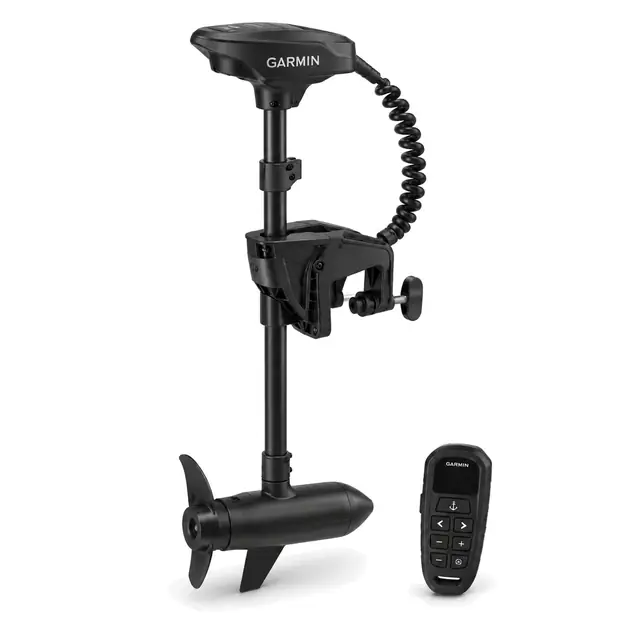
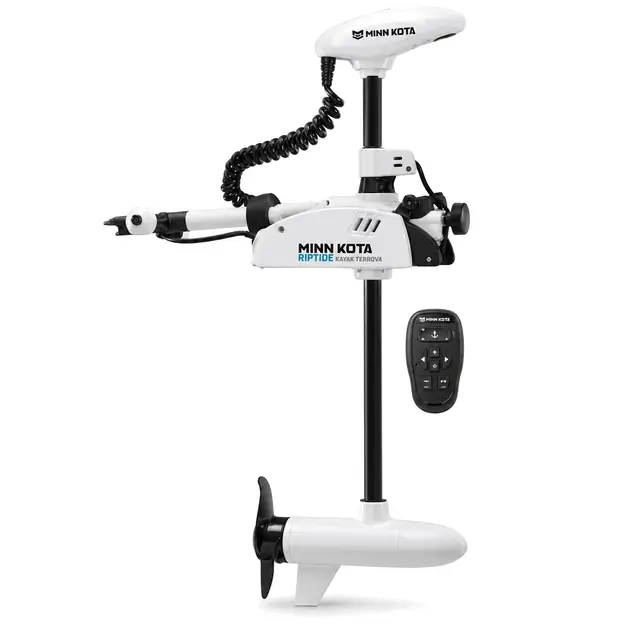
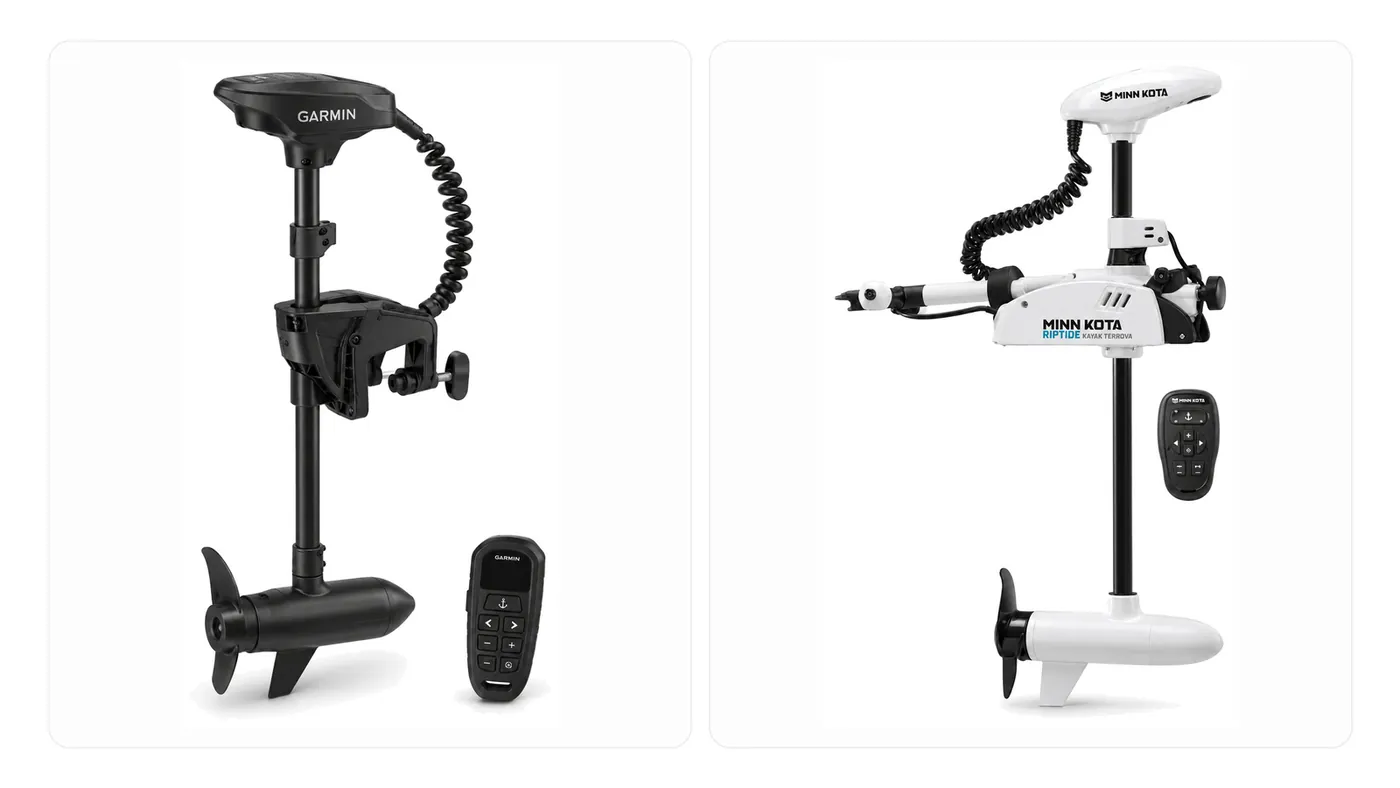
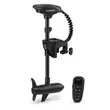
Left: Garmin Force Current. Right: Minn Kota Riptide Kayak Terrova. Manufacturer product photography.
Garmin Force Current vs Minn Kota Riptide Kayak Terrova: The $1,100 Question
The Minn Kota Riptide Kayak Terrova makes 55 lb of thrust on a single 12V battery for $1,899.99. The Garmin Force Current makes 50 lb of thrust, but only if you wire it to 24V, and it costs…
By Larry MurrayUpdated 6 September 202619 min readBuyer’s Guide
The quick answer
These two motors are the entire saltwater kayak GPS anchoring category, so the comparison is not academic. The trap is comparing 50 lb of Garmin thrust against 55 lb of Minn Kota thrust without noticing that the Garmin figure is measured at 24V and the Minn Kota figure at 12V.
For most kayak anglers, the Minn Kota Riptide Kayak Terrova is the better buy. It produces 55 lb of thrust on a single 12V battery for $1,899.99, which is more thrust, on a simpler and lighter battery system, for $1,100 less than the Garmin Force Current. It integrates with Humminbird fish finders and the One-Boat Network app.
Buy the Garmin Force Current instead if any of these apply to you: you already run Garmin chartplotters and want motor control from the same screen, your kayak has very low freeboard and needs the Force Current’s 11.4 to 16.6 inch adjustable shaft rather than the Minn Kota’s fixed 36 inches, or you’re willing to pay for what published GPS specifications suggest should be the more precise anchor lock.
Both motors are worth cross-shopping before you commit, and both belong in your evaluation regardless of which way you’re leaning. See the current pricing and availability for the [Minn Kota Riptide Kayak Terrova] and the [Garmin Force Current] before you decide.
Affiliate disclosure. Affiliate disclosure: ReefReadyGear earns a commission on some links below at no extra cost to you. We don’t accept payment for placement. This comparison is built from manufacturer specifications, authorized retailer listings and published owner reports, verified in September 2026. No independent head-to-head test of these two motors has been published, and we say so plainly where it matters.
Voltage is the whole comparison
Every headline thrust figure in this category hides a voltage assumption, and the battery that assumption implies is a real cost in dollars and in kayak payload. This page prices both motors as complete systems rather than as motor heads.
ReefReadyGear does not run a testing programme, and nothing on this page is presented as a first-hand test result.
Every figure here is drawn from manufacturer and builder documentation, authorised retailer listings and published
angler experience, verified in September 2026 and dated where it matters. Where a number is our calculation rather
than a published figure, we label it and show the method.
Thrust compared at matched voltage rather than at each maker’s headline figure
System pricing built from motor, battery and charger, not motor MSRP alone
Payload cost of each battery configuration stated in pounds carried on the kayak
No independent head-to-head test of these two motors has been published, and nothing here is presented as one
Where two authoritative sources disagree, both are quoted and attributed rather than blended, and where a maker
publishes no figure at all we say so instead of estimating quietly.
The Minn Kota Riptide Kayak Terrova makes 55 lb of thrust on a single 12V battery for $1,899.99. The Garmin Force Current makes 50 lb of thrust, but only if you wire it to 24V, and it costs $2,999.99. Wire the Force Current to a single 12V battery instead, the same battery the Minn Kota runs on, and it drops to 30 lb.
That is the sentence that decides most of this purchase, and it is missing from nearly every comparison currently ranking for this query. Retailers list the two thrust numbers side by side and let 55 look ten percent bigger than 50. It is not. Compared on the same battery, it is 83 percent bigger, and the Garmin costs $1,100 more to deliver less.
That is not the end of the argument, because the Force Current has real advantages the sticker price doesn’t show: a shaft that adjusts to fit low-freeboard kayaks where the Minn Kota’s fixed 36 inch shaft might not, dual-frequency GPS that should translate into tighter position holding, and integration with Garmin chartplotters that matters enormously if you already run one. This article prices the whole system, works through the shaft fit question with a method you can apply to your own kayak, and settles the ecosystem question by reader type rather than a single verdict.
Garmin Force CurrentMinn Kota Riptide Kayak Terrova
The specifications, side by side
Published specifications
Thrust
50 lb at 24V (ISO 13342, high-efficiency prop)
55 lb at 12V
Thrust on the other voltage
30 lb at 12V
Not offered at 24V
Shaft length
Adjustable, 11.4 in to 16.6 in
Fixed, 36 in composite
Position hold
GPS anchor lock, autopilot, route following, heading hold, cruise control
Spot-Lock, Autopilot, Drift Mode, Follow Mode
GPS type
Dual-frequency GPS
Standard GPS (not published as dual-frequency)
Remote
Floating wireless remote, 1.2 in color display, IPX7
Micro Remote, plus app and fish finder control
Fish finder integration
Garmin chartplotters
Humminbird units, One-Boat Network app
Corrosion protection
Rated for fresh, brackish and salt water
Grit-blasted, aluminum-coated lower unit
Propeller
Weedless-style high-efficiency prop
Weedless propeller
Stow and deploy
Lever-operated
Lever-operated stow-and-deploy
Foot pedal option
Power Steer, $3,599.99
Not offered
MSRP
$2,999.99 ($3,599.99 with Power Steer)
$1,899.99
Availability
Current production
Launched October 15, 2025
Every figure above traces to Garmin’s Force Current product documentation and Minn Kota’s Riptide Kayak Terrova launch materials and product page, both verified in September 2026. Street pricing at authorized retailers can run below MSRP by a modest margin on either motor; confirm current pricing before you buy, since both are frequently dealer-fulfilled rather than stocked broadly.
Thrust, compared properly
The Garmin Force Current is rated at 50 lb of thrust at 24V and drops to 30 lb at 12V, measured to ISO 13342 with its high-efficiency propeller. That rating depends entirely on how the motor is wired, so a Force Current running on the single 12V battery most kayak anglers already own delivers considerably less thrust than the headline 50 lb figure suggests.
Here is why that matters more than any other number in this comparison. Nearly everything currently ranking for this query lists “50 lb” against “55 lb” as though they were measured the same way. They are not. The Minn Kota’s 55 lb figure is a 12V rating, full stop. The Garmin’s 50 lb figure is a 24V rating. Put both motors on the battery system most kayak anglers actually run, a single 12V battery, and the comparison looks like this:
Configuration
Garmin Force Current
Minn Kota Riptide Kayak Terrova
On a single 12V battery
30 lb thrust
55 lb thrust
Battery weight required
One 12V battery (~14 to 27.5 lb depending on capacity)
One 12V battery (~14 to 27.5 lb depending on capacity)
Battery cost required
Single 12V pack, roughly $200 to $500 for a lithium unit
Single 12V pack, roughly $200 to $500 for a lithium unit
On the motor’s rated configuration
50 lb thrust, requires 24V
55 lb thrust, requires only 12V
Battery weight required
Two 12V batteries in series or one 24V pack, roughly 28 to 55 lb
One 12V battery, roughly 14 to 27.5 lb
Battery cost required
Roughly double a single 12V lithium pack, often $700 to $1,200
Roughly $200 to $500 for a lithium unit
On one 12V battery, the same battery that gives the Minn Kota its full rated performance, the Garmin produces 30 lb against the Minn Kota’s 55 lb. That is not a 10 percent gap. It is an 83 percent gap in the Minn Kota’s favor, on equal battery weight and equal battery cost. To get the Force Current’s headline 50 lb figure, you have to add a second battery, and that second battery is the real price of the comparison, not the $1,100 on the sticker.
To be fair to Garmin, there is a real mitigating factor here that most treatments of this comparison skip. Voltage sag reduces effective thrust under sustained load, and it reduces it more on a 12V system than a 24V one, so a 24V Force Current holds a larger share of its 50 lb rating through a long day than a 12V Force Current holds of its 30 lb, or than a 12V Kayak Terrova holds of its 55 lb. That narrows the practical gap somewhat, but it does not close an 83 percent difference in starting thrust. The Minn Kota still wins the like-for-like comparison decisively.
Expert tip: decide your battery system before you decide your motor. On a kayak, the battery is the actual constraint, not the motor mount. If you’re committed to a single 12V battery for weight reasons, that decision alone points toward the Kayak Terrova. If you’re already planning a 24V system for other reasons, the Force Current’s real rating becomes available to you and the comparison changes.
On one battery the cheaper motor pushes harder. The Garmin needs a second battery to get close.
What the voltage really costs
Thrust numbers on a spec sheet do not show up on your kayak by themselves. They arrive attached to a battery, a charger, and a chunk of your usable payload. This is the section every other comparison of these two motors skips, and it is where the real $1,100 gap either widens or narrows depending on which voltage you actually run.
Cost factor
12V system (either motor)
24V system (Force Current only, to reach 50 lb)
Battery weight
~14 lb (50Ah lithium) to ~27.5 lb (100Ah lithium)
~28 to 55 lb, two batteries in series or one 24V pack
Battery cost
Roughly $200 to $500
Roughly $700 to $1,200
Charger
Single-battery charger, roughly $80 to $150
Multi-bank or 24V-rated charger, typically $150 to $300
Deck space
One battery box or tray
Two battery boxes, or one larger 24V pack occupying similar footprint to two 12V units
Payload consumed
Lowest of the options here
Roughly double the 12V figure, taken directly from usable capacity
Now total each complete system, motor plus a representative lithium battery plus a charger, using street-level pricing:
System
Motor
Battery
Charger
Approximate system total
Minn Kota Riptide Kayak Terrova, 12V
$1,899.99
~$350 (100Ah lithium)
~$100
~$2,350
Garmin Force Current, 12V (30 lb)
$2,999.99
~$350
~$100
~$3,450
Garmin Force Current, 24V (50 lb, rated)
$2,999.99
~$700 (two 100Ah lithium, or one 24V pack)
~$200
~$3,900
Run the Force Current at its full rated thrust and the complete system costs roughly $1,550 more than the Kayak Terrova system, not $1,100. That’s the real price of the voltage decision, and it’s the number that belongs in your budget rather than the motor MSRP alone. The payload consequence matters just as much on a kayak, since a second 12V battery for a 24V build typically adds another 14 to 27.5 pounds beyond what a single-battery system needs, and every pound comes out of a fixed and already tight capacity.
For the full method behind calculating what that costs you in usable capacity, see our usable payload guide, and for sizing the battery against your runtime needs, see 50Ah vs 100Ah lithium for a kayak trolling motor. For choosing the pack and charger once you know your voltage, see best 36V lithium batteries for saltwater trolling motors and best onboard chargers.
Shaft length: will it fit your kayak?
Usually the Minn Kota’s 36 inch shaft fits, but check it against your own hull before you buy, because kayak freeboard is low enough that a fixed-length shaft can genuinely be the wrong length for a specific mounting height.
The standard method for sizing a trolling motor shaft, per West Marine’s trolling motor advisor, places the propeller 12 to 18 inches below the surface, measured down from the mounting surface, and calls for choosing the longer shaft when your measurement falls between sizes. That method was built around boats, where mounting height above the waterline varies within a narrow band. Kayaks vary far more: a low-profile sit-on-top and a high-deck pedal kayak can differ by six inches or more, and that difference changes which shaft length actually lands the propeller in the right band.
Here’s how to apply it to your own boat:
Measure from your intended mount point down to the waterline, with the kayak loaded the way you’ll actually fish it.
Add 12 to 18 inches to that measurement. That’s your target total shaft depth, propeller to mount.
Compare the target to what each motor offers. The Force Current adjusts from 11.4 to 16.6 inches, so if your target falls within that range, it fits and you can dial it precisely. The Kayak Terrova is fixed at 36 inches, so if your mounting height puts the propeller well past the target band at that length, check with the dealer whether the mount can be raised.
When you’re between sizes, choose the longer option, per West Marine’s guidance, since a shaft that’s slightly too long can usually be trimmed or mounted higher, while one too short cannot be extended.
Working through two representative mounting heights makes the pattern clear. On a low-profile sit-on-top with roughly a 6 inch mounting height, the target prop depth lands around 18 to 24 inches total, comfortably inside the Force Current’s adjustable range but well under the Minn Kota’s fixed 36 inches, meaning the propeller would run deeper than the 12 to 18 inch target unless the mount is raised or shimmed. On a higher-deck pedal kayak with an 18 to 20 inch mounting height, the target climbs to roughly 30 to 38 inches, a comfortable fit for the Minn Kota’s fixed shaft and outside the Garmin’s adjustable range entirely.
The practical takeaway: the Garmin’s adjustability is a genuine advantage on low-freeboard kayaks, and the Minn Kota’s fixed length is a non-issue on taller pedal kayaks where 36 inches lands in the right band naturally. Neither motor is universally right on shaft fit. It depends on your hull.
Warning: a propeller mounted too shallow ventilates, meaning it sucks air and loses bite, especially in chop. When that happens, it reads to the angler like a weak motor or an unreliable anchor lock. It is neither. It’s a mounting height problem, and it gets misdiagnosed constantly because the symptom looks like a performance failure rather than a fit failure.
The ecosystem question
For a meaningful share of readers, this section decides the purchase more than any thrust figure does.
The Minn Kota Riptide Kayak Terrova integrates with Humminbird fish finders and the One-Boat Network app. The Garmin Force Current integrates with Garmin chartplotters. That integration is not a nice-to-have. It buys real things on a small, wet, cluttered kayak deck: motor control and status on the same screen you’re already watching for structure and fish, position and route sharing without a separate remote, and one fewer device competing for space in a cockpit that doesn’t have much to spare.
Run through this decision tree against what’s already on your deck or in your near-term plans:
You currently run a Humminbird unit, or plan to. The Minn Kota is the natural fit, and the ecosystem argument reinforces the thrust and price argument rather than competing with it.
You currently run a Garmin ECHOMAP, GPSMAP, or similar chartplotter, especially with LiveScope. The Force Current’s integration is a real functional advantage a spec sheet alone won’t capture, and it may be worth the premium on its own for the control and display convenience.
You don’t own a fish finder yet, or you’re brand-agnostic. The question becomes forward-looking: buying the Minn Kota nudges you toward Humminbird next, and buying the Garmin nudges you toward a Garmin plotter. Decide which ecosystem you’d rather be locked into before you buy either.
You own electronics from a third brand entirely, such as Lowrance. Neither motor’s integration applies directly to you, so decide on thrust, price, and shaft fit alone.
There’s a resale consequence worth naming plainly. A motor that’s part of a matched ecosystem, Garmin-plus-Garmin or Humminbird-plus-Minn Kota, tends to hold value better as a package, because the next buyer inherits a working system rather than two mismatched brands.
If your fish finder is already chosen, see best fish finders for offshore kayak fishing for how the ecosystem question plays out on the electronics side of this same decision.
How each one holds position
Both motors advertise GPS-based position holding, Garmin’s anchor lock and Minn Kota’s Spot-Lock, and it’s worth being precise about what’s actually different between them rather than treating the two as interchangeable words for the same feature.
Position holding works as a closed loop: the motor’s GPS receiver reports where the boat is, software compares that to where it should be, and the motor fires in short bursts to correct the difference. Two things determine how well that loop performs. The first is fix quality, how precisely the receiver knows where the boat actually is; a receiver with more position error reports a wandering position even when the boat itself is holding still, and the motor corrects against that wander unnecessarily, which shows up as restless movement rather than a calm hold. The second is correction authority, how much thrust the motor has available to push the boat back on station once it has genuinely drifted.
Garmin publishes dual-frequency GPS on the Force Current, which is the most defensible part of its price premium and deserves a fair hearing rather than a dismissal. Dual-frequency receivers reduce position error compared to single-frequency GPS, particularly in conditions like tree cover, bridge shadow, or reflective water where signal multipath confuses a single-frequency fix. Better fix quality should translate into a tighter, less twitchy hold, all else equal. Minn Kota does not publish the Kayak Terrova’s GPS as dual-frequency, but its advantage runs the other way: at 55 lb on 12V, it has substantially more correction authority on the same battery than a 12V Force Current does, and more thrust in reserve matters most once the boat has actually drifted and needs pushing back, such as against tidal current or wind gusts.
Warning: no independent head-to-head test comparing these two motors’ actual hold performance exists at the time of writing. Any source, including this one, that states confidently which motor “holds better” without having tested both is reasoning from published specifications, the same as we are here. Treat any unqualified claim of superior hold performance with real skepticism. What can be said honestly is that Garmin’s specifications suggest a fix-quality advantage and Minn Kota’s suggest a correction-authority advantage on equal battery, and that both plausibly matter, in different conditions.
Corrosion and saltwater durability
Both manufacturers make durability claims, and it’s worth comparing them as the different kinds of claim they actually are rather than treating them as equivalent statements. Neither is an independent durability test.
Minn Kota describes the Riptide Kayak Terrova’s lower unit as grit-blasted and aluminum-coated, a specific manufacturing process applied to the housing around the motor and gearing below the waterline. Garmin rates the Force Current for fresh, brackish and salt water use, a broader use-case rating rather than a coating description. One is a claim about how a component is made; the other is a claim about where the product is meant to operate. Both are the manufacturer’s own wording, not third-party verification.
In practice, saltwater durability on either motor comes down heavily to rinse discipline regardless of what the lower unit is made from. Rinse the drive with fresh water after every saltwater trip, ideally before salt has a chance to dry on it, and dry it before storage. Trapped salt water against any metal component accelerates corrosion regardless of the coating underneath. Check both motors’ warranty terms before you buy, since coverage on saltwater use varies and is worth reading in full.
Is the foot pedal version worth it on a kayak?
Generally, no, for most kayak anglers. Garmin’s Power Steer foot pedal option adds $600 to the Force Current’s price, bringing it to $3,599.99, and it’s a genuinely questionable proposition on a kayak specifically, even though it makes obvious sense on a bass boat with a wide-open front deck.
The reasoning is straightforward. Kayak deck space is scarce to begin with, and a foot pedal claims a fixed amount of it directly in front of the seated angler, exactly where a pedal drive’s own pedals often already are. If you’re fishing a pedal-drive kayak, your feet are already occupied, and a second foot-operated control competing for the same floor space creates real ergonomic conflict rather than convenience. Even on a paddle kayak, most anglers fish seated, where a hand-operated remote is simply easier to reach than a foot pedal on a narrow, uneven deck.
The pedal option makes more sense on boats, where a standing angler has room to plant a pedal and still cast freely with both hands, a layout a kayak cockpit doesn’t replicate. On a kayak, the $600 premium is better spent on the second battery a 24V Force Current build requires, or saved by going with the Kayak Terrova instead.
Which one should you buy?
Rather than a single verdict, here’s a recommendation by reader type, because the right answer genuinely differs depending on what’s already on your deck and what you’re optimizing for.
Reader profile
Recommendation
Why
Runs Humminbird electronics
Minn Kota Riptide Kayak Terrova
Direct ecosystem integration with the fish finder already on the deck
Runs Garmin electronics, especially with LiveScope
Garmin Force Current
Motor control and display integration with the chartplotter already aboard
Already owns a single 12V lithium battery
Minn Kota Riptide Kayak Terrova
Delivers its full 55 lb rating on the battery already owned; the Force Current would need a second battery to reach its rated thrust
Payload-constrained hull, or fishing near the boat’s usable capacity
Minn Kota Riptide Kayak Terrova
Lower total system weight, since it avoids the second-battery requirement of a 24V Force Current build
Very low mounting freeboard
Garmin Force Current
The adjustable 11.4 to 16.6 inch shaft fits low-freeboard kayaks the fixed 36 inch Minn Kota shaft may not
Wants the lowest total system cost
Minn Kota Riptide Kayak Terrova
Roughly $1,550 less as a complete motor-plus-battery-plus-charger system at the Force Current’s rated 24V configuration
Wants the finest station keeping regardless of cost, and no fish finder brand preference
Garmin Force Current
Dual-frequency GPS should give the tightest fix quality of the two, though this is reasoned from specifications, not tested
If none of those rows describes you cleanly, default to the short answer at the top: for most kayak anglers, the Minn Kota is more thrust, on a simpler battery, for $1,100 to $1,550 less depending on how you count the system. The Force Current earns its premium for Garmin ecosystem owners, low-freeboard hulls, and readers willing to pay for GPS precision that specifications support but no independent test has yet confirmed.
50 lb at 24V, measured to ISO 13342 with the high-efficiency propeller, and 30 lb at 12V. The rating depends on wiring, so a Force Current on a single 12V kayak battery delivers considerably less than the headline figure suggests.
The Riptide Kayak Terrova runs on one 12V battery. The Force Current reaches its full 50 lb rating only on 24V, meaning a 24V pack or two 12V batteries in series, which roughly doubles battery weight and cost against the Minn Kota and comes directly out of usable payload.
Usually, but check it against your hull. The standard method places the propeller 12 to 18 inches below the surface, measured from the mount down. Kayak freeboard is low, so measure before buying. The Garmin’s adjustable 11.4 to 16.6 inch shaft exists precisely because that measurement varies so much between kayaks.
Neither has been independently tested head to head, so treat any confident claim with caution. On specifications, Garmin’s dual-frequency GPS should give a tighter fix and finer station keeping, while the Minn Kota’s higher 12V thrust gives more authority to correct once it has drifted.
Yes. It’s built with a grit-blasted, aluminum-coated lower unit for saltwater use, part of the Riptide line’s saltwater construction. Rinse it with fresh water after every trip regardless.
Generally not. Power Steer adds $600 and claims deck space that’s already scarce, particularly if a pedal drive already occupies the same footwell. It suits an open boat deck better than a seated kayak cockpit.
Roughly $2,350 for a Minn Kota with a single 12V lithium battery and charger. Roughly $3,900 for a Garmin run at its rated 24V configuration, or about $3,450 on a single 12V battery at the reduced 30 lb rating.
Both make saltwater claims of different types. Minn Kota describes a grit-blasted, aluminum-coated lower unit; Garmin rates the Force Current for fresh, brackish and salt water. Neither is an independent test, and rinse discipline matters more in practice than either claim.
Yes. Both mount independently of a pedal drive and are commonly run alongside one, pedaling for propulsion and using the trolling motor for GPS anchoring. See our category guide for how that pairing is typically rigged.
In many states, yes. Adding any motor can move a kayak into a registered vessel category depending on state rules. Check with your state boating agency before mounting either motor.
Compared like for like, on the same 12V battery, the Minn Kota Riptide Kayak Terrova delivers 55 lb of thrust against the Garmin Force Current’s 30 lb, for $1,100 less at the motor and roughly $1,550 less once you price the battery system the Force Current needs to reach its full rated 50 lb. For most kayak anglers, that makes the Minn Kota the better buy. The exception is real and worth naming clearly: anglers already running Garmin chartplotters, fishing kayaks with very low mounting freeboard where the Force Current’s adjustable shaft genuinely fits better than the Minn Kota’s fixed 36 inches, or anyone willing to pay for GPS precision that the specifications support but no independent test has yet confirmed.
Larry Murray
Editor, ReefReadyGear
Larry edits ReefReadyGear, a research-led saltwater gear publication. Recommendations here are built from manufacturer specifications, authorised retailer listings and published angler experience, and we say so plainly rather than implying a testing programme we do not run. Where a claim comes from a manufacturer, we attribute it. Where we have not verified something, we do not print it.
Specifications on this page were taken from manufacturer and authorised retailer listings and the regulatory and safety sources below, consulted September 2026. Prices and specifications change; confirm current figures before buying.
Garmin vs Minn Kota: What the Extra Money Buys
Garmin Force Current product documentation and specifications (thrust at 24V and 12V, ISO 13342 rating, shaft adjustment range), reviewed September 2026
Minn Kota Riptide Kayak Terrova launch materials and product page (12V, 55 lb thrust, 36 in composite shaft, Spot-Lock, Autopilot, Drift Mode), reviewed September 2026
West Marine trolling motor advisor: propeller depth method of 12 to 18 inches below the surface, and the choose-the-longer-shaft rule when between sizes
Street pricing at authorised retailers can sit below MSRP on either motor, and both are frequently dealer-fulfilled; confirm current pricing before purchase
Join The ReefReady Community
Get saltwater Fishing Guides, expert Buyers Guides, equipment recommendations,
marine electronics insights, and practical gear tips delivered to your inbox.
 Better value for most anglers
 Better for Garmin owners