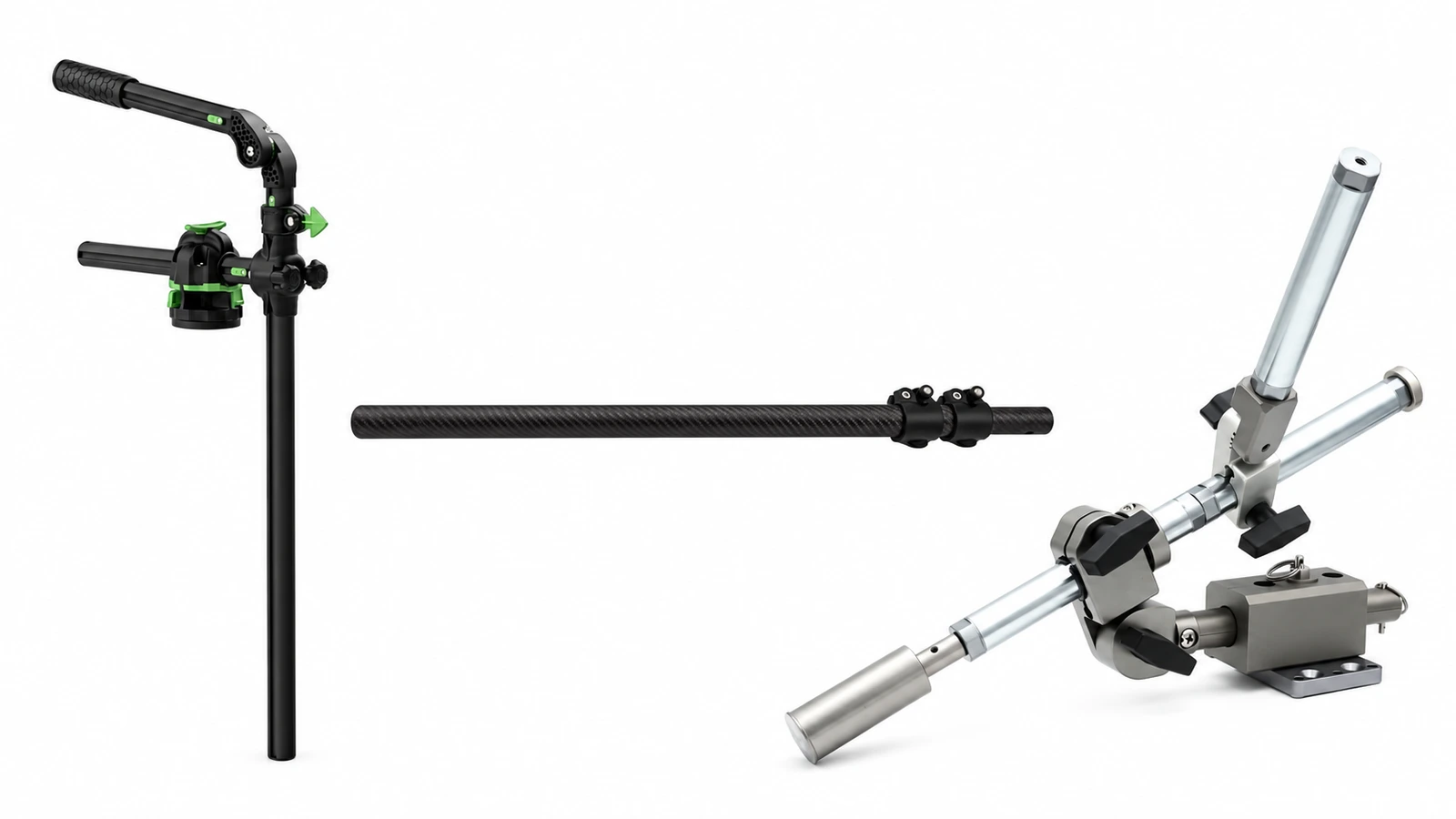
Best Forward-Facing Sonar Poles for Kayaks: Why the Inch Number on the Box Isn't the Reach You Actually Get
You're paddling a grass edge at first light, watching the forward cone for a mark holding off the drop, and the moment you reach up to turn the pole toward it is when a weak installation becomes the whole problem.
The quick answer
The RAILBLAZA HEXX Live Pole 30 is the best forward-facing sonar pole for most kayak anglers. It arrives as a 30-inch shaft with the HEXX mount, kayak track-mount hardware, a direction indicator and cable-management clips already decided for you, at a published 768 mm overall and 4.4 lb. Confirm two things before ordering: your exact transducer adapter, and the length the mount collar retains, which RAILBLAZA does not publish. Anglers whose measured reach lands well away from 30 inches should buy the Summit carbon-fiber bare pole instead, sized from an 18 to 36-inch kayak option and priced as a shaft with no handle, mount or cable clamp in the box.
Everything below is judged on one question: how much of the published length you still get to aim once the mount and the water take their share.
Affiliate disclosure. ReefReadyGear earns a commission on some links below at no extra cost to you. This guide draws on manufacturer product pages, a product-launch announcement and installation manuals, checked September 12, 2026, and it is a researched buying guide rather than a claim of first-hand testing.
Overall length is not the reach you get to fish with
Part of every published length sits inside the mount or below the waterline before you ever get to aim it, and the portion the mount retains is the figure that decides fit, not the number printed on the box. None of the three products compared in this guide publish that retained-length figure, which is exactly why the length stack-up below exists.
The three picks
The three at a glance
| If you want | Consider | Why |
|---|---|---|
| A compact, largely defined package for a low-freeboard kayak | RAILBLAZA HEXX Live Pole 30 | A 30-inch shaft with mount, track hardware and a direction indicator included, though the length the collar retains isn't published |
| A pole sized to a specific reach, built from parts you choose | Summit carbon-fiber bare pole | Three shaft lengths, including an 18 to 36-inch kayak option, but the listing excludes every handle, mount and cable clamp |
| Extra reach or tilt to clear a deck edge or gunwale | FishFinderMounts Pin Lock/Gen3 | Assembles a 20-inch and a 12-inch link into a 32-inch pole with 5 or 10-inch beam offset choices |
On this page
- The quick answer
- The three picks
- The three at a glance
- How we chose
- What "independent aim" actually buys you
- How much pole length do you actually need for your kayak
- What independent aim costs you elsewhere
- The check nobody runs before locking the mount down
- Match the exact transducer before comparing poles
- The best forward-facing sonar poles for kayaks
- RAILBLAZA HEXX Live Pole 30
- Summit carbon-fiber bare pole
- FishFinderMounts Pin Lock/Gen3
- Where each pole sits on the trade-off
- Keeping aim once it's set
- Test the whole rig before your first serious trip
- Compare complete costs, not just the pole
- Do you need a dedicated pole mount at all?
- Frequently asked questions
- Final verdict
- Related reading
- Sources
How we chose
ReefReadyGear does not run a testing programme, and nothing here is presented as a first-hand result. Every specification is drawn from manufacturer product pages, a manufacturer's own launch announcement and installation manuals, verified September 12, 2026. Where a claim is our calculation rather than a published figure, it's labelled as ours with the method shown.
- Fit is checked as a length stack-up, not a single overall-length number, since a pole that's too short or too long at the mount is unfinished rigging regardless of its rotation spec
- Independent aiming and motor-mounted aiming are never compared as if they solved the same problem, because they don't
- Cable routing is treated as part of the installation, not an afterthought, following the transducer manufacturer's own cautions
- Bare-shaft listings are never priced as if they were complete, ready-to-fish kits
What "independent aim" actually buys you
Buy a dedicated pole when you need to aim the transducer somewhere other than wherever the boat happens to be pointed. Mount the transducer on the trolling motor shaft when your aim and your steering are always the same direction anyway. Those are the two real options in this category, and every fixed-versus-modular decision inside pole shopping is secondary to that first one.
RAILBLAZA presents independent sonar aiming as the stated purpose of its Live Pole system: a spot-lock or GPS motor can hold the kayak's position while the transducer keeps scanning wherever you point it, which a motor-mounted transducer cannot do once the motor stops steering. RAILBLAZA's Live Pole launch announcement frames the product around exactly that separation of jobs.
A motor-mounted transducer is the simpler system, and it's simpler because it gives something up. There's one less handle, one less mount and one less stowage task, and for an angler who is always looking in the direction the motor is already pushing the kayak, that simplicity is a legitimate choice rather than a compromise. The trade only becomes a problem when you need to hold position and look somewhere else, which is a specific, namable fishing situation rather than a universal need.
Within independent poles, the second real choice is fixed length against modular length. A fixed pole like the RAILBLAZA HEXX arrives close to ready, at the length RAILBLAZA chose for a kayak-scale installation. A modular assembly like Summit's bare carbon shaft or FishFinderMounts's linked sections lets you set the exact reach your kayak needs, at the cost of selecting every handle, clamp and adapter yourself. Choose fixed when the published length already matches your measured requirement. Choose modular when it doesn't, and you're willing to build the rest of the kit deliberately.
How much pole length do you actually need for your kayak
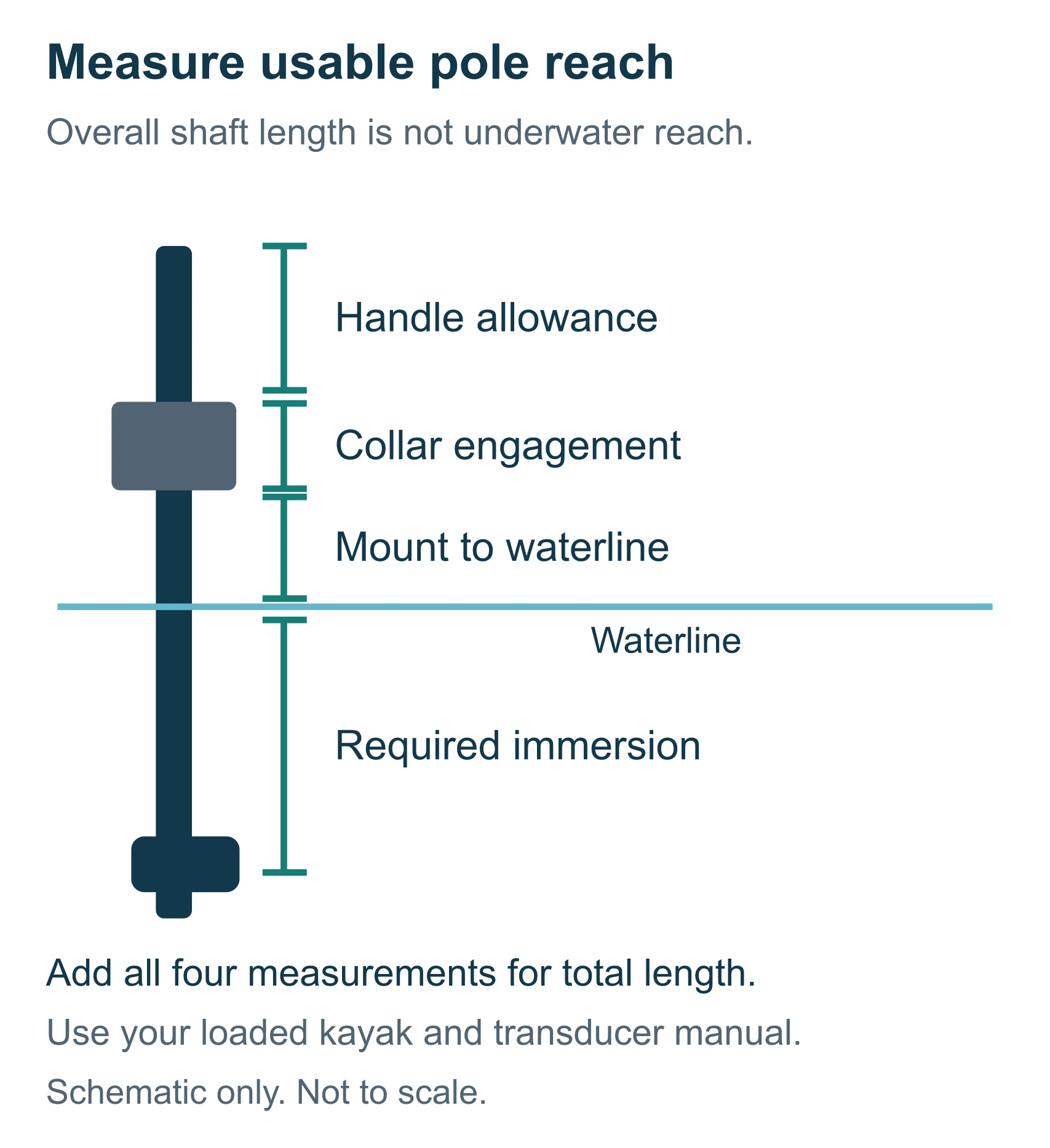
This is the number that decides fit, and it's the number every one of the three listings in this guide leaves for you to work out.
The method
- With the kayak loaded the way you'll actually fish it, measure the height of your proposed mounting point above the waterline. Have a helper take this measurement rather than leaning over the side to get it yourself.
- Check your specific transducer's installation guidance for the immersion depth it requires below the waterline for the viewing modes you intend to use. This figure belongs to your transducer's manual, not to the pole.
- Measure the handle length you need above the mount for a comfortable seated grip, with your paddle and rod already in your hands, not on an empty deck.
- Ask the seller how much shaft length the mount collar or clamp retains and cannot be used as reach. None of the three products in this guide publish that figure.
- Add the four numbers together. The result is the minimum overall pole length your installation needs, and it's a floor, not a target: anything shorter leaves the transducer short of its required immersion or puts the handle out of comfortable reach.
Manufacturer overall-length figures are a starting comparison, not a confirmed fit, because none of them include step four.
The length stack-up
| Input | What it represents | Where it comes from |
|---|---|---|
| Mounting height above the loaded waterline | Distance the pole rises before reaching the water | Measured on your own kayak, loaded |
| Required immersion depth | How far the transducer must sit below the waterline for your intended viewing modes | Your transducer's own installation manual, for example Garmin's LVS34 cable and installation guidance |
| Seated handle allowance | Extra length needed above the mount for a comfortable grip with a rod already in hand | Measured with your own paddle and rod |
| Length retained in the mount collar | Shaft that disappears into the clamp and isn't available as reach | Not published for the RAILBLAZA HEXX Live Pole 30, the Summit bare pole or the FishFinderMounts Pin Lock/Gen3 system; ask the seller directly |
| Minimum overall pole length needed | The sum of the four rows above | Ours, calculated from your own measurements |
Every row in that stack is either something you measure yourself or something none of the three sources in this guide publish. That's the calculation, and there's no shortcut around the fourth row.
Set your result against the published options: RAILBLAZA's HEXX Live Pole 30 lists a 30-inch shaft and a 768 mm overall length. RAILBLAZA's HEXX Live Pole 30 product page Summit's bare carbon pole comes in 18 to 36, 24 to 60 and 32 to 80-inch versions, with the shortest identified as its kayak option. Summit's carbon-fiber pole listing FishFinderMounts assembles a 20-inch and a 12-inch link into a 32-inch pole. FishFinderMounts's Gen3 configuration page None of those three figures, on their own, confirm that the pole reaches your intended aim point, because none of them subtract what the mount retains.
If a seller can't or won't tell you the retained length, treat the overall-length figure as unconfirmed rather than assuming it will work. That refusal to guess is the point of running the stack-up before you order, not after.
What independent aim costs you elsewhere
Every advantage a dedicated pole gives you is paid for somewhere on the kayak. A pole that stands above the deck to give you independent aim also stands above the deck as a lever: the longer it extends and the higher its mounting point sits, the more leverage wind and boat motion get on the mount and the attachment beneath it. That's a mechanical trade, not a defect in any specific product, and it applies more as pole length and mounting height increase.
A pole is also one more thing that can catch something. Line, a landing net, a low dock or a low bridge, and your own paddle stroke are all candidates, and the risk rises with how far the pole extends above your normal working height. RAILBLAZA's own package includes cable-management clips specifically because a loose cable on a rotating pole is a known snag point, not a hypothetical one. RAILBLAZA's HEXX Live Pole 30 product page
And a pole mounted forward of your seat adds weight and a task in front of you rather than beside you. Managing a rod in one hand and correcting a loose or awkwardly positioned pole with the other is a workload problem before it's a hardware problem. If your normal routine already has both hands busy when a fish shows up, the pole's aim retention and reach deserve more weight in your decision than any feature list, because that's the moment the installation either holds or costs you the fish.
Choose independent aim when you'll actually use it to hold position on a spot while looking elsewhere. Choose the simpler motor-mounted transducer when you won't, and let that honest answer, not the feature list, decide which category you're shopping in.
The check nobody runs before locking the mount down
Almost every pole listing stops at rotation degrees and shaft diameter. The check that determines whether the installation still works after a season of folding, stowing and changing viewing modes is what the cable does at the two extremes of its actual sweep, and it's rarely mentioned before the sale.
Garmin's own LVS34 installation guidance warns that overtightened ties or clamps can damage the transducer cable, that repeated rotation needs deliberate consideration, and that the transducer and cable should be test-fitted before final installation. Garmin's LVS34 cable and installation guidance Use the manual written for your own transducer for the specifics; the LVS34 is an example here, not a universal cable spec that applies to every unit on the market.
A pole that mechanically rotates through 360 degrees still has a cable that doesn't wind that far. Establish a repeatable operating range you'll actually use, and unwind through it rather than letting turns accumulate in one direction.
The thirty-second check almost nobody runs before locking the mount down: with the system powered off, extend the pole to your intended immersion depth, then rotate the handle to one extreme of your planned sweep while watching the cable at the mount, not just the handle. Repeat to the other extreme. If the cable pulls at the connector, bunches against the folding joint, or catches on the locking mechanism at either end, the mount position or the cable route needs to change before you tighten anything down, not after the first trip reveals it on the water.
If the transducer needs to come off for transport, use the manufacturer's approved connector procedure rather than improvising. Garmin documents a split-collar removal process for the LVS34 specifically because it's a different operation from cutting a cable, and the wrong shortcut here can cost you the transducer, not just the pole. Garmin's LVS34 split-collar connector instructions
Match the exact transducer before comparing poles
"Fits Garmin" is not a complete answer, and it's the answer most listings are content to give. Record the transducer model printed on the unit or its own documentation, and identify the specific viewing modes, forward, down, or both, that you intend to run.
| Compatibility item | What a useful confirmation looks like |
|---|---|
| Transducer | Exact model and generation |
| Pole | Product and version |
| Adapter | Part number and supported modes |
| Shaft interface | Correct diameter and fastening arrangement |
| Kayak connection | Named base, track hardware and support requirements |
| Cable | Approved route through the full movement range |
A mount built to support both forward and down orientation may need different hardware for a wide horizontal viewing mode than for a narrow one. FishFinderMounts, for example, distinguishes between its cylinder and perspective adapter choices, which are not interchangeable across every mode. FishFinderMounts's Gen3 configuration page
Don't assume a newly released transducer fits an older adapter just because both belong to the same product family. Get written confirmation covering your exact model and generation, and keep that confirmation with your purchase record rather than relying on memory if a warranty question comes up later.
The best forward-facing sonar poles for kayaks
Category boundary, stated plainly: this guide covers manually aimed poles built or sold specifically for kayak-scale forward-facing sonar installations, evaluated on documented specifications and installation requirements rather than a same-kayak test of aiming accuracy, slippage or deployment speed. None of the three verdicts below claim a winner on those unmeasured qualities.
A note on pricing. Prices and current retailer stock change too often to publish reliably here, and a bare-shaft price is not comparable to a complete kit price regardless of what either currently costs. Confirm current pricing and full kit contents directly with the seller before ordering.
RAILBLAZA HEXX Live Pole 30 - Compact, Largely Defined Package
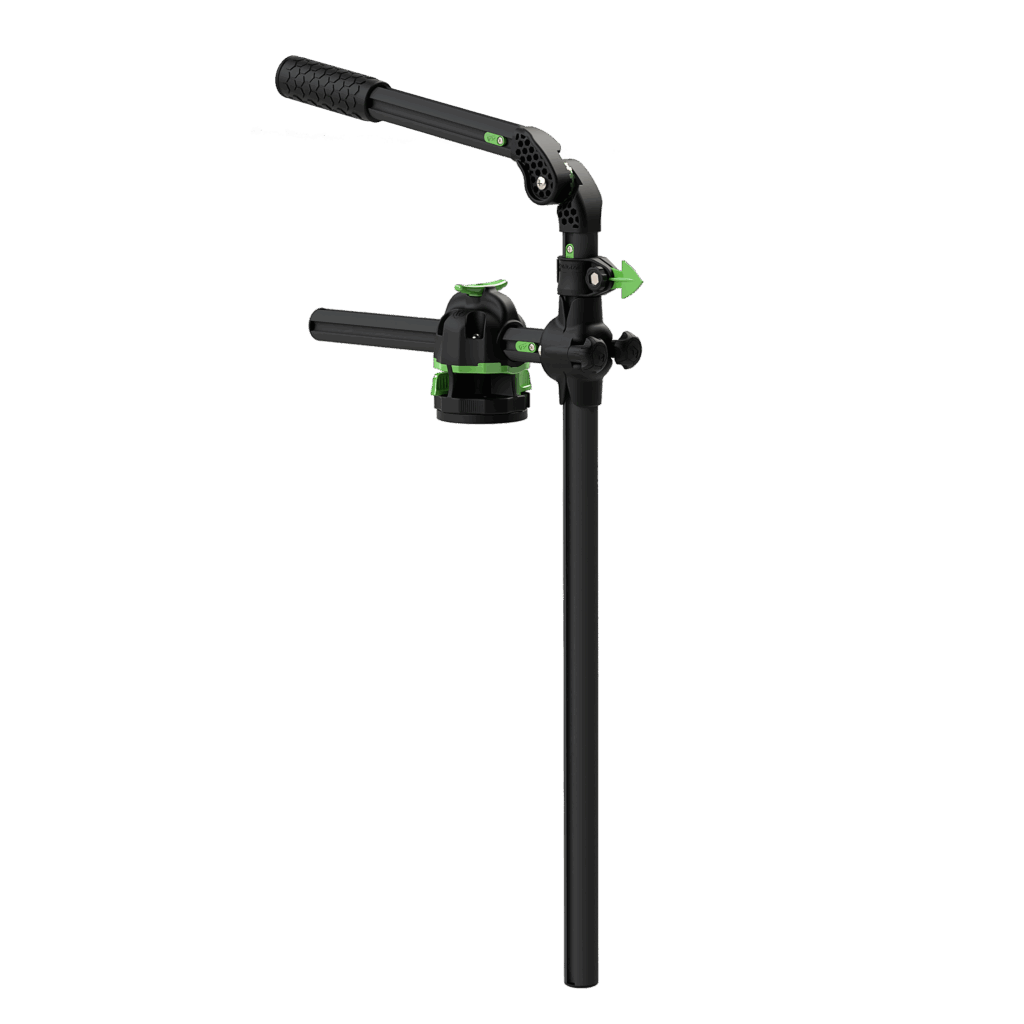
The HEXX wins because it removes most of the decisions before you have a chance to get them wrong. A 30-inch shaft, the HEXX mount, kayak track-mount hardware, a direction indicator and cable-management clips arrive together, which is the whole difference between this and a bare shaft you have to build around. RAILBLAZA publishes 768 mm overall, about 30.2 inches, at 4.4 lb. That is enough definition to plan an install around, and it is why this is the pole to shortlist first on a low-freeboard kayak.
| Shaft length | 30 in |
|---|---|
| Overall length | 768 mm (about 30.2 in) |
| Weight | 4.4 lb |
| Included hardware | Live Pole, HEXX mount, kayak track-mount hardware, direction indicator, cable-management clips |
| Length retained in mount collar | Not published; confirm with the seller |
Source: RAILBLAZA HEXX Live Pole 30 product page. The overall length is the manufacturer's published total, not a confirmed usable-reach figure once the mount collar is subtracted.
Why the direction indicator is the part you would otherwise miss
An independently aimed pole can point somewhere other than the bow, which is the point of it, and also what makes it easy to lose track of where the transducer is actually looking. The included direction indicator gives you a fixed reference against the boat, so the aim you think you have set is the aim you have set. A bare-shaft assembly gives you nothing equivalent unless you source one yourself.
The two figures you have to get from the seller
RAILBLAZA does not publish the length its mount collar retains, and that retained portion is the difference between 30.2 inches on the box and the reach you actually fish with. Track compatibility and the exact transducer adapter are the other open questions, and the product page answers neither.
The published rotation capability is also not a licence to spin the pole freely, because cable winding sets a practical limit the rotation figure does not describe. Treat aim changes as deliberate adjustments rather than something you do casually mid-drift.
Where it fits on a real kayak
This is the pole for an angler who sits low in the water and would rather start from a defined package than assemble one from a parts list. Order it once the seller has confirmed your exact track, your exact transducer adapter and the retained-length figure.
Best for. The low-freeboard kayak angler who wants most of the mounting hardware already chosen and is willing to confirm the two unpublished figures first.
Skip it if. Your length stack-up came out meaningfully longer or shorter than 30 inches, because a fixed shaft cannot be argued with.
Summit Carbon-Fiber Bare Pole - Build Your Own Reach
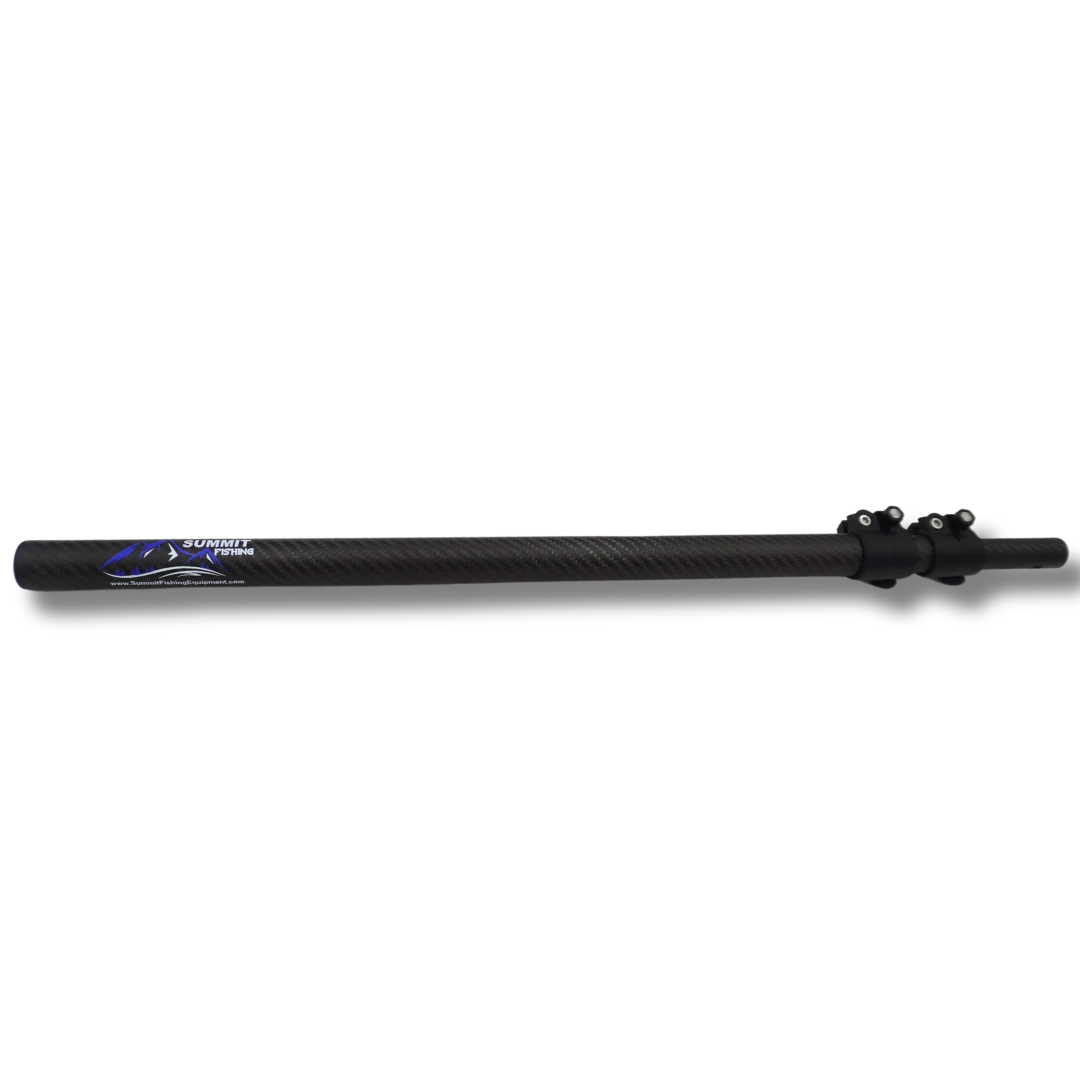
Summit earns this award by selling reach rather than a package. Three length ranges are listed, 18 to 36 in, 24 to 60 in and 32 to 80 in, and Summit identifies the shortest of those as the kayak option. That is a genuine choice of length to set against your measured requirement, which a single fixed 30-inch pole cannot offer. The trade is that the listing is a bare carbon shaft, so the finished configuration is entirely whatever you build around it.
| Available lengths | 18 to 36 in, 24 to 60 in, 32 to 80 in |
|---|---|
| Kayak-identified option | The 18 to 36 in version |
| Included hardware | Bare carbon shaft only |
| Excluded | Handles, transducer mounts, cable clamps, boat mounts |
| Generation compatibility | Excludes Gen1 accessories; identifies an adapter requirement for certain Gen2 transducer mounts |
Source: Summit carbon-fiber pole listing. The bare-shaft price is not comparable to a complete operating kit until handles, mounts and clamps are added to the comparison.
Buy the shortest length that clears your stack-up
Run the length stack-up first, then take the shortest Summit range that clears the result. Shaft above what you need does not buy extra usable reach; it only makes the pole harder to stow and handle on a small deck.
What "bare shaft" actually leaves you to buy
Handles, transducer mounts, cable clamps and boat mounts are all excluded, and each one has to be selected deliberately and priced separately. That makes the shaft price incomparable with a complete kit price until the full parts list is added back in. The modular route pays off when you already own a compatible mount and handle and simply need a shaft sized correctly.
It goes badly in the other order. Buying the shaft first and solving handles, mounts and clamps afterward is how an expensive piece of carbon ends up in a drawer.
Generation compatibility is its own check
The listing excludes Gen1 accessories outright and identifies an adapter requirement for certain Gen2 transducer mounts, so compatibility here is not a blanket yes. Confirm your exact transducer generation against the listing before you commit to a length.
Best for. The angler who has already measured a specific reach and is prepared to price handles, mounts and clamps as part of the purchase.
Skip it if. You want a working setup out of one box, or you have not yet confirmed your transducer generation is supported without an adapter.
FishFinderMounts Pin Lock/Gen3 - Reach and Tilt Solution
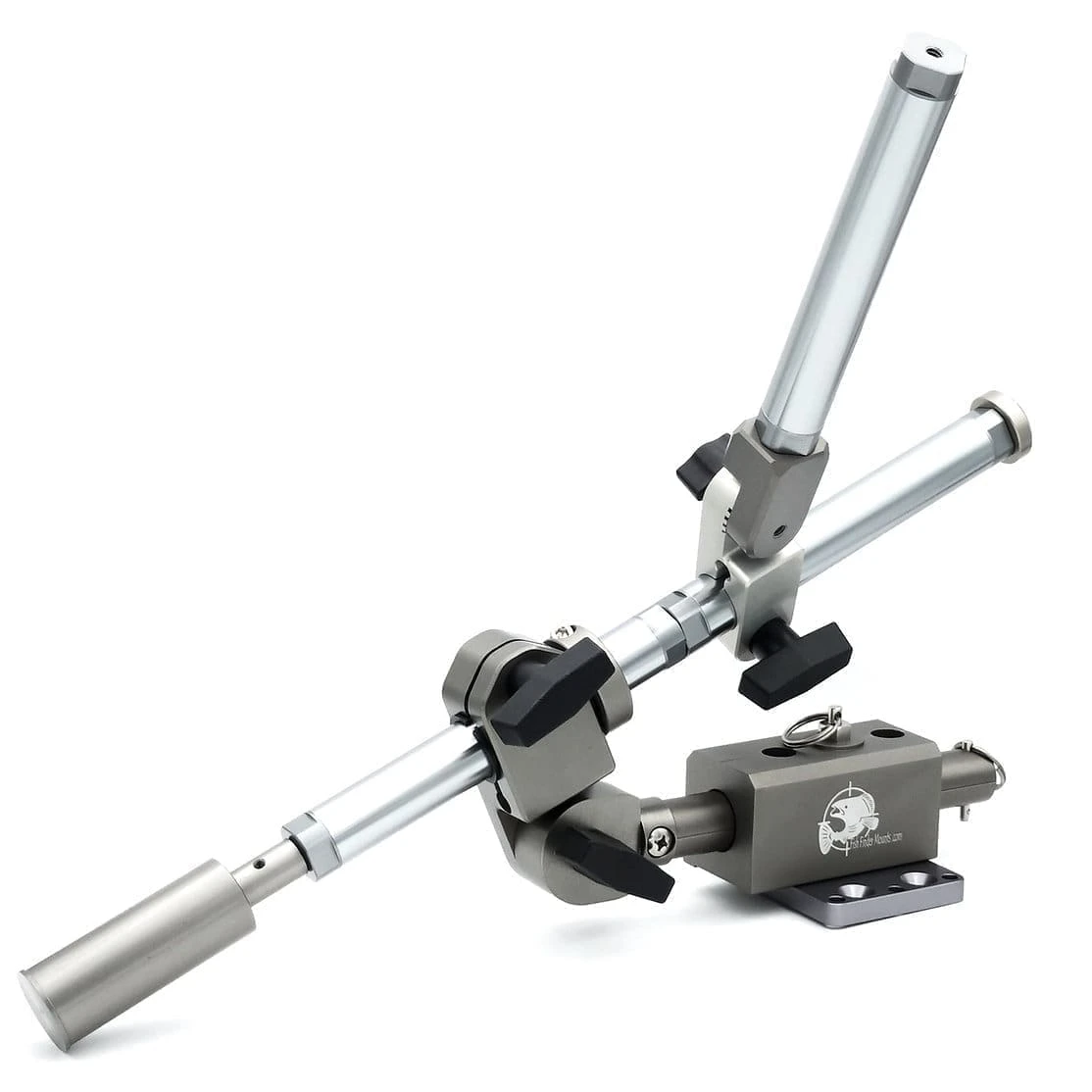
This system exists for the installations a straight vertical pole cannot serve. It assembles a 20-inch and a 12-inch link into a 32-inch pole, and offers a 5-inch or 10-inch beam offset so the transducer can sit out past a deck edge or gunwale. Cylinder and perspective adapters are selected to match your viewing mode, and a handle can be added at ordering. It earns its place as a geometry solution, not as a default upgrade.
| Assembled length | 32 in, from a 20-in and a 12-in shaft link |
|---|---|
| Beam offset choices | 5 in or 10 in |
| Adapter options | Cylinder and perspective, selected to match viewing mode |
| Handle | Optional at ordering |
Source: FishFinderMounts Gen3 configuration page. A boat-track adapter is not automatically a kayak T-track adapter; confirm the exact track hardware for your kayak before ordering.
The beam offset should be solving a problem you can name
Shortlist this only when you can point at the specific clearance a vertical pole creates on your kayak, then choose the smallest offset that solves it. If your fixed or bare vertical pole already reaches the target, the offset buys you nothing and costs you complexity.
Every adjustment point is a setting you have to re-check
Linked sections, a beam offset and a tilt are three more things that can move, and none of them is a one-time decision once the rig starts taking chop and handling. That is the honest price of the flexibility, and it is worth paying only when the geometry genuinely demands it.
A boat-track adapter is not a kayak T-track adapter
Track hardware described for boats does not automatically fit a kayak T-track, so confirm the exact track hardware for your hull before ordering. Product descriptions that name a sonar family still leave the exact generation unconfirmed, which is a separate question to settle with the seller.
Best for. An installation where the transducer has to reach over a deck edge or gunwale a vertical pole cannot clear.
Skip it if. A fixed or bare vertical pole already reaches your aim point, since the extra adjustment points are not free.
Where each pole sits on the trade-off
| Pole | How defined out of the box | Reach flexibility | What you still have to confirm |
|---|---|---|---|
| RAILBLAZA HEXX Live Pole 30 | Largely defined package | Fixed at 30 in | Adapter fit, track compatibility, retained mount length |
| Summit carbon-fiber bare pole | Shaft only | Three length ranges to choose from | Every handle, mount and clamp, plus generation compatibility |
| FishFinderMounts Pin Lock/Gen3 | Partially defined, configurable at order | Adjustable beam and tilt | Kayak track adapter, exact transducer generation, every added setting |
No pole in this shortlist gives you a fully defined package and full length flexibility at once. The more a product leaves configurable, the more of the fit confirmation shifts onto you before you order, and that's the trade to choose deliberately rather than the one to discover after the box arrives.
Keeping aim once it's set
A stiff pole can't compensate for a moving base underneath it. Inspect the whole path from the transducer bracket, through the pole and mount, to the track or deck attachment, since aim retention is only as good as its weakest link.
Ask the kayak and mounting manufacturers about the load your installation puts on the attachment. Supplied fasteners tell you what's in the box; they don't establish the strength of a track installation neither manufacturer has specifically evaluated.
In a controlled setup, follow the maker's adjustment instructions and watch each connection while gently operating the handle.
| Observed issue | Inspection priority |
|---|---|
| Handle turns before the transducer responds | Joint or adapter play |
| Entire assembly changes position | Base or track attachment |
| Direction indicator disagrees with the image | Indicator alignment and transducer orientation |
| Pole becomes hard to turn at one angle | Cable tension or interference |
| Depth setting changes after stowing | Collar or depth-setting arrangement |
These are inspection priorities, not measured faults attributed to any of the three shortlisted products.
Set the direction indicator according to the pole and transducer instructions, then confirm the relationship during a controlled on-water check against a known, fixed structure viewed from a safe position. Don't use the boat's heading as proof the transducer is aimed the same way. With an independent pole, those two directions can intentionally differ, and that's the entire point of buying one.
Test the whole rig before your first serious trip
Start with a sheltered, controlled outing and a simple fishing layout, and evaluate the complete assembly, not just whether the display produces an image.
- Deploy the pole and set the intended immersion depth.
- Establish the direction indicator's relationship to the transducer.
- Sweep across a known area and stop deliberately at a target.
- Cast or lower a lure without contacting the pole.
- Retrieve the net or other equipment you'd normally reach for.
- Stow and secure the assembly before travel or landing.
Keep notes on what needs repositioning, and adjust one variable at a time so the result is actually understandable rather than a guess about which change fixed what.
This sequence does not establish a product's maximum speed or structural rating. Follow the lowest applicable limit stated by the pole, the mount, the transducer and the kayak manufacturer, and don't leave the assembly deployed at speed based on another angler's unrelated setup.
Compare complete costs, not just the pole
| Required item | Included or separate? |
|---|---|
| Pole and depth adjustment | Confirm exact configuration |
| Handle and direction indication | Confirm contents |
| Transducer adapter | Match exact model and viewing modes |
| Kayak base or track attachment | Identify the supported installation |
| Cable-management parts | Confirm suitable sizes and positions |
| Storage protection | Plan the transport arrangement |
| Installation work | Include any approved support or access work |
A bare pole can be a genuinely good replacement part if you already own the rest of a compatible kit. It's a poor price benchmark against a complete, ready-to-fish system unless the missing components are priced into the same comparison.
Do you need a dedicated pole mount at all?
Not every angler running forward-facing sonar needs one. If you always look in the direction the trolling motor is already pushing the kayak, mounting the transducer directly to the motor shaft with the motor manufacturer's own bracket solves the aiming problem without adding a second handle, a second cable route or a second stowage task to the deck.
A dedicated pole earns its cost and its complexity specifically when you need to hold position with a spot-lock or GPS motor while aiming somewhere the boat isn't pointed, or when your kayak's layout puts the motor mount somewhere a transducer genuinely can't see from. That's a real, namable situation rather than a universal upgrade, and the honest advice for an angler who doesn't have it is to save the pole's cost and the deck space it takes, not to buy one because the category exists.
Frequently asked questions
Will a LiveScope adapter fit every LiveScope transducer?
Don't assume so. Confirm the exact transducer model and adapter generation, including the specific viewing modes you need, with the seller before ordering. Adapter compatibility inside the same product family isn't guaranteed across generations.
Is a carbon-fiber pole automatically more accurate than an aluminum one?
No accuracy claim follows from the shaft material alone. Aim retention depends on the complete assembly, including the mount, the joint and the kayak attachment, and its installation, not on what the pole tube is made from.
Can I use the same pole for forward and down viewing?
Possibly, with the correct transducer and adapter for each mode. Verify the supported orientations and how you switch between them before buying, since a mount built for one mode may need different hardware for the other.
Should the pole go on my casting side or the opposite side?
Choose based on your complete routine, not a rule of thumb. Rehearse casting, paddling strokes, net use and stowage on both sides with a mock-up, then pick the position that produces fewer conflicts with your actual gear.
Can I leave the pole deployed while motoring between spots?
Only within the limits stated for your exact pole, mount, transducer and kayak, and only if you can confirm those limits from the manufacturer. If you can't confirm them, stow the pole before traveling rather than borrowing a speed allowance from another angler's unrelated setup.
Which of the three should I buy first?
Run the length stack-up in this guide before comparing prices. If the result lands near 30 inches and you want a largely defined package, shortlist the RAILBLAZA HEXX Live Pole 30. If it calls for a different length or you already own compatible hardware, shortlist Summit's bare carbon pole. If your kayak needs the transducer to clear a deck edge or gunwale, shortlist FishFinderMounts's Pin Lock/Gen3 system.
Final verdict
The inch number on a sonar pole's box is overall length, not the reach you get to fish with, and the gap between those two figures is the length the mount collar retains, a number none of the three products in this guide publish. Run the stack-up in this guide, using your own mounting height, your transducer's required immersion and your seated handle reach, before you compare a single price. The RAILBLAZA HEXX Live Pole 30 is the strongest starting shortlist for a largely defined package once its retained length and adapter fit are confirmed; Summit's bare carbon pole is the better call when your measured reach doesn't match a fixed 30 inches; FishFinderMounts's Pin Lock/Gen3 belongs on the list only when a deck edge or gunwale genuinely requires the extra beam offset. And if your aim never needs to differ from wherever the trolling motor is already pointed, the honest answer may be no pole at all.
Related reading
Sources
Specifications on this page were taken from manufacturer product pages and the sources below, reviewed September 2026. Prices and specifications change; confirm current figures with a dealer before buying.
- RAILBLAZA HEXX Live Pole 30 product specifications, intl.railblaza.com, reviewed September 2026
- RAILBLAZA Live Pole launch announcement, railblaza.com/railblaza-launches-hexx-live-pole, reviewed September 2026
- Summit carbon-fiber bare pole product listing, summitfishingequipment.com, reviewed September 2026
- FishFinderMounts Gen3 Pin Lock/Beam Mounting Kit configuration page, fishfindermounts.com, reviewed September 2026
- Garmin LVS34 cable and installation guidance, www8.garmin.com/manuals, reviewed September 2026
- Garmin LVS34 split-collar connector instructions, www8.garmin.com/manuals, reviewed September 2026
Join The ReefReady Community
Get saltwater Fishing Guides, expert Buyers Guides, equipment recommendations, marine electronics insights, and practical gear tips delivered to your inbox.
No spam. Unsubscribe in one click.