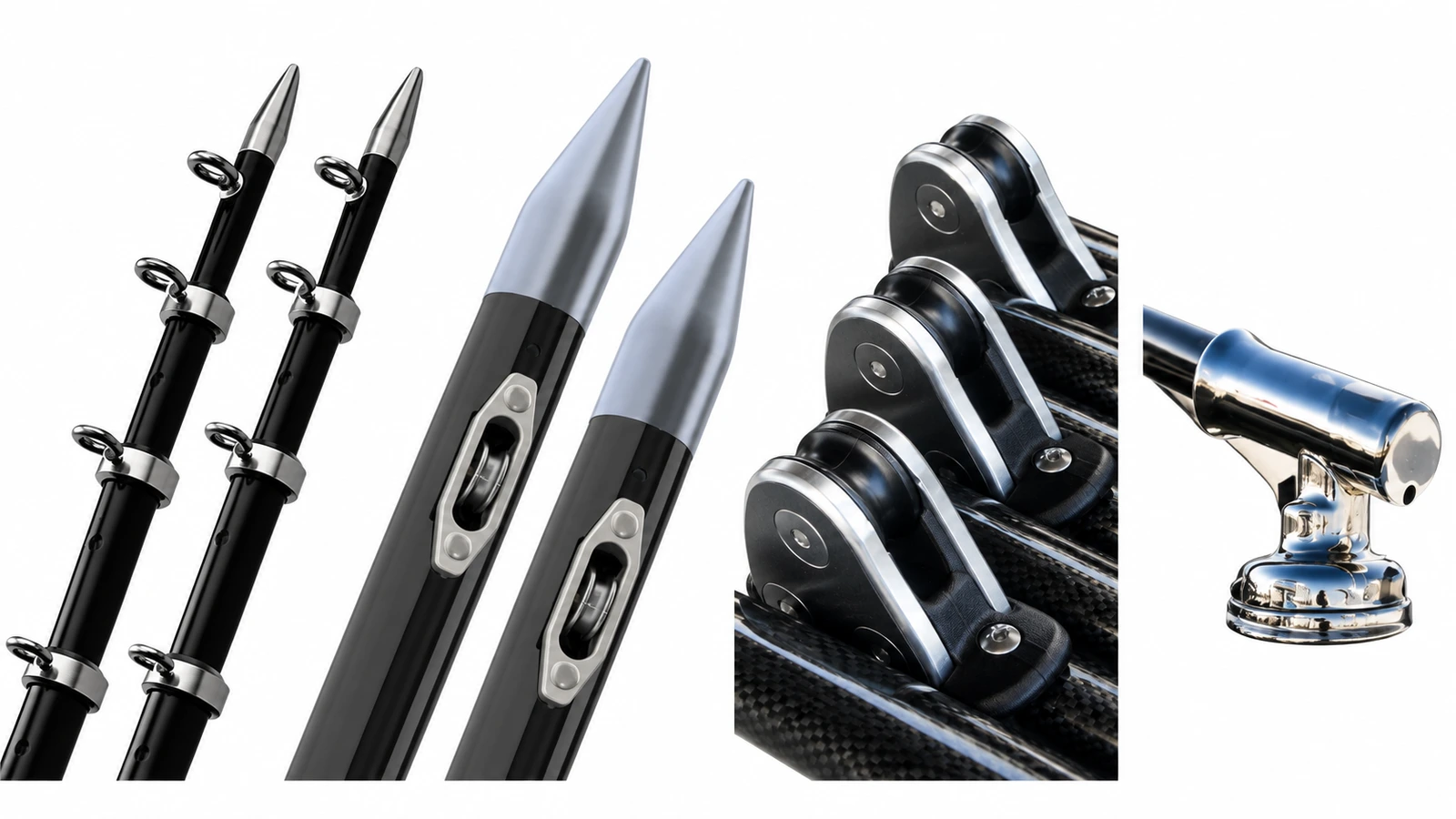
Carbon fiber vs aluminum outriggers: why the material label isn't what decides this upgrade
Holding an outrigger at shoulder height while lining it up with the mount is where a pole's weight and balance stop being spec sheet numbers and become a problem you solve with your hands on a rocking boat.
The quick answer
Neither material wins on its own, so buy carbon or hybrid poles only when a documented improvement in handling, joint behavior or rigging solves a problem your current aluminum poles actually have. Keep serviceable aluminum if it already provides the spread, handling and storage arrangement your boat needs. Neither TACO nor Gemlux publishes a matched-length, matched-load comparison between its own aluminum and carbon lines, which means a general claim that carbon flexes less is not evidence about the pole you are about to buy. Anglers whose telescoping sections bind, or whose storage routine fights a retracting tube, should move to a carbon system instead, where the fixed-length Gemlux Bluewater removes the moving joints altogether and the three-piece TACO Open Water breaks down rather than retracting.
Everything below is judged on one question: what the finished pole does at your deployed length, not what the material label promises.
Affiliate disclosure. Affiliate disclosure: ReefReadyGear earns a commission on some links below at no extra cost to you. This comparison draws on manufacturer product and installation documentation and a peer-reviewed materials-science paper on composite-to-metal joints, checked September 12, 2026. It is a researched buying guide rather than a claim of first-hand testing or a matched physical test of the products discussed.
The material label is a filter, not a verdict
A carbon pole is not a blanket upgrade over an aluminum one, and the material printed on the listing tells you less than the flex behavior at your actual deployed length, the weight your mount carries aloft when the boat rolls, and whether the composite-to-metal joint is isolated from galvanic corrosion. Treat carbon and aluminum as a starting filter for this purchase, not a verdict on it.
The four awards
The four at a glance
| If you want | Consider | Why |
|---|---|---|
| To keep spending exactly where it is until something actually fails | TACO Tele-Outrigger (aluminum) | Anodized aluminum construction with a documented locking-button and bushing mechanism, so a binding joint is often a service issue, not a replacement decision |
| A fixed-length full-carbon pole with the fewest joints | Gemlux Bluewater | 100% carbon-fiber tubes at a fixed, externally rigged length, with specified base-adapter options published |
| A carbon pole that breaks down instead of telescoping | TACO Open Water | Three-piece construction with a twist-and-lock connection, a genuinely different joint design from a telescoping tube |
| A carbon blend positioned differently than full carbon | Gemlux Coastal | A proprietary carbon-fiber blend Gemlux treats as its own category, not a discount version of the Bluewater tube |
On this page
- The quick answer
- The four awards
- The four at a glance
- How we chose
- Carbon vs aluminum: what actually decides the upgrade
- How much does pole weight aloft actually affect boat roll?
- What carbon's weight savings cost you elsewhere
- The check almost nobody runs before buying
- The outrigger poles worth comparing
- TACO Tele-Outrigger
- TACO Open Water
- Gemlux Bluewater
- Gemlux Coastal
- Where each pole sits on the weight-vs-cost trade-off
- When keeping your aluminum poles is the better call
- Frequently asked questions
- Final verdict
- Related reading
- Sources
How we chose
ReefReadyGear does not run a testing programme, and nothing here is presented as a first-hand result. Every specification is drawn from manufacturer product and manual pages, and from a peer-reviewed materials-science paper on composite-to-metal joints, verified September 12, 2026. Where a claim is our calculation rather than a published figure, it is labelled as ours with the method shown.
- Stiffness and weight claims are checked against what each manufacturer actually publishes, not against a general reputation carbon fiber has in the category
- Hybrid poles are treated as their own product category, never scored as a discount version of full carbon
- Where two documented facts point in different directions, such as a lighter tube that still requires the same base inspection as a heavier one, both are stated rather than resolved in the direction that flatters an upgrade
- Corrosion risk is checked at the joint where composite meets metal hardware, not assumed away because the tube itself is carbon fiber
You are holding an outrigger at shoulder height, trying to line its butt up with the mount while keeping the tip clear of the dock and your own leg. This is where a pole's weight and balance stop being spec-sheet numbers and become a physical problem you are solving with your hands, right now, on a boat that will not stop rocking against the pilings.
Later, that same pole is fully deployed at trolling angle, the halyard is tensioned against a spread of baits, and the boat starts working through a beam swell. Stiffness and joint behavior enter the conversation in a way that has nothing to do with how the pole felt at the dock. A tube that seemed plenty stiff when you flexed it by hand can still load and unload at the joint every time the hull rolls through a wave.
Carbon fiber is marketed as the straightforward answer to both moments: lighter to carry, stiffer to fish. The question this guide exists to test is whether a material label alone actually delivers that, or whether the real decision sits somewhere the spec sheet doesn't print.
It sits in three places instead: how the finished pole flexes under a comparable load, how much weight it carries aloft at the specific length you fish, and whether the joint where composite tube meets metal hardware is built to keep saltwater from turning that joint into a corrosion cell. This guide runs the calculation nobody puts on the spec sheet, names the dealer check almost no buying guide mentions, and refuses to declare a universal stiffness or weight winner where the published evidence does not support one.
Carbon vs aluminum: what actually decides the upgrade
The material printed on the spec sheet decides less than four things almost no buying guide separates out: how the finished pole flexes under an actual trolling load, how much weight it carries aloft where a rolling hull turns pounds into leverage, whether the composite-to-metal joint is isolated from corrosion, and what the complete upgrade costs once bases and adapters are on the invoice.
Flex behavior under a comparable load, not a material reputation. Stiffness describes resistance to deformation, and strength describes the ability to withstand load without failure. Those are different properties, and a listing that uses them interchangeably is not giving you a usable answer. Neither TACO nor Gemlux publishes a matched-length, matched-load deflection comparison between its own aluminum and carbon lines, so a shopper has to request that specific data directly, comparing the same pole length, the same mounting conditions and the same applied load, rather than accepting a general claim that carbon "flexes less."
Weight aloft, which is a leverage problem more than a carrying problem. A pound saved at the dock is not the same pound once the pole is swung out and fishing, because the further that pound sits from the mount, the more it multiplies into the moment the base and boat have to absorb. Handle the fully assembled candidate through the sequence that actually matters: carrying it from storage, inserting and retaining it, extending or assembling it, positioning it for fishing, and collapsing or removing it afterward. Which specific step gets easier is a stronger reason to buy than an unqualified percentage weight claim.
Corrosion at the interface, which has nothing to do with whether the tube itself is composite or metal. Carbon composite does not make attached metal hardware immune to corrosion. Published research on carbon-composite and aluminum joints documents galvanic-corrosion concerns when exposed carbon and metal form an electrical connection in a suitable environment, which is exactly the environment a saltwater outrigger base lives in. That supports using the manufacturer's designed interface and isolation provisions, not inventing a contact arrangement of your own (ACS Omega, "Galvanic corrosion of carbon fiber composite and aluminum joints," pubs.acs.org, reviewed September 2026).
The complete cost, once bases, adapters and rigging are on the invoice, not just the pole pair. The meaningful premium is the difference between two complete paths: retaining and servicing the current installation, or buying and commissioning the replacement.
| Cost category | Keep aluminum | Change system |
|---|---|---|
| Pole work | Inspection and approved service | Replacement pair |
| Bases | Inspect existing mounts | Reuse only if suitable, otherwise replace |
| Interface parts | Existing approved arrangement | Adapters and retention components |
| Rigging | Replace worn items | New or confirmed reusable rigging |
| Labor | Service and operating check | Installation and commissioning |
| Storage | Existing solution | Any changes required by new poles |
Compare finished poles on those four points before comparing them on material name.
How much does pole weight aloft actually affect boat roll?
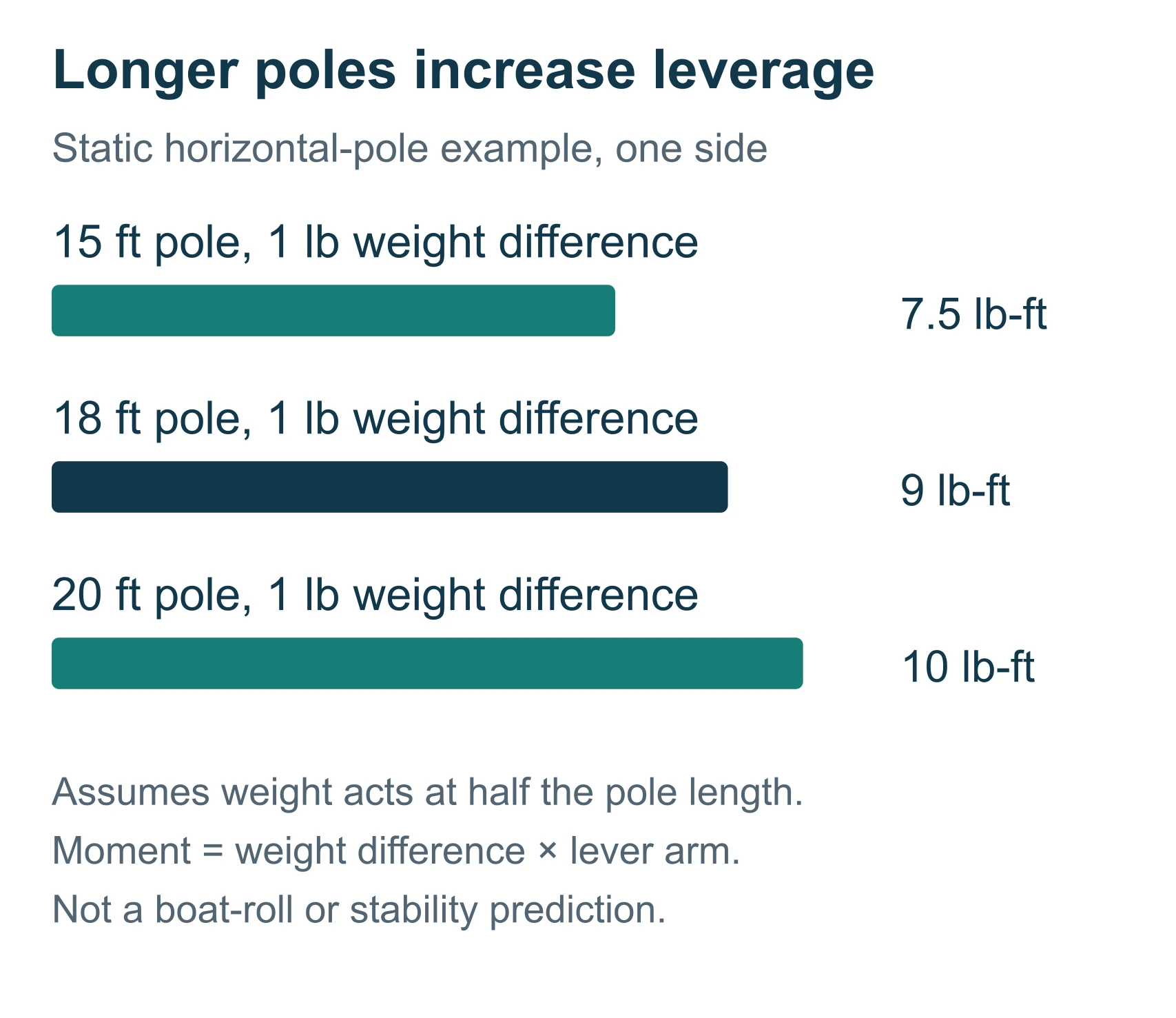
Every outrigger listing states a weight or omits one, but almost none translate that number into what it actually does to the boat once the pole is deployed and fishing, which is where a few pounds turns into a real lever arm working against the base and the hull.
The method
- Get the finished, rigged weight of each candidate pole at your actual deployed length, not a bare-tube weight, weighed by the dealer if the manufacturer does not publish one directly comparable across its aluminum and carbon lines.
- Confirm the deployed length you actually fish at, mount to tip, since a longer pole multiplies the same weight difference into a larger moment.
- Estimate the horizontal lever arm as roughly half the deployed length, treating the pole's mass as evenly distributed along its length. This is a simplifying assumption, not a measured center of gravity, because real outrigger tubes taper and carry hardware unevenly along their run.
- Multiply any weight difference between two candidate poles by that lever arm to get the moment difference in pound-feet on one side, then double it, since most boats run a matched pole on each side.
A small weight difference between two poles does not stay small once it is multiplied by a 15-to-20-foot lever arm on each side of the boat, which is exactly why this number is worth calculating instead of guessing at.
None of the manufacturers reviewed for this guide publish a finished-pole weight comparison at matched lengths across their aluminum, full-carbon and hybrid lines, so the figures below are an illustrative example built to show the method, not a claim about any named product's actual weight.
The moment table
| Deployed length | Assumed lever arm (half of length) | Moment per lb of weight difference, one side | Moment per lb of weight difference, both sides |
|---|---|---|---|
| 15 ft | 7.5 ft | 7.5 lb-ft | 15 lb-ft |
| 18 ft | 9.0 ft | 9.0 lb-ft | 18 lb-ft |
| 20 ft | 10.0 ft | 10.0 lb-ft | 20 lb-ft |
Every figure in this table is our calculation, using an illustrative weight difference and a simplified lever-arm assumption, not a manufacturer-published weight for any pole named in this guide, so the method matters more than the specific numbers.
Using a hypothetical 4-pound difference per pole at 18 feet as an example only, that works out to 4 lb × 9 ft × 2 poles, or roughly 72 lb-ft less heeling moment aloft for the lighter pair, which is a meaningfully larger number than "4 pounds lighter" sounds on its own. Ask the dealer to weigh your actual finished candidates at your actual deployed length, then run that real number through this same method rather than trusting the illustrative one above.
A boat that already rolls quickly at rest carries this effect differently than one that doesn't. Hull shape and loading affect how much a given moment aloft actually shows up as motion on deck, so the same weight difference matters more on a shallow-draft bay boat than on a deep-vee offshore hull, and a dealer familiar with your specific boat is a better source for that than a general rule.
What carbon's weight savings cost you elsewhere
Every advantage a lighter pole buys is paid for somewhere else on the invoice or in the repair shop, and that trade is the part most listings leave out. If you have not yet chosen a base and mount system for the boat, our companion guide on outriggers for a 20-foot center console covers that decision separately; this section assumes a base already exists and focuses on what swapping the poles actually costs.
For a worked ownership example, suppose an upgrade costs $2,000 more than retaining the current aluminum system, and you expect 50 relevant trips over your chosen ownership period. The premium is $2,000 divided by 50, or $40 per trip. Those are illustrative inputs, not market prices or a lifespan forecast, and the calculation does not decide the purchase by itself. It turns a vague premium into a personal comparison you can actually weigh against the specific handling or rigging benefit you are buying.
The repair path is a second, less obvious cost. TACO's carbon-pole maintenance documentation warns against heavy contact that could weaken the structure, and separately addresses sun exposure, excessive halyard tension and operating extended poles in rough conditions (TACO Marine, carbon fiber outrigger maintenance manual, tacomarine.com, reviewed September 2026). Whether a specific instance of damaged carbon can be repaired depends on the exact damage and construction. A general composite-repair tutorial does not establish that a repair is appropriate for a particular pole's service, so a struck, crushed or unfamiliar mark needs a manufacturer or specialist assessment before the pole goes back to work, not a cosmetic wrap called a repair.
Weigh the complete installed cost and the repair path against the specific benefit you can name and use, not against an assumed weight saving you have not yet confirmed for your actual candidate poles.
The check almost nobody runs before buying
Almost every buying guide in this category argues about stiffness and weight and stops there. The check that actually determines whether a carbon or hybrid pole holds up in saltwater is where the composite tube physically meets metal hardware, a base sleeve or a retention collar, and it is rarely mentioned before the sale.
Carbon composite does not make attached metal hardware immune to corrosion. The peer-reviewed research on carbon-composite and aluminum joints cited above identifies galvanic-corrosion concerns specifically where exposed carbon and metal form an electrical connection in a suitable environment, and a saltwater outrigger base is exactly that environment. This is a materials principle, not evidence that a named outrigger product will corrode. It supports asking the manufacturer how its actual assembly is isolated at that joint, rather than inventing a contact arrangement on your own.
TACO's storage guidance calls for cleaning poles and rigging, drying the equipment, and checking the operating components before reuse, and recommends inspecting places anglers normally overlook when the poles stay aboard: the butt, base socket, joints, locking parts and halyard guides (TACO Marine, "7 Taco Tips for Storing Outrigger Poles," tacomarine.com, reviewed September 2026).
The dealer check almost nobody runs: ask to see, in person, the exact point on the candidate pole where the composite tube meets any metal sleeve, collar, base adapter or retention hardware. Look for a visible isolating layer, a bushing, a coating or a designed gap, rather than bare carbon fiber touching bare metal. Then ask the manufacturer, by name, how that specific joint is isolated and what its cleaning and inspection interval is. A dealer or listing that cannot answer that question specifically has not demonstrated the joint was engineered for saltwater, no matter how the tube itself is described.
The outrigger poles worth comparing
Category boundary, stated plainly: this comparison covers complete outrigger pole systems built in anodized aluminum, full carbon fiber and Gemlux's hybrid carbon blend, evaluated for saltwater trolling and spread use on boats that already have, or are planning, an outrigger base. It does not cover the bases and mounts themselves, or dredge and teaser rigging beyond how it attaches to the pole.
A note on the overlap with our outriggers guide. If you have not yet chosen a base and mount system, that decision belongs in our companion guide on outriggers for a 20-foot center console. This article assumes a base already exists or is being sourced separately, and compares the poles that attach to it.
Pricing has not been verified for this comparison and is not stated here. Confirm current pricing and availability with the dealer or manufacturer before buying.
TACO Tele-Outrigger: Best if your aluminum poles still work
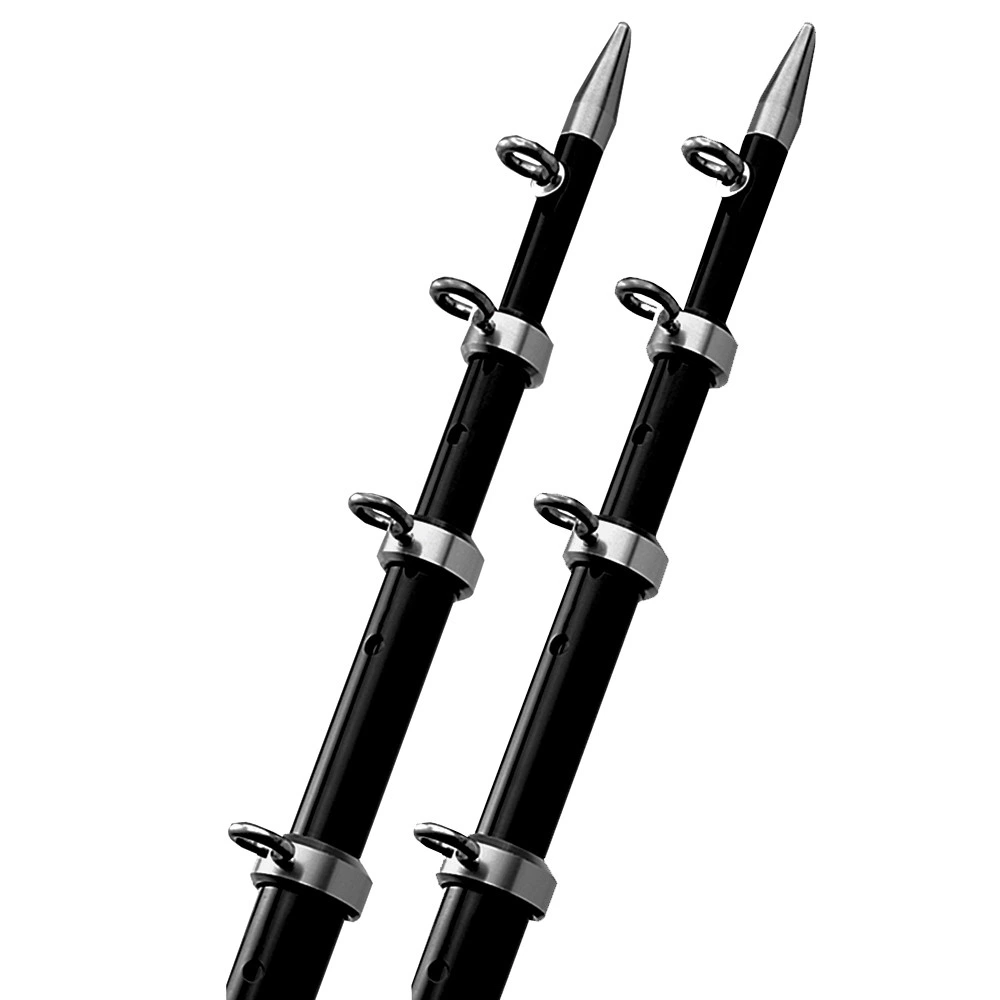
Check 15-ft / 1½-inch TACO poles on Amazon
This is the pole most readers already own, and the reason it earns an award is that replacing a working one rarely buys anything measurable. TACO documents a locking-button and bushing arrangement specific to its Tele-Outriggers, with model-specific care advice covering how the sections retract and lock, so a section that starts to bind is often a service question rather than a replacement decision. The line also runs multiple butt diameters and mount combinations, which is what keeps an existing base in play. Swapping a pair like this for carbon buys a lighter swing and a different corrosion profile at the joints, not a documented change in how many fish come over the rail.
| Construction | Anodized aluminum tube |
|---|---|
| Joint arrangement | Telescoping, with a locking-button and bushing mechanism |
| Butt diameter and mounting | Multiple diameters and mount combinations across the Tele-Outrigger line |
| Deployed length | Varies by model |
| Weight | Not published for direct comparison against the carbon models in this guide |
TACO does not publish a finished-pole weight comparable across its aluminum and carbon lines at matched lengths. Confirm the exact model's weight and length combination with the dealer before comparing it to a carbon candidate.
Why a serviceable joint is worth more than a lighter tube
A telescoping aluminum section that sticks can usually be diagnosed against published guidance and repaired, because the locking button and bushing are named parts with documented behavior (TACO Marine, outrigger FAQ, tacomarine.com, reviewed September 2026). That is a genuinely different ownership path from a composite tube, where a struck or crushed section needs a manufacturer or specialist assessment before it goes back to work.
The limit of that advantage is honest enough to state plainly. A pole that binds or resists movement needs a specialist to evaluate it rather than being forced through a demonstration at the dock, and TACO does not disclose what that repair or replacement will cost before you commit to it.
The weight number TACO does not publish
There is no finished-pole weight here that is directly comparable to the carbon models in this guide at matched lengths, which makes every seller claim about weight saving unverified until somebody weighs both candidates. Ask the dealer to weigh the assembled poles at the deployed length you actually fish, then run that real number through the moment method above rather than accepting a percentage.
Best for. An angler whose current aluminum installation already fits the boat, locks correctly and suits the fishing and storage routine, and who is deciding whether to keep it rather than replace it.
Skip it if. A section binds, a lock has failed, or the pole shows impact damage a specialist has not assessed.
TACO Open Water: Best carbon pole for breakdown storage
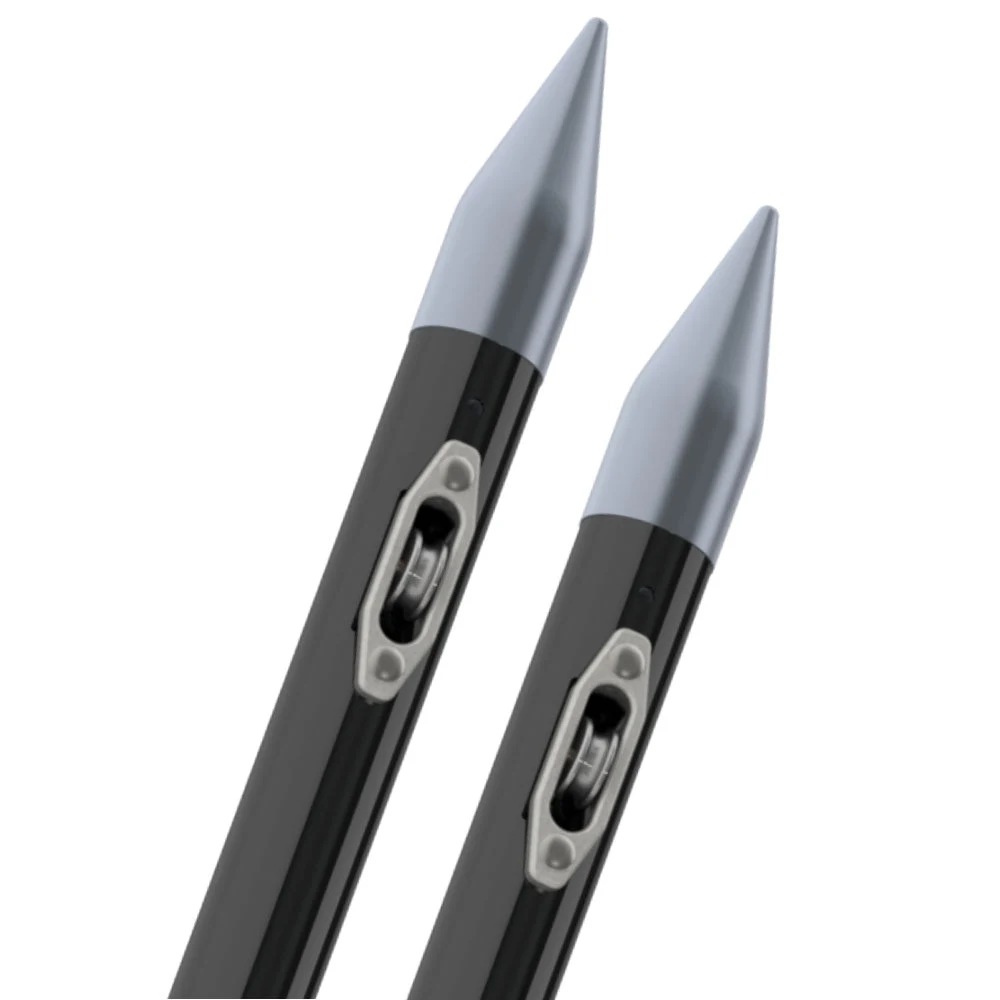
Check 19-ft Open Water poles on Amazon
TACO's Open Water carbon poles use a three-piece arrangement with a twist-and-lock connection, which is a genuinely different joint design from the telescoping Tele-Outrigger rather than the same mechanism built in a new material. That distinction is the whole reason this pole earns its own award. A pole that comes apart into three sections cannot suffer the bind-and-stick failure that affects retracting aluminum, and it stows in shorter lengths for transport (TACO Marine, Open Water carbon system, tacomarine.com, reviewed September 2026).
| Construction | Carbon fiber |
|---|---|
| Joint arrangement | Three-piece, twist-and-lock connection, not telescoping |
| Rigging | Confirm internal versus external halyard routing for the exact model with the dealer |
| Storage footprint | Breaks down into three separate sections rather than retracting into itself |
| Weight | Not published for direct comparison against TACO's own aluminum Tele-Outrigger line |
No matched-length weight or deflection figure comparing this pole to TACO's aluminum Tele-Outrigger line was published in the pages reviewed for this guide. Request a weighed comparison at your actual deployed length before buying.
Why breaking down beats retracting on a trailered boat
For a marina-kept boat, breaking a pole into three pieces at the end of the day is a minor task. For a boat that is trailered home after every trip, the same three sections are three more things to secure and three more things to lose overboard while gear is being stowed in a hurry, so the storage routine decides this one more than the material does.
What the dealer has to confirm before you order
Internal versus external halyard routing is model-specific here and needs confirming for the exact pole, since it changes the inspection routine you will live with. There is also no published matched-length weight or stiffness comparison against TACO's own aluminum line, which means a claimed handling improvement stays a claim until you have handled both poles at the dealer.
Best for. A boat where a three-piece breakdown pole suits the storage and transport routine better than a telescoping tube.
Skip it if. You need a single-piece retract-and-go pole for a quick offload, or you would rather not manage and inspect three loose sections at the dock.
Gemlux Bluewater: Best fixed-length full-carbon pole
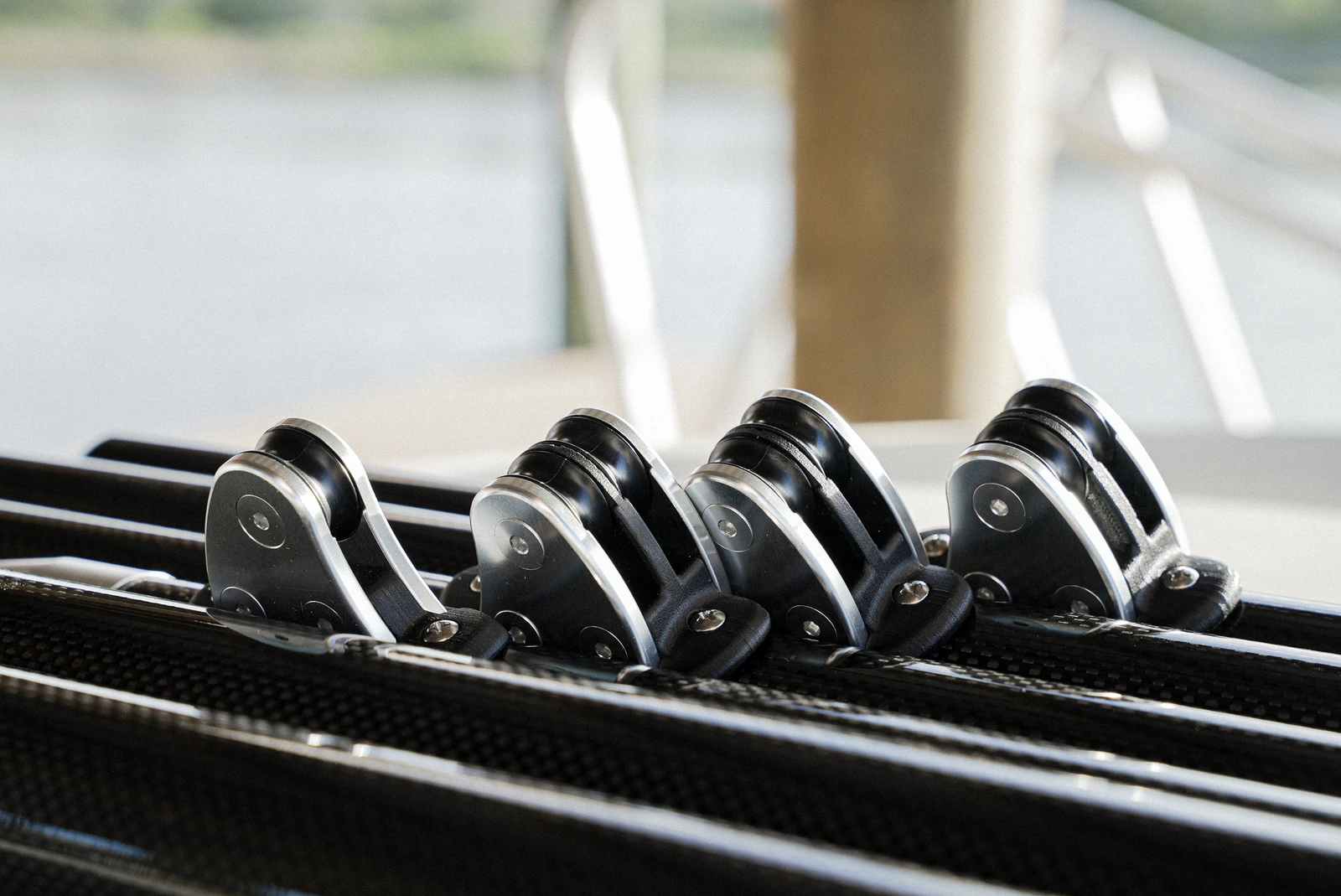
Gemlux identifies the Bluewater tubes as 100% carbon fiber, fixed-length and externally rigged, and that combination is the least complicated joint arrangement in this comparison. Nothing telescopes and nothing comes apart, so there are fewer places for a joint-specific failure to start. Gemlux also publishes specified base-adapter options on the product listing, which is the documentation to request before assuming the pole will interface with an existing base. That published route matters more than a matching nominal diameter, which is a starting check rather than approval.
| Construction | 100% carbon-fiber tubes, per Gemlux |
|---|---|
| Length | Fixed-length, not telescoping or sectioned |
| Rigging | Externally rigged halyard path |
| Base interface | Specified base-adapter options published on the product listing |
| Weight | Not published for direct comparison against TACO's aluminum or carbon lines |
Gemlux's wording identifies the tubes as 100% carbon fiber. The finished, rigged assembly also includes hardware and other components that description alone does not cover (Gemlux, Bluewater fixed-length externally rigged carbon-fiber outrigger, gemlux.com, reviewed September 2026).
Fixed length is the decision you cannot revisit
A center console with a settled base location and a known mounting height is the straightforward case here. Once the pole is bought there is no telescoping or sectioning adjustment left, so measuring the deployed and stowed dimensions against the boat before ordering matters more with this pole than with any other in the comparison.
External rigging changes the maintenance routine
The halyard path sits outside the tube, which is easy to inspect but exposed, and the product listing alone does not fully detail the routine that comes with it. Ask Gemlux directly what the cleaning and inspection interval is, and while you are asking, get the answer on how the composite tube is isolated where it meets the metal base adapter and retention hardware.
Best for. A buyer who wants a fixed-length, externally rigged carbon pole and has already confirmed that length against their storage space and mounting height.
Skip it if. You have not settled on a base location, or you change rigging configurations seasonally and need an adjustable deployed length.
Gemlux Coastal: Best carbon blend, evaluated on its own terms
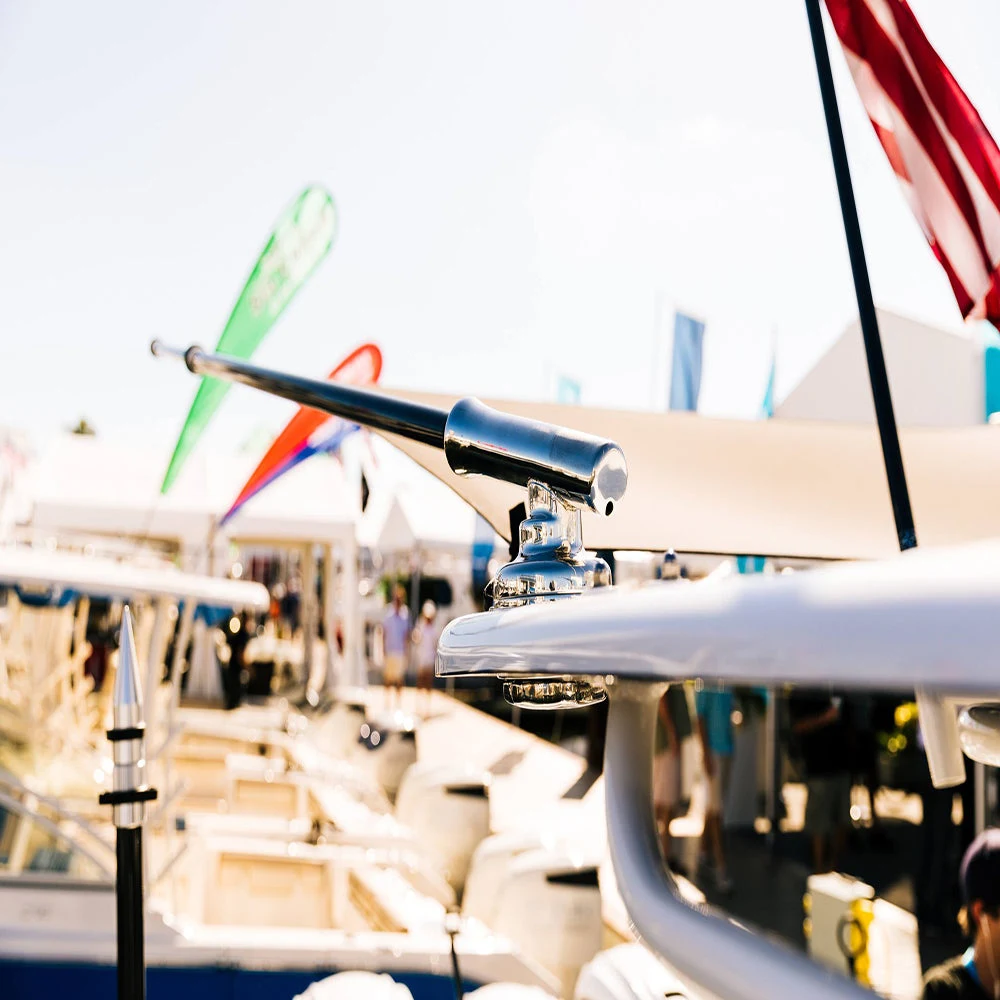
Gemlux describes Coastal as a proprietary carbon-fiber blend and identifies it separately from the full-carbon Bluewater tubes, treating it as its own category rather than a cheaper version of the same product. That gives a buyer a documented middle option between anodized aluminum and full carbon instead of a binary choice. It also creates the obligation this award is really about: asking for Coastal-specific figures rather than accepting a Bluewater number by association.
| Construction | Proprietary carbon-fiber blend, per Gemlux |
|---|---|
| Category | Treated by Gemlux as its own product line, distinct from the Bluewater full-carbon tubes |
| Performance claims | Model-specific; do not transfer a figure from the Bluewater line based on a similar finish |
| Weight and length | Not published for direct comparison in the pages reviewed for this guide |
Gemlux describes Coastal as a proprietary carbon-fiber blend and identifies it separately from its full-carbon tube products (Gemlux, Coastal hybrid construction, gemlux.com, reviewed September 2026).
Why the word hybrid tells you almost nothing
Hybrid and blend are not standardized terms across manufacturers, so a performance claim for Coastal says nothing about another brand's hybrid pole, and a claim about another brand's hybrid says nothing about this one. Treat the construction description as a prompt to request model-specific data, not as a performance figure.
The figures that are missing, and what to do about it
No published weight or deflection figure in the documentation reviewed for this guide is directly comparable to either the aluminum Tele-Outrigger or the full-carbon Bluewater tube. This is the pole to name out loud when a dealer floats carbon as an upgrade without saying which Gemlux line they mean, and the conversation is worth having only if they can separate Coastal's claims from the Bluewater listing's own documentation.
Best for. A buyer who wants a carbon blend positioned on its own terms in Gemlux's lineup and is willing to request model-specific performance figures before ordering.
Skip it if. A seller cannot produce Coastal-specific figures and keeps answering with Bluewater documentation.
Where each pole sits on the weight-vs-cost trade-off
| Pole | Construction | Joint type | Base interface documentation | Where it sits |
|---|---|---|---|---|
| TACO Tele-Outrigger | Anodized aluminum | Telescoping, locking-button and bushing | Multiple diameters and mount combinations across the line | Lowest documented complexity if the current installation already fits and locks |
| TACO Open Water | Carbon fiber | Three-piece, twist-and-lock | Confirm with dealer against existing or new base | Breakdown storage over telescoping convenience |
| Gemlux Bluewater | 100% carbon-fiber tubes | Fixed-length, externally rigged | Specified base-adapter options published | Fewest joints, least length flexibility |
| Gemlux Coastal | Proprietary carbon-fiber blend | Confirm with manufacturer | Confirm with manufacturer | Its own tier, not a discount Bluewater |
No pole in this comparison occupies every advantage at once. The aluminum pole trades a documented, serviceable joint for whatever weight aloft it carries. The fixed-length carbon tube trades length flexibility for fewer joints.
The three-piece carbon pole trades single-unit retraction for breakdown storage. The hybrid blend trades full-carbon positioning for a price and performance tier Gemlux itself has not equated with its full-carbon line. That is the actual comparison, not a gap in the research.
When keeping your aluminum poles is the better call
Keep and service the aluminum poles you already have, when the installation still locks, still fits and still does the job. The cost band here is inspection and approved service on the existing pair, reuse of the existing bases and rigging, and no new adapters or retention hardware to source. This is the right call for a boat whose current Tele-Outrigger pair operates correctly, meets the fishing and storage routine, and shows no impact damage a specialist has flagged.
Move to a hybrid blend, when a specific Coastal-documented benefit solves a problem your aluminum poles actually have, and a full-carbon tube's fixed length or price and performance tier does not suit your boat. The cost band here includes the replacement pair itself, an approved adapter if the base interface changes, and confirmed reusable or new rigging, priced against the specific handling improvement you can name.
Move to full carbon, only when the exact system, its base-adapter options and its rigging arrangement solve a benefit you can name and use, not because a carbon label alone reads as an upgrade. The cost band here is the same replacement, adapter and rigging categories as the hybrid path, plus the repair-path consideration covered earlier: a struck or crushed carbon tube needs a manufacturer or specialist assessment before it goes back to work.
None of those three paths is the one that sells the most poles, and for a lot of boats reading this, the honest answer is the first one: keep what already works, and put the upgrade budget toward something the boat actually needs. That is not the exciting recommendation, but it is the one the evidence in this guide supports.
Frequently asked questions
Does carbon fiber always flex less than aluminum?
That cannot be confirmed across all finished products from the documentation available. Compare like-for-like lengths and construction using documented test conditions from the manufacturer, since joint design and pole geometry affect flex as much as the tube material does. A general claim that "carbon flexes less" is not a substitute for a matched-length, matched-load comparison.
Are hybrid outrigger poles inferior to full carbon?
The label alone does not establish that. Gemlux identifies its Coastal blend separately from its full-carbon Bluewater tubes, and evaluating the exact hybrid against your handling, fit and fishing requirements is the only way to answer this for your own boat. Ask the manufacturer which performance claims apply to the specific hybrid model you are considering.
Can a lighter or stiffer pole pull a bigger dredge?
Only with explicit approval for the complete pole, base and boat installation. A material change alone does not supply a load rating, and no manufacturer documentation reviewed for this guide states that switching from aluminum to carbon authorizes a heavier dredge or teaser load on an existing base.
Is carbon fiber maintenance-free?
No. The carbon tube is part of an assembly with finishes, joints and metal hardware, and TACO's own maintenance documentation covers impact damage, sun exposure, halyard tension and rough-condition use specifically for its carbon poles. Follow the exact manufacturer's inspection, cleaning and storage guidance rather than assuming composite construction needs less attention than aluminum.
Can damaged carbon outriggers be repaired?
That depends on the specific damage and construction, and needs a product-specific assessment from the manufacturer or a qualified specialist. A general composite-repair tutorial does not establish that a repair is appropriate for a particular pole's service, so a struck, crushed or unfamiliar mark should stop the pole from being used until it is assessed.
Will carbon poles fit my existing aluminum bases?
Only when the exact pole interface, adapter and retention arrangement are confirmed compatible. Matching nominal diameter is a starting check, not complete approval. Gemlux's Bluewater listing publishes specified base-adapter options, and TACO's own FAQ covers sleeve and base compatibility, so use those documented routes rather than improvised packing.
Which material should an occasional offshore angler buy?
Keep suitable aluminum if it already does the job, since occasional trolling rarely exhausts what a well-maintained aluminum pole can do. When buying new, compare complete systems at the length you need and pay for carbon or hybrid construction only when the actual product gives you a benefit you can identify and use.
Final verdict
A material label does not decide this purchase. The moment-arm math above shows how a few pounds of pole weight, once carried 15 to 20 feet out on each side of the boat, turns into a meaningfully larger heeling moment than the raw weight difference suggests, which is the number this category's marketing skips. The dealer check that matters more than any stiffness claim is the joint where composite tube meets metal hardware, since that interface is where saltwater actually does its damage, not inside the carbon tube itself. Keep the TACO Tele-Outrigger pair if it already locks, fits and meets your routine. Move to the Gemlux Bluewater for the fewest joints at a fixed length, to the TACO Open Water for breakdown storage over telescoping, or to the Gemlux Coastal blend once you have model-specific figures in hand, and in every case, price the complete installation and the repair path before the pole pair alone.
Related reading
Sources
Specifications on this page were taken from manufacturer product and installation documentation and the peer-reviewed materials-science source below, consulted September 2026. Prices and specifications change; confirm current figures before buying.
- TACO Tele-Outrigger (OT series) product specifications, tacomarine.com, reviewed September 2026
- TACO outrigger FAQ (locking-button and bushing arrangement, base and sleeve compatibility), tacomarine.com/product-knowledge/faq/outriggers-faq, reviewed September 2026
- TACO Open Water carbon outrigger system (OI series) product specifications, tacomarine.com/sport-fishing-outrigger-poles-oi-series, reviewed September 2026
- TACO, "7 Taco Tips for Storing Outrigger Poles," tacomarine.com/7-taco-tips-for-storing-outrigger-poles, reviewed September 2026
- TACO carbon fiber outrigger maintenance manual (2022), tacomarine.com, reviewed September 2026
- Gemlux Bluewater fixed-length externally rigged carbon-fiber outrigger product specifications, gemlux.com/products/bluewater-fixed-length-externally-rigged-carbon-fiber-outrigger, reviewed September 2026
- Gemlux Coastal hybrid construction product page, gemlux.com/products/9172, reviewed September 2026
- ACS Omega, research on galvanic corrosion in carbon-fiber composite and aluminum joints, pubs.acs.org/doi/10.1021/acsomega.6c00063, reviewed September 2026
Join The ReefReady Community
Get saltwater Fishing Guides, expert Buyers Guides, equipment recommendations, marine electronics insights, and practical gear tips delivered to your inbox.
No spam. Unsubscribe in one click.