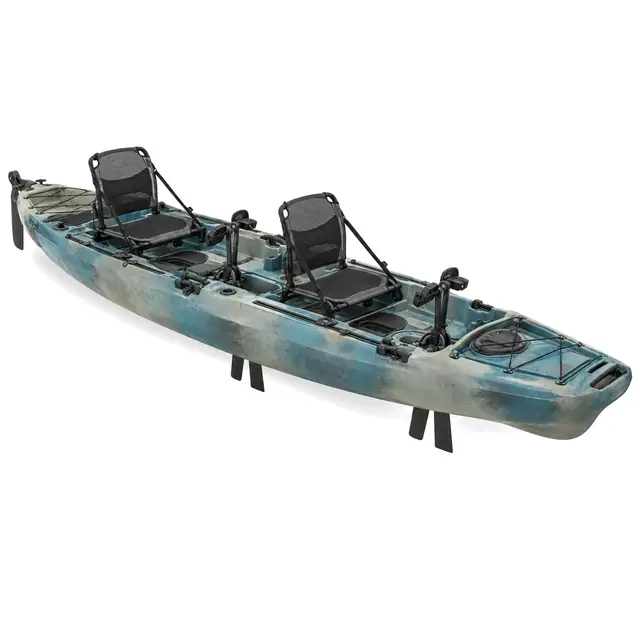
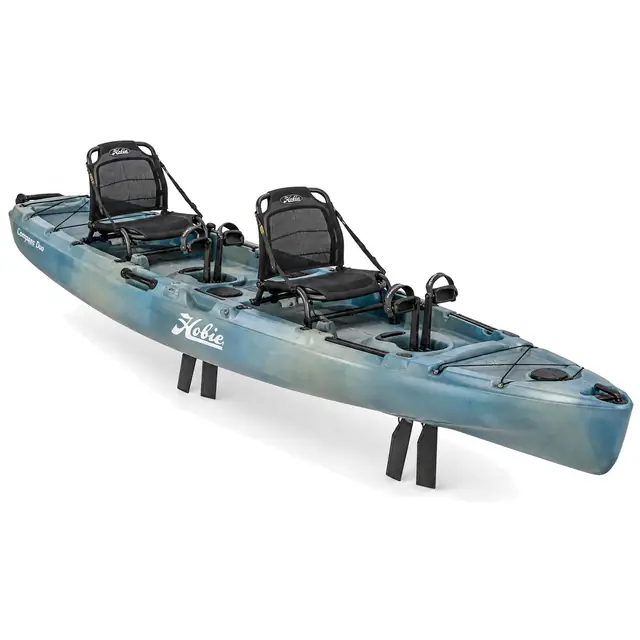
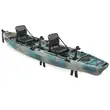
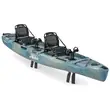
Left: Hobie Mirage Oasis. Right: Hobie Mirage Compass Duo. Manufacturer product photography, not a staged comparison shot.
Best Tandem Pedal Kayaks for Offshore Fishing: Can Two Adults Really Fit?
Two people stand at a dealership looking at a kayak with two seats and two sets of pedals, and they do the obvious math. Two seats, two people, done. Add it to the cart.
By Larry MurrayUpdated 6 September 202624 min readBuyer’s Guide
The quick answer
Two seats on a spec sheet is a seating plan, not a capacity statement. What decides whether a tandem works offshore is usable payload after the hull, both drives and both seats come out of the rated number, whether each seat’s own rating clears the angler sitting in it, and how the boat trims when the two people aboard are not the same size.
Most two-angler pairs fit best on the Hobie Mirage Oasis, which carries 420 lb of usable payload after subtracting its own rigged weight from its 550 lb total capacity. The lighter, less expensive Hobie Mirage Compass Duo drops to 348 lb usable, which two average-sized adults in fishing gear can exceed before loading a single rod. If your combined body weight plus a realistic gear load is close to or over these figures, two solo pedal kayaks will likely serve you better than one tandem, and we cover that comparison next.
Both boats are dealer-only, so pricing and availability run through Hobie’s authorized dealer network rather than a standard retail link. Find a Hobie dealer to confirm current pricing and demo availability before you buy.
Affiliate disclosure. Affiliate disclosure: ReefReadyGear earns a commission on some links below at no extra cost to you. We don’t accept payment for placement, and every boat here was selected on published specifications and expert and owner feedback. Specifications verified September 2026.
Two seats is not two adults
A 550 lb rated tandem can leave a pair with less working payload than two solo hulls costing the same money, and the per-seat rating, not the hull rating, is what fails first. This page runs that arithmetic before it recommends anything, including the case for not buying a tandem at all.
ReefReadyGear does not run a testing programme, and nothing on this page is presented as a first-hand test result.
Every figure here is drawn from manufacturer and builder documentation, authorised retailer listings and published
angler experience, verified in September 2026 and dated where it matters. Where a number is our calculation rather
than a published figure, we label it and show the method.
Usable payload calculated as rated capacity minus fully rigged weight, using each maker’s published figures
Per-seat weight ratings checked separately from hull ratings, and named where a maker does not publish one
Trim treated as a two-variable problem, since unequal angler weights change how a tandem sits and steers
Two-solo-boat alternative priced against each tandem, rather than assumed away
Where two authoritative sources disagree, both are quoted and attributed rather than blended, and where a maker
publishes no figure at all we say so instead of estimating quietly.
Two people stand at a dealership looking at a kayak with two seats and two sets of pedals, and they do the obvious math. Two seats, two people, done. Add it to the cart.
That arithmetic is wrong more often than it’s right, and the number that proves it is sitting in the manufacturer’s own spec sheet, unread by almost everyone who buys one of these boats. Hobie publishes a per-seat capacity of 275 lb on both the Mirage Compass Duo and the Mirage Oasis, a separate figure from the hull’s total capacity. Subtract the boat’s own weight from that total and you get what’s actually left for two anglers and their gear, and on the more affordable of the two Hobie tandems, two average adult men in PFDs are over that number before a rod goes aboard.
This guide runs that calculation properly, for two people instead of one, which is a different and harder problem than the solo capacity math most kayak guides stop at. Some pairs will not fit on some of these boats no matter what the brochure implies. And for a meaningful number of readers, the honest answer is that two solo pedal kayaks serve them better than one tandem, at a similar total price. We’ll show you why, and we’ll show you the two boats that are actually worth considering if a tandem is still the right call for your pair.
How we got these numbers. Every capacity figure, weight, and dimension here comes from manufacturer specification pages, verified in September 2026. The two-angler payload calculation is our own method, built on the same subtraction principle we use across our kayak coverage, and we show the arithmetic rather than asking you to trust a conclusion. Where we describe handling, trim behavior, or self-rescue technique, we’re working from published expert reviews, owner and forum feedback, and established paddling instruction rather than from our own on-water testing, and we say so at each point.
Can two adults actually fit?
This is the feasibility test, and it comes before any product recommendation because it decides whether a tandem is even the right category for your pair. Skip this section and you’re shopping on the same bad number everyone else shops on.
Total capacity is not what you get
Tandem pedal fishing kayaks are typically rated between 475 and 550 lb total, but that figure includes the boat. Subtract the fully rigged weight and usable payload falls to roughly 348 lb on the Hobie Mirage Compass Duo and 420 lb on the Mirage Oasis. Hobie also caps each individual seat at 275 lb.
The subtraction is simple and it’s the whole article:
Usable payload for two = total capacity - fully rigged boat weight
Run it on both hulls and the gap between them stops looking like a rounding difference and starts looking like the entire decision.
Boat
Total capacity
Fully rigged weight
Usable payload for two
Hobie Mirage Compass Duo
475 lb
127 lb
348 lb
Hobie Mirage Oasis
550 lb
130 lb
420 lb
Seventy-two pounds separates those two boats in usable payload, for a boat that costs $800 less. That gap is the entire recommendation in this article, and it’s worth sitting with before you look at anything else, including price.
Now put two people on that number. Two 180 lb anglers, dressed to fish (PFD, boots, wet clothing after the first hour) weigh roughly 385 lb combined. On the Compass Duo, that pair is already 37 lb over the boat’s usable payload with nothing aboard but themselves. Two rods, a tackle crate, and a cooler haven’t even left the truck. On the Oasis, that same pair has 35 lb of margin left for gear, which is not much for two sets of tackle, safety equipment, drinking water, and a cooler.
This is the number nobody selling you a tandem walks you through, because “475 lb capacity” printed on a spec sheet sounds like plenty of room for two people, and it is not the number that governs whether two people fit.
Each seat has its own rating
Yes. Hobie publishes a 275 lb per-seat capacity on both the Mirage Compass Duo and the Mirage Oasis, separately from the hull’s total rating. If either angler is above that figure, the seat is the limiting component regardless of how much hull capacity remains. Most other manufacturers do not publish a per-seat number at all.
This is a separate engineering limit on a separate component, and it does not scale with hull capacity. A seat frame, mounted on an elevated track with hardware doing all the work, has its own load rating that has nothing to do with how much weight the hull can displace. That means a pair can pass the hull test and still fail the seat test. Two anglers who together weigh well under the boat’s total usable payload can still be turned away by a single seat if one of them is over 275 lb individually.
Our big-angler kayak capacity guide walks through this principle in full for solo boats, including why so few manufacturers disclose a per-seat rating at all. The short version applies here too: one number governs the boat, a different number governs the seat you’re sitting in, and the lower of the two is the one that matters for you.
If either angler in your pair is near or over 275 lb, get the seat rating confirmed in writing from the dealer before you sign anything. Do not accept “the boat holds 550 lb” as an answer to a question about one seat.
Run the numbers for your pair
The formula is short enough to do on a napkin, but it’s worth working through three realistic pairs so you can see how sensitive the result is to who’s actually in the boat.
Two-Angler Capacity Method
1. Add both anglers' wet weights (body weight + PFD, boots, wet clothing; add 10-15 lb per person)
2. Add your realistic gear load (see the load stack in our big-angler guide for an itemized list)
3. Add those two numbers together: this is your payload
4. Compare payload against the boat's usable payload for two (see the table above)
5. Separately, confirm each individual angler is under the boat's per-seat rating
Example 1: a lighter pair. Two anglers at 150 lb and 140 lb, wet weight around 165 lb and 155 lb. Combined body weight: 320 lb. A standard gear load (tackle crate, rods, safety kit, cooler, water) runs about 90 lb. Total payload: 410 lb. On the Oasis, that clears the 420 lb usable figure with only 10 lb to spare, not a comfortable margin offshore. On the Compass Duo, at 348 lb usable, this pair is 62 lb over before the return-trip catch goes aboard.
Example 2: an average pair. Two 180 lb anglers, wet weight around 195 lb each. Combined: 390 lb. Add the same 90 lb standard gear load: 480 lb payload. That exceeds usable capacity on both hulls. This is the pair the marketing photo shows, and it’s the pair the arithmetic rules out on both boats without a significantly lighter gear load than most offshore trips call for.
Expert tip. Weigh yourselves in the actual clothing and PFDs you fish in, not your bathroom-scale weight. And run the sum again for the trip home, not just the trip out. A good day of bottom fishing or a couple of kingfish can add 30 to 60 pounds that wasn’t aboard at launch, and it lands during the afternoon wind, not the calm morning.
If your pair’s numbers look like examples 1 or 2 above, read the next section before you read any further. It’s the section that will save some of you from buying a boat that technically floats and genuinely doesn’t work.
The number on the box is not the number you fish. Both figures are Hobie’s own; the subtraction is ours.
One tandem, or two singles?
This is the honest fork in the road, and it belongs here, before the product reviews, because it can save the wrong reader four thousand more words.
Two solo pedal kayaks purchased at the same combined budget as one tandem frequently outperform the tandem on nearly every axis that matters for two-angler fishing. Here’s the comparison laid out plainly.
Factor
One tandem (Oasis)
Two solo pedal kayaks (comparable budget)
Total usable capacity
420 lb, shared between two people
Roughly 700 to 900 lb combined, one boat’s rating per person
Independent range
No. Both anglers go where the boat goes.
Yes. Either angler can fish a different stretch of reef or turn back independently.
Fish alone on a weeknight
No, or only awkwardly (see below)
Yes, always, with no compromise
Trim and load balance
Requires managing who sits where and how much each person’s gear weighs
Not a factor. Each hull carries its own designed load.
Single point of failure
Yes. One capsize puts both anglers in the water at once.
No. A capsize affects one boat; the other angler can assist or call for help from a stable platform.
Cost at matched budget
$3,799 to $4,599
Two solo pedal kayaks in the $1,800 to $2,300 range each land in a similar total
Resale
One transaction if priorities change
Two smaller transactions, generally easier to sell individually
Transport
127 to 130 lb, a two-person carry (convenient only if both people are present)
Two lighter hulls, each transportable solo
A tandem genuinely wins in a specific set of situations: fishing with a child who cannot yet operate their own pedal drive and rudder, fishing with a partner who wants to be along for the trip rather than actively fishing and operating a boat, or a budget that only stretches to one boat rather than two. Outside those situations, two solo kayaks usually give a fishing pair more total capacity, independent range, and the freedom to fish alone, often at a similar total price.
If a tandem is still right for your situation, the next section covers the two boats worth considering.
The question this guide keeps answering. Four honest checks, and most pairs end up with two hulls.
The best tandem pedal kayaks for offshore fishing
Here’s the part of this article we had to write honestly rather than pad out. The genuine pedal-drive tandem fishing kayak market is small, and it is almost entirely Hobie. Most other major kayak fishing brands (Old Town, Native Watercraft, Jackson, Vibe, Perception) either don’t currently sell a two-seat pedal-drive fishing hull, or their tandem-capable models are paddle-only, which disqualifies them from an article about offshore pedal fishing.
We looked. Vibe’s Yellowfin 130T is widely sold as a tandem fishing kayak but ships as a paddle boat with no factory pedal drive option, so it’s out. Old Town’s tandem-capable Sportsman models are similarly paddle-only in their current lineup. Native Watercraft does not currently list a true two-seat pedal fishing tandem in its offshore-capable range.
That leaves two boats. Padding this list with paddle-only tandems or recreational doubles to reach five or seven entries would contradict the feasibility test you just read, and it would tell you this article wasn’t written for the offshore angler asking the actual question. So: two boats, reviewed at the depth they deserve.
Hobie Mirage Oasis — Best overall tandem
Published specifications
Dimensions
14’6″ x 33″
Fitted hull weight
96 lb
Fully rigged weight
130 lb
Total capacity
550 lb
Usable payload for two
420 lb (calculated)
Per-seat capacity
275 lb (each seat)
Drive
Two MirageDrive 180 units with Kick-Up fins and ARC cranks
Price
around $4,599
Best for
Two anglers with a combined wet weight and gear load under roughly 400 lb who want the most capable genuine pedal tandem currently on the market, and who are willing to pay for it.
Key features
The Oasis runs two full MirageDrive 180 units, one per seat, so both anglers pedal independently rather than sharing a single drive. Each person can adjust their own cadence, and either can stop pedaling without the boat losing all forward power. Kick-Up fins on both drives fold back on impact, which matters at 14’6″ and 130 lb, a hull with real momentum you do not want driving fins into structure at speed. ARC cranks make the pedal stroke more efficient over a long run, which counts when two people are pedaling out of phase for two hours. At 33 inches wide, the Oasis is narrower than either Hobie solo offshore boat in our big-angler guide: length gives you tracking and speed, not width, and width is what gives a hull most of its initial stability.
Advantages
420 lb of usable payload, 72 lb more than the Compass Duo
Two independent MirageDrive units, so either angler can pedal, coast, or stop without disabling the other’s propulsion
Kick-Up fins and ARC cranks on both drives
550 lb total capacity is the highest published figure in the true pedal tandem category
Hobie’s dealer and parts network is the strongest in the fishing kayak industry
Limitations
Still only 420 lb of usable payload for two people and all their gear, which two average-sized adults can exceed with a standard offshore load
130 lb fully rigged is a two-person carry; solo loading is not realistic
At 33 inches, narrower than most solo offshore fishing kayaks, so initial stability is not what the boat’s length suggests
$4,599 before rigging is a serious commitment for a boat that a good number of pairs will still outgrow on gear alone
Two drives means twice the maintenance and twice the rinse routine after every saltwater trip
Real-world application
This is the boat for a couple or a parent-and-teenager pair running four to six miles to a nearshore reef, trolling for kingfish with both anglers pedaling, and coming home with a moderate catch and a standard gear load. It is not the boat for two anglers who each want a full electronics package, a livewell, and a cooler for two, because the payload math stops working well before either person’s individual comfort does.
Who should buy it
Pairs whose combined wet weight and realistic gear load land comfortably under 420 lb, who want two independent pedal drives rather than one shared system, and who have confirmed both anglers clear the 275 lb per-seat rating.
Who should avoid it
Pairs whose combined weight and gear approaches or exceeds 400 lb, based on the worked examples above. Anyone planning a heavy electronics build, a livewell, or a serious tackle load for two. Anyone who hasn’t run their own numbers through the calculation in the feasibility section.
One MirageDrive 180 (front) plus one MirageDrive GT with Glide Technology (rear)
Price
around $3,799
Best for
A lighter pair, or a pair where one person is a beginner or a passenger rather than an equal contributor to propulsion, who want the lowest-cost entry into a genuine Hobie pedal tandem.
Key features
The Compass Duo mixes drive types rather than running two matched units: a MirageDrive 180 up front and a MirageDrive GT with Glide Technology in the rear seat. Glide Technology lets the rear pedaler coast without the fins dragging, useful for a pair where one person tires faster or wants to rest without slowing the boat as much as a standard drive would while idle. At 35 inches, it’s two inches wider than the Oasis, which gives it better initial stability at the cost of a foot of waterline and the tracking that comes with it. It’s $800 less than the Oasis and 3 lb lighter fully rigged, though it’s still a two-person carry either way.
Advantages
$800 less than the Oasis, the lowest-cost entry point into a genuine pedal tandem
Glide Technology on the rear drive lets the weaker or more tired pedaler coast without full drag
Wider hull (35″) than the Oasis, with better initial stability at the dock and in calm water
127 lb rigged, marginally lighter than the Oasis
Limitations
348 lb of usable payload for two people is the number that disqualifies this boat for a large share of adult pairs, as the math at the top of this article shows
Shorter waterline than the Oasis, so it tracks less cleanly and loses some speed advantage on a long offshore run
Two different drive types means two different maintenance profiles and spare parts to keep on hand
The 72 lb payload gap versus the Oasis is a bigger practical difference than the $800 price gap suggests
Real-world application
This boat works well for a lighter adult paired with a child or a smaller-framed partner, fishing nearshore water rather than a long offshore run, with a light gear load. It is the wrong boat for two average or larger adults with a full day’s worth of tackle, water, and a cooler, because the usable payload simply is not there.
Who should buy it
A pair whose combined wet weight and gear load lands well under 348 lb; a parent fishing with a lighter child or teenager; a couple prioritizing price over payload and willing to fish light.
Who should avoid it
Two average-sized adults planning a full offshore load. Anyone who ran the numbers in the feasibility section and landed near or over 348 lb. If that’s you, the Oasis’s extra 72 lb of payload is worth the $800, or two solo boats are worth considering instead.
Trim on a tandem is not a minor comfort issue. It’s the difference between a hull that tracks straight and one that buries its bow and broaches on the way back in.
Generally the heavier angler sits in the rear seat, which keeps the bow up and helps the hull track rather than bury. A bow-heavy tandem steers poorly, buries in a following sea, and is more likely to broach on a landing. A 220 lb angler in the bow and a 130 lb angler in the stern pushes the boat’s center of gravity forward of where the hull is designed to carry it. The bow rides low, the stern rides high, and the rudder has less bite because there’s less hull in the water at the back to steer with. In a beam sea or a following sea, that bow-heavy trim is what turns a manageable chop into a boat that wants to dig in and turn sideways.
The general rule, then: put the heavier angler in the rear seat, and trim the load (crates, coolers, batteries) to balance rather than compound the imbalance. But the general rule is not universal. Some weight differences and some hulls invert it, particularly if the lighter angler is in the bow with a heavy tackle crate strapped in front of them, which can undo the benefit of putting the heavier body aft. The water is the authority here, not a rule of thumb printed in an article.
Check trim on flat, calm water before your first offshore trip, fully loaded exactly as you plan to fish. Watch the waterline at the bow and stern. If the bow rides noticeably lower than the stern, move gear aft, swap seats, or both, and check it again before you leave protected water.
Two drives, two people, one rudder
A tandem is not just a longer solo kayak. It’s a small, ongoing negotiation between two people who each have their own fitness level, their own pedaling rhythm, and their own opinion about which way to point the boat.
Cadence and fitness. Two people pedaling out of phase, at different strengths, is a real coordination problem on a long offshore run, not a minor annoyance. The stronger or fresher pedaler ends up doing more of the work whether or not that’s the plan, and a mismatch that doesn’t matter nearshore becomes fatigue four miles out with a headwind building.
Rudder control. Steering is normally controlled from one seat, usually the rear, so one person makes the moment-to-moment steering decisions for the whole boat. Agree before you launch on who steers, and understand that the other angler is along for those decisions in a way they wouldn’t be on their own boat.
Casting arcs. Two anglers casting from one hull at the same time is a real hooking risk, more so on a tandem than most people expect, because the seats sit closer together than two solo kayaks fishing side by side ever would. Stagger your casts and communicate before you cast toward the other seat.
The decision to turn back. Agree in advance, before conditions deteriorate, on who calls it and what the trigger is (wind speed, sea state, how the boat is handling loaded). A tandem offshore is a shared decision in a way a solo kayak never is, and that conversation is easier to have at the dock than three miles out with a squall building.
Getting back in with two people
A tandem kayak is a single point of failure offshore. If it capsizes, both anglers are in the water at the same time, and the boat is harder to right and reboard than a solo hull because of its length and weight. This is the safety content that no competing tandem guide covers, and it deserves real attention before your first trip, not an afterthought.
Reboarding a capsized tandem in open water is a fundamentally different problem from a solo remount. Two people, one hull, and competing leverage each time someone tries to climb aboard. Practice this in chest-deep water, rigged as you would fish, before you take a tandem offshore for the first time.
Both anglers swim to the hull together and right it together if it capsized. A 127 to 130 lb loaded hull is significantly harder to right than a solo kayak and takes two people working in coordination.
Agree who reboards first. The stronger swimmer generally stabilizes the boat from the water side rather than climbing in first, holding the far side down and steady while the other person gets aboard.
The first angler reboards using the same technique they’d use solo (kicking hard, pulling across the seat, rolling into position) while the second angler holds the boat’s stability from the water.
Once the first angler is aboard and stable, they help stabilize the boat from inside while the second angler reboards.
If one angler cannot self-rescue unassisted, the stronger swimmer needs a specific plan for assisting them from the water, a harder task than a solo remount and one that should be practiced in advance, not improvised.
Do this three times in a row in controlled shallow water before your first offshore trip, and repeat it after any significant rigging change, since a new battery, a livewell, or added electronics change how the loaded hull rolls and rights.
For the technique itself, learn it from the American Canoe Association or a certified instructor rather than from this article. We’re describing the sequence and the reasoning; we are not a substitute for hands-on instruction on a skill this safety-critical.
Both anglers should carry their own handheld VHF radio with DSC and their own personal locator beacon, clipped to their person rather than the boat. If the boat and the anglers separate in a capsize, anything attached to the hull leaves with it, and on a tandem, that risk applies to two people at once rather than one.
Fishing a tandem alone
Yes, on both Hobie tandems, with a real caveat: a solo angler in a tandem sits well off the boat’s designed balance point, and the hull will trim and track differently than it does with two people aboard.
Both the Oasis and the Compass Duo can be pedaled by one person, usually from the rear seat, where the primary rudder control lives. Fishing solo shifts the boat’s balance significantly toward the stern, which raises the bow and can affect tracking, particularly in wind. Some owners add ballast (a water jug, a stowed anchor, extra gear) forward to help level the hull when fishing alone. It’s a workable solution for the occasional solo day, not an ideal one, and the hull will not handle the same way it does fully crewed.
The bigger practical issue on a solo day is transport. A 130 lb boat, rigged, is comfortably a two-person carry. On the day only one of you turns up to fish, you’re loading and unloading it alone, which is a genuinely different task than the boat was designed around. A cart rated for the weight is close to mandatory if solo days are a regular part of how you’ll use this boat, and it’s worth factoring into the purchase decision if one partner frequently can’t make it out.
Transport and rigging a tandem
Boat
Fully rigged weight
Practical transport
Hobie Mirage Compass Duo
127 lb
Two-person carry; truck bed, trailer, or a cart rated for the weight
Hobie Mirage Oasis
130 lb
Two-person carry; truck bed, trailer, or a cart rated for the weight
Neither boat is going on a car roof without serious equipment and a plan, and cartopping a 130 lb hull solo is unrealistic for most people regardless of the loading system used. A truck bed with a bed extender or a small trailer is the practical answer for most owners. If you’re using a cart, get one rated for the full weight, and load it at the vehicle rather than at the water’s edge.
The genuine convenience here, and it’s a real one, is that there are usually two of you present to carry the boat. That works fine on the days you fish together. Plan separately for the days you don’t, because a 130 lb boat doesn’t get lighter just because only one person showed up.
It can be, within the capacity limits covered in this guide, but understand that a tandem is a single point of failure: if it capsizes, both anglers go into the water at the same time, and the boat is harder to right and reboard than a solo hull. Practice two-person reboarding in controlled water before your first offshore trip, and both anglers should carry their own VHF and PLB.
Yes, and this is one of the situations where a tandem genuinely makes more sense than two solo boats, since a child typically cannot operate a solo pedal kayak’s drive and rudder independently. Confirm the child’s weight plus gear against the per-seat rating (275 lb on both Hobie tandems, so this is rarely the constraint for a child), and always fit a properly sized PFD rather than an adult PFD sized down.
No. Either boat can be pedaled by one person while the other rests, fishes, or is simply along for the ride. On the Compass Duo, the rear MirageDrive GT includes Glide Technology, which lets that pedaler coast without drag, useful if one person tires before the other or wants to fish hands-free for a stretch.
Some owners do, typically to supplement rather than replace the pedal drives on a long run or as a backup if a drive fails. Adding any motor can move a kayak into a registered vessel category in many states, so check your state’s boating agency before mounting one. See our saltwater GPS anchor trolling motor guide for how motorization changes the propulsion decision. —
Final verdict
Two seats does not mean two adults, and the number that decides it is usable payload, not the total capacity printed on the box. The Hobie Mirage Oasis, with 420 lb of usable payload and two independent pedal drives, is the better tandem for most pairs who clear the calculation. But run your own numbers first, because a meaningful share of two-angler pairs, once you add real body weight and a real gear load, are better served by two solo pedal kayaks than by either tandem in this guide, and that is the most useful thing this article can tell you.
Larry Murray
Editor, ReefReadyGear
Larry edits ReefReadyGear, a research-led saltwater gear publication. Recommendations here are built from manufacturer specifications, authorised retailer listings and published angler experience, and we say so plainly rather than implying a testing programme we do not run. Where a claim comes from a manufacturer, we attribute it. Where we have not verified something, we do not print it.
Specifications on this page were taken from manufacturer and authorised retailer listings and the regulatory and safety sources below, consulted September 2026. Prices and specifications change; confirm current figures before buying.
eCFR, 33 CFR Part 183 Subpart B, section 183.21: kayaks excluded from federal capacity-plate requirements (used to explain why capacity figures are manufacturer declarations rather than a standardized test)
American Canoe Association: referenced for reboarding technique rather than inventing rescue procedure in-house
Join The ReefReady Community
Get saltwater Fishing Guides, expert Buyers Guides, equipment recommendations,
marine electronics insights, and practical gear tips delivered to your inbox.
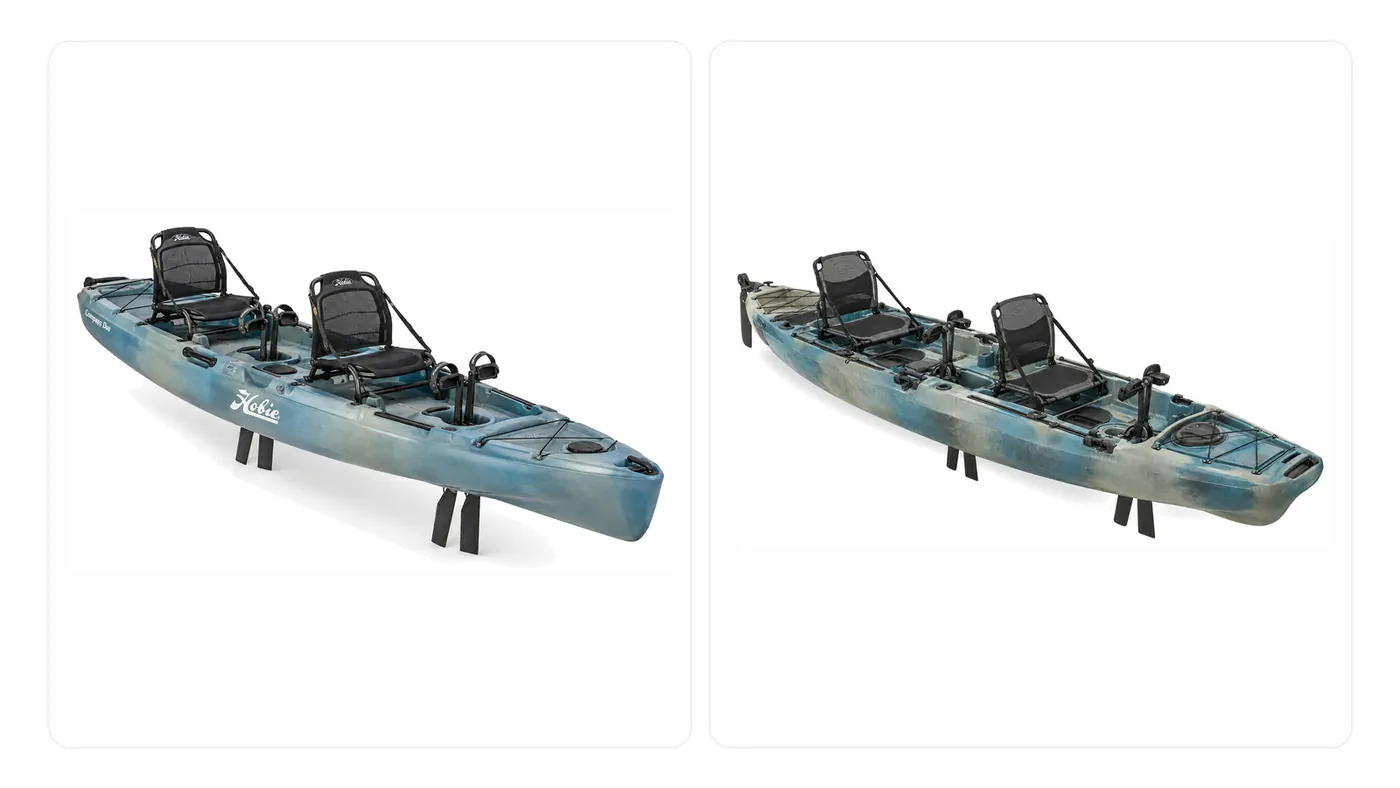
 Best overall tandem
 Best for lighter pairs