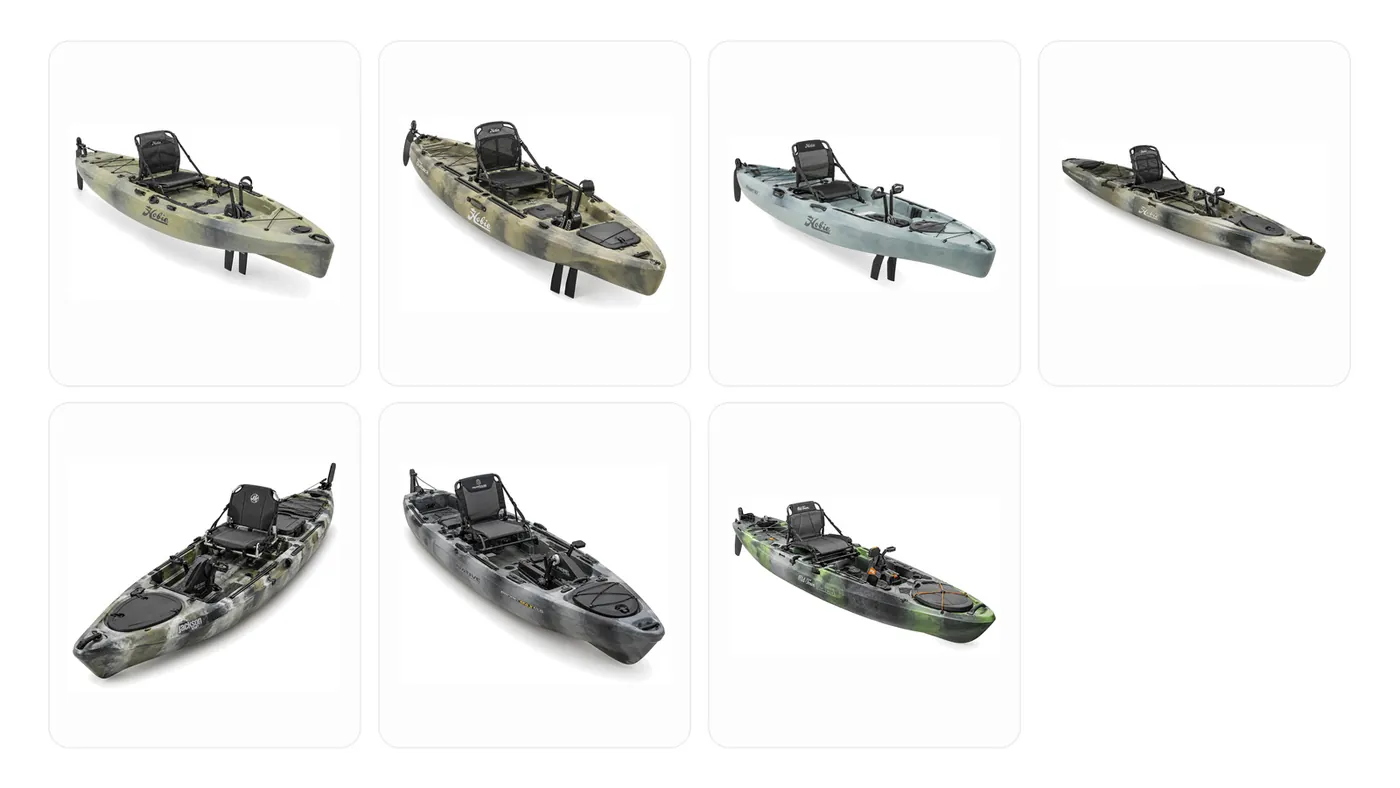
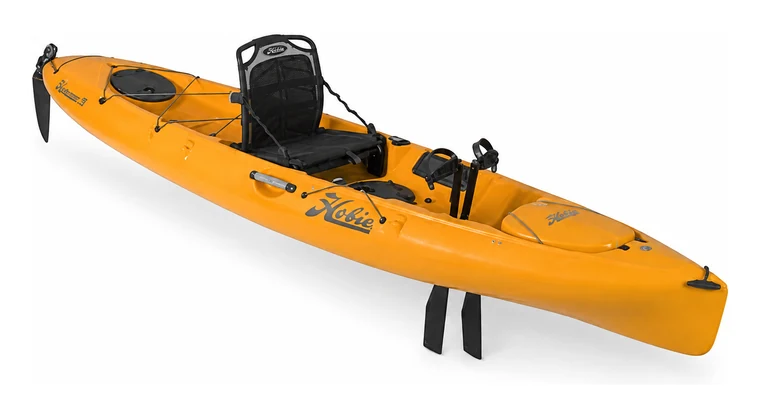
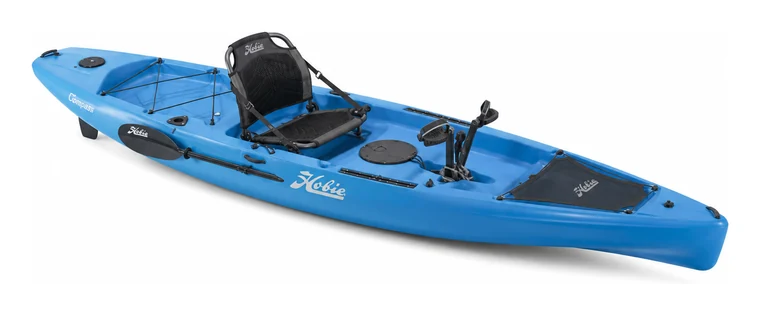
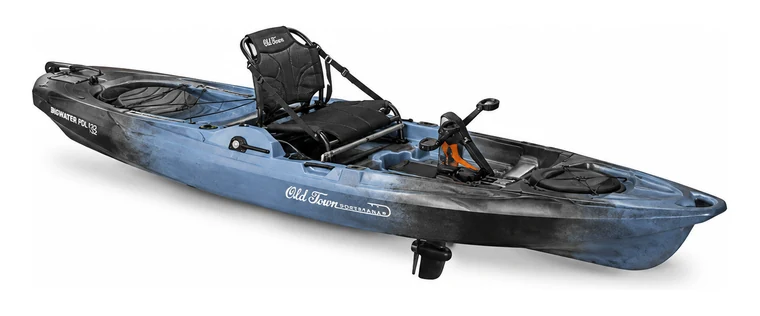
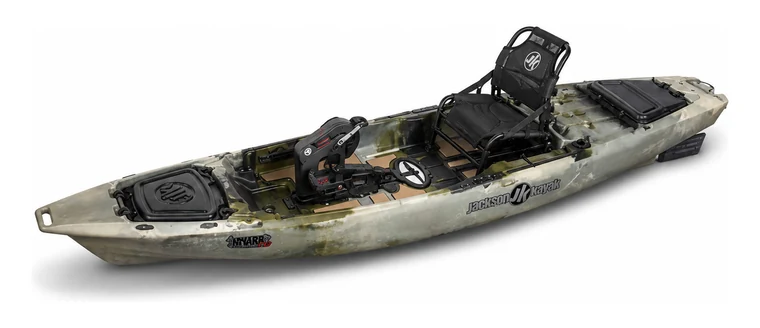
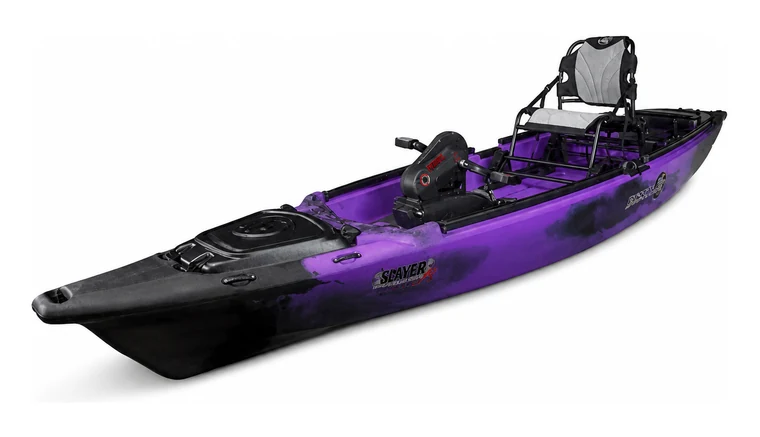
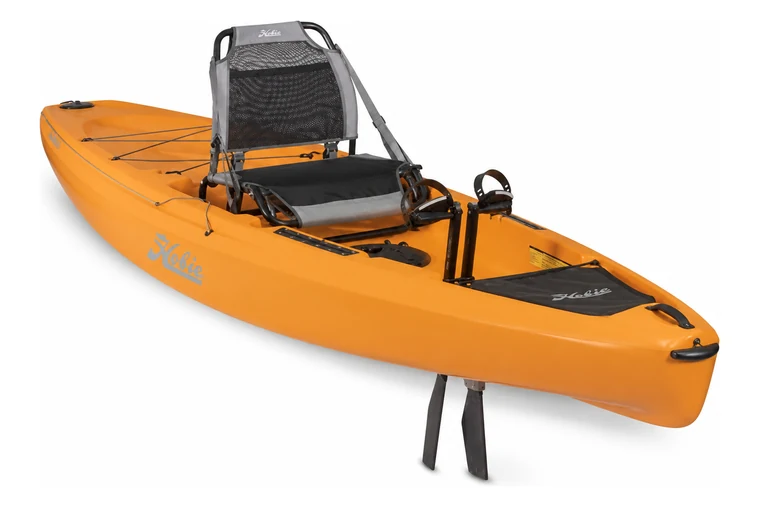
The pedal fishing kayaks reviewed below. Manufacturer product photography.
7 Best Pedal Fishing Kayaks for Surf Launches and Offshore Fishing
Seven pedal and pedal-plus-paddle platforms ranked on what happens at the breakers: drive protection, drainage, re-entry, beach weight and offshore efficiency.
By Larry MurrayUpdated 25 August 202618 min readBuyer’s Guide
The quick answer
The Hobie Mirage Outback is the best pedal fishing kayak for surf launches for most anglers.
It pairs a 103 lb fully rigged weight and a 34-inch beam with Kick-Up fins, a Kick-Up rudder and enough fishing
capability to justify the trip. Anglers who put surf performance above deck space should buy the Mirage
Revolution 13 instead, at 13′5″ by 28.5″ and 88 lb fully rigged.
Everything below is judged on one question: what happens at the breakers, not how comfortable the boat is once
you are safely outside them.
Affiliate disclosure. ReefReadyGear is a participant in the Amazon Services LLC Associates Program. As an Amazon Associate I earn from qualifying purchases. Links to products on this page are affiliate links, and they never change what you pay.
The thesis of this page
An offshore-capable pedal kayak is not automatically a good surf-launch kayak. A surf-launch boat
has to work before, during and after the breakers: manageable on the beach, controllable through shorebreak, able to
protect its drive and rudder, quick to drain, recoverable after a capsize, and efficient once it is offshore. Most
roundups rank ocean kayaks on width, capacity and storage. Those matter. They do not answer this question.
Read the weight column carefully. Manufacturer weight terms are not interchangeable, so each figure
carries the wording its maker uses. Hobie publishes fully rigged weights, Old Town publishes an assembled weight, and
Jackson publishes a weight with seat and drive fitted. Comparing them is useful; treating them as one measurement is
not. Specifications read 25 August 2026.
Surf-launch pedal kayak comparison
Model
Drive
Drive protection
Rudder protection
Published weight
Width
Capacity
Main drawback
Hobie Mirage OutbackBest Overall
MirageDrive 180 Turbo, Kick-Up fins
Fins kick up on impact
Kick-Up rudder
103 lb fully rigged
34″
425 lb
Neither the lightest nor the narrowest of the seven
Hobie Mirage Revolution 13Best Pure Surf-Launch Performer
MirageDrive, Kick-Up fins
Fins kick up on impact
Kick-Up rudder
88 lb fully rigged
28.5″
350 lb
Lowest capacity here, and no stand-up fishing platform
Hobie Mirage CompassBest Lightweight Premium Pick
MirageDrive 180, Kick-Up fins
Fins kick up on impact
Kick-Up rudder
87 lb fully rigged
34″
400 lb
Fewer fishing features than an Outback at a similar beam
Old Town Sportsman BigWater PDL 132Best Prop-Drive for Big Water
PDL prop drive, forward and reverse
Console docks up or lifts out
Rudder deploys and retracts
122 lb assembled
36″
500 lb total / 378 lb usable
122 lb assembled is a different animal on a beach
Jackson Knarr FDBest Drive Protection and Gear Security
Flex Drive Mark IV prop drive
Auto-retracting lower unit
Rudder retracts
158 lb with seat and drive
37″
425 lb
The heaviest complete system on this list by a wide margin
Native Slayer Propel Max 12.5Best High-Capacity Offshore Pick
Propel prop drive, forward and reverse
Drive lifts and stows
Rudder deploys and retracts
125 lb fully rigged
34″
500 lb
Capacity does not buy surf manoeuvrability
Hobie Mirage Passport 12.0 RBest Budget Surf-Friendly Fin Drive
MirageDrive GT, Kick-Up fins
Fins kick up on impact
Kick-Up rudder
83 lb fully rigged
34″
400 lb
Simpler outfitting than the Outback, Revolution or Compass
We built a 100-point model because “good in the ocean” is too blunt to buy from. It weights the seven things that
decide whether a pedal kayak survives a beach launch and a beach landing.
What this score is, and what it is not
This is our editorial model, not an industry standard and not test data. Each score reasons from
published specifications and published drive architecture. ReefReadyGear does not run a testing programme, and nothing
here is presented as a measured result. Where a number reflects a judgement, that judgement is ours and we show the
working.
Surf Launch Readiness Score by factor
Model
Surf penetration /20
Drive + rudder /20
Drainage /15
Re-entry /15
Gear retention /10
Beach transport /10
Offshore efficiency /10
Total /100
Hobie Mirage Revolution 13
20
18
11
10
6
9
10
84
Hobie Mirage Outback
16
19
12
12
8
7
9
83
Hobie Mirage Compass
15
18
11
12
7
9
7
79
Hobie Mirage Passport 12.0 R
15
17
10
12
6
10
6
76
Old Town BigWater PDL 132
12
14
11
11
8
5
9
70
Jackson Knarr FD
10
18
11
10
10
2
9
70
Native Slayer Propel Max 12.5
12
13
11
11
8
5
8
68
The Revolution 13 tops the score and does not win Best Overall. That is deliberate. The model
measures surf launch readiness only. It does not measure fishing capability, deck space or standing stability, which
is exactly why the Outback wins the award while scoring a point lower. Read the score as an answer to “how well does
this boat handle the beach and the breakers”, not “which boat should I buy”.
How we chose them
Seven factors, in the weighting above.
Surf penetration and hull efficiency (20). Waterline length, beam, bow profile and how quickly
the hull accelerates when you need to square up to a breaker.
Drive and rudder protection (20). Whether the appendages fold, kick up, dock, retract or must be
removed, and whether that protection needs a decision from you at the worst possible moment.
Drainage (15). How fast a self-bailing deck sheds green water after a wave lands in the
cockpit.
Re-entry and recovery (15). Gunwale height, seat obstruction, grab points and deck clutter, all
of which decide whether you get back aboard offshore.
Gear retention (10). Whether a capsize in shorebreak costs you rods, tackle and electronics.
Beach transport (10). Fully rigged or assembled weight, because that is the complete system you
carry.
Offshore pedal efficiency (10). What the hull does once you are past the break and pointed at a
mark two miles out.
Discontinued models were excluded from the awards. Availability should be reconfirmed before you buy.
Offshore-capable is not surf-launchable
These are two different jobs, and the industry sells them as one.
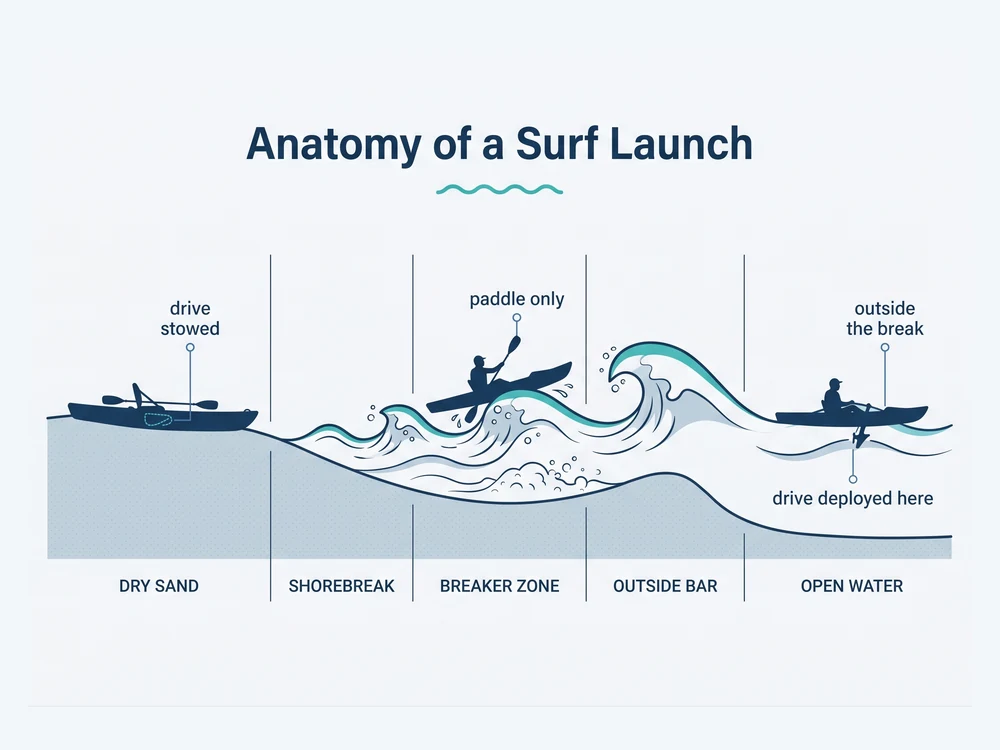
The five zones a beach launch actually crosses. Most roundups only judge the last one.
Offshore from a protected launch runs ramp to harbour to inlet to ocean. The boat never has to be
dragged over sand, never has to accelerate through a breaking wave, and never has to be landed in shorebreak. Weight
barely matters. Capacity, stability and deck space matter a lot.
Offshore from the beach runs sand to shorebreak to breakers to ocean, then does the whole thing in
reverse when you are tired. Weight is a performance figure. Drive protection is a damage-control figure. Drainage is a
stability figure.
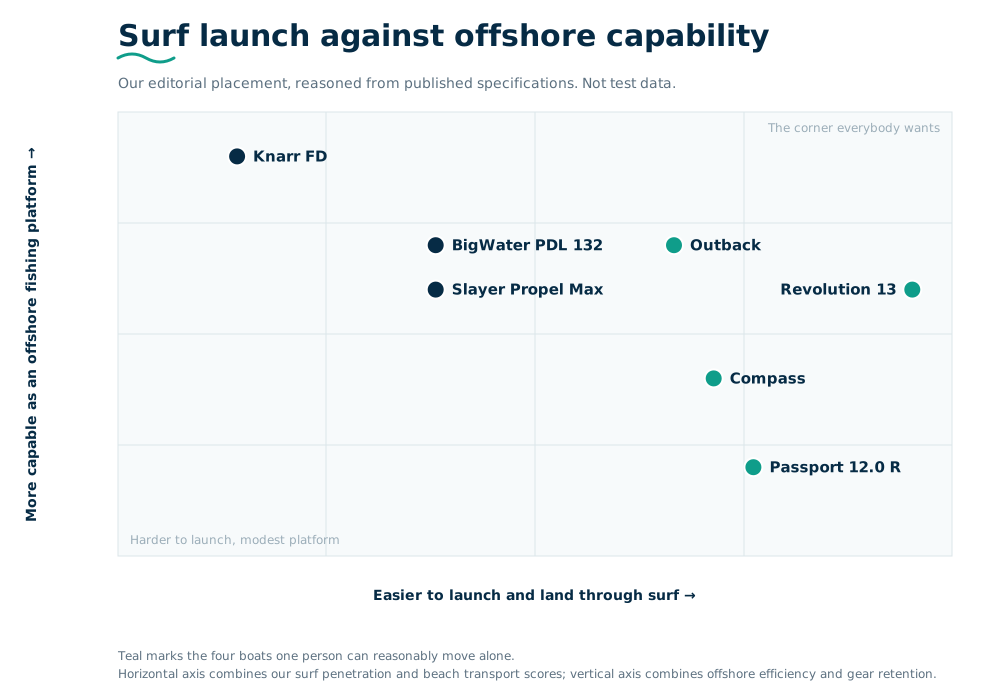
Surf launch against offshore capability
Model
Beach handling
Punching the break
Fishing platform
Payload
Rough-water systems
Hobie Mirage Revolution 13
Excellent
Excellent
Very Good
Limited
Very Good
Hobie Mirage Outback
Very Good
Very Good
Excellent
Very Good
Excellent
Hobie Mirage Compass
Very Good
Good
Very Good
Good
Very Good
Hobie Mirage Passport 12.0 R
Very Good
Good
Good
Good
Good
Old Town BigWater PDL 132
Limited
Very Good
Excellent
Excellent
Good
Jackson Knarr FD
Not Ideal
Very Good
Excellent
Very Good
Excellent
Native Slayer Propel Max 12.5
Limited
Good
Very Good
Excellent
Good
Read the two ends of that table together. The Knarr scores Not Ideal on beach handling and Excellent on rough-water
systems, and both are true at once. It is a superb rough-water boat that happens to weigh 158 lb with the seat and
drive fitted.
The same table plotted. Nothing sits in the top right corner, which is the whole problem.
The seven in detail
Hobie Mirage Outback — Best Overall
The Outback wins because it refuses to specialise. At 12′9″ by 34″ and 103 lb fully rigged, it sits in the narrow band where a boat is light enough to move alone, stable enough to fish hard from, and efficient enough to be worth pedalling offshore. Kayak Angler names it their best pedal-powered ocean fishing kayak, and their review describes launching it through surf at La Jolla.
Hobie Mirage Outback published specifications
Length and width
12′9″ × 34″
Published capacity
425 lb
Published weight
103 lb fully rigged
Drive
MirageDrive 180 Turbo, Kick-Up fins
Drive protection
Fins kick up on impact
Rudder protection
Kick-Up rudder
Surf Launch Readiness Score
83 / 100 (our editorial model, below)
Why the drive matters more than the thrust
The MirageDrive 180 Turbo runs Kick-Up fins, and the rudder kicks up too. Both appendages react to an impact without waiting for you to make a decision. That is the single most useful property a drive can have when you are landing in knee-deep water with a wave behind you.
The fishing case
425 lb of published capacity, a deck built for standing, and enough track space for a screen and a transducer arm. This is a boat you would still choose if the surf were not part of the equation, which is why it wins overall rather than winning on surf alone.
The honest drawback
103 lb fully rigged is manageable, not easy. Across soft sand, alone, at the end of a long day, you will feel every pound of it. The bow is also known to give a wetter ride than a drier, higher-volume hull.
Best for. The angler who wants one boat that launches off a beach and still fishes like a proper platform.
Skip it if. You want the lightest possible carry, or the narrowest possible hull. Look at the Compass or the Revolution 13.
Hobie Mirage Revolution 13 — Best Pure Surf-Launch Performer
13′5″ long, 28.5″ wide, 88 lb fully rigged. Those three numbers describe a completely different design argument from the 36-inch fishing platforms that dominate the category, and for a surf launch they are the right numbers.
Hobie Mirage Revolution 13 published specifications
Length and width
13′5″ × 28.5″
Published capacity
350 lb
Published weight
88 lb fully rigged
Drive
MirageDrive, Kick-Up fins
Drive protection
Fins kick up on impact
Rudder protection
Kick-Up rudder
Surf Launch Readiness Score
84 / 100 (our editorial model, below)
Why narrow and long wins at the break
A long waterline and a narrow beam accelerate faster and knife through a wave face instead of climbing it. When you are trying to punch through a set, that acceleration is the whole game. The same hull then pedals efficiently for miles once you are outside.
What you give up
350 lb capacity is the lowest here, and 28.5 inches is not a standing platform. This boat is for sitting, casting and covering water. Judging it against a flats platform misses the point, because that is not this query.
Best for. Crossing surf efficiently and pedalling distance offshore, with stand-up stability a distant second.
Skip it if. You fish standing, carry heavy tackle, or need deck space for a large screen and a cooler.
Hobie Mirage Compass — Best Lightweight Premium Pick
The Compass exists to solve beach logistics. At 12′ by 34″ and 87 lb fully rigged, it saves 16 lb against the Outback and as much as 71 lb against the Knarr, and it does so without giving up the Kick-Up fin architecture that makes a Hobie worth buying for surf.
Hobie Mirage Compass published specifications
Length and width
12′ × 34″
Published capacity
400 lb
Published weight
87 lb fully rigged
Drive
MirageDrive 180, Kick-Up fins
Drive protection
Fins kick up on impact
Rudder protection
Kick-Up rudder
Surf Launch Readiness Score
79 / 100 (our editorial model, below)
Where 16 pounds actually shows up
Solo unloading from a roof rack. Getting the cart under it alone. Two hundred yards of soft sand above the tide line. Dragging it clear after a landing that did not go to plan. Weight is not a transport inconvenience on a beach launch, it is the thing that decides whether you go.
What it is not
It is not an Outback with the weight removed. The outfitting is simpler and the fishing features are fewer. Buy it for the carry, not because you expect the same deck.
Best for. Long carries, soft sand, solo loading, and anglers who have decided weight is their limiting factor.
Skip it if. You want the Outback’s fishing deck, or you already have help at the beach.
Old Town Sportsman BigWater PDL 132 — Best Prop-Drive for Big Water
Old Town builds the BigWater PDL 132 around open water: 13′2″ by 36″, a performance tri-hull, 500 lb total and 378 lb usable capacity, and a PDL prop drive that docks up or lifts out of the well. It is a serious big-water fishing boat that happens to weigh 122 lb assembled.
Old Town Sportsman BigWater PDL 132 published specifications
Length and width
13′2″ × 36″
Published capacity
500 lb total / 378 lb usable
Published weight
122 lb assembled
Drive
PDL prop drive, forward and reverse
Drive protection
Console docks up or lifts out
Rudder protection
Rudder deploys and retracts
Surf Launch Readiness Score
70 / 100 (our editorial model, below)
The drive is protectable, but it asks you first
The PDL console docks upward or comes out entirely, which protects the prop properly. The difference from a Kick-Up fin is that you have to decide to do it, and you have to decide early enough. Plan that action into both the launch and the landing rather than improvising it.
Why the award is worded carefully
We gave it Best Prop-Drive for Big Water, not Easiest Surf Launcher. A 122 lb assembled boat behaves differently on sand and in knee-deep water than an 87 lb Hobie, and pretending otherwise would be the exact error this page exists to correct.
Best for. Open water reached from a ramp or a firm, short beach carry, with a full fishing deck and real payload.
Skip it if. Your launch is a long soft-sand walk, or you routinely go alone.
Jackson Knarr FD — Best Drive Protection and Gear Security
Jackson designed the Knarr around oceans, wind, current and tide, and it shows in two places that matter here: the Flex Drive Mark IV, which Jackson describes as an auto-retracting lower unit with several operating positions, and rod management built for rough water rather than for a photograph.
Jackson Knarr FD published specifications
Length and width
13′9″ × 37″
Published capacity
425 lb
Published weight
158 lb with seat and drive
Drive
Flex Drive Mark IV prop drive
Drive protection
Auto-retracting lower unit
Rudder protection
Rudder retracts
Surf Launch Readiness Score
70 / 100 (our editorial model, below)
The best drive protection story on this list
An auto-retracting lower unit protects itself on impact and offers a fully retracted position for transport and landing. Combined with a retracting rudder, that is the most complete appendage-protection package of the seven, and it is why the boat scores 18 out of 20 on that factor despite its weight.
Gear security as a performance feature
A capsize in shorebreak turns loose equipment into debris. Jackson markets the Knarr around secure rod management, and it earns full marks from us on gear retention because the boat is built to hold onto its contents when it goes over.
The weight problem is real
158 lb with seat and drive fitted. That is 75 lb more than a Passport. Beach transport stops being a detail and becomes a logistics plan involving a good cart, firm sand, or a second person.
Best for. Rough water where drive protection and gear security outrank everything, launched somewhere you can reach.
Skip it if. You launch alone off soft sand. The number that beats you is 158, not the surf.
Native Slayer Propel Max 12.5 — Best High-Capacity Offshore Pick
Native positions the Slayer Propel Max 12.5 for offshore and inshore saltwater use, at 12′6″ by 34″ with 500 lb of published capacity and 125 lb fully rigged. The Propel drive gives conventional forward and reverse through a propeller.
Native Slayer Propel Max 12.5 published specifications
Length and width
12′6″ × 34″
Published capacity
500 lb
Published weight
125 lb fully rigged
Drive
Propel prop drive, forward and reverse
Drive protection
Drive lifts and stows
Rudder protection
Rudder deploys and retracts
Surf Launch Readiness Score
68 / 100 (our editorial model, below)
Capacity is the reason to buy it
500 lb carries a larger angler, a full tackle load, a cooler, electronics and proper offshore safety kit without crowding the number. If your loaded weight is what rules boats out, this is the one that stays in.
Capacity is not surf manoeuvrability
A high capacity figure describes how much mass the hull floats. It says nothing about how the boat accelerates into a wave face or how it behaves when a breaker catches the stern. Do not let the biggest number on the page decide a surf purchase.
Best for. Heavy anglers and heavy loads that still need conventional forward and reverse pedal propulsion.
Skip it if. Your priority is punching the break rather than carrying payload.
Hobie Mirage Passport 12.0 R — Best Budget Surf-Friendly Fin Drive
The Passport 12.0 R is the cheapest honest way into a protected fin drive. Published specifications put it at 12′ by 34″, 400 lb capacity and 83 lb fully rigged, running a MirageDrive GT with Kick-Up fins.
Hobie Mirage Passport 12.0 R published specifications
Length and width
12′ × 34″
Published capacity
400 lb
Published weight
83 lb fully rigged
Drive
MirageDrive GT, Kick-Up fins
Drive protection
Fins kick up on impact
Rudder protection
Kick-Up rudder
Surf Launch Readiness Score
76 / 100 (our editorial model, below)
What you keep at this price
The thing that matters most for surf: fins that kick up on impact, and a hull light enough that one person can move it. 83 lb is the lightest complete system of the seven, which is why it takes full marks on beach transport.
What you give up
Simpler outfitting than the Outback, Revolution or Compass. Fewer tracks, a less refined seat, less fishing furniture. You are buying the architecture, not the fit-out.
Best for. A first surf-launch pedal kayak, or a second boat kept for beach days.
Skip it if. You need the deck, the tracks and the seat of a premium platform from day one.
The Old Town Sportsman Salty PDL was an unusually surf-relevant pedal kayak, purpose-built for coastal use, and it
still appears as a headline recommendation in several current ocean-kayak roundups. Old Town’s own site now
lists the Salty PDL 120 under discontinued products.
We do not give awards to discontinued models. If you find remaining stock, that can still be a good buy, but weigh
it against parts availability, warranty terms and dealer support before you commit. None of that is a criticism of the
boat.
Hull shape and acceleration through a breaker
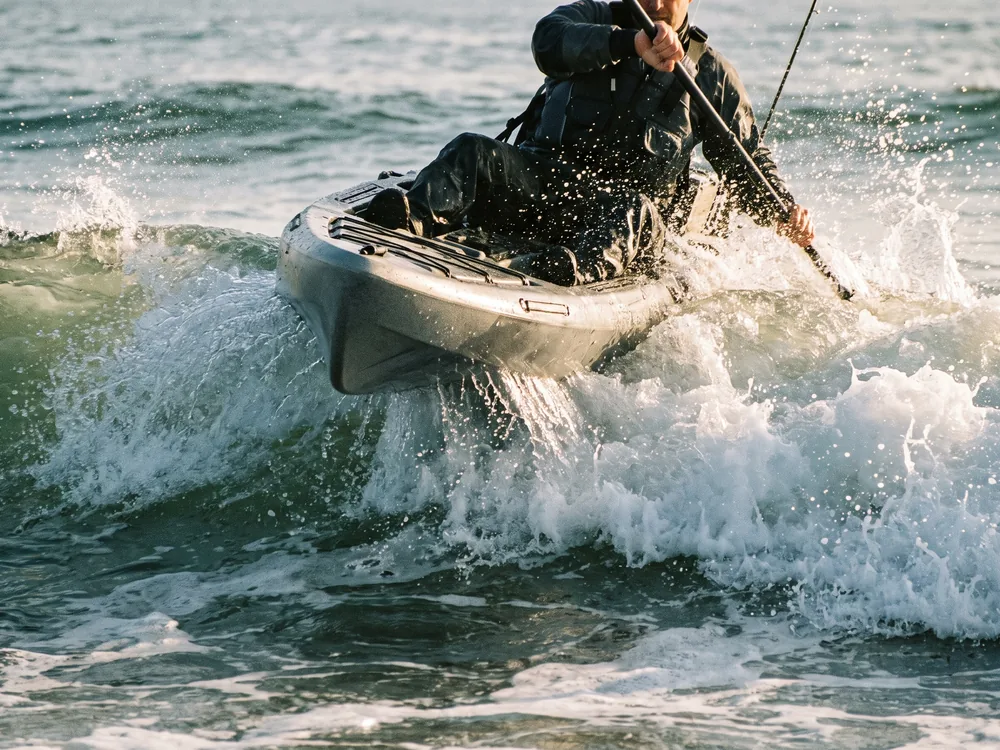
Punching through surf is an acceleration problem before it is a stability problem. You need to reach the wave face
with enough speed to go through it rather than get stopped, turned and broached.
Speed at the wave face is what stops a broach. Illustrative photography, not one of the seven boats reviewed here.
Waterline length helps. A longer hull carries speed and tracks straighter when a wave tries to spin it. Beam hurts,
up to a point: a 28.5-inch Revolution accelerates and slices in a way a 37-inch Knarr cannot, because there is simply
less boat to push.
Do not reduce this to narrow equals better. Beam buys the stability you need to fish, to re-enter
after a capsize and to stay upright when a wave lands on the deck. Bow profile and rocker matter as much as beam: a
bow that lifts sheds water over the sides, and a bow that knifes takes it over the deck. The right answer is the
narrowest boat that still does the fishing you actually do.
Pedal-drive protection at launch and landing
Most reviews treat the drive as a propulsion specification. For a beach launch it is also a damage variable and a
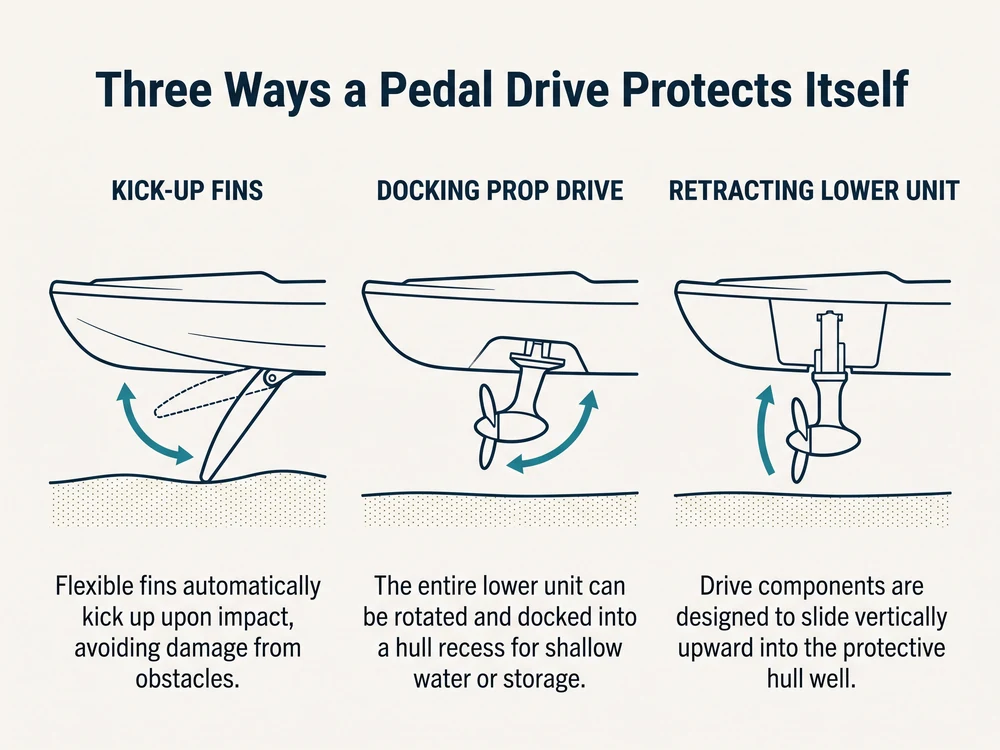
control variable, and there are three architectures worth understanding.
The three drive architectures, drawn generically. Your own boat’s manual is the authority on how to use them.
Kick-up or folding fins. Hobie’s Kick-Up fin systems move out of the way when they strike an
underwater object. The protection is passive, which means it works whether or not you saw the sandbar coming.
Docking or removable prop drives. Old Town’s PDL console docks upward or lifts out of the well.
The protection is complete, but it is an action you take, so it has to be planned into the launch and the landing.
Retracting lower units. Jackson describes the Flex Drive Mark IV as auto-retracting, with
operating positions including fully retracted for transport and landing. That combines passive protection with a
deliberate stowed position.
Follow the manual, not a rule of thumb
There is no universal instruction such as “always leave the drive installed through the breakers”. The correct
procedure differs by system, and the manufacturer’s manual for your specific boat is the authority. Read the
shallow-water and landing sections before your first surf trip, not after.
Fin drive against prop drive for surf
The format war is the wrong argument. Compare the protection mechanism instead.
Fin drive against prop drive for surf launching
Factor
Fin drive
Prop drive
How the drive is protected
Fins fold or kick up when they strike something, on systems built that way
Lower unit docks upward, retracts, or lifts out of the well
Does protection need a decision?
Kick-up fins react on impact without input from the angler
Docking or retracting is usually an action you take, or an auto-retract on impact
Reverse
System-dependent; MirageDrive 180 reverses by reversing the fins
Commonly mechanical through the drive, as on PDL and Propel
Under-hull exposure
Fins sweep a wide arc but fold flat
A propeller and lower unit sit in a fixed housing until stowed
Landing through shallow breakers
Fins can take a strike and keep working
Better to stow before the boat touches down
What actually decides it
The protection mechanism on that specific model
The protection mechanism on that specific model
Choose the protection system, not the marketing category. A prop drive that retracts automatically
protects itself better than a fin drive that does not fold, and the reverse is equally true. Ask what the appendage
does at the moment it hits sand.
Rudder protection is a separate question
Drive protection and rudder protection are not the same feature, and a boat can be excellent at one and exposed at
the other. The rudder is vulnerable at launch, in shallow water, during grounding, on a stern-first landing and
throughout a capsize.
Check three things on any boat you are considering: whether the blade kicks up on impact, whether you can retract
it from the seat, and how exposed it sits when the hull touches down on sand. All four Hobies here run Kick-Up
rudders. The Old Town, Jackson and Native rudders deploy and retract.
Drainage after green water comes aboard
When a breaker dumps over the bow, several gallons of water arrive in the cockpit at once. That is weight in the
worst possible place, and it raises your centre of gravity exactly when you least want it raised.
A sit-on-top hull sheds it through the scuppers, which is a large part of why sit-on-tops own this category. The
Hobie Outback, for example, uses through-hull scupper points, and surf-oriented reviews have noted its ability to
handle offshore conditions while accepting that the bow gives a wetter ride.
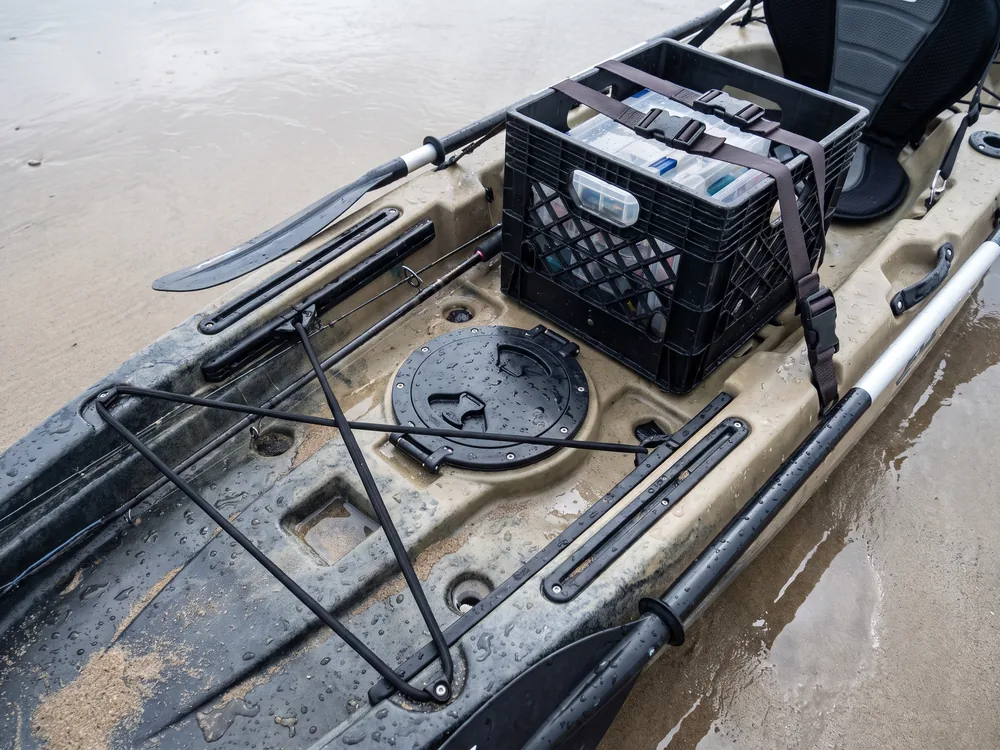
Check that your own rigging does not defeat the drainage. A crate wedged over a scupper, a battery
box in a well or a tackle bag flat on the deck can each turn a self-bailing boat into a bathtub. This is the cheapest
performance gain on the list and almost nobody checks it.
Re-entry after a capsize
Treat re-entry as a buying criterion, not an afterthought. Sit-on-top fishing kayaks are simpler to remount than
enclosed cockpits, but the ability is not automatic and it is not free.
What to look at on the boat:
Gunwale height. How far you have to haul yourself up out of the water.
Seat obstruction. An elevated frame seat can be the thing standing between you and the deck.
Side handle placement. Whether there is something to pull on where you need it.
Deck clutter. Rods, crates and screens all occupy the space you are trying to climb into.
Recovery with the drive installed. Test it as you actually fish, not with the boat stripped.
Practise it before you need it
Self-rescue is a skill, not a specification. Practise in warm, shallow, supervised water until you can right the
boat, get back aboard and restore propulsion without thinking about it. An untested re-entry offshore is not a plan,
it is a hope.
Seat height and centre of gravity
The category has been selling seat height for a decade, and it does buy real things: a better sightline for sight
fishing, a more comfortable casting position and an easier stand-up transition.
In surf and swell it also costs you. A raised seat lifts your mass above the hull, which increases the leverage a
breaking wave gets on you, adds side-to-side movement in a beam sea and makes re-entry a taller climb.
Lower is not automatically better. Hull design decides how much a high seat actually costs, and a
wide, stable hull carries an elevated seat far better than a narrow one. What matters is that you make the choice
knowingly, and that you can drop the seat to its low position before you commit to a launch.
Gear retention, or how to avoid a yard sale
A capsize in shorebreak scatters anything not attached to the boat, and the surf zone does not give things back.
Gear retention is a performance feature here, not a tidiness preference.
Will this rig survive a yard sale?
Rods stored horizontally, secured, with the tips protected
Crate strapped or tethered to the boat, not resting in the well
Tackle boxes latched shut, not stacked loose
All hatches closed and latched before you leave the sand
Screen and transducer either removed or properly mounted, never balanced
Drive retained per the manufacturer’s method
Paddle secured but reachable in one movement
Safety equipment attached to you, not to the deck
The last point is the one people get wrong. A PFD in a hatch is cargo. Communication gear in a crate is cargo. If
the boat goes one way and you go the other, the only equipment you have is the equipment you are wearing.
Everything strapped, latched or leashed before the boat leaves dry sand. Illustrative photography.
What you actually move across the beach
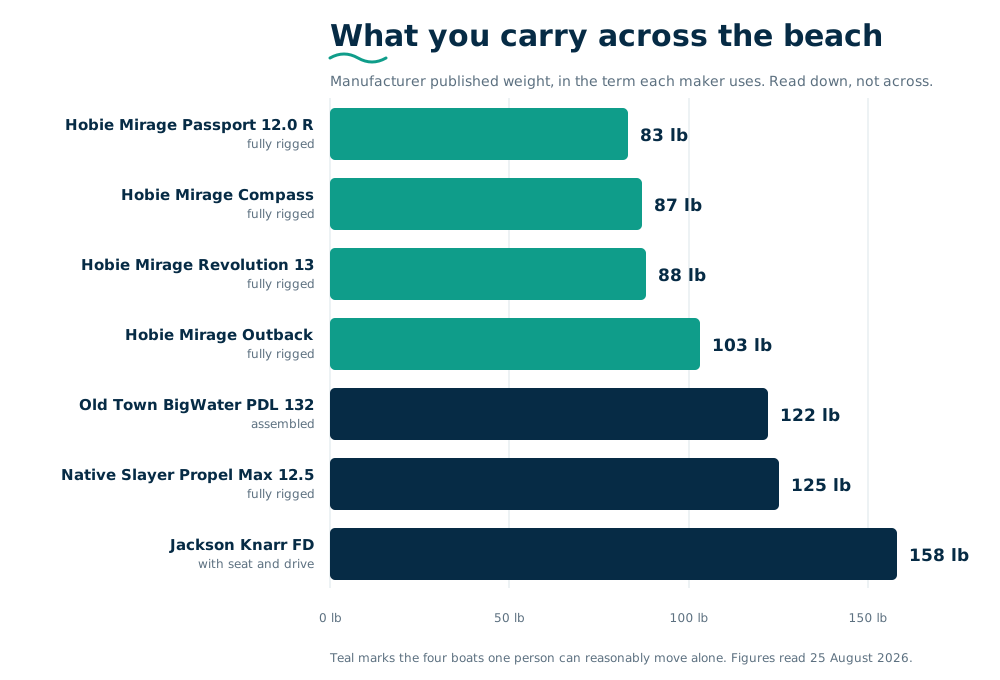
Published weight gets treated as a transport inconvenience. On a direct beach launch it is a performance figure,
because you carry the complete system before you fish and again after you are tired.
Published weights and what they mean on sand
Model
Published weight
Maker’s term
What that means on a beach
Hobie Mirage Passport 12.0 R
83 lb
fully rigged
Lightest complete system here
Hobie Mirage Compass
87 lb
fully rigged
The soft-sand argument in one number
Hobie Mirage Revolution 13
88 lb
fully rigged
Light and narrow, the easiest to control in knee-deep water
Hobie Mirage Outback
103 lb
fully rigged
Manageable solo with a cart on firm sand
Old Town BigWater PDL 132
122 lb
assembled
Plan the carry before you plan the trip
Native Slayer Propel Max 12.5
125 lb
fully rigged
Two people, or a very good cart
Jackson Knarr FD
158 lb
with seat and drive
Treat beach transport as a project
The spread from the Passport to the Knarr is 75 lb. That is not a rounding difference, it is the difference between
a boat one person carries and a boat that needs a plan.
The same figures as the table above, drawn to scale. Each bar carries the weight term its maker publishes.
At-the-beach weight = kayak + seat + drive + paddle + electronics + rods and tackle + safety gear + cart.
Start from the maker’s rigged or assembled figure, then add everything you carry. The unpowered and lighter platforms
in our Saltwater Craft category are the alternative if that total rules a
boat out.
Paddling with the drive stowed
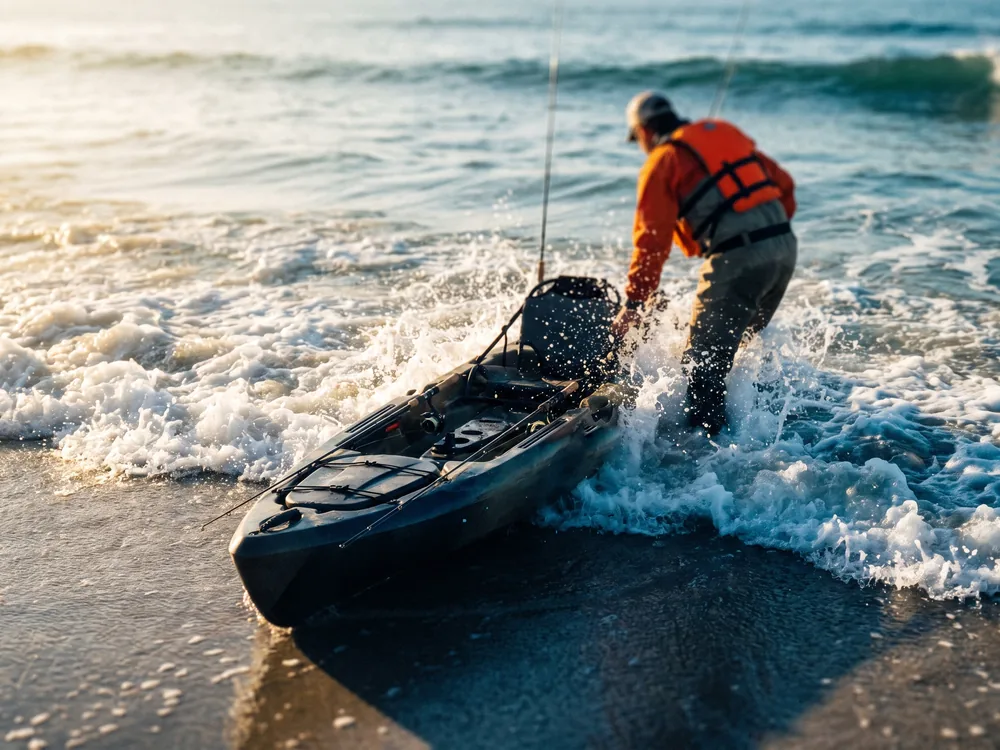
Here is the part most pedal-kayak reviews skip. During the most consequential thirty seconds of a beach launch, the
drive may be stowed, and you are paddling.
So the question is not only how the boat pedals. It is how it paddles when the pedals are unavailable: whether you
can reach the water cleanly over the beam, whether the seat position lets you get a full stroke in, how fast the hull
accelerates from a standstill, and whether you can square the bow to an incoming wave with two strokes.
A 28.5-inch Revolution 13 paddles like a kayak. A 37-inch fishing platform paddles like a barge, and needs a longer
paddle and more effort to do the same job. That difference is invisible on a spec sheet and obvious in a shorebreak.
The thirty seconds the drive is usually stowed and the paddle is doing the work. Illustrative photography.
Rigging checklist for a surf launch
Before the boat leaves the sand
Forecast checked, including the surf-zone and rip-current products
Drive protection plan decided for both the launch and the landing
Rudder stowed or deployed per the manual
Paddle secured and reachable in one movement
Rods horizontal, secured, tips protected
All hatches latched
Loose tackle contained and closed
Electronics removed or properly mounted
Crate tethered to the boat
Cart stowed aboard or carried back above the tide line
PFD worn, not stowed
Communication carried on your person
Float plan left with someone ashore
Landing plan decided before you launch
Checking the surf before you launch
The National Weather Service publishes surf-zone forecasts and rip-current risk products, and those belong in your
pre-trip routine alongside the marine forecast, the tide and the nearby buoy observations.
A “low” rip-current category does not mean no rip-current risk. It describes a general condition
across a stretch of coast. Conditions around inlets, jetties, piers and sandbars can differ sharply from the forecast
for the beach either side of them, and those are exactly the features kayak anglers are drawn to.
No wave height is universally safe. The threshold depends on your boat, your load, your launch, the water
temperature, the period between waves and your own experience. A pedal drive does not compensate for conditions the
hull and the angler cannot handle.
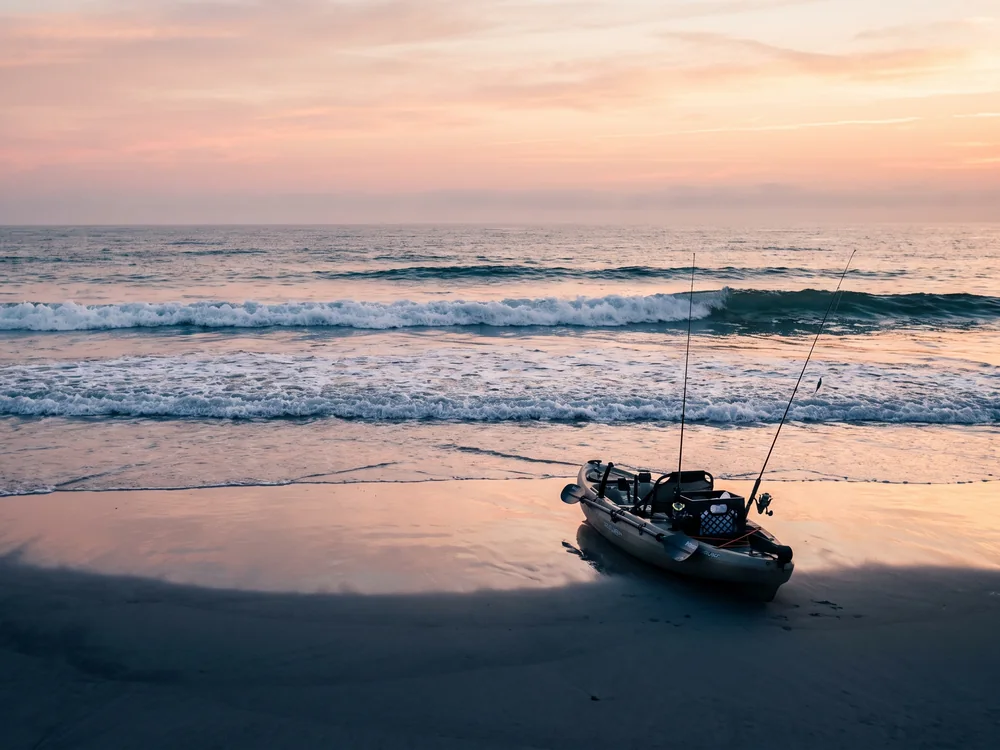
Watch a set or two from the sand before you commit. Illustrative photography.
Offshore safety beyond the kayak
Once you are past the break, the boat is only part of the system.
PFD. Worn, not stowed. U.S. recreational vessel requirements include a Coast Guard approved
wearable life jacket for each person aboard.
Paddle. Carry one regardless of propulsion, and know where it is without looking.
Communication you can reach while swimming. On your person, not on the deck.
Float plan. Someone ashore who knows where you launched and when you are due back.
Self-rescue practice. Rehearsed, in advance, in conditions you chose.
Exposure protection and water. Offshore trips run long more often than they run short.
How far must you move it across sand? Under fifty yards on firm sand opens the whole list. Two
hundred yards of soft sand, alone, rules out the Knarr and makes the Native and the BigWater hard work.
How exposed is your launch to shorebreak? A steep beach with a dumping break rewards the
Revolution 13. A gentle, forgiving break lets you choose on fishing capability instead.
Surf efficiency or stand-up stability? You do not get both at the extremes. The Revolution sits
at one end, the Knarr and the BigWater at the other, and the Outback is the honest middle.
What is your loaded payload? Add your body weight, tackle, cooler, electronics and safety gear,
then compare against the published capacity in that maker’s own terms.
How do the drive and rudder protect themselves? Passive kick-up protection asks nothing of you.
Docking and retraction ask for a decision. Decide which you trust yourself to manage in a breaking wave.
The Hobie Mirage Outback, because it balances a 103 lb fully rigged weight, a 34-inch beam, Kick-Up fins and a Kick-Up rudder with real fishing capability.
Anglers who care more about punching through surf and covering distance than about deck space should look at the narrower, lighter Mirage Revolution 13 instead.
Some are, and some are not. A surf-friendly pedal kayak needs a drive and rudder you can protect, a weight you can move across sand, quick drainage and a workable re-entry.
A wide, heavy pedal kayak can be excellent offshore from a ramp and still be awkward in shorebreak.
It depends on the system, and the manufacturer’s manual is the authority for your boat. Some drives are designed to stay installed and take a strike; others should be docked or removed first.
Whatever the answer, plan the same decision for the landing, when the boat comes in over shallow breaking water.
No. Offshore-capable and surf-launchable are separate attributes.
A heavy, stable hull can handle swell well after launching from a harbour and still be hard to drag over sand, accelerate through breakers, land in shorebreak or recover after a wipeout.
Final verdict
Buy the Hobie Mirage Outback if you want one boat that launches off a beach and still fishes like a
proper platform. 103 lb fully rigged, a 34-inch beam, Kick-Up fins and a Kick-Up rudder, and enough deck to justify
the trip.
Buy the Mirage Revolution 13 if surf performance comes first and you have made peace with a
smaller fishing platform. It tops our Surf Launch Readiness Score for a reason.
Buy the Compass when the carry is the thing that decides whether you go fishing at all.
Buy the BigWater PDL 132 when your launch is easy and your fishing is serious.
Buy the Knarr FD when drive protection and gear security outrank the 158 lb you have to move.
Buy the Native Slayer Propel Max when payload is what rules other boats out. Buy the Passport
12.0 R when you want the protected fin architecture at the lowest honest price.
The choice comes down to how you reach open water, not what the boat does once you are out there. Judge every one
of these at the breakers.
Larry edits ReefReadyGear, a research-led saltwater gear publication. Recommendations here are built from manufacturer specifications, authorised retailer listings and published angler experience, and we say so plainly rather than implying a testing programme we do not run. Where a claim comes from a manufacturer, we attribute it. Where we have not verified something, we do not print it.
Specifications on this page were taken from the following manufacturer and authorised retailer listings, consulted 25 August 2026. Prices change; always confirm the current figure on Amazon before buying.
Get saltwater Fishing Guides, expert Buyers Guides, equipment recommendations,
marine electronics insights, and practical gear tips delivered to your inbox.