Skip to content
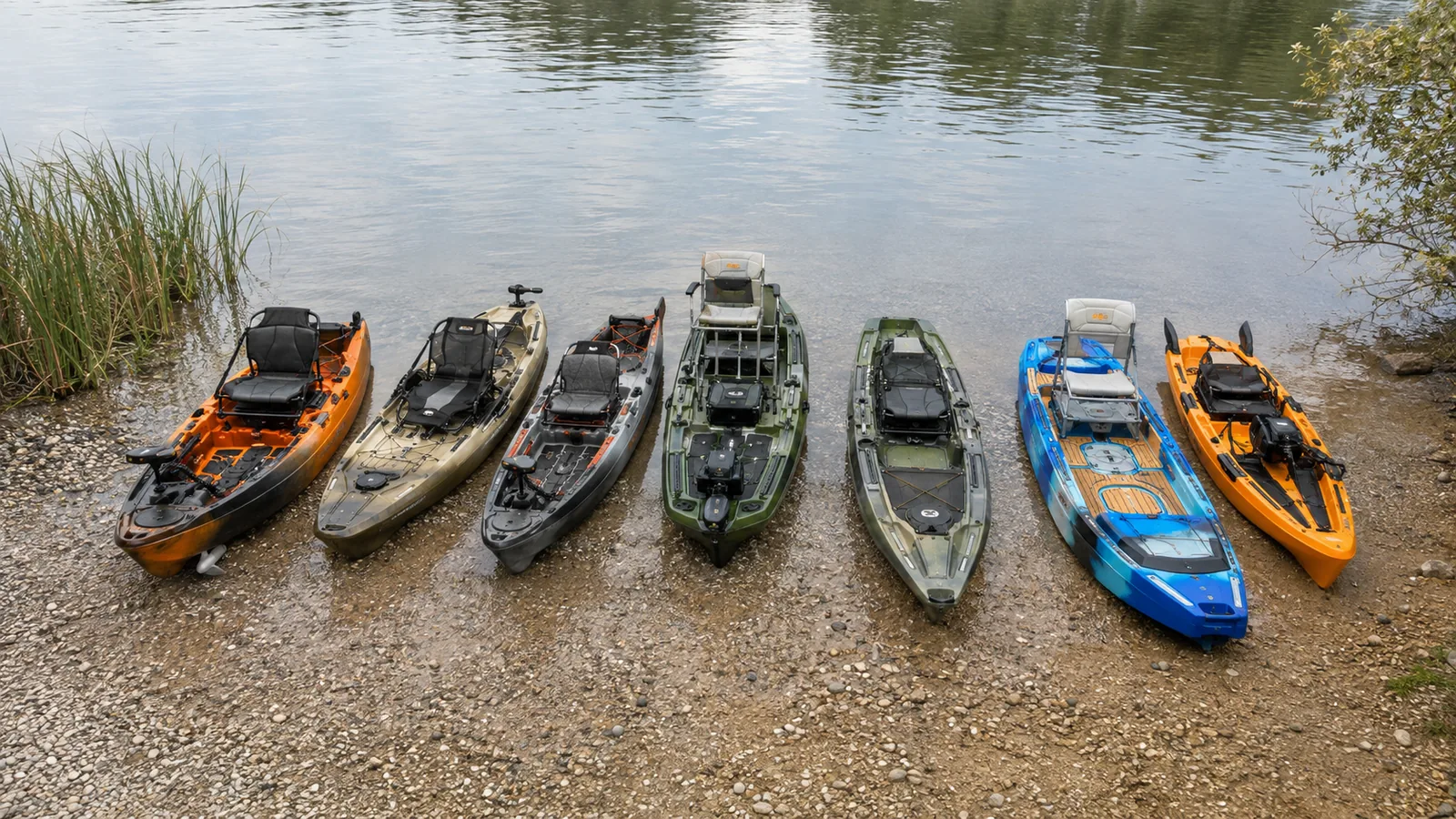
Seven motorized and motor-ready fishing kayaks lined up bow-first on a gravel shore beside calm water
All seven, side by side. Rigging, weight and payload decide more about a powered kayak than thrust does, and specifications on this page come from the manufacturers rather than from our own testing.

Best Motorized Fishing Kayaks for Saltwater

Seven motorized and motor-ready saltwater kayaks compared on published thrust, weight, capacity and battery figures, with the payload maths each brand’s own numbers actually support.

By Larry Murray Updated 24 August 2026 14 min read Buyer’s Guide

The short answer

Thrust ratings and hull width tell you almost nothing about how a powered kayak performs in salt. What decides the purchase is the whole system: how the motor is controlled, the battery you have to buy and carry, what the rig weighs loaded, how much payload survives after the power system takes its share, whether you can still move the boat when the electronics quit, and what salt does to the connectors over a season.

The Old Town Sportsman AutoPilot 136 is the strongest overall pick, pairing a saltwater-ready Minn Kota motor with i-Pilot GPS position holding and 502 lb of published usable capacity. The Old Town Sportsman BigWater ePDL+ 132 is the better answer for open-water travel, because it keeps manual pedal propulsion when the battery is gone.

Check Price on Amazon

Affiliate disclosure. ReefReadyGear is a participant in the Amazon Services LLC Associates Program. As an Amazon Associate I earn from qualifying purchases. Links to products on this page are affiliate links, and they never change what you pay.

Motor included, or motor-ready?

Some kayaks here arrive with a motor. Others are motor-ready hulls where propulsion is a separate purchase. That distinction is labelled on every pick, and it is the single biggest reason two boats on this page can look thousands of dollars apart and end up costing the same.

Quick picks

The Old Town Sportsman AutoPilot 136 is the best motorized fishing kayak for saltwater for most anglers. Its integrated 45 lb thrust 12V saltwater-ready Minn Kota motor with i-Pilot and Spot-Lock holds position over structure in wind and tidal current, and Old Town publishes 502 lb of usable capacity. The BigWater ePDL+ 132 is the better open-water choice because its pedal drive still works with the battery dead.

The seven at a glance

Propulsion and published figures

Motorized saltwater fishing kayak specifications
ModelPropulsion typeMotor included Battery includedGPS position holdPublished weight Capacity, maker’s own terms
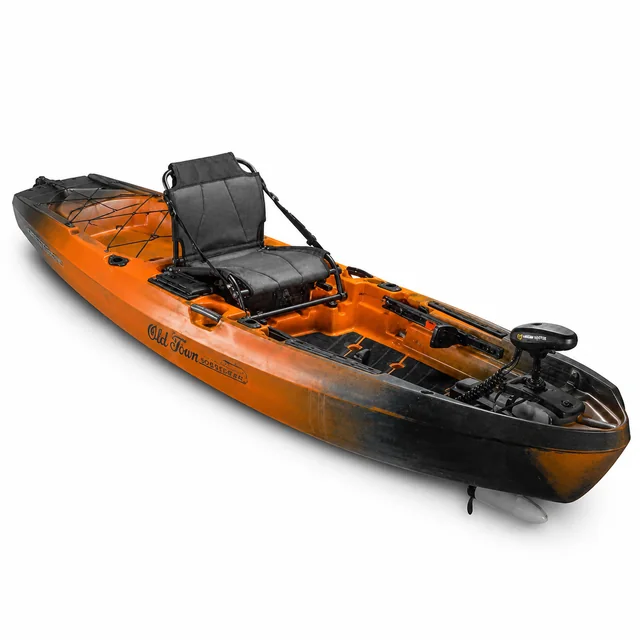
Old Town Sportsman kayak in orange and black on a white background, seat, gear tracks and a transom-mounted Minn Kota motor visibleOld Town Sportsman AutoPilot 136Best Overall Integrated bow GPS trolling motor, 45 lb thrust 12V Minn KotaYesNo (Group 27 or smaller) Yes, i-Pilot / Spot-Lock158 lb assembled502 lb usable / 660 lb total
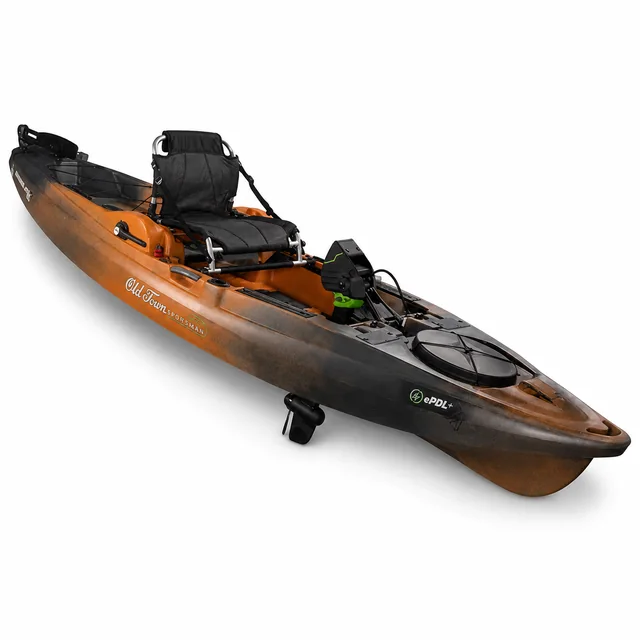
Old Town Sportsman BigWater ePDL+ in orange and black on a white background with the ePDL+ badge and the pedal drive unit below the hullOld Town Sportsman BigWater ePDL+ 132Best for Offshore and Open-Water Travel Pedal-electric hybrid: manual, assist, full electricDrive includedYes, 36V 20Ah lithium and charger No143 lb assembled357 lb usable / 500 lb total
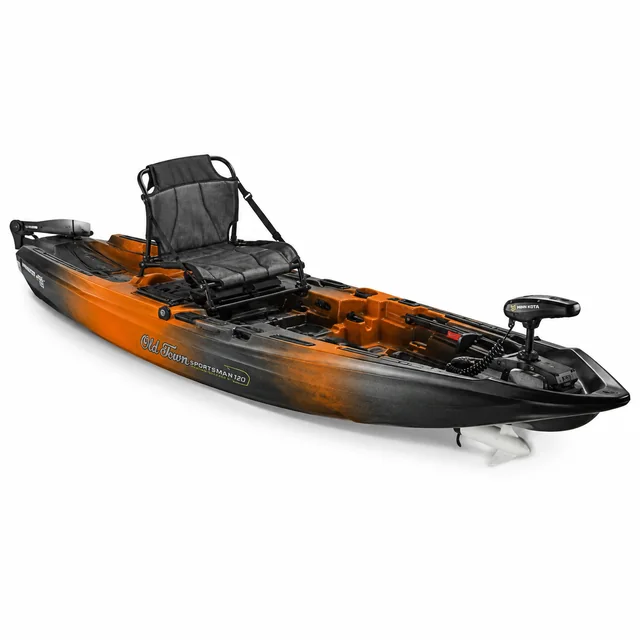
Old Town Sportsman 120 in orange and black on a white background with a Minn Kota motor and a rigged deckOld Town Sportsman AutoPilot 120Best Inshore GPS Pick Integrated bow GPS trolling motor, 45 lb thrust 12V Minn KotaYesNo (Group 27 or smaller) Yes, i-Pilot / Spot-Lock152 lb assembled406 lb usable / 558 lb total
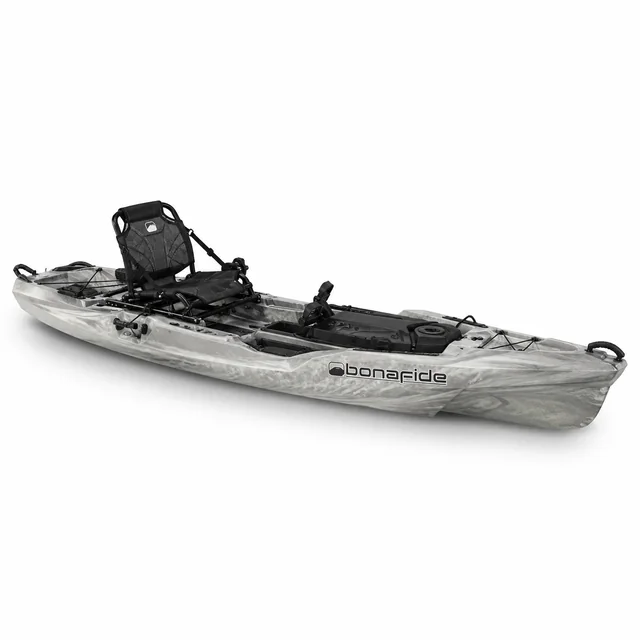
Bonafide kayak in grey camo on a white background showing an open deck, tracks and mounting points with no motor fittedBonafide PWR129Best Custom Motor-Ready Platform Motor-ready, bow and stern capableNoNo Depends on the motor you buy78 lb hull / 102 lb fitted rigged500 lb max capacity
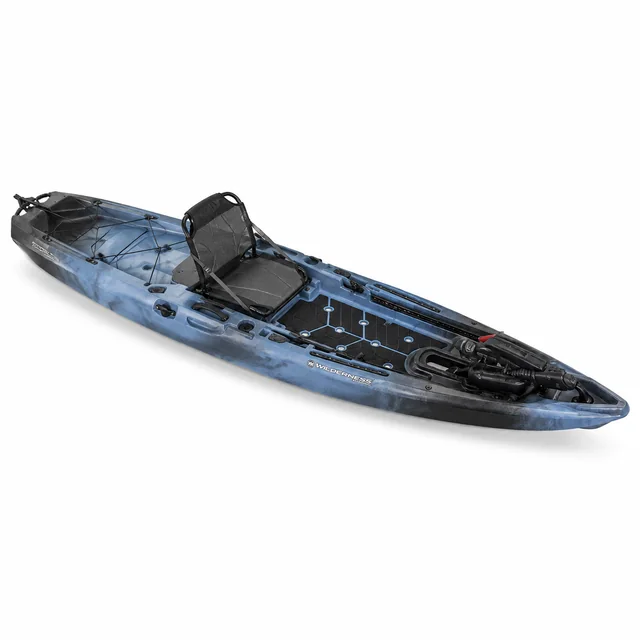
Wilderness Systems kayak in blue and black on a white background with a wide padded standing deck and factory tracksWilderness Systems Tactical Pro 128Best High-Capacity Power Rig Motor-ready, bow and stern mountsNoNo Depends on the motor you buy158 lb800 lb max capacity
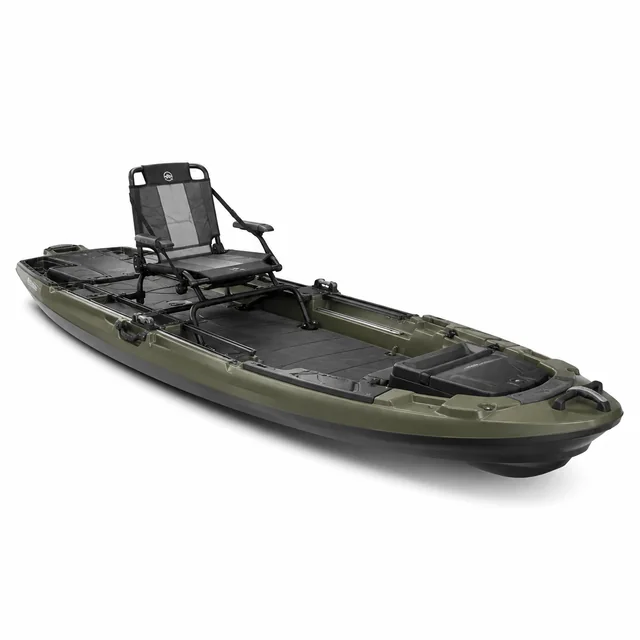
Kaku kayak in olive green on a white background with a raised framed seat and a flat open deckKaku Zulu X3Best Multi-Propulsion Coastal Platform Paddle, fin or prop pedal drive, bow or stern motorNoNo Depends on the motor you buy105 lb hull550 lb capacity
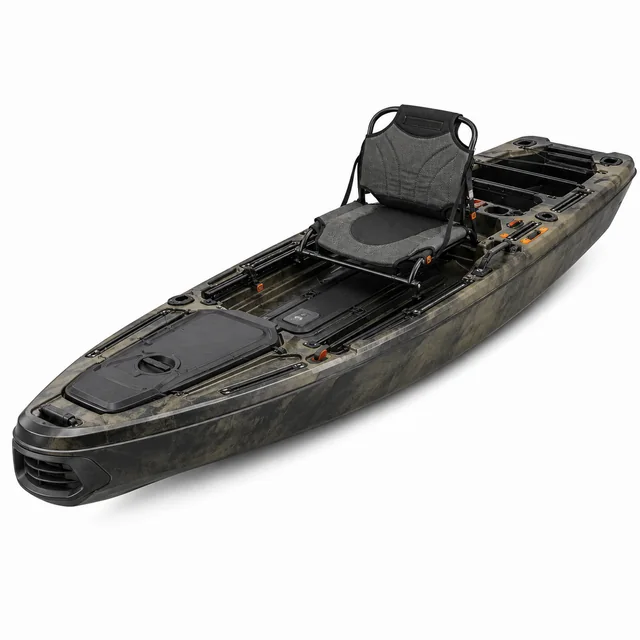
FluxJet kayak in camouflage on a white background, the enclosed jet-drive intake moulded into the bow in place of a propellerFluxJetBest Shallow-Water Motor Innovation Integrated electric jet drive, no exposed propYesNo (Group 31 box, 36V recommended) No88 lb bare / 112 lb fitted / 122 lb rigged400 lb including battery, angler and gear

Fit, tradeoff and price

Motorized saltwater fishing kayak fit and tradeoffs
ModelBest forMain tradeoff Price, 24 August 2026Link 
Old Town Sportsman kayak in orange and black on a white background, seat, gear tracks and a transom-mounted Minn Kota motor visibleOld Town Sportsman AutoPilot 136 Bays, estuaries, structure fishing158 lb before you add a battery$4,999.99 Check Price on Amazon
Old Town Sportsman BigWater ePDL+ in orange and black on a white background with the ePDL+ badge and the pedal drive unit below the hullOld Town Sportsman BigWater ePDL+ 132 Open-water travel from protected launchesNo GPS anchoring, lowest usable capacity here$5,499.99 Check Price on Amazon
Old Town Sportsman 120 in orange and black on a white background with a Minn Kota motor and a rigged deckOld Town Sportsman AutoPilot 120 Flats, creeks, docks, bridgesOnly 6 lb lighter than the 136$4,499.99 Check Price on Amazon
Bonafide kayak in grey camo on a white background showing an open deck, tracks and mounting points with no motor fittedBonafide PWR129 Anglers designing their own power systemHull price is not system price$2,049 ($2,199 with the PRO seat) Check Price on Amazon
Wilderness Systems kayak in blue and black on a white background with a wide padded standing deck and factory tracksWilderness Systems Tactical Pro 128 Big anglers, heavy electronics, multi-battery builds158 lb of hull before any propulsion$2,759 Check Price on Amazon
Kaku kayak in olive green on a white background with a raised framed seat and a flat open deckKaku Zulu X3 Anglers who fish very different water typesEvery propulsion mode is a separate purchaseFrom $1,899 ($2,599 fin drive, $2,699 prop drive) Check Price on Amazon
FluxJet kayak in camouflage on a white background, the enclosed jet-drive intake moulded into the bow in place of a propellerFluxJet Grass, oyster flats, skinny waterNewest platform here, tightest payload$3,499 Check Price on Amazon

Read the capacity column carefully

Capacity terms are not interchangeable. Old Town publishes both a total and a usable capacity, and the two differ by the assembled weight of the boat. Wilderness Systems, Bonafide and Kaku publish a single maximum capacity without splitting it. FluxJet states its 400 lb figure already includes battery, angler and gear. Compare within a brand’s definition, not across them.

Prices are as read on 24 August 2026 and are not live Amazon prices. Confirm current pricing and availability before buying.
How we chose

These rankings weigh saltwater system performance rather than generic kayak features, using current manufacturer specifications. Manufacturer test figures are labelled as such, and no first-hand test data is claimed here.

  • Saltwater durability and serviceability. Whether the motor is rated for salt, how exposed the wiring, terminals, plugs and fasteners are, and how easily the drive, prop or jet is rinsed and inspected.
  • Motor control and GPS positioning. Spot-Lock or equivalent, low-speed steering, remote or foot control, and whether that control helps around tidal structure.
  • Hull and open-water behaviour. Width, length, freeboard, tracking and windage, judged from published dimensions and design intent rather than claimed performance.
  • Practical payload. What remains after angler, motor, battery, electronics, tackle, cooler and safety gear.
  • Propulsion redundancy. Credit for platforms that keep pedal or paddle propulsion when electric power fails.
  • Transport and launch practicality. Assembled weight, removable components, cart and trailer needs, and whether one person can load and launch the rig.
  • Electronics and battery integration. Moulded battery compartments, factory wiring, transducer and live-sonar mounting, accessory track space.

Discontinued models were excluded from the awards, and availability should be reconfirmed before purchase.

Offshore capability is not surf-launch suitability

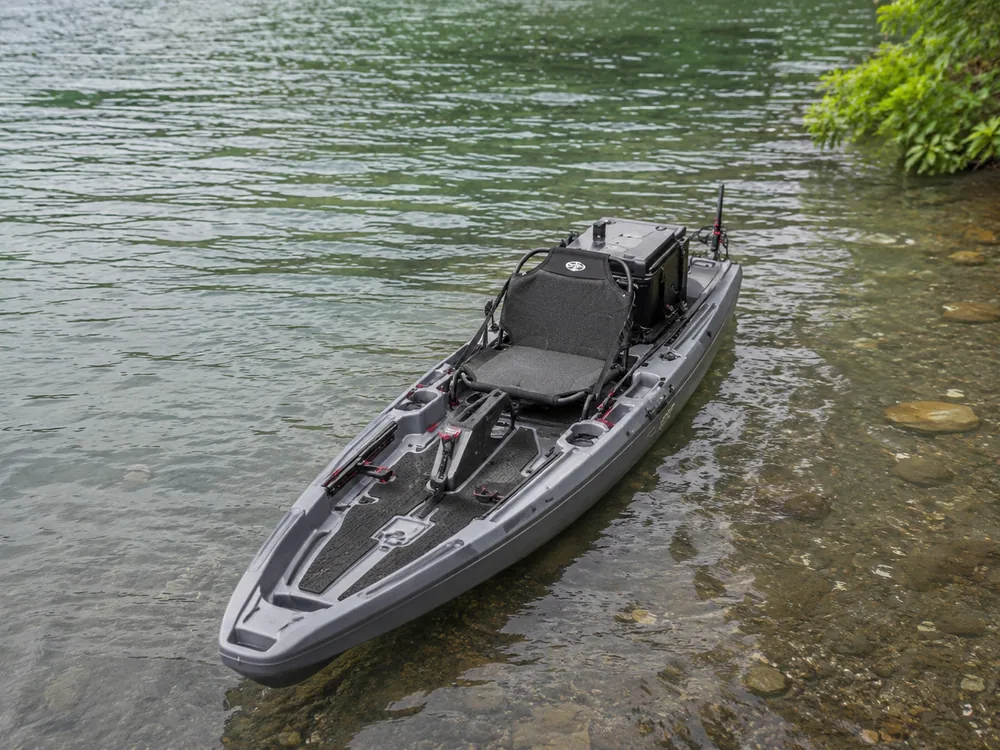
A rigged fishing kayak floating in clear shallow water beside a green shoreline
A protected launch in ankle-deep water. This is the entry these boats are built for, not a beach with a shorebreak.

An offshore-capable motorized kayak is not automatically a good surf-launch kayak. That distinction separates a useful buying decision from a dangerous one.

A 158 lb hull with a bow motor and a 30 lb battery can be an excellent open-water platform launched at a ramp, marina or protected inlet. The same rig in breaking surf is a different problem: you cannot sprint it through a set, the motor and mount take sand and impact, a broach puts real mass on top of you, and re-entry after a capsize is harder with the extra weight.

Beach-launch anglers are better served by lighter boats. If you launch through waves routinely, none of the heavy integrated systems below is the right buy, and our guide to pedal kayaks built for surf launches covers that intent properly.

The seven in detail

Old Town Sportsman AutoPilot 136 — Best Overall

Old Town Sportsman kayak in orange and black on a white background, seat, gear tracks and a transom-mounted Minn Kota motor visible

The AutoPilot 136 wins because it is the most complete factory saltwater system here: a saltwater-ready motor, real GPS position holding, and the largest published usable capacity of the seven. It suits anglers fishing structure in bays, estuaries and tidal rivers who can launch from a ramp or marina. Its weight is not a footnote, it is the central compromise.

Classification. Factory motor included, battery sold separately, GPS trolling-motor system.

Old Town Sportsman AutoPilot 136 published specifications
Dimensions13 ft 6 in × 37 in
PropulsionIntegrated bow GPS trolling motor, 45 lb thrust 12V Minn Kota
Motor includedYes
Battery includedNo (Group 27 or smaller)
GPS position holdYes, i-Pilot / Spot-Lock
Published weight158 lb assembled
Capacity, in the maker’s own terms502 lb usable / 660 lb total
Price, 24 August 2026$4,999.99

Motor and propulsion system

Old Town specifies a 45 lb thrust 12V Minn Kota motor with lift-assist, controlled through i-Pilot with Spot-Lock. That changes how you fish rather than how fast you travel. Spot-Lock holds the boat over a piling, a rock pile or the down-current edge of an oyster bar while you re-rig, unhook a fish, or make the same cast eight times. A 12V, 45 lb thrust system is built for that control, not for covering distance at speed.

Payload, water and drawbacks

That 502 lb usable figure carries a large angler, a Group 27 lithium battery, live sonar and a full tackle load without crowding the limit. Fish it in bays, estuaries, tidal rivers and protected open water reached from a ramp, marina or inlet.

At 158 lb assembled with no battery aboard, this is a trailer or heavy-duty-cart boat, not a roof-rack kayak. The battery is an extra purchase on top of the $4,999.99 MSRP, and 12V propulsion prioritises fishing control over travel speed.

Best for. Structure-focused inshore and protected open-water anglers who want position holding out of the box.

Skip it if. You launch off a beach, have no trailer, or mostly want to cover miles quickly.

Check Price on Amazon

Old Town Sportsman BigWater ePDL+ 132 — Best for Offshore and Open-Water Travel

Old Town Sportsman BigWater ePDL+ in orange and black on a white background with the ePDL+ badge and the pedal drive unit below the hull

The BigWater ePDL+ 132 earns the open-water award for one reason: propulsion redundancy. It suits anglers who travel distance from protected launches and want a mechanical fallback that does not depend on a charge state. It gives up GPS anchoring to get there.

Classification. Pedal-electric hybrid drive included, 36V 20Ah lithium battery and charger included, no GPS position hold.

Old Town Sportsman BigWater ePDL+ 132 published specifications
Dimensions13 ft 2 in × 36 in
PropulsionPedal-electric hybrid: manual, assist, full electric
Motor includedDrive included
Battery includedYes, 36V 20Ah lithium and charger
GPS position holdNo
Published weight143 lb assembled
Capacity, in the maker’s own terms357 lb usable / 500 lb total
Price, 24 August 2026$5,499.99

Why redundancy changes the risk maths

The ePDL+ drive runs three ways: manual pedalling, powered assist, and full electric propulsion with five speed settings and cruise control. If the battery dies two miles from the inlet, your legs still move the boat. On a prop-driven kayak you are paddling a 180 lb rig against wind and current. This is not better offshore because it has a motor. It is better offshore because it works when the motor does not.

Battery and manufacturer runtime

Old Town includes a 36V 20Ah lithium-ion battery, listed at 8.5 lb, and a charger, and publishes runtimes of 46 hours at Cruise 1, 23 hours at Cruise 3 and 3 hours at Cruise 5, based on a fully charged battery on flat water with a moderate load. Those are manufacturer figures under stated conditions, not field range, and the drop from 23 hours to 3 hours shows how steep the penalty for speed is.

Payload and launch type

That 357 lb usable figure is the tightest of the three Old Town boats, so a heavy angler running live sonar and a cooler should do the maths first. Launch from ramps, marinas and inlets: open-water capable does not mean surf-friendly, and 143 lb of boat plus a drive does not belong in a shorebreak.

Best for. Anglers crossing bays and fishing nearshore water from protected launches who want a mechanical backup.

Skip it if. Holding position on small targets is your priority. Buy an AutoPilot instead.

Check Price on Amazon

Old Town Sportsman AutoPilot 120 — Best Inshore GPS Pick

Old Town Sportsman 120 in orange and black on a white background with a Minn Kota motor and a rigged deck

The AutoPilot 120 puts the same GPS-controlled system in a shorter, more manoeuvrable hull, which makes it the better AutoPilot for creeks, flats and tight structure. It is smaller. It is not light.

Classification. Factory motor included, battery sold separately, GPS trolling-motor system.

Old Town Sportsman AutoPilot 120 published specifications
Dimensions12 ft × 37 in
PropulsionIntegrated bow GPS trolling motor, 45 lb thrust 12V Minn Kota
Motor includedYes
Battery includedNo (Group 27 or smaller)
GPS position holdYes, i-Pilot / Spot-Lock
Published weight152 lb assembled
Capacity, in the maker’s own terms406 lb usable / 558 lb total
Price, 24 August 2026$4,499.99

Where the shorter hull earns its place

The 12 ft hull turns and holds a line in narrow tidal creeks better than the 136, and around pilings, dock lines and creek mouths Spot-Lock does what an anchor cannot: it holds you off the structure in current with no rope to snag or retrieve. The motor is the same 45 lb thrust 12V saltwater-ready Minn Kota, and the pre-wired battery box is sized for a Group 27 or smaller 12V lithium, SLA or AGM battery.

Read the weight honestly

The 120 saves 6 lb over the 136 and gives up 96 lb of usable capacity. Choosing it for easier handling buys a shorter boat, not a lighter one.

Best for. Flats, marsh creeks, docks and bridge fishing where position holding beats range.

Skip it if. You need payload for a big angler plus heavy electronics, or you regularly run open water.

Check Price on Amazon

Bonafide PWR129 — Best Custom Motor-Ready Platform

Bonafide kayak in grey camo on a white background showing an open deck, tracks and mounting points with no motor fitted

The PWR129 is for anglers who want to engineer the propulsion system rather than accept a factory one. Bonafide sells the hull; the motor, battery, charger and wiring are yours to specify. Judge it on build cost, not sticker price.

Classification. Motor-ready, motor sold separately, battery sold separately, bow-motor and stern-motor compatible.

Bonafide PWR129 published specifications
Dimensions12 ft 9 in × 35 in, 16 in depth
PropulsionMotor-ready, bow and stern capable
Motor includedNo
Battery includedNo
GPS position holdDepends on the motor you buy
Published weight78 lb hull / 102 lb fitted rigged
Capacity, in the maker’s own terms500 lb max capacity
Price, 24 August 2026$2,049 ($2,199 with the PRO seat)

Factory wiring is the real argument

Bonafide publishes bow and stern motorisation points and plug-and-play wiring through five Power Link ports. Mount points and pre-run power at both ends mean fewer holes drilled in a hull that lives in salt, and every hole you do not drill is a leak and a corrosion site you never have to service.

Price it honestly

A $2,049 hull plus a saltwater GPS trolling motor, lithium battery, charger and connectors lands in AutoPilot territory and often above it. What the money buys is control over thrust, voltage, placement and upgrade path. Motor selection is covered in our marine electronics category.

Best for. Anglers who know exactly what motor, voltage and layout they want.

Skip it if. You want to buy one box and go fishing this weekend.

Check Price on Amazon

Wilderness Systems Tactical Pro 128 — Best High-Capacity Power Rig

Wilderness Systems kayak in blue and black on a white background with a wide padded standing deck and factory tracks

The Tactical Pro 128 is the platform for heavy loads: a large angler, multiple batteries, live sonar and a serious rigging footprint. Its published 800 lb maximum capacity is the headline, and also the number most likely to be misread.

Classification. Motor-ready, motor sold separately, battery sold separately, bow and stern motor mounts included.

Wilderness Systems Tactical Pro 128 published specifications
Dimensions152 in (12 ft 8 in) × 38 in, 18.3 in depth
PropulsionMotor-ready, bow and stern mounts
Motor includedNo
Battery includedNo
GPS position holdDepends on the motor you buy
Published weight158 lb
Capacity, in the maker’s own terms800 lb max capacity
Price, 24 August 2026$2,759

The rigging justifies the award

Wilderness Systems lists bow and stern motor mounts, factory-rigged wiring, marine-grade power plates and internal battery storage. Moulded internal battery storage placed for balanced trim matters more than raw capacity on a boat carrying two batteries, a live-sonar head unit and a transducer pole, and 38 in of beam with bow pontoons gives a working platform for anglers who stand to cast.

A high capacity number does not prove seaworthiness

Capacity describes how much mass the hull floats, not how it behaves in a beam sea or a 20-knot crosswind on a high-sided boat. Wilderness Systems also publishes one maximum capacity rather than splitting total from usable, so it will not compare directly with Old Town’s usable figures.

Best for. Heavy anglers and electronics-heavy builds, including the live-sonar and power gear in our Fish Finders and Marine Electronics category.

Skip it if. You want a turnkey motor, or you have to load 158 lb of bare hull alone.

Check Price on Amazon

Kaku Zulu X3 — Best Multi-Propulsion Coastal Platform

Kaku kayak in olive green on a white background with a raised framed seat and a flat open deck

The Zulu X3 is the most configurable boat here: paddle, fin pedal drive, prop pedal drive, bow motor and stern motor all fit the same hull. It suits coastal anglers who fish genuinely different water week to week, and every propulsion mode is a separate line item.

Classification. Motor-ready, motor sold separately, battery sold separately, paddle and pedal capable, bow-motor and stern-motor compatible.

Kaku Zulu X3 published specifications
Dimensions12.7 ft × 36 in
PropulsionPaddle, fin or prop pedal drive, bow or stern motor
Motor includedNo
Battery includedNo
GPS position holdDepends on the motor you buy
Published weight105 lb hull
Capacity, in the maker’s own terms550 lb capacity
Price, 24 August 2026From $1,899 ($2,599 fin drive, $2,699 prop drive)

Modularity is the point

Run the fin drive over grass where a prop fouls, swap to a stern motor for a bay crossing, paddle the backcountry where neither belongs. Kaku lists a moulded under-seat battery compartment sized to hold multiple batteries for a motor, sonar and lighting.

The boat you priced is not the boat you will fish

Pricing starts at $1,899 for the base hull, $2,599 with the fin pedal drive and $2,699 with the prop pedal drive, before a motor or a battery. Budget the configuration you actually intend to fish.

Best for. Coastal anglers who fish flats, creeks and bays and refuse to commit to one drive.

Skip it if. You want GPS position holding without assembling the system yourself.

Check Price on Amazon

FluxJet — Best Shallow-Water Motor Innovation

FluxJet kayak in camouflage on a white background, the enclosed jet-drive intake moulded into the bow in place of a propeller

The FluxJet is the only pick here with no exposed propeller, a real advantage over grass, oyster and sand. Its motor is included at a lower price than the factory Old Towns. It is also the newest platform on this list, with the least independent long-term saltwater history.

Classification. Integrated jet propulsion, motor included, battery sold separately.

FluxJet published specifications
Dimensions132 in (11 ft) × 35 in
PropulsionIntegrated electric jet drive, no exposed prop
Motor includedYes
Battery includedNo (Group 31 box, 36V recommended)
GPS position holdNo
Published weight88 lb bare / 112 lb fitted / 122 lb rigged
Capacity, in the maker’s own terms400 lb including battery, angler and gear
Price, 24 August 2026$3,499

Why an enclosed jet matters on a flat

An enclosed jet has no blades to strike an oyster bar and nothing for seagrass to wrap, which removes the two failure modes that end a prop kayak’s day on the flats. The tradeoff is the tightest payload here and a shorter, lighter hull that is not built for inlets or open water.

Battery and saltwater care

The battery is not included: the Group 31 box measures 14 in by 6.8 in by 9.8 in, the system accepts 12V to 60V, and the manufacturer recommends 36V. FluxJet states the platform is fully rated for saltwater, uses ceramic bearings in the jet drive rather than steel, and instructs owners to give the hull and jet drive a thorough freshwater rinse after every coastal trip.

Treat the durability claims as manufacturer claims

Ceramic bearings and a saltwater rating are engineering decisions, not proof of multi-season service life in salt, which established platforms have accumulated and this one has not yet.

Best for. Skinny-water anglers over grass, oysters and sand who want power without a prop.

Skip it if. You fish inlets or nearshore water, or you need payload for a big angler plus heavy gear.

Check Price on Amazon

Which kayak suits your water

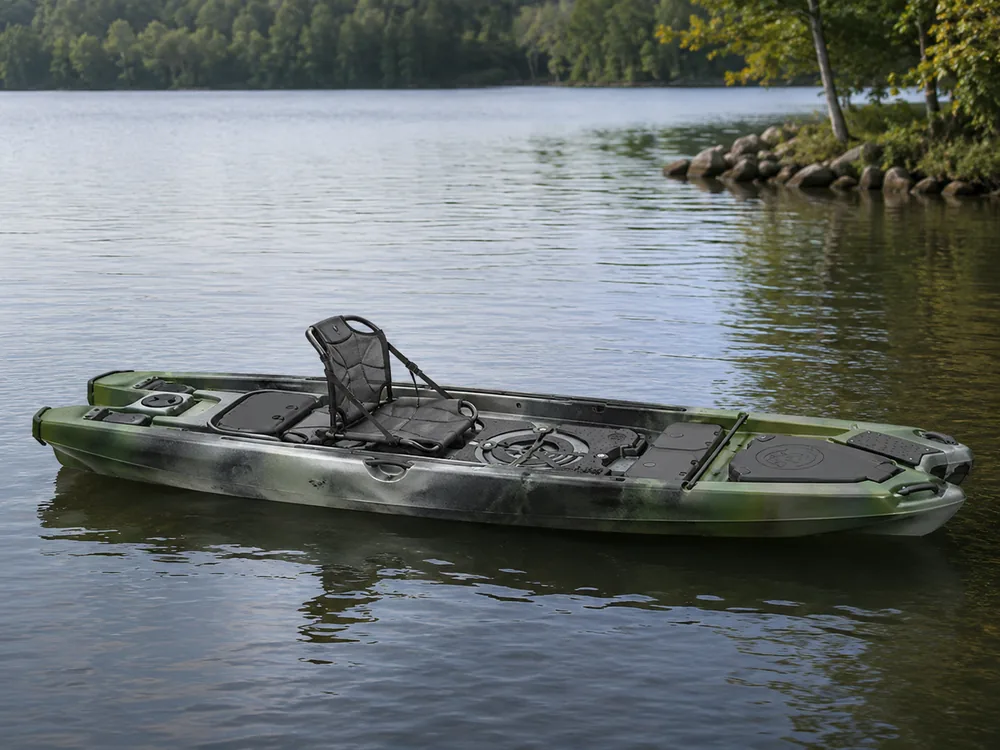
A camouflage fishing kayak with a flat open deck sitting on calm open water beside a wooded shoreline
Hull length, beam and freeboard decide where a kayak is comfortable long before the motor does.
Suitability by water type
KayakMarsh and creeksFlats BaysTidal riversInlets Protected offshoreDirect surf launch
AutoPilot 136GoodGoodExcellentExcellentVery GoodVery GoodNot Ideal
BigWater ePDL+ 132GoodGoodVery GoodVery GoodVery GoodExcellentNot Ideal
AutoPilot 120Very GoodVery GoodExcellentExcellentGoodGoodNot Ideal
Bonafide PWR129Very GoodVery GoodVery GoodVery GoodGoodGoodLimited
Tactical Pro 128GoodGoodVery GoodVery GoodGoodGoodNot Ideal
Kaku Zulu X3Very GoodVery GoodVery GoodVery GoodGoodGoodLimited
FluxJetExcellentExcellentVery GoodVery GoodLimitedLimitedNot Ideal

These ratings reflect hull dimensions, propulsion architecture, weight and published capacity. Sea state, wind, tidal stage, your load, your launch and your own skill can move any boat a column either way, and motor-ready hulls shift with the system you build on them.
Factory motor, motor-ready, hybrid or jet

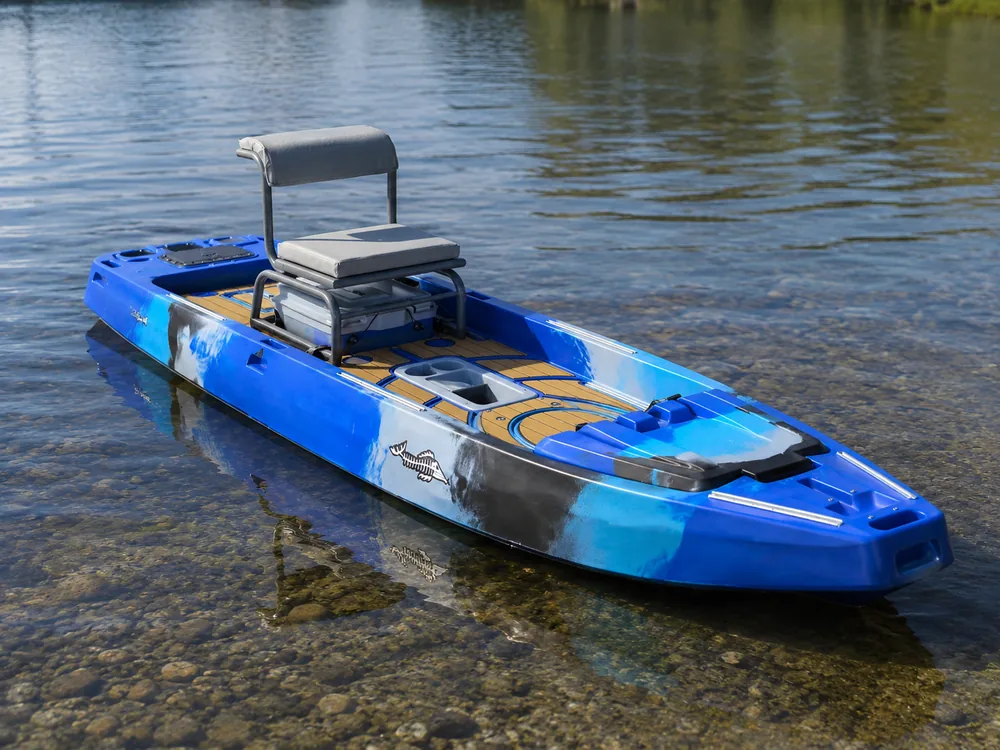
A blue fishing kayak in shallow clear water fitted with a raised pedestal seat and a teak-look deck
Four propulsion architectures, four different boats. What you mount decides the deck you end up standing on.
Propulsion architecture comparison
Propulsion architectureMain advantage Main disadvantageBest for
Integrated GPS trolling motorPosition hold and heading control out of the boxHeaviest and most expensive complete systemStructure fishing in wind and current
Motor-ready custom platformYou choose thrust, voltage, placement and upgrade pathSetup complexity, and a build cost the hull price hidesAnglers who know their power requirements
Pedal-electric hybridRedundancy that does not depend on charge statePremium price, no GPS anchoringDistance travel and open water
Integrated jet propulsionNo exposed prop to strike or foulNewer ecosystem, tighter payloadGrass, oyster and skinny water

The decision underneath the table is which single capability you are actually buying. Position control, efficient travel, configuration freedom and shallow-water protection are four different purchases, and no kayak here leads in all four.
Is Spot-Lock worth it on a saltwater fishing kayak?

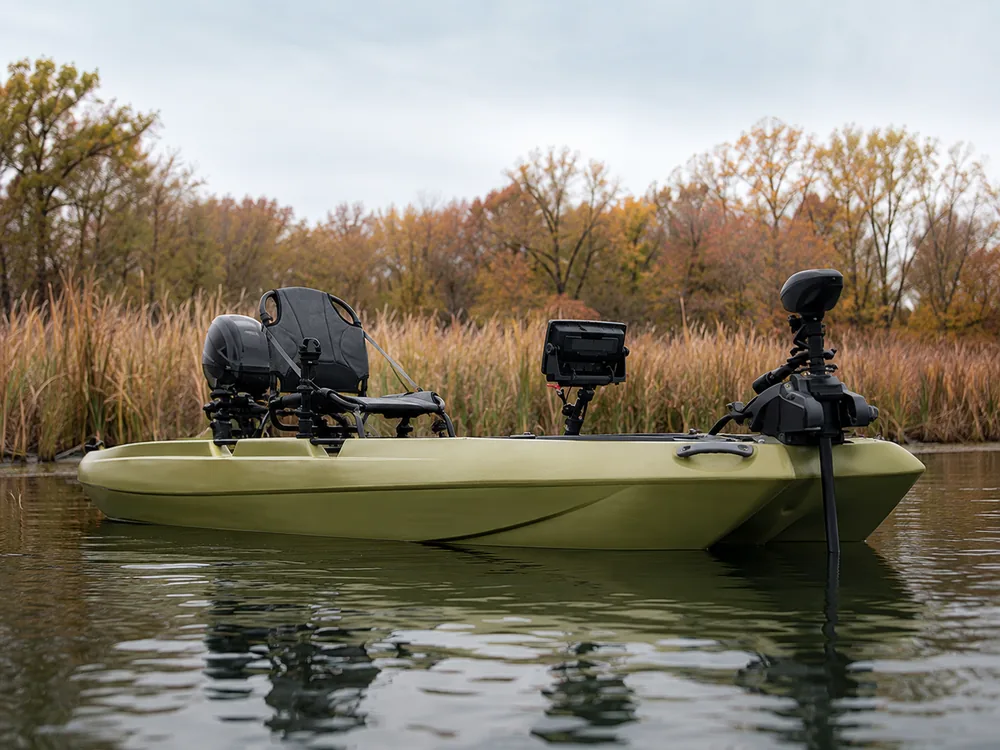
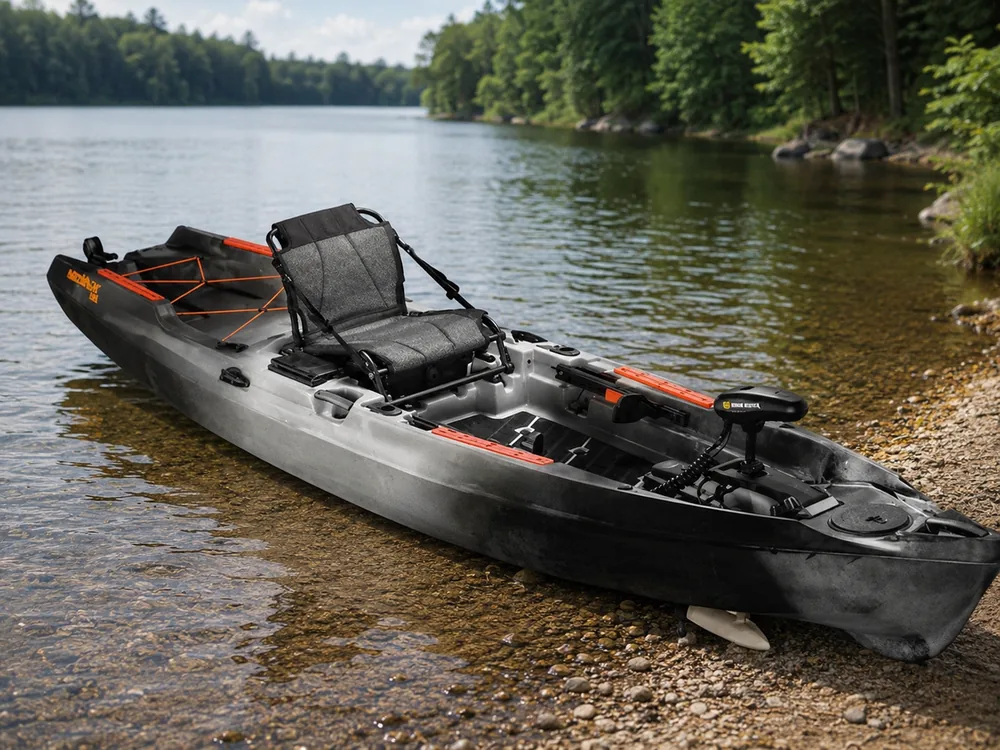
Side view of an olive fishing kayak on the water with a bow-mounted trolling motor and a fish finder screen on a track mount
A bow motor and a screen. This is the layout that holds a position over structure instead of drifting off it.

Spot-Lock is worth it if you fish small fixed targets in moving water, and worth little if your priority is covering distance. GPS position holding uses the motor to keep the boat on a saved point, correcting for wind and current automatically.

That matters at a bridge piling on a running tide, at a creek mouth on the last of the fall, on the down-current edge of a reef or wreck, along a channel drop, and in the wind-against-current situations no one holds by hand. It also earns its keep re-tying a leader, landing a fish, or repositioning a rod without losing the spot you just found.

It is less valuable if you mostly run from launch to spot and back, if you fish shallow flats where a stakeout pole is faster and quieter, or if your day is built around drifting. It is not an emergency anchoring system and it is not a substitute for a real anchor in conditions where a motor should not be relied on.
Check Price on Amazon

How much battery does a motorized fishing kayak need?

A black and grey fishing kayak on a lake shore with a stern-mounted trolling motor and its coiled power lead running into the hull
The coiled lead running back into the hull is the part worth planning. Voltage first, then watt-hours, then a reserve.

Battery size depends on the motor’s voltage, its current draw at the speeds you actually run, the runtime you need and the reserve you keep. Amp-hours alone will mislead you across different systems.

Nominal watt-hours = volts × amp-hours

A 12V 100Ah battery is 1,200 Wh. A 36V 20Ah battery is 720 Wh. The 100Ah figure looks five times larger, but the energy difference is under two to one, and those packs feed motors with entirely different draw characteristics. Compare watt-hours whenever voltages differ.

Then account for what drains the pack in practice:

  1. Throttle setting. Draw climbs steeply with speed: Old Town’s ePDL+ figures fall from 23 hours at Cruise 3 to 3 hours at Cruise 5 under identical conditions.
  2. Current and wind. Pushing into a tide or headwind raises draw for the same speed over ground.
  3. Payload. A more deeply loaded hull costs energy on every mile.
  4. Repeated acceleration. Stop-and-go structure fishing draws more than steady cruising.
  5. Electronics. Sonar, live sonar and lights pull from the same supply on many builds.
  6. Chemistry and temperature. Usable capacity varies with battery type and conditions.

Keep a reserve and plan the day assuming you will not spend the full theoretical capacity. No universal percentage is defensible, so set yours by how far out you go and how survivable the paddle home is. Battery and power options sit in our marine electronics category.
How much usable payload do you really have?

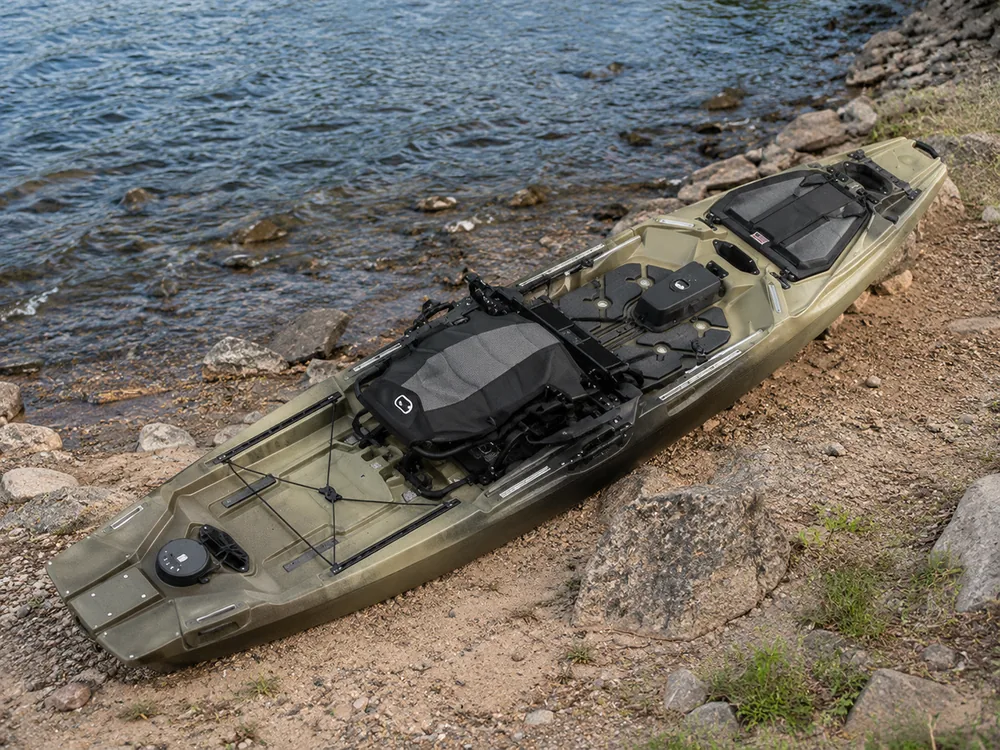
Overhead view of an olive fishing kayak on a rocky shore showing the full deck, seat, tracks and hatches
Everything in this frame counts against the payload figure, and so does the angler who is not in it yet.

Manufacturers do not define capacity the same way, and reading one brand’s number against another’s is the most common mistake in this category.

  • Total capacity: everything the hull floats, including the boat itself in some brands’ terms.
  • Usable capacity: what you may load on top of the assembled boat.
  • Self-bailing capacity: the load below which scuppers still drain.
  • Hull weight: bare plastic, no seat or drive.
  • Assembled weight: hull plus seat, hardware and factory drive or motor.
  • Fully rigged launch weight: assembled weight plus battery, electronics and everything you carry.

Old Town publishes both figures, and the relationship is consistent: assembled weight plus usable capacity equals total capacity. The AutoPilot 136 is 158 lb plus 502 lb for 660 lb. The AutoPilot 120 is 152 plus 406 for 558. The BigWater ePDL+ 132 is 143 plus 357 for 500. That makes a valid subtraction possible.

Available fishing load = usable capacity − battery − angler − electronics − tackle − safety gear

Using 30 lb as a planning figure for a Group 27 12V lithium, the AutoPilot 136 leaves roughly 472 lb for the angler and everything else, and the AutoPilot 120 roughly 376 lb. The BigWater ePDL+ 132, with its 8.5 lb pack, leaves about 348 lb, so a 250 lb angler in wet gear has around 98 lb for electronics, tackle, water, a cooler and safety equipment. Workable, not unlimited.

Bonafide, Wilderness Systems and Kaku publish a single maximum capacity without stating whether the hull sits inside or outside it, so that subtraction is not valid on those boats. FluxJet’s 400 lb figure already includes battery, angler and gear, making it a payload allowance rather than a gross number. Confirm the definition before planning a build around it.
What your motorized kayak actually weighs at the ramp

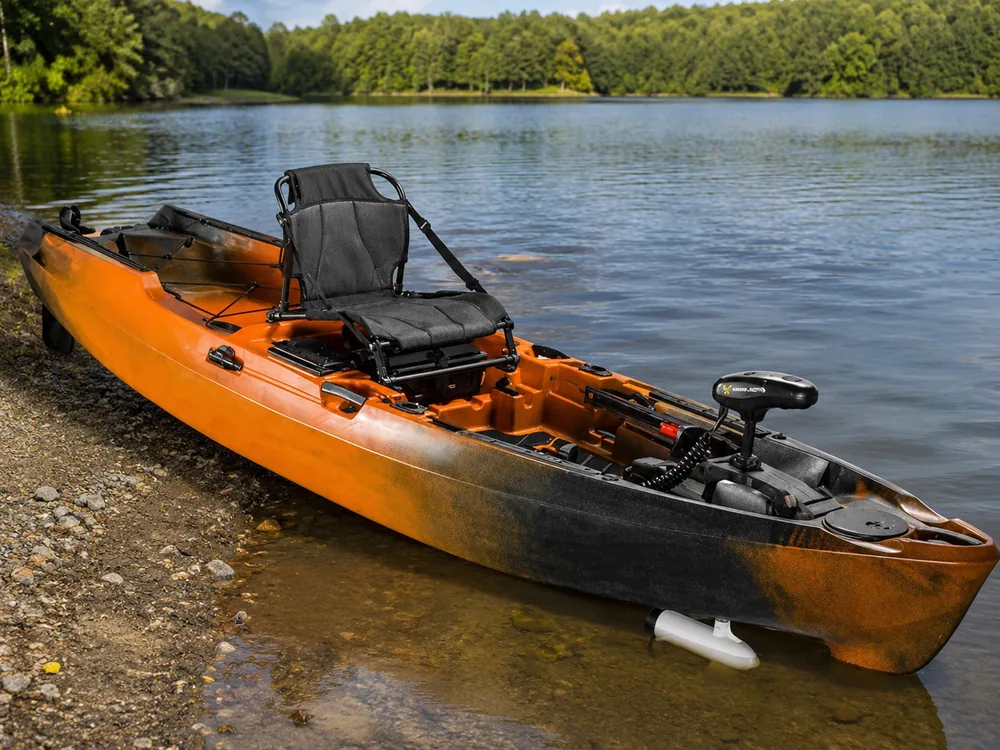
An orange and black fishing kayak resting on a gravel shore with a stern-mounted trolling motor fitted
The moment that decides which of these you can actually own: the boat, loaded, between the vehicle and the water.

The number that governs your transport is not hull weight. It is kayak plus seat plus drive or motor plus battery plus electronics plus rods, tackle and safety gear.

Rigged weight at the ramp
ModelPublished weightBattery Weight before rods, tackle and safety gear
AutoPilot 136158 lb assembled, motor includedGroup 27, not suppliedAbout 188 lb with a 30 lb lithium
AutoPilot 120152 lb assembled, motor includedGroup 27, not suppliedAbout 182 lb with a 30 lb lithium
BigWater ePDL+ 132143 lb assembled, drive included8.5 lb 36V pack includedAbout 152 lb
Bonafide PWR129102 lb fitted riggedYours to buy102 lb plus your entire power system
Tactical Pro 128158 lbYours to buy158 lb plus your entire power system
Kaku Zulu X3105 lb hullYours to buy105 lb plus drive, motor and battery
FluxJet122 lb rigged, motor includedGroup 31 box, 36V recommended122 lb plus your battery

Battery weights other than the ePDL+ pack are planning assumptions, not manufacturer specifications, and vary by brand and chemistry.

Those totals decide real things. Roof loading a 180 lb rig alone is not practical for most anglers, which pushes you toward a truck bed, a trailer, or a heavy-duty cart with wide wheels for soft sand. If you fish alone, solve vehicle-to-water before you choose a model: that constraint eliminates more candidates than anything on the spec sheet.

How to protect a motorized kayak from saltwater corrosion

Salt attacks the electrical system before it attacks the hull. Follow the manufacturer’s published maintenance instructions for your boat and motor first, since procedures differ by design. FluxJet, for example, directs owners to give the hull and jet drive a thorough freshwater rinse after every coastal trip.

A working post-trip routine:

  • Rinse hull, drive or motor and mounting hardware with fresh water before anything dries.
  • Flush the prop or jet intake, clear grass, line and shell, and check the shaft or housing for line wrap every trip.
  • Wipe and dry battery terminals, checking for white or green deposits.
  • Disconnect, inspect and dry quick-disconnect plugs and exposed connectors.
  • Check wiring where it passes through the hull or flexes at the mount.
  • Inspect stainless fasteners and mounting bolts for staining and looseness.
  • Open the battery compartment, drain standing water and let it air dry.
  • Cycle the steering and lift-assist mechanism through full travel while rinsing.
  • Recharge on the manufacturer’s schedule rather than storing at a low state of charge.

Connectors and terminals are where most saltwater failures start, and they are the cheapest parts to protect.

Safety and legal considerations for powered fishing kayaks

PFD. U.S. recreational vessel requirements include a Coast Guard approved wearable life jacket for each person aboard. On a powered kayak in open water, wearing it is the only version of that rule that helps you.

Navigation lights. A kayak under mechanical propulsion is treated as a power-driven vessel for navigation-light purposes, a different standard from the all-round white light a paddler shows. If you run before sunrise, after sunset or in restricted visibility, confirm what your rig must display.

Registration. Adding a motor can change how your kayak is classified. Requirements vary by state and jurisdiction and there is no single national rule, so check with your state boating agency before launching a newly motorized kayak.

Offshore backup. Carry a paddle regardless of propulsion, keep pedal capability where the platform offers it, and plan a battery reserve rather than a full discharge. Carry communication you can reach while swimming. File a float plan, and check the NOAA marine forecast, tides and nearby buoy observations before committing to a crossing. Safety and handling gear sits in our Tools and Accessories category.

No wind speed or wave height is universally safe

The threshold depends on your boat, load, launch, water temperature, current and experience, and a motor does not compensate for conditions the hull cannot handle.

How to choose the right motorized saltwater fishing kayak

  1. Where will you launch? Beach and surf rule out every heavy integrated system here. Ramps, marinas and inlets open all of them.
  2. Spot-Lock or efficient travel? Position holding points to an AutoPilot. Distance and redundancy point to the BigWater ePDL+ 132.
  3. What will the rigged kayak weigh? Add motor, battery and gear to the published weight, then decide whether you can move that number alone.
  4. How much payload remains? Subtract your weight and your battery from the manufacturer’s own payload figure, using that brand’s definition.
  5. Turnkey or custom? Buy an AutoPilot or a FluxJet to fish this weekend. Buy a PWR129, Tactical Pro 128 or Zulu X3 to specify the system yourself.

If the answers pull you away from motors, pedal platforms built for surf launching cover the alternatives, and the complete saltwater kayak setup guide puts a whole build in order. Electronics-first buyers should start in Fish Finders and Marine Electronics.

Check Price on Amazon

Frequently asked questions

The Old Town Sportsman AutoPilot 136, combining a saltwater-ready 45 lb thrust 12V Minn Kota motor, i-Pilot Spot-Lock position holding and 502 lb of published usable capacity.

Anglers who value propulsion redundancy and open-water travel over position holding should choose the BigWater ePDL+ 132 instead.

Yes, from an appropriate launch and in appropriate conditions. Offshore use asks for a hull suited to open water, a backup means of propulsion, a real battery reserve, communication gear and a checked marine forecast.

Heavy powered kayaks belong at ramps, marinas and protected inlets rather than in breaking surf.

It is worth it if you fish structure in wind or tidal current. Holding over a piling, creek mouth, reef edge or channel drop without correcting drift changes how many good casts you get on a spot.

It matters less for anglers whose priority is covering distance or drifting flats.

Match the motor’s voltage first, then size by watt-hours rather than amp-hours: volts multiplied by amp-hours gives nominal watt-hours.

Factor in the motor’s draw at realistic throttle settings, wind and current, your electronics load, and a reserve you do not plan to spend.

There is no fixed figure. Range depends on battery capacity, motor draw, speed, load, wind, current and chop.

Manufacturer runtime numbers, such as Old Town’s ePDL+ figures, come from stated test conditions on flat water and should be treated as a ceiling rather than a plan.

Sometimes. Adding a motor can change a kayak’s legal classification, and registration or numbering requirements vary by state and jurisdiction.

Confirm current rules with your state boating agency before launching, since requirements can also differ by motor type.

It is a poor fit for the heavy integrated systems here. A 150 lb hull plus motor and battery is hard to control through breaking waves, exposes drive components to sand and impact, and makes re-entry after a capsize harder.

Lighter pedal or paddle platforms are the better surf-launch tools.

Final verdict

The AutoPilot 136 is the broadest correct answer for saltwater anglers: the most complete factory system here, with GPS position holding that changes how you fish structure and the largest usable payload of the seven. Accept the transport burden that comes with 158 lb before a battery, or choose something else.

Take the BigWater ePDL+ 132 when distance and redundancy outrank position holding, because a drive you can pedal home is worth more than a feature list on a long day in open water. Take the AutoPilot 120 when you fish tight tidal structure and want the same GPS control in a shorter hull, understanding that it is smaller rather than lighter.

The motor-ready platforms serve a different buyer. The PWR129, Tactical Pro 128 and Zulu X3 reward anglers who know what thrust, voltage and placement they want and would rather build the system than inherit one. Price them as complete builds, motor and battery and charger and wiring included, before comparing them with anything factory-powered.

Check Price on Amazon

Larry Murray, Editor, ReefReadyGear

Larry Murray

Editor, ReefReadyGear

Larry edits ReefReadyGear, a research-led saltwater gear publication. Recommendations here are built from manufacturer specifications, authorised retailer listings and published angler experience, and we say so plainly rather than implying a testing programme we do not run. Where a claim comes from a manufacturer, we attribute it. Where we have not verified something, we do not print it.

Sources

Join The ReefReady Community

Get saltwater Fishing Guides, expert Buyers Guides, equipment recommendations, marine electronics insights, and practical gear tips delivered to your inbox.

No spam. Unsubscribe in one click.

*