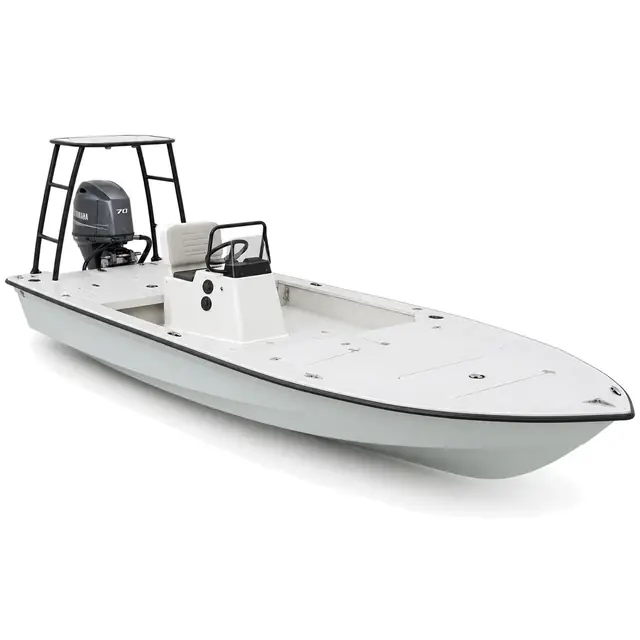
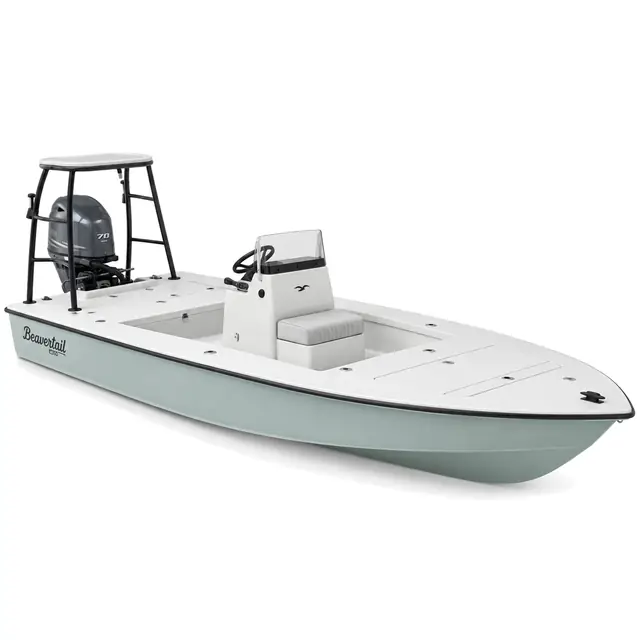
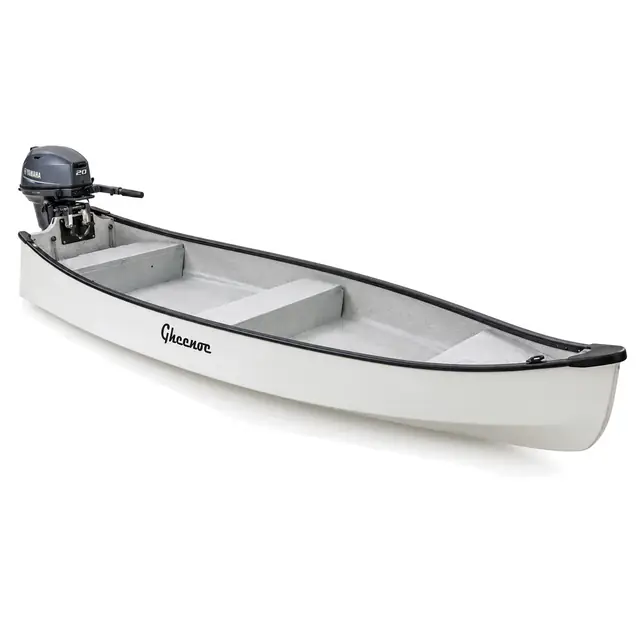
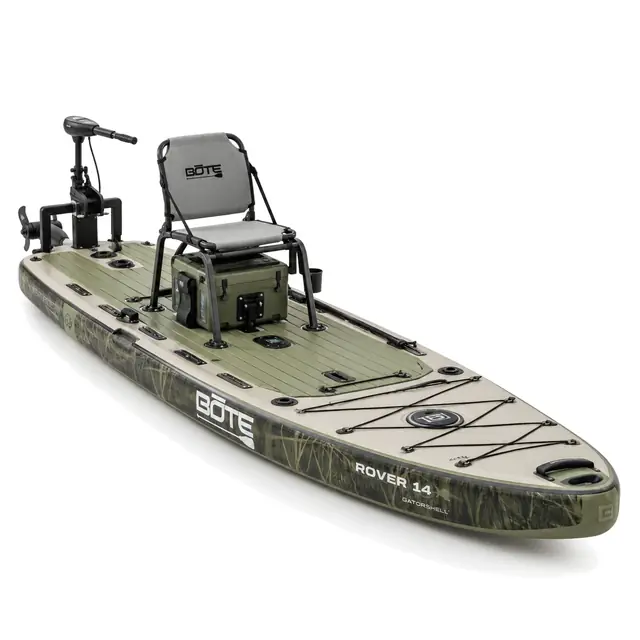
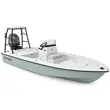
The micro skiffs reviewed below: Salt Marsh SM1444, Beavertail Micro, Gheenoe Classic 15’6″ and BOTE Rover 14. Manufacturer product photography.
Best Micro Skiffs for Two Anglers: Draft After Load, Not the Brochure Number
There’s a specific moment that decides whether a micro skiff purchase works out: the moment the second angler steps aboard and the hull settles noticeably lower than it did at the dealer’s dock, on a…
By Larry MurrayUpdated 6 September 202623 min readBuyer’s Guide
The quick answer
A published micro skiff draft figure describes a bare hull with nothing aboard. Add a second angler, an outboard, fuel and a day’s gear to a boat that weighs 300 lb dry and you can more than double its weight, which is the arithmetic that decides whether you reach the flat you came for.
Best overall for two anglers: Salt Marsh SM1444. Verified waterline beam, an honest 20 hp ceiling, and enough builder transparency to run a real loaded draft estimate.
Best for the skinniest water with two aboard: still the SM1444. Its 44 inch waterline beam relative to its 300 pound dry weight gives the best displacement-to-load ratio in this shortlist.
Best budget entry: Gheenoe Classic 15’6″, with the honest caveat that its narrow beam makes it a marginal two-caster boat rather than a comfortable one.
Affiliate disclosure. This is a lead generation and research guide, not an affiliate roundup. Micro skiffs are sold direct through builders and dealers, and ReefReadyGear does not earn a commission on a boat sale. Where this article recommends rigging, safety, or accessory products for a new skiff owner, that content may carry affiliate links, which are marked clearly. Specifications verified September 2026 from builder pages and the sources listed at the end of this article.
Draft after load, not draft on paper
Every draft figure on this page is stated against a defined load, following the convention that a draft number means nothing without the weight it was measured at. Our two-angler load standard is an editorial model, and the itemised list behind it is published so you can substitute your own numbers.
ReefReadyGear does not run a testing programme, and nothing on this page is presented as a first-hand test result.
Every figure here is drawn from manufacturer and builder documentation, authorised retailer listings and published
angler experience, verified in September 2026 and dated where it matters. Where a number is our calculation rather
than a published figure, we label it and show the method.
A two-angler load standard defined line by line, then applied identically to every hull
Draft reported against that defined load, with builder figures quoted separately and dated
Hulls where the builder publishes no usable draft figure named as such rather than estimated silently
Length, dry weight and horsepower ceilings stated numerically so the category boundary is checkable
Where two authoritative sources disagree, both are quoted and attributed rather than blended, and where a maker
publishes no figure at all we say so instead of estimating quietly.
There’s a specific moment that decides whether a micro skiff purchase works out: the moment the second angler steps aboard and the hull settles noticeably lower than it did at the dealer’s dock, on a boat that was floating on 5 inches of water twenty minutes ago.
Every micro skiff spec sheet publishes a draft figure, and every one describes an empty boat. Salt Marsh lists 5 inches for its SM1444, a 14 foot hull with a 58 inch beam that weighs 300 pounds dry. That’s honest for what it measures, but it doesn’t tell you whether the boat will float two anglers across the flat you actually fish. Put two 190 pound anglers, a 20 horsepower outboard, a battery, full fuel, a cooler, and two days of tackle into that hull, and you’ve added something in the neighborhood of 700 pounds, well over twice the boat’s own weight. The waterline moves. How far is the question this guide answers.
This is a use case guide, not a model showcase. It builds a defined two-angler load standard, borrowed from a convention the bay boat press already uses and the micro skiff category never has, applies it to a shortlist of real hulls, and says plainly which boats fish two people and which only look like they do.
What counts as a micro skiff in this guide
Four boat articles on this site cover adjacent hull sizes, and without a stated boundary they’ll blur into each other. Here is this article’s line, stated numerically.
A micro skiff, for this guide, is 17 feet or less overall, weighs under about 450 pounds dry, and carries a builder maximum horsepower rating of 30 hp or less.
That catches the Salt Marsh SM1444 at 14 feet and 300 pounds, the Beavertail Micro at 16 feet 8 inches and 400 pounds, and the lighter hulls below both. Ankona’s Native SUV 17 sits right at the length ceiling, a fair example of a hull straddling the line between a micro skiff and the technical poling skiffs covered in our shallow water and choppy bay skiff guide. Above 17 feet or 30 hp, you’re shopping a different category, and that guide is where to go.
Below this category sits the kayak. If you’re here because two kayaks stopped working for your fishing, our tandem pedal kayak guide and the usable payload math from our big-angler kayak guide are the honest starting point before you spend skiff money.
Can two people really fish one?
Yes, and the constraint that stops most pairs is draft, not capacity. A micro skiff weighing 300 to 400 pounds dry adds a second body, an outboard, fuel, and gear that together can exceed the boat’s own weight. The published draft figure describes none of that. Capacity, how much weight the hull can carry before it stops floating properly, is rarely the binding limit for two people of ordinary weight. Draft after load and deck space for two casters almost always are.
Three separate questions hide inside “can two people fish this,” and spec sheets answer none of them directly.
Payload. Can the hull support two anglers and gear without swamping or losing meaningful freeboard. Usually fine on a properly sized micro skiff.
Draft. How much water does the loaded hull need to float and run. Nobody publishes an answer, and it decides whether you can reach the flat you’re trying to fish.
Deck space. Where do two people stand, cast, and pole without fouling each other’s lines on a 58 inch beam. A layout problem, not a specification, covered further down.
A boat can pass the first test comfortably and still fail the second two. That’s the trap in this category, and why the load standard below exists.
The draft nobody publishes
Three kinds of draft, defined
Static draft is the depth a hull needs to float, sitting still at a stated weight, almost always empty in builder literature. Loaded draft is the depth the same hull needs once anglers, motor, fuel, and gear are aboard, and nobody in this category publishes it. Running draft is how much water the hull needs while moving, usually shallower, and depends heavily on trim, tunnel design, and prop configuration, so no single number captures it. The buyer question is almost always loaded static draft: how deep the boat sits stopped or poling with two people aboard, the figure this section builds.
Why a light hull sinks more per pound than a heavy one
Every hull displaces its own weight in water. Add weight, and it sinks until it displaces that much more. How much it sinks per pound depends on waterplane area, essentially how much flat bottom contacts the water at the surface. A wide, flat hull spreads added weight over more area and sinks less per pound; a narrow or already-light hull sinks more, because it starts with less displacement to begin with.
This is why waterline beam, not the overall beam on the spec sheet, actually predicts load response. Salt Marsh publishes both for the SM1444: 58 inches overall, 44 inches at the waterline. The gap is flare in the topsides, which does nothing for displacement.
Our two-angler load standard
The one honest precedent for this kind of disclosure in the wider boat press comes from HydraSports, which, as reported by Sport Fishing Magazine, states its bay boat draft figures against a defined load: one person, fishing gear, five batteries, 50 gallons of fuel, a shallow water anchor, and a bow-mount trolling motor, engine trimmed up. Micro skiff builders don’t follow that convention. We’re adopting it here, scaled to a two-angler micro skiff.
The ReefReadyGear two-angler load standard:
Item
Weight
Two anglers, 190 lb each
380 lb
Outboard motor, 20 hp four-stroke class
172 lb
Marine battery
30 lb
Full fuel, 6 gallon portable tank
44 lb
Cooler with ice
25 lb
Tackle for two anglers
30 lb
Safety kit: PFDs, handheld VHF, flares, first aid
12 lb
Push pole
8 lb
Anchor, rope, stake-out pole
8 lb
Total added load
709 lb
That’s the load standard we apply to every hull below. It’s editorial, not a manufacturer specification, and we’re publishing it in full so a builder, a forum, or a reader with a lighter or heavier rig can adjust it and check our arithmetic. If your actual load looks different, the method matters more than our specific total.
Our loaded draft estimates, and how we got them
We estimated added draft using a standard small craft displacement approximation: pounds per inch of immersion in salt water is roughly equal to waterline length in feet, times waterline beam in feet, times 5.34. That’s a reasonable approximation for a flat-bottomed skiff near its working waterline, not a precision naval architecture calculation. We show the method because a labeled estimate is useful and an unlabeled one is a fabrication.
Boat
Published static draft
Estimated loaded draft (load standard applied)
Method note
Salt Marsh SM1444
5 in
about 7.5 to 8 in
Calculated from the published 44 in waterline beam. Our most confident estimate here.
Beavertail Micro
5 in
about 7 to 7.5 in
Waterline beam not published; estimated from overall beam, so directional rather than precise.
Gheenoe Classic 15’6″
not published
roughly 6 to 6.5 in
Static draft is an owner report (about 3.5 in empty), so the loaded figure carries two layers of estimation.
BOTE Rover 14 (Gatorshell)
not published
not calculated
Rated to 6 hp, not this standard’s 20 hp motor. Owner reports put loaded running draft around 4 to 6 in with a matched motor.
BOTE Rover Aero 12’6″ (inflatable)
not published
not calculated
Inflatable hulls behave differently near the waterline; treat as lighter-duty and calmer-water rather than a full load carrier.
Two things stand out. Only one hull here publishes the waterline beam our method needs, the same disclosure gap the kayak category has around seat ratings. And every estimate puts loaded draft meaningfully above the brochure number, roughly 2 to 3 inches deeper. On a flat where the difference between running and walking is 2 inches, that’s not a rounding error.
Expert tip: Ask a builder for draft at a stated load, the way HydraSports does for its bay boats. Builders who can answer, rather than repeating the empty-hull figure, are telling you something about how seriously they’ve thought about how the boat actually gets used.
Every hull here floats two to three inches deeper once two anglers and a day’s gear are aboard.
Usable payload for two
Unlike a kayak, a powered micro skiff under 20 feet is not exempt from federal capacity requirements. Kayaks and canoes are specifically excluded under 33 CFR 183.21; a powered skiff is not, and it carries a capacity plate stating a maximum person count under 33 CFR 183 Subpart B.
That person count is a regulatory and seating figure, not a fishing payload figure. The standard formula for boats under 20 feet is length in feet times beam in feet, divided by 15, rounded down. Run that against the SM1444’s 14 foot length and 58 inch beam and it allows just over 4 persons; Salt Marsh rates the boat at 3, more conservative than the regulation requires, and a reminder that the plate number and the number of people you can actually fish from are two different things.
None of the builders here publish a maximum weight capacity in pounds, only a person count, the same gap most kayak brands leave around seat weight ratings. The workaround is the one we use for kayaks: subtract the boat’s own weight from what it can realistically carry, using the load standard above as the test. See our kayak usable payload method for the full arithmetic.
The practical version of that test: does the boat keep workable freeboard and a manageable draft once the load standard is aboard. On the SM1444, at an estimated 7.5 to 8 inches loaded draft, the answer is yes for most hard sand and firm grass flats, and a much closer call on soft mud, where the limit is often getting stuck rather than swamping.
Seven hundred pounds is more than most of these hulls weigh dry. That is the whole problem.
Where the second angler stands
A spec sheet cannot tell you whether two people can actually fish from a boat, because that’s a layout question, not a capacity one. A 14 foot hull with a 58 inch beam has, generously, about 8 feet of usable deck once the console, motor well, and bow platform are accounted for, and two people fly casting from that space at once is a genuine safety and etiquette problem, not just a comfort one.
The working arrangement on nearly every micro skiff that actually fishes two people is sequential, not simultaneous: one angler poles or holds position while the other casts, and they trade off. The margin for error shrinks fast as the hull gets smaller. Agree on a casting lane before the trolling motor goes in the water, and know which side the second rod rides on so a hookup doesn’t cross lines with the person working the platform.
Console position matters more than most buyers expect. A side console, common on the SM1444, keeps the centerline open for the poling platform and gives the bow angler a clear casting arc. A tiller boat, like the Gheenoe Classic in most rigs, opens deck length but puts the operator’s weight at the stern, slowing the handoff between poling and casting.
Fly rod clearance deserves a mention: a 9 foot rod needs real backcast room, and on a beam under 60 inches with a second angler nearby, that room doesn’t exist without a plan. Salt Marsh’s dedicated rod storage on the SM1444 solves this; boats without it put that graphite loose on the deck.
Diagram concept: a plan view of two hulls of different beam, shaded to show usable standing and casting area per angler and the overlap zone. See the visuals section below.
Trim with two unequal anglers
On a heavier boat, a 60 pound difference between two people barely registers. On a 300 pound hull, it’s 20 percent of the boat’s own weight on one side of the centerline, and it changes how the boat sits, poles, and runs.
Put the heavier angler slightly aft of center and the lighter angler forward, then adjust once both are aboard. Bow-heavy trim buries the bow in chop and makes poling into wind harder. Stern-heavy trim lifts the bow, fine at rest, but affects the bow angler’s casting angle and how the hull comes onto plane.
Most owners land on a movable cooler or tackle box used as ballast, shifted once both anglers are set. It’s a small adjustment that matters more here than on a heavier boat, because there’s so little hull to absorb the imbalance.
The best micro skiffs for two anglers
Salt Marsh SM1444 — Best all-round two-angler micro skiff
Published specifications
Length
14 ft
Beam
58 in
Waterline beam
44 in
Dry weight
300 lb
Published draft
5 in
Our estimated loaded draft
about 7.5 to 8 in
Maximum horsepower
20 hp
Person capacity
3
Hull construction
Kevlar reinforced bottom
Package price
from around $14,400 (boat, motor, and trailer)
Best for
Pairs who want a genuine two-person poling skiff at the smallest, most affordable end of the category, fishing hard sand or firm grass.
Key features
The only hull here that publishes waterline beam, so we can run a real loaded draft estimate against it. The Kevlar bottom suits a light boat meeting oyster and hard sand regularly. Dedicated 9 foot fly rod storage solves the deck clutter that undermines two-angler casting.
Advantages
Best displacement-to-weight ratio here, from the only published waterline beam figure
Kevlar reinforced bottom and dedicated long rod storage
Lowest package price among hulls with a documented two-angler layout
Limitations
20 hp ceiling means loaded performance is noticeably softer than empty
3 person capacity leaves little margin if either angler runs heavy
Semi-custom production means real lead times
Real-world application
A hard sand flat at the bottom of the tide, two anglers trading the poling platform, running to a mangrove creek mouth on the push.
Who should buy it
Two anglers near our 380 pound standard, fishing hard bottom or firm grass, comfortable with a semi-custom order.
Who should avoid it
Pairs well past 400 pounds combined, or anyone fishing soft mud where a few extra inches of draft means walking the boat.
Beavertail Micro — Best build quality
Published specifications
Length
16 ft 8 in
Beam
60 in
Gross weight
400 lb
Published draft
5 in
Our estimated loaded draft
about 7 to 7.5 in (waterline beam estimated, not published)
Maximum horsepower
up to 30 hp
Person capacity
3
Fuel tank
8 gallons
Livewell
10 gallons
Base price
around $35,900
Best for
Pairs who want more length and horsepower headroom than the SM1444, and whose budget favors a premium, composite-built skiff over the lightest entry price.
Key features
Near the top of this article’s length ceiling, with more usable deck and a longer waterline than the SM1444, helping loaded trim and tracking. The 30 hp ceiling gives real headroom above a two-angler load. A built-in 10 gallon livewell and 8 gallon fuel tank are range and bait-keeping features most true micro skiffs skip.
Advantages
Longer waterline than most of this shortlist, which helps loaded handling
30 hp ceiling gives meaningfully more power reserve loaded
Built-in livewell, uncommon at this size
Limitations
Price is more than double the SM1444’s package, well into technical skiff territory
Waterline beam not published, so our loaded draft estimate is directional here, not the confident calculation we run on the SM1444
400 pound gross weight is close to this article’s ceiling; confirm the exact dry figure with the dealer
Real-world application
A pair who wants micro skiff shallow-water access without compromising fit and finish, running longer distances and holding more horsepower reserve for wind.
Who should buy it
Anglers who’ve already decided on a genuine micro skiff, not a technical skiff, but want the extra length, power, and livewell the SM1444 skips.
Who should avoid it
Anyone shopping primarily on price; at this cost, cross-shop it against entry-level technical poling skiffs first.
Gheenoe Classic 15'6" — Best budget entry
Published specifications
Length
15 ft 6 in
Beam
4.5 ft (54 in)
Weight
245 lb
Static draft
not published by the builder; commonly reported around 3.5 in empty
Our estimated loaded draft
roughly 6 to 6.5 in (owner-reported baseline, treat as directional)
Maximum horsepower
25 hp
Best for
A budget-focused pair who wants the lightest, cheapest way into two-angler shallow water fishing, and accepts a narrower, less specialized deck for the price.
Key features
A traditional canoe-hulled skiff, not a purpose-built poling skiff, and that heritage cuts both ways. At 245 pounds it’s the lightest hull here with real two-person capability, the cheapest to acquire, and genuinely solo-trailerable. The tradeoff is a narrower waterline, meaning less stable standing room for two anglers casting at once.
Advantages
Lightest genuinely two-capable hull here, and the lowest cost of entry
Efficient hull that paddles or poles well without the motor running
Custom Gheenoe builders offer rigging flexibility most builders don’t
Limitations
No published static draft figure, a real transparency gap even by this category’s low bar
Narrower beam means less stable simultaneous casting for two people
No dedicated poling platform or long rod storage on the base layout
Real-world application
Protected creeks and calm flats, with two anglers trading the front deck rather than fishing it simultaneously.
Who should buy it
Budget-conscious pairs, or anglers building a first rig who want to add electronics and a platform themselves.
Who should avoid it
Anyone who wants a builder-published draft figure to plan around, or a pair who both want to stand and cast at the same time.
BOTE Rover 14 (Gatorshell) — Best hybrid platform
Published specifications
Length
14 ft
Beam
40 in
Depth
12 in
Weight
105 lb
Capacity
500 lb (builder published)
Maximum horsepower
6 hp
Price
around $4,449
Best for
A pair who wants the lightest true hard-hull micro skiff available, prioritizes cartop or truck-bed transport over range and power, and fishes calm, protected water.
Key features
At 105 pounds, dramatically lighter than anything else here, built on BOTE’s Gatorshell polyethylene construction. It’s the only hull here one person can realistically load without a trailer. The 500 pound builder-published capacity sounds generous, but the 6 hp motor ceiling is the real constraint: this isn’t built to carry a 20 hp outboard.
Advantages
Lightest true hard hull here by a wide margin, and solo-loadable without a trailer
Published 500 lb capacity, more transparent than most of this category
Lowest price of the hard-hull options here
Limitations
6 hp ceiling rules out this article’s 20 hp load standard; a lower-power, lower-range boat
40 inch beam is the narrowest here; standing room for two casters is tight
No published static draft figure
Real-world application
A calm backwater or protected pond-to-flat run, launched off a truck bed by one person, fished by two anglers who trade the bow.
Who should buy it
Anglers who want the lightest hard-hull two-angler platform and don’t need real horsepower or range.
Who should avoid it
Anyone planning to run this article’s two-angler load standard; the 6 hp ceiling means a fundamentally lighter rig.
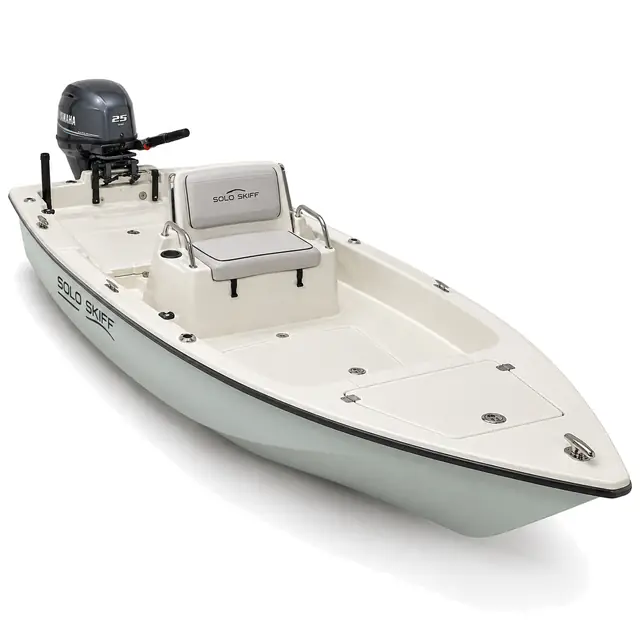
A boat worth naming and ruling out: Solo Skiff
The name says it plainly, and the specifications back it up: the Solo Skiff is rated for one person, capped at a 6 hp short-shaft motor, and built around a single seated angler with an integrated cooler, not a two-person deck. It shows up constantly in “micro skiff” searches from anglers looking for a two-angler boat, and it doesn’t belong on that shortlist. At around $2,450, it’s an honest piece of gear for exactly what it’s built for: one angler, skinny water, minimal footprint. Padding this list with it would be a disservice.
Can you still fish it alone?
A two-angler boat that can’t be launched, retrieved, and rigged by one person on the days a partner isn’t available gets fished at half its potential, and solo usability is one of this class’s genuine advantages over anything larger.
Boat
Launch and retrieve alone
Move on trailer by hand
Load the outboard alone
Pole solo
Store in a garage
Salt Marsh SM1444
Yes, with a trailer
Yes, at 300 lb dry
Manageable
Easier than loaded
Yes
Beavertail Micro
Yes, with a trailer
Difficult alone at 400 lb
Manageable
More work solo
Yes
Gheenoe Classic 15’6″
Yes
Easily at 245 lb
Manageable
Yes
Yes
BOTE Rover 14
Often without a trailer
Yes, lightest here
Easy, 6 hp class
Yes
Yes, cartop-viable
Every hull here poles far more comfortably solo than loaded with two. The trailer and loading columns are really a function of dry weight, and that’s the clearest argument in this category for choosing the lightest hull that still does what you need, rather than the biggest one you can afford.
When a technical skiff or two kayaks is the better buy
Every micro skiff page that only sells its own category leaves out the honest half of the answer. Here’s where the boundaries fall.
Micro skiff
Technical poling skiff
Two kayaks
Typical loaded draft, two anglers
roughly 6 to 8 in, estimated
roughly 8 to 12 in, published or builder-quoted more often
3 to 6 in, no motor
Payload margin
tight, as shown above
comfortable
independent per boat
Ride in chop
poor to fair, flat and light
fair to good, more deadrise and freeboard
poor, low freeboard
Range
good, 20 to 30 mile day trips reasonable
very good
limited by pedaling or paddling range
Typical cost
$14,000 to $40,000 rigged
$30,000 to $80,000+ rigged
$2,000 to $6,000 per boat
Solo usability
good
fair, heavier and often trailer-only
excellent, especially under 100 lb
If your combined weight and gear clear the loaded draft numbers above for the water you fish, and the price fits, a micro skiff is the right category. If you’re consistently landing near or past this article’s dry weight and horsepower ceiling to get comfortable payload margin, you’ve outgrown a micro skiff and want a technical poling skiff instead. Our shallow water and choppy bay skiff guide covers that class and its own draft-and-deadrise tradeoffs, which we don’t re-derive here.
If the numbers above make a micro skiff feel like a stretch, on price, on solo storage, or on loaded draft for genuinely skinny water, two kayaks is a legitimate answer, not a consolation prize. Our tandem pedal kayak guide and big-angler kayak capacity guide cover that side of the boundary, with the same loaded-payload arithmetic applied to kayaks. A pair who fishes together once a month, on a tight budget, with no trailer and no boat storage, is often better served by two kayaks than by any boat on this page.
Rough water with two aboard
Micro skiffs are flat, light, and low to the water by design, because that’s what shallow draft requires. That same design is the class’s real limit once you’re not on a protected flat anymore.
Loaded freeboard, how much hull sits above the waterline with two anglers and gear aboard, is lower than the empty-boat photographs in builder marketing suggest. On a 300 pound hull carrying roughly 700 pounds of added load, freeboard that looked generous at the dock shrinks fast, and chop a heavier bay boat shrugs off starts coming over the gunnels.
Loaded freeboard is the number that matters when the wind gets up, not the freeboard you saw sitting empty at the ramp. Crossing open bay water in a breeze with a full two-angler load is a judgment call that should be made conservatively. Check a current marine forecast before any open-water crossing, and if the wind and fetch are climbing, the honest answer is often to stay inside the protected water this class of boat is actually built for.
It depends on the hull, and the manufacturer’s maximum rating is a ceiling, not necessarily the right answer for two anglers. A 300 pound hull rated to 20 hp works meaningfully harder loaded with two people than the rating suggests empty. Match motor weight and horsepower to your actual load.
A micro skiff is smaller, lighter, and cheaper, generally under 17 feet and 30 hp, trading payload and rough-water ability for shallow draft and solo usability. A technical flats skiff, covered in our shallow water and choppy bay guide, is larger, carries more payload, and rides better in chop, at a meaningfully higher price.
In nearly all states, yes, since a powered vessel generally requires registration regardless of length. Requirements and fees vary by state, so check with your state boating agency before launching.
Some of the lightest hulls, generally under about 110 pounds, can be cartopped by one or two people, similar to a heavy fishing kayak. Anything near 300 or 400 pounds needs a trailer.
Rigged packages, including boat, motor, and trailer, generally run from around $14,000 at the lighter end of this category to well over $40,000 for the most heavily built or accessorized hulls. Get a current quote directly from the builder, since pricing here changes without much notice. —
Final verdict
A published micro skiff draft figure describes an empty hull, and adding a second angler, an outboard, fuel, and a day’s gear to a boat that may weigh only 300 pounds dry can add more than twice its own weight, the arithmetic that decides whether you’ll reach the water you’re planning to fish. For most pairs near our load standard fishing hard sand or firm grass, the Salt Marsh SM1444 is the strongest choice, since it’s also the only hull here transparent enough to support a real loaded draft estimate. If your numbers run heavier, or the water is softer and skinnier, the honest next step is a technical poling skiff or two kayaks, not a bigger motor on a boat never built to carry that much.
Larry Murray
Editor, ReefReadyGear
Larry edits ReefReadyGear, a research-led saltwater gear publication. Recommendations here are built from manufacturer specifications, authorised retailer listings and published angler experience, and we say so plainly rather than implying a testing programme we do not run. Where a claim comes from a manufacturer, we attribute it. Where we have not verified something, we do not print it.
Specifications on this page were taken from manufacturer and authorised retailer listings and the regulatory and safety sources below, consulted September 2026. Prices and specifications change; confirm current figures before buying.
Salt Marsh SM1444: builder specification page, verified September 2026 (length, beam, waterline beam, dry weight, draft, horsepower, capacity, package pricing)
Beavertail Micro: beavertailskiffs.com, verified September 2026 (length, beam, gross weight, draft, horsepower, capacity, fuel, livewell, base price)
Gheenoe Classic 15’6″: gheenoe.net, verified September 2026 (length, beam, weight, horsepower). Static draft not published by the builder; the figure used in this article is described as an owner report and should be re-confirmed against current Microskiff.com threads before publication
BOTE Rover 14 (Gatorshell): trailexpeditions.com dealer listing and boteboard.com, verified September 2026 (length, beam, depth, weight, capacity, price). Maximum horsepower of 6 hp is consistent across multiple dealer listings and should be confirmed directly against BOTE’s current owner’s manual before publication
BOTE Rover Aero 12’6″: boteboard.com and trailexpeditions.com, verified September 2026 (length, beam, weight, capacity, price)
Solo Skiff: soloskiff.com FAQ page, verified September 2026 (one-person rating, 6 hp motor ceiling, price, built-in cooler)
Ankona Native SUV 17: only the model name and approximate 17 foot length were confidently verifiable at time of writing; a third-party aggregator listing (itboat.com) returned a draft figure that appears inconsistent with the rest of this category and was not used in the article. Re-verify full specifications directly from ankonaboats.com before adding a full product block for this model
HydraSports defined-load draft methodology, as reported by Sport Fishing Magazine: precedent for the two-angler load standard, per the master content brief
eCFR, 33 CFR 183, Subpart B: capacity plate requirements, the kayak exemption under 183.21, and the persons-capacity formula for boats under 20 feet
Join The ReefReady Community
Get saltwater Fishing Guides, expert Buyers Guides, equipment recommendations,
marine electronics insights, and practical gear tips delivered to your inbox.
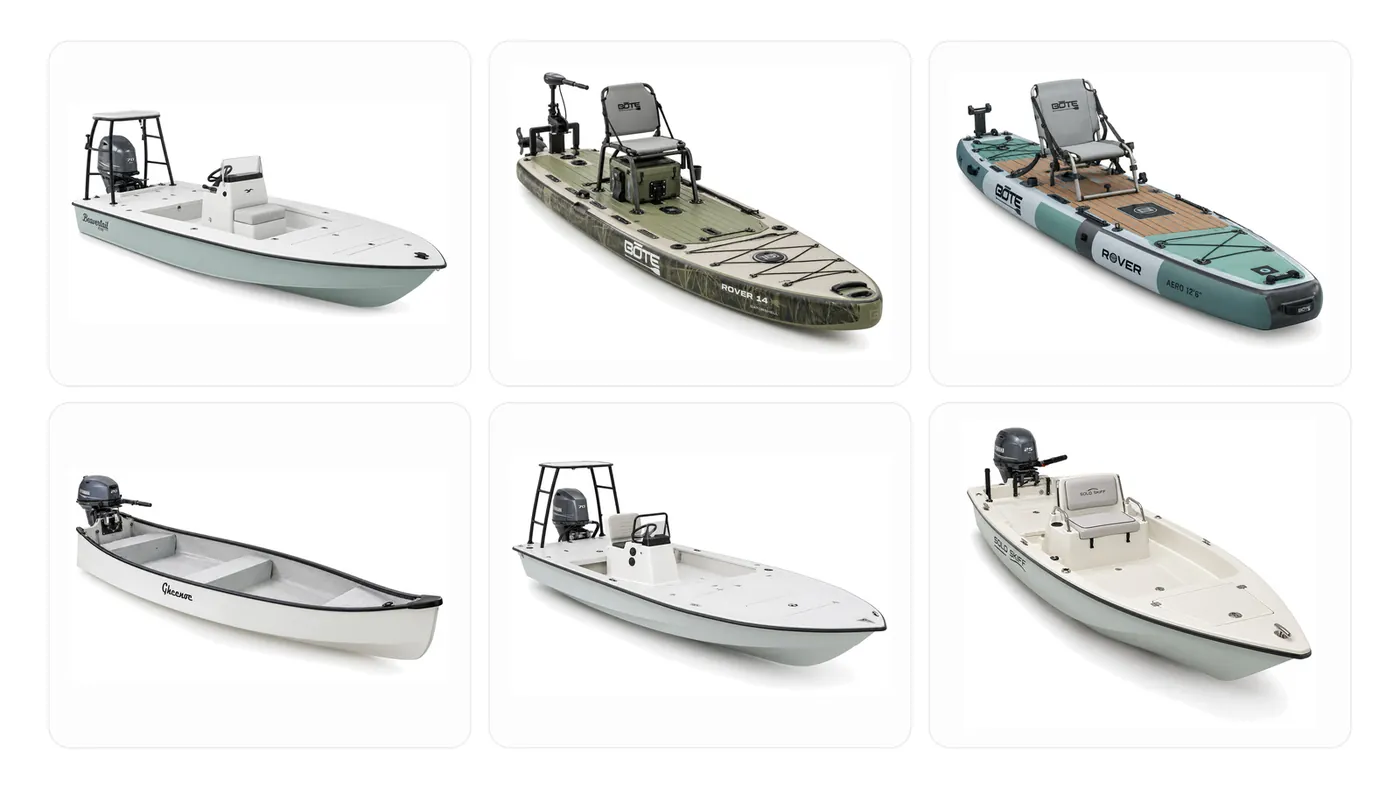
 Best all-round two-angler micro skiff
 Best build quality
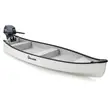 Best budget entry
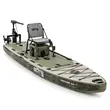 Best hybrid platform
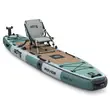 BOTE Rover Aero 12’6″ (inflatable)